Mathematics
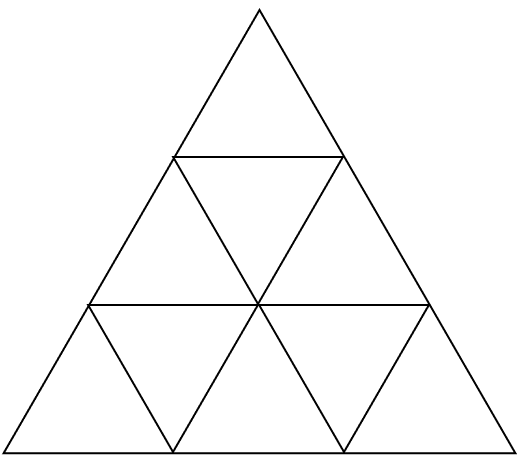
In the adjoining figure, find:
(i) the number of triangles pointing up.
(ii) the total number of triangles.
Geometrical Concepts
2 Likes
Answer
The adjoining figure shows a large equilateral triangle whose each side is divided into 3 equal parts, creating a network of 9 unit triangles inside it (6 pointing up and 3 pointing down).
Let us count the triangles of each size carefully.
(i) Triangles pointing up:
- Size 1 (unit upward triangles): There are 6 unit upward triangles.
- Size 2 (formed by 4 unit triangles together): There are 3 such upward triangles.
- Size 3 (the whole large triangle): There is 1 such upward triangle.
Total triangles pointing upwards = 6 + 3 + 1 = 10.
∴ The number of triangles pointing up is 10.
(ii) Triangles pointing down:
- Size 1 (unit downward triangles): There are 3 unit downward triangles.
- No larger downward triangles exist in this figure.
Total downward triangles = 3
Total number of triangles = Triangles pointing up + Triangles pointing down
= 10 + 3 = 13
∴ There are total 13 triangles in the figure.
Answered By
2 Likes
Related Questions
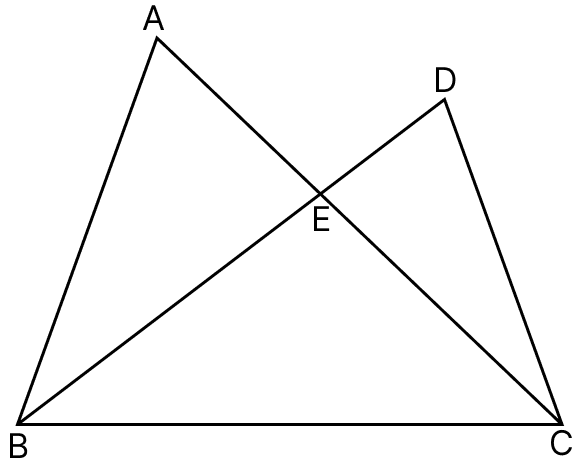
In context of the adjoining figure, name
(i) all triangles
(ii) all triangles having point E as common vertex.
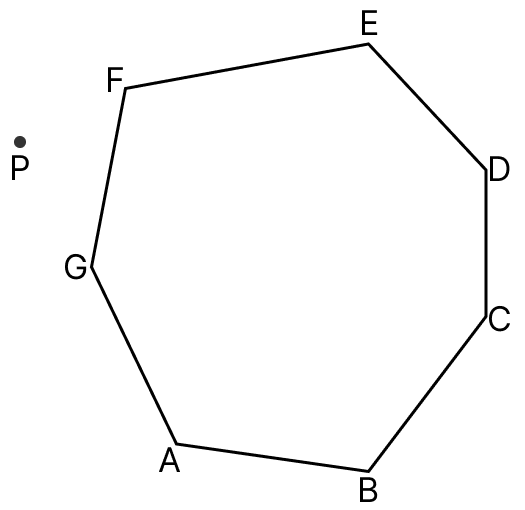
In context of the adjoining figure, answer the following questions:
(i) Is ABCDEFG a polygon?
(ii) How many sides does it have?
(iii) How many vertices does it have?
(iv) Are adjacent sides?
(v) Is a diagonal of the polygon?
(vi) Are diagonals of the polygon?
(vii) Is point P in the interior of the polygon?
(viii) Is point A in the exterior of the polygon?
Can a sector and a segment of a circle coincide? If so, name it.
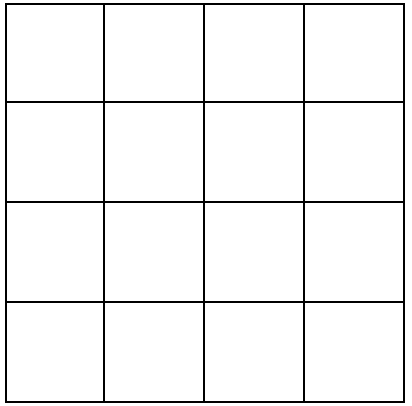
In the adjoining figure, find the total number of squares.