
Mathematics
In the adjoining figure, identify:
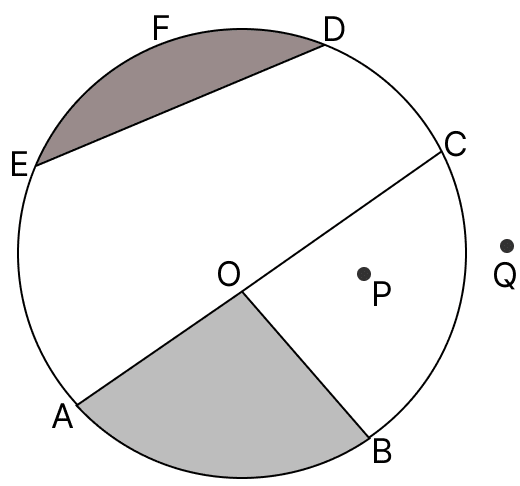
(i) the centre of the circle
(ii) three radii
(iii) a diameter
(iv) a chord
(v) two points in the interior
(vi) a point in the exterior
(vii) a sector
(viii) a segment.
Geometrical Concepts
1 Like
Answer
(i) The centre of the circle is the fixed point from which all points on the circle are at an equal distance.
∴ The centre of the circle is O.
(ii) A radius is a line segment from the centre of the circle to any point on the circle.
∴ The three radii are .
(iii) A diameter is a chord of the circle that passes through its centre.
∴ The diameter is .
(iv) A chord is a line segment joining any two points on the circle.
∴ A chord is .
(v) A point lies in the interior of a circle if its distance from the centre is less than the radius of the circle.
∴ Two points in the interior are O and P.
(vi) A point lies in the exterior of a circle if its distance from the centre is greater than the radius of the circle.
∴ A point in the exterior is Q.
(vii) A sector is the part of the circular region enclosed by an arc of the circle and its two bounding radii.
∴ A sector is AOB (enclosed by radii and arc AB).
(viii) A segment is the part of the circular region enclosed by a chord and the corresponding arc.
Segment EFD(shaded portion).
Answered By
2 Likes
Related Questions
In context of the given figure:
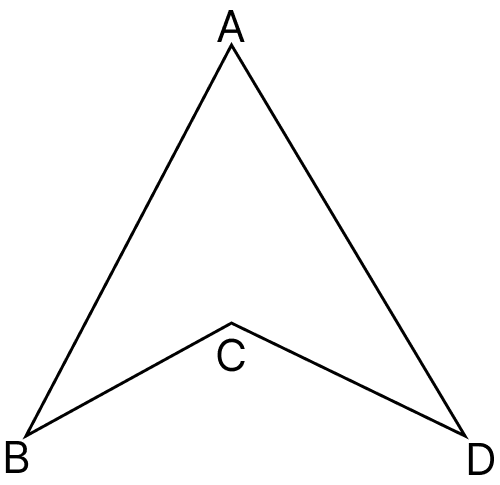
(i) Is it a simple closed curve?
(ii) Is it a quadrilateral?
(iii) Draw its diagonals and name them.
(iv) State which diagonal lies in the interior and which diagonal lies in the exterior of the quadrilateral.
Draw a rough sketch of a quadrilateral KLMN. State:
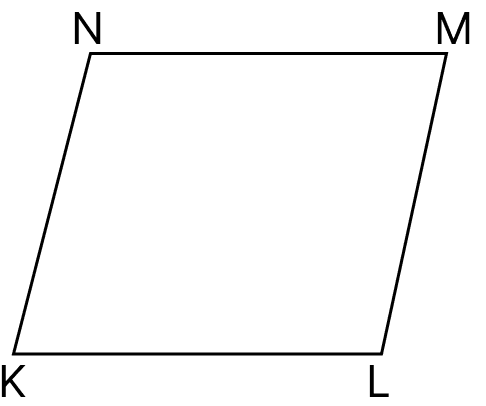
(i) two pairs of opposite sides
(ii) two pairs of opposite angles
(iii) two pairs of adjacent sides
(iv) two pairs of adjacent angles
State whether the following statements are true (T) or false (F):
(i) Every diameter of a circle is also a chord.
(ii) Every chord of a circle is also a diameter.
(iii) Two diameters of a circle will necessarily intersect.
(iv) The centre of the circle is always in its interior.
Fill in the following blanks:
(i) There is exactly one line passing through ….. distinct points in a plane.
(ii) Two different lines in a plane either ….. at exactly one point or are parallel.
(iii) The curves which have different beginning and end points are called ….. curves.
(iv) A curve which does not cross itself at any point is called a ….. curve.
(v) A simple closed curve made up entirely of line segments is called a …. .
(vi) A quadrilateral has ….. diagonals.
(vii) A line segment has a ….. length.