
Mathematics
Consider the adjoining figure of the line . State whether the following statements are true (T) or false (F) in context of the given figure.
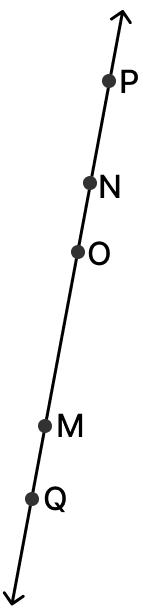
(i) Q, M, O, N and P are points on the line .
(ii) M, O and N are points on the line segment .
(iii) M and N are end points of the segment .
(iv) O and N are end points of the segment .
(v) M is a point on the ray .
(vi) M is one of the end point of the segment .
(vii) Ray is same as ray .
(viii) Ray is not opposite to ray .
(ix) Ray is different from ray .
(x) O is not an initial point of ray .
(xi) N is the initial point of .
Geometrical Concepts
3 Likes
Answer
From the figure, the points lie on line MN in the order Q, M, O, N, P.
(i) True — All five points Q, M, O, N and P lie on the line MN.
(ii) True — Since O lies between M and N, the points M, O and N all lie on the line segment MN.
(iii) True — M and N are the end points of the segment MN, by definition.
(iv) False — The end points of the segment OP are O and P (not O and N). N is a point on the segment OP, not an end point.
(v) False — Ray OP starts at O and extends in the direction of P. M lies on the opposite side of O, so M is not a point on ray OP.
(vi) False — The end points of segment QO are Q and O. M lies between Q and O, so it is not an end point of QO.
(vii) False — Ray OP starts at O and goes towards P, while ray OM starts at O and goes towards M (opposite direction). They are opposite rays, hence not the same.
(viii) False — Ray OM and ray OP have the same initial point O but extend in opposite directions, so they are opposite rays. Hence, the statement "ray OM is not opposite to ray OP" is false.
(ix) True — Ray OP has initial point O while ray QP has initial point Q. Since the initial points differ, the rays are different.
(x) False — O is the initial (starting) point of ray OP.
(xi) True — Ray NP and ray NM both start from N, so N is the initial point of both rays.
Answered By
1 Like
Related Questions
In the adjoining figure, write
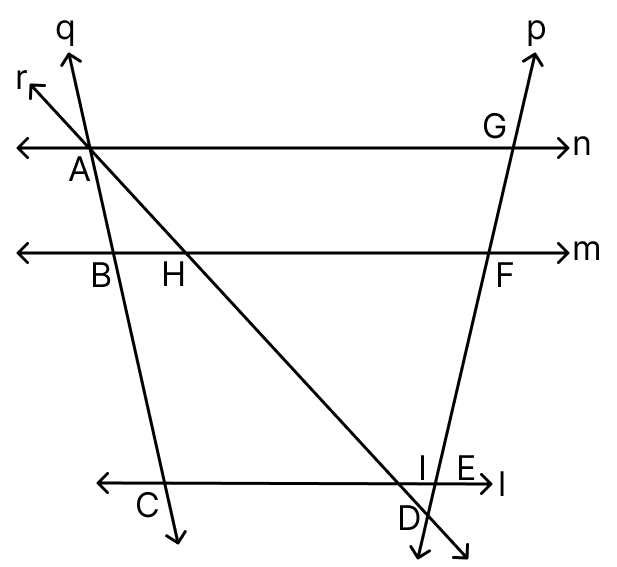
(i) all pairs of parallel lines.
(ii) all pairs of intersecting lines.
(iii) concurrent lines.
(iv) collinear points.
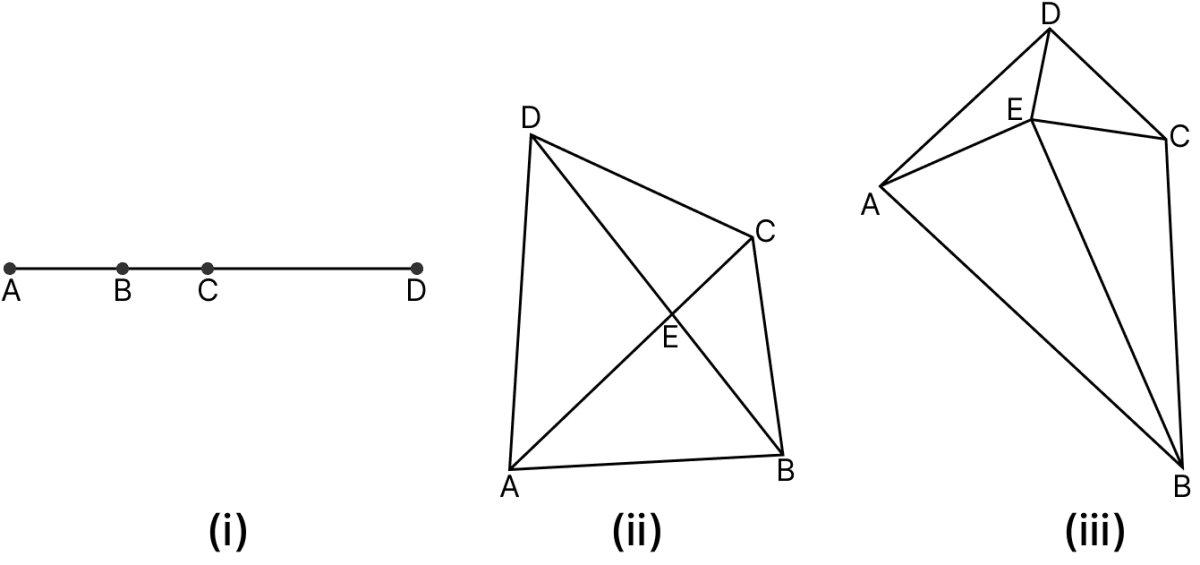
Count the number of line segments drawn in each of the following figures and name them:
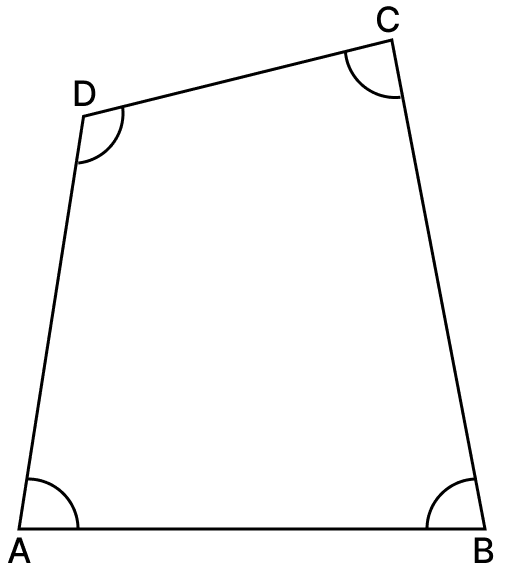
How many angles are there in the adjoining figure? Name them.
In the adjoining figure, name the point(s)
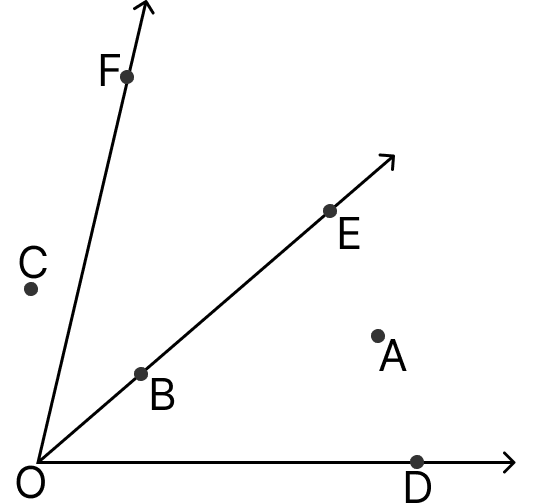
(i) in the interior of ∠DOE
(ii) in the exterior of ∠EOF
(iii) on ∠EOF