Mathematics
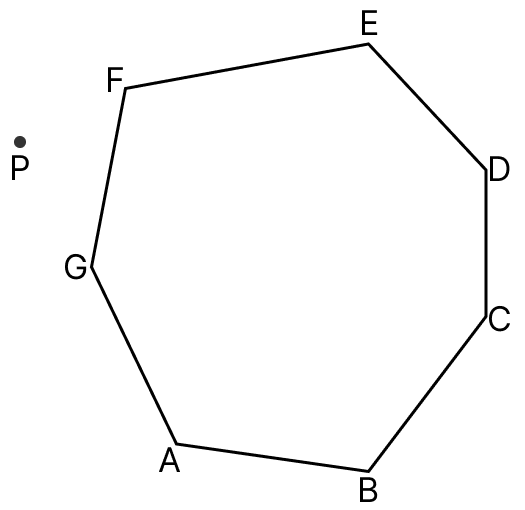
In context of the adjoining figure, answer the following questions:
(i) Is ABCDEFG a polygon?
(ii) How many sides does it have?
(iii) How many vertices does it have?
(iv) Are adjacent sides?
(v) Is a diagonal of the polygon?
(vi) Are diagonals of the polygon?
(vii) Is point P in the interior of the polygon?
(viii) Is point A in the exterior of the polygon?
Geometrical Concepts
1 Like
Answer
(i) The figure ABCDEFG is a simple closed curve made up entirely of line segments. Therefore, it satisfies the definition of a polygon.
∴ Yes, ABCDEFG is a polygon.
(ii) The sides of the polygon ABCDEFG are . So, the polygon has 7 sides.
∴ The polygon ABCDEFG has 7 sides.
(iii) The vertices of the polygon ABCDEFG are A, B, C, D, E, F and G. So, the polygon has 7 vertices.
∴ The polygon ABCDEFG has 7 vertices.
(iv) Two sides of a polygon with a common end point are called adjacent sides.
The side has end points A and B, and the side (same as ) has end points F and E. They do not share any common end point, so they are not adjacent sides.
∴ No, are not adjacent sides.
(v) The diagonals of a polygon are the line segments formed by joining non-adjacent vertices.
The segment (same as ) joins the vertices G and F, which are adjacent vertices (they are the end points of the same side ). So, is a side of the polygon, not a diagonal.
∴ No, is not a diagonal of the polygon; it is a side of the polygon.
(vi) Let us check each line segment:
- In : vertex A is adjacent to B and G, but not to C. So, A and C are non-adjacent vertices.
- In : vertex A is adjacent to B and G, but not to D. So, A and D are non-adjacent vertices.
- In : vertex A is adjacent to B and G, but not to E. So, A and E are non-adjacent vertices.
Since each of these segments joins two non-adjacent vertices, they are all diagonals of the polygon.
∴ Yes, are all diagonals of the polygon.
(vii) Looking at the figure, point P does not lie inside the boundary of polygon ABCDEFG.
∴ No, point P is not in the interior of the polygon.
(viii) Point A is a vertex of the polygon ABCDEFG, so it lies on the boundary of the polygon, not in its exterior.
∴ No, point A is not in the exterior of the polygon; it lies on its boundary.
Answered By
3 Likes
Related Questions
How many angles are marked in the adjoining figure? Name them.
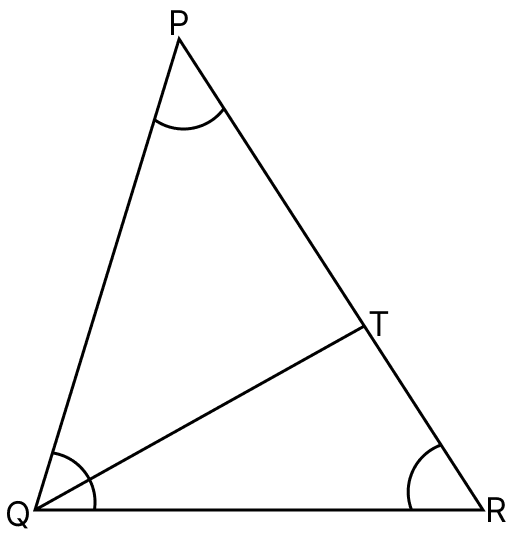
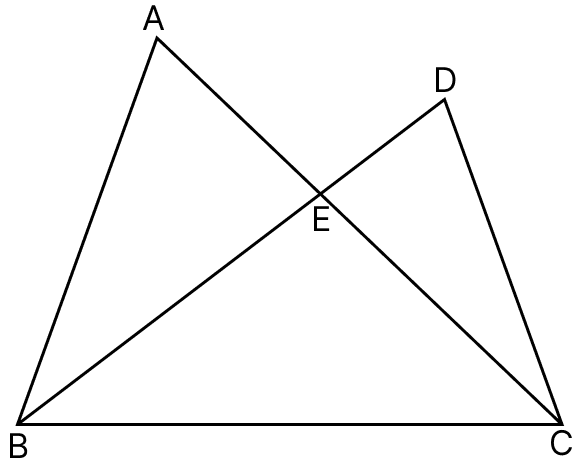
In context of the adjoining figure, name
(i) all triangles
(ii) all triangles having point E as common vertex.
Can a sector and a segment of a circle coincide? If so, name it.
In the adjoining figure, find:
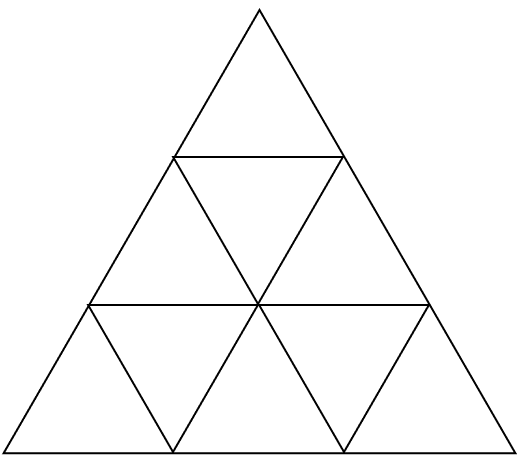
(i) the number of triangles pointing up.
(ii) the total number of triangles.