
Mathematics
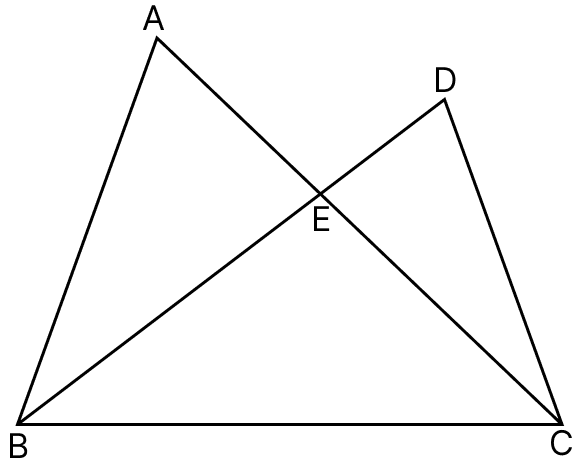
In context of the adjoining figure, name
(i) all triangles
(ii) all triangles having point E as common vertex.
Geometrical Concepts
3 Likes
Answer
In the given figure, we have two overlapping triangles △ABC and △DBC sharing the common base BC. The line segments AC and BD intersect each other at point E in the interior of the figure.
(i) Looking carefully at the figure, the line segments drawn are AB, BC, CA, BD and DC. These line segments, along with the intersection point E, form the following triangles:
- △ABC (formed by sides AB, BC and CA)
- △DBC (formed by sides DB, BC and CD)
- △ABE (formed by sides AB, BE and EA)
- △BEC (formed by sides BE, EC and CB)
- △CDE (formed by sides CD, DE and EC)
∴ The five triangles in the figure are △ABC, △DBC, △ABE, △BEC and △CDE.
(ii) Point E is the intersection point of segments AC and BD. A triangle has point E as a vertex only if two of its sides meet at E.
The triangles having point E as common vertex are △ABE, △BEC and △CDE.
∴ The triangles having point E as common vertex are △ABE, △BEC and △CDE.
Answered By
2 Likes
Related Questions
In context of the adjoining figure, state whether the following statements are true (T) or false (F):
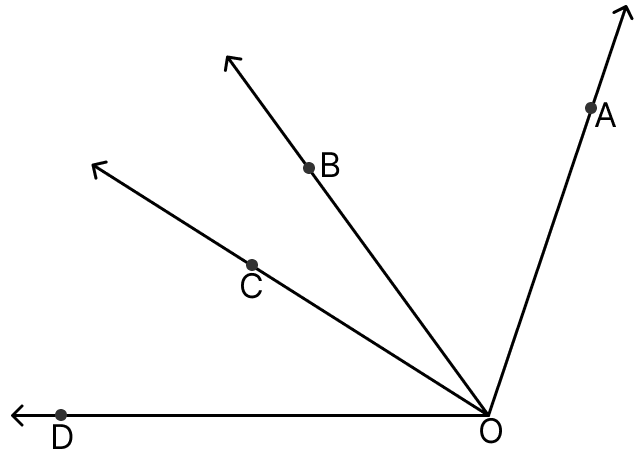
(i) Point A is in the interior of ∠AOD.
(ii) Point B is in the interior of ∠AOC.
(iii) Point C is in the exterior of ∠AOB.
(iv) Point D is in the exterior of ∠AOC.
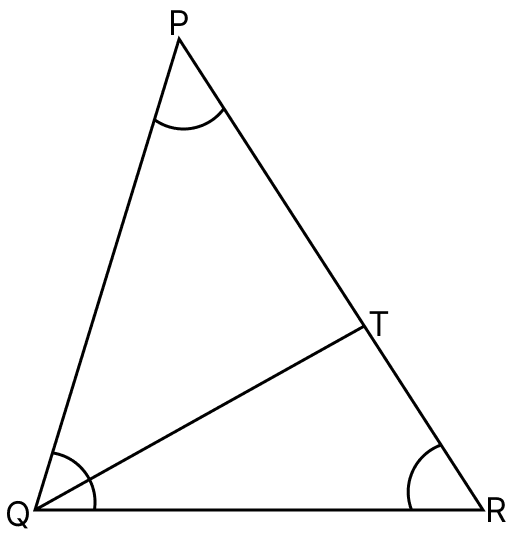
How many angles are marked in the adjoining figure? Name them.
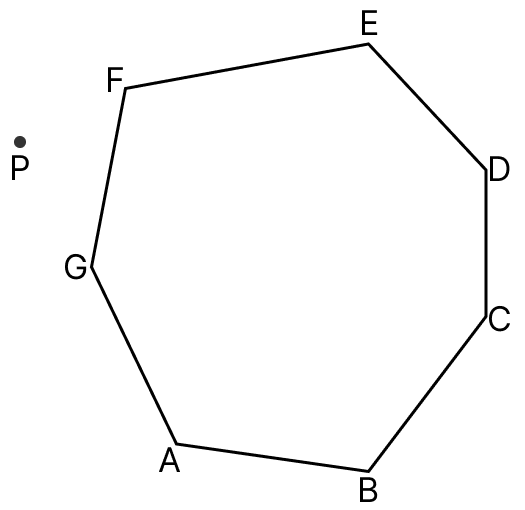
In context of the adjoining figure, answer the following questions:
(i) Is ABCDEFG a polygon?
(ii) How many sides does it have?
(iii) How many vertices does it have?
(iv) Are adjacent sides?
(v) Is a diagonal of the polygon?
(vi) Are diagonals of the polygon?
(vii) Is point P in the interior of the polygon?
(viii) Is point A in the exterior of the polygon?
Can a sector and a segment of a circle coincide? If so, name it.