
Mathematics
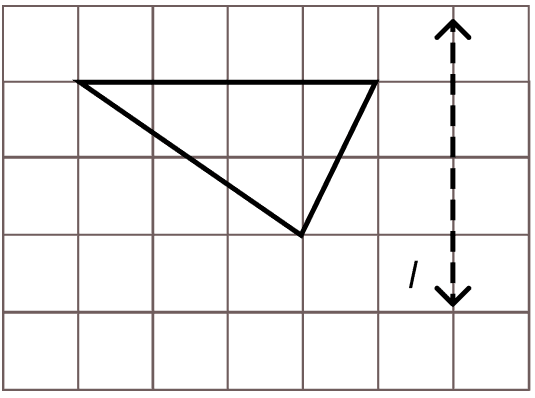
Copy the following figure on a squared paper and find their reflections in the mirror line l.
Symmetry
3 Likes
Answer
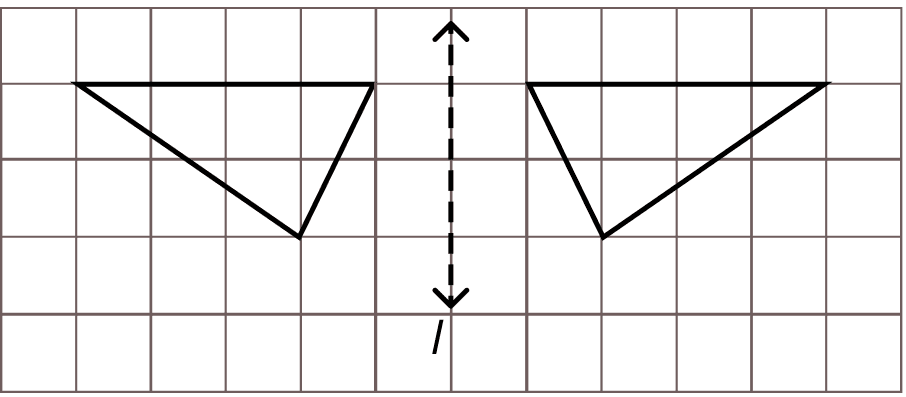
The reflection of the figure is obtained by drawing its mirror image in the line l. The image has the same shape and size as the original figure, but with a left-right change in orientation. The mirror line l is the perpendicular bisector of the line segments joining the corresponding points (vertices) of the figure and its image.
Answered By
2 Likes
Related Questions
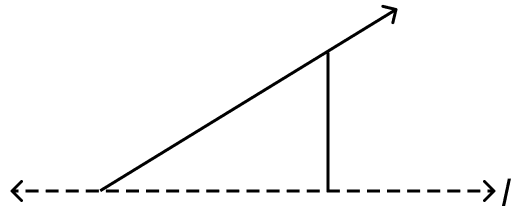
In the adjoining figure, l is the line of symmetry. Complete the diagram to make it symmetrical.
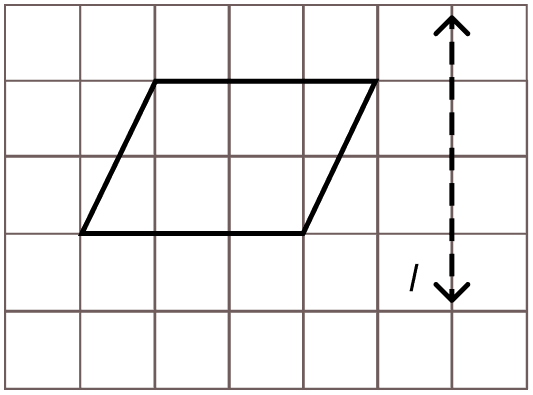
Copy the following figure on a squared paper and find their reflections in the mirror line l.
Fill in the blanks:
(i) The subtraction symbol – has ….. lines of symmetry.
(ii) The addition symbol + has ….. lines of symmetry.
(iii) Line of symmetry is also known ….. line or ….. of symmetry.
(iv) A kite has ….. line(s) of symmetry.
(v) A parallelogram has ….. line(s) of symmetry.
(vi) The number of lines of symmetry in a regular hexagon is ….. .
(vii) A rectangle is symmetrical about the lines joining the ….. of the opposite sides.
(viii) The number of capital letters of the English alphabet having only vertical line of symmetry is ….. .
(ix) The number of capital letters of the English alphabet having only horizontal line of symmetry is ….. .
(x) The number of capital letters of the English alphabet having both horizontal and vertical lines of symmetry is ….. .
(xi) The digits having two lines of symmetry are ….. and ….. .
State whether the following statements are true (T) or false (F):
(i) The letter N has one line of symmetry.
(ii) Every hexagon has six lines of symmetry.
(iii) All right angled triangles have one line of symmetry.
(iv) A triangle with more than one line of symmetry must be an equilateral triangle.
(v) A line of symmetry divides a figure into two identical parts.
(vi) A circle has only 8 lines of symmetry.
(vii) A regular octagon has 10 lines of symmetry.
(viii) A square and a rectangle have the same number of lines of symmetry.
(ix) A right angled triangle can have atmost one line of symmetry.
(x) If an isosceles triangle has more than one line of symmetry, then it must be an equilateral triangle.
(xi) If a rectangle has more than two lines of symmetry, then it must be a square.