Biology
The experimental set-up given below demonstrates anaerobic respiration in germinating seeds. Read the information below the figure and answer the following questions :
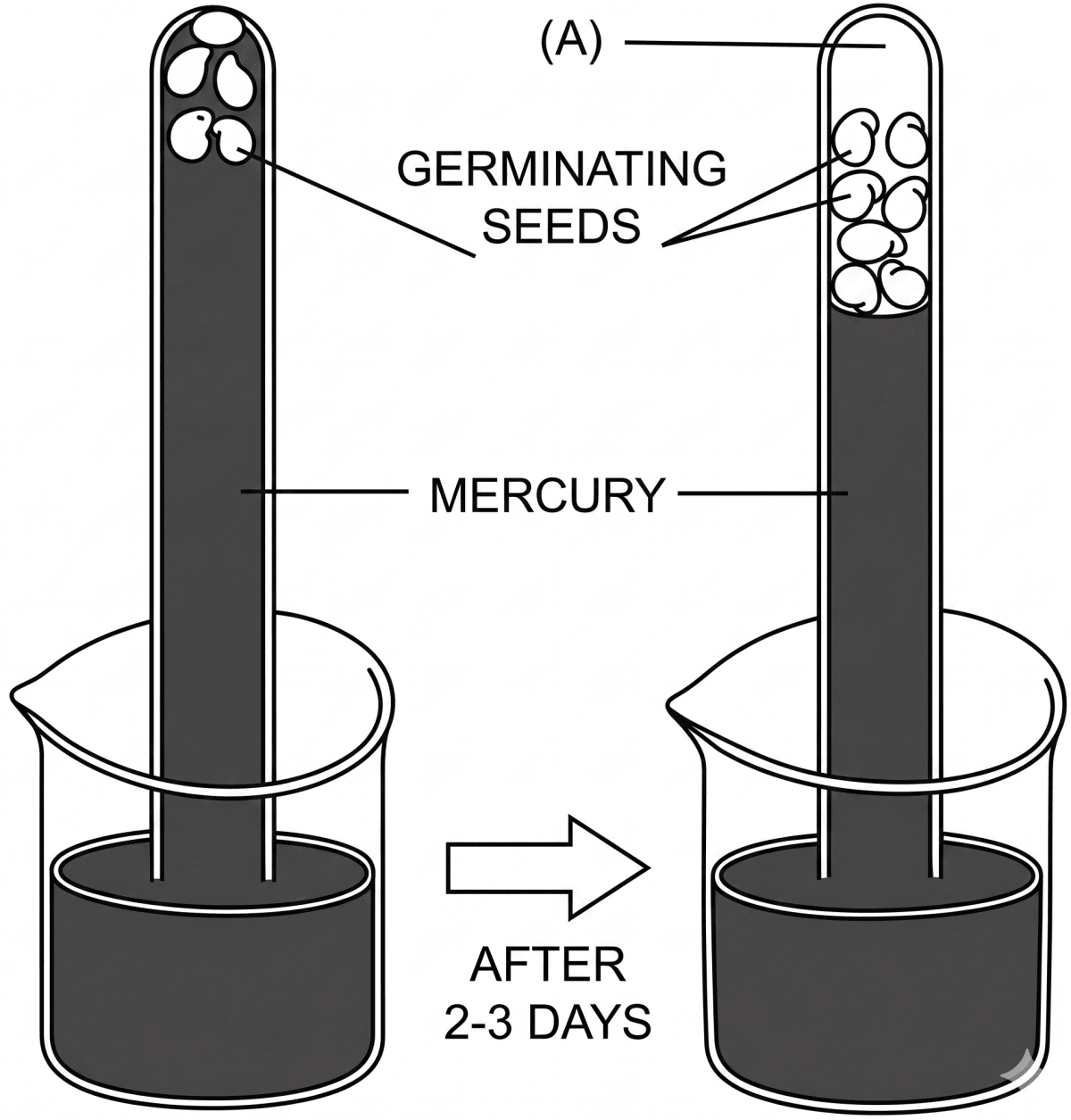
Seeds can respire anaerobically for some time but later the radicles dry up and seedlings could not be produced. Soaked seeds are peeled and placed over mercury for germination.
(a) Why do we fill mercury in the test tube ? Can we do the same experiment in water or air ?
(b) Name the gas released by the germinating seeds, shown (A) in the figure.
(c) Can we do the above experiment with the seeds without peeling them ?
(d) How can we test the gas released in the above set-up ? Explain in short.
(e) How can we set the 'control set-up' for the above experiment ?
Answer
(a) Mercury is used because it excludes air and prevents oxygen from entering the test tube, thus creating anaerobic conditions. It also does not dissolve gases easily, so the gas released can collect at the top.
We cannot use air because it contains oxygen and would make respiration aerobic. Water is also not suitable because it contains dissolved gases and can dissolve carbon dioxide, preventing proper collection of the gas.
(b) The gas released by the germinating seeds is carbon dioxide.
(c) Yes, the experiment can be done without peeling the seeds, but peeling the seed coat hastens the outward diffusion of carbon dioxide.
(d) The gas released can be tested by introducing potassium hydroxide (KOH) into the test tube. KOH absorbs carbon dioxide, causing the mercury level to rise again. Alternatively, carbon dioxide can be confirmed by passing the gas through limewater, which turns milky due to the formation of calcium carbonate.
(e) A control set-up can be prepared in the same way, but with boiled and sterilised seeds instead of germinating seeds. Since boiled seeds are dead, they do not respire and no gas is produced.
Related Questions
Draw a neat and labelled, diagram showing the experimental set up (initial and final stages) to demonstrate anaerobic respiration in germinating seeds.
The following two chemical reactions are supposed to indicate a certain process occurring in the green plants under two different conditions:
(a) C6H12O6 + 6O2 → 6CO2 + …… + 38ATP
(b) C6H12O6 → …… + 2CO2 + 2ATP
- Fill in the blanks of each reaction
- Name the process represented by the two chemical equations
- What are the conditions under which the two reactions (a) and (b) are occurring?
In order to study and prove a particular physiological process in plants, the following experiment was set up. Study the same and then answer the questions that follow:
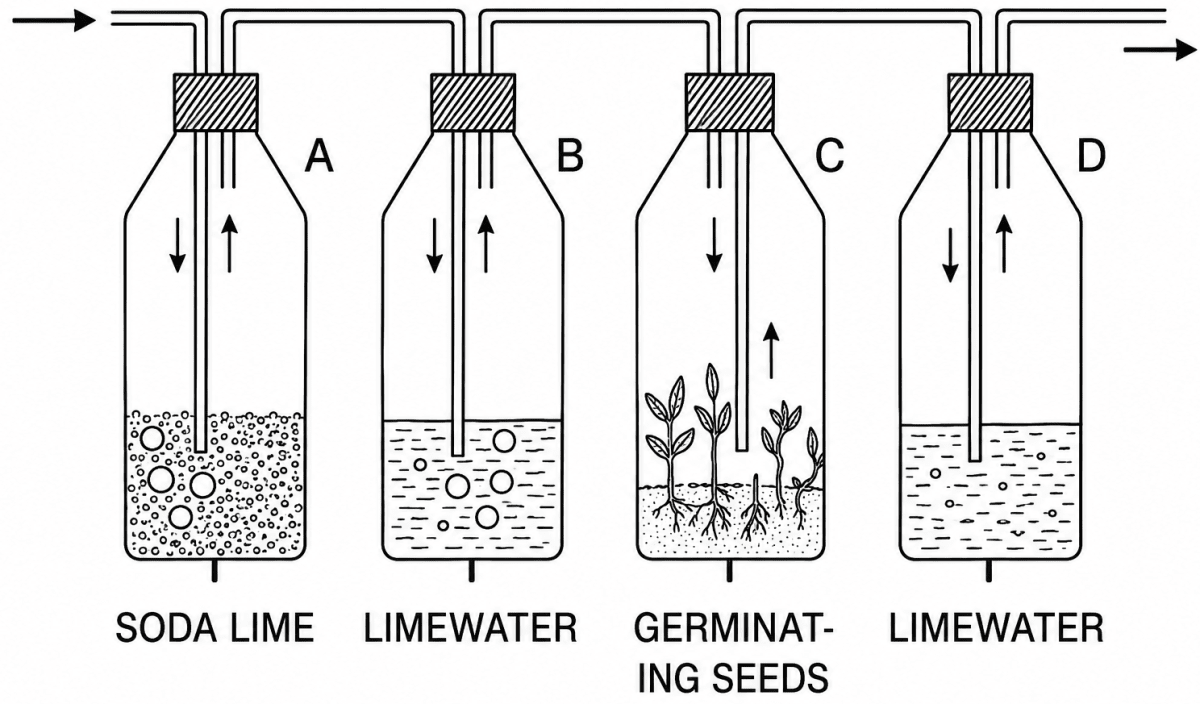
(a) Name the physiological process being studied.
(b) What is the function of soda lime in the bottle 'A' and why is limewater placed in bottle 'B'?
(c) What change would you expect to observe in bottle 'D'?
(d) Represent the physiological process named in (a) above in the form of a chemical equation.
(e) In order to obtain accurate results, the bottle ‘C’ should be covered with a piece of black cloth. Why?
(f) If bottle 'C' was fitted with a 3-holed rubber stopper and a thermometer were introduced in such a way that its bulb reaches close to the germinating seeds, what would you observe? Why?
The following diagram refers to an apparatus which is used to demonstrate a physiological process:
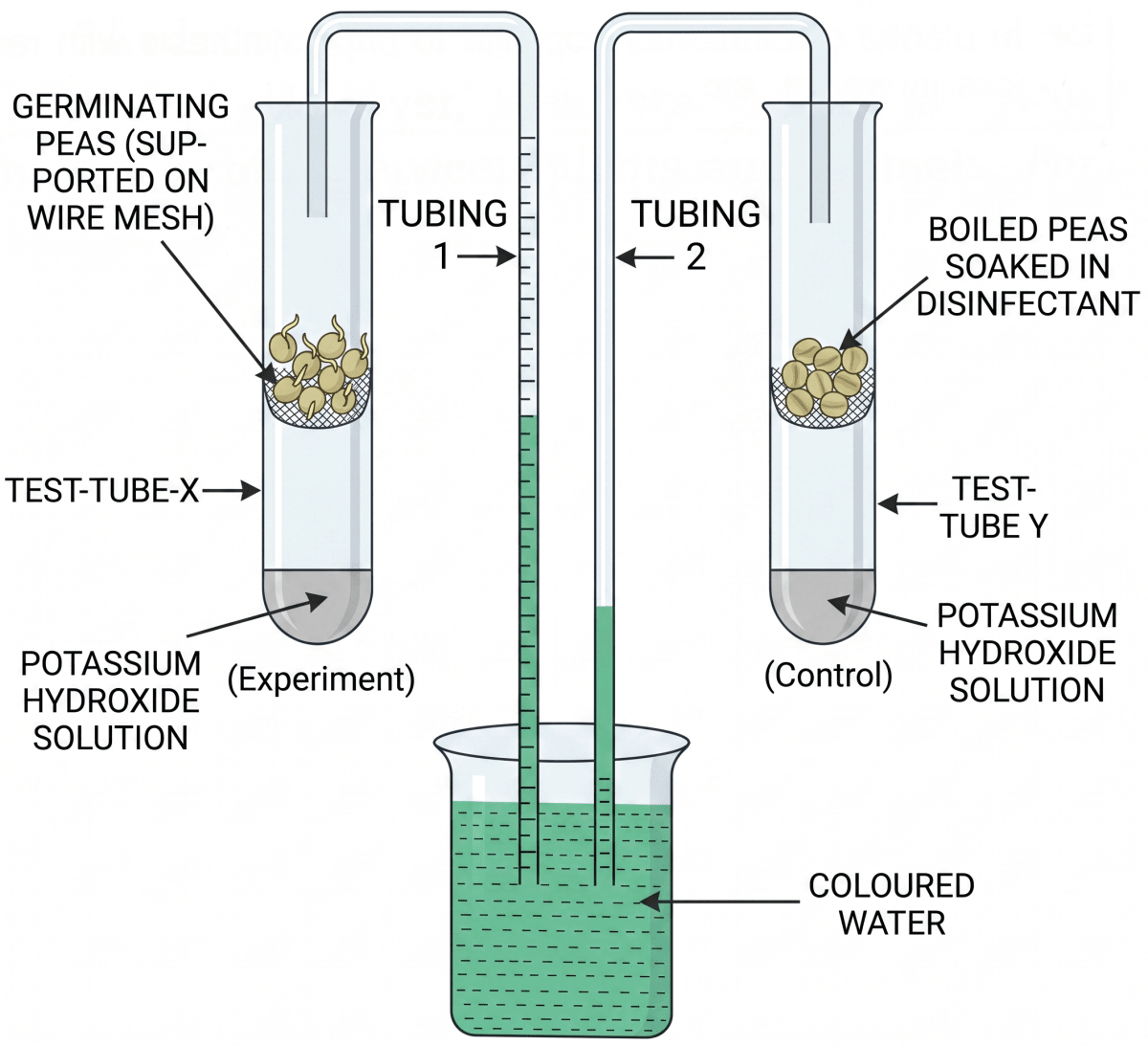
(a) What is the purpose of keeping potassium hydroxide solution in the test tubes X and Y?
(b) Why has the coloured water risen in tubing 1?
(c) What is the purpose of keeping boiled peas soaked in a disinfectant in test tube Y?
(d) Name the biological process which causes the above rise.
(e) Define the biological process shown in the experiment