Mathematics
Fill in the following blanks:
(i) There is exactly one line passing through ….. distinct points in a plane.
(ii) Two different lines in a plane either ….. at exactly one point or are parallel.
(iii) The curves which have different beginning and end points are called ….. curves.
(iv) A curve which does not cross itself at any point is called a ….. curve.
(v) A simple closed curve made up entirely of line segments is called a …. .
(vi) A quadrilateral has ….. diagonals.
(vii) A line segment has a ….. length.
Answer
(i) There is exactly one line passing through two distinct points in a plane.
(ii) Two different lines in a plane either intersect at exactly one point or are parallel.
(iii) The curves which have different beginning and end points are called open curves.
(iv) A curve which does not cross itself at any point is called a simple curve.
(v) A simple closed curve made up entirely of line segments is called a polygon.
(vi) A quadrilateral has two diagonals.
(vii) A line segment has a definite length.
Related Questions
In the adjoining figure, identify:
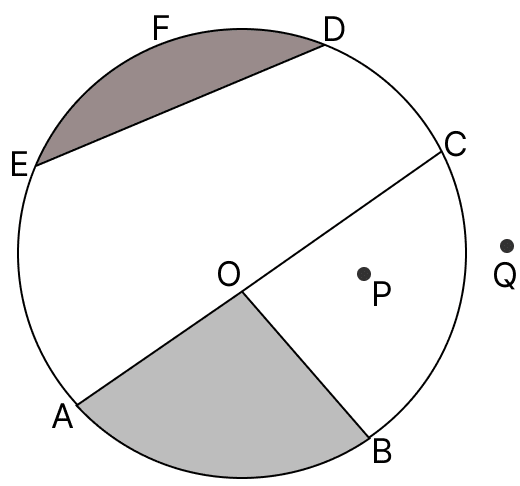
(i) the centre of the circle
(ii) three radii
(iii) a diameter
(iv) a chord
(v) two points in the interior
(vi) a point in the exterior
(vii) a sector
(viii) a segment.
State whether the following statements are true (T) or false (F):
(i) Every diameter of a circle is also a chord.
(ii) Every chord of a circle is also a diameter.
(iii) Two diameters of a circle will necessarily intersect.
(iv) The centre of the circle is always in its interior.
Fill in the blanks with correct word(s) to make the statement true:
(i) Radius of a circle is one-half of its …..
(ii) A radius of a circle is a line segment with one end point at ….. and the other end-point on …..
(iii) A chord of a circle is a line segment with its end points ….
(iv) A diameter of a circle is a chord that ….. the centre of the circle.
(v) All radii of a circle are …..