
Mathematics
(i) Name all the rays shown in the given figure whose initial point is A.
(ii) Is ray different from ray ?
(iii) Is ray different from ray ?
(iv) Is ray different from ray ?
(v) Is ray different from ray ?

Geometrical Concepts
2 Likes
Answer
From the figure, the points lie on a line in the order E, A, B, C and D.
(i) Rays whose initial point is A — from A we can draw rays in two opposite directions on the line. Rays extend in one direction, and ray extends in the opposite direction.
∴ The rays with initial point A are .
(ii) Ray AB starts at A and goes in the direction of B. Ray AD also starts at A and goes in the same direction (through B and C to D). Since they have the same initial point and same direction, they are the same ray.
∴ Ray AB is not different from ray AD. They are the same ray.
(iii) Ray CA starts at C and goes in the direction of A. Ray CE also starts at C and goes in the same direction (through A to E). Since they have the same initial point and same direction, they are the same ray.
∴ Ray CA is not different from ray CE. They are the same ray.
(iv) Ray BA has initial point B and goes towards A. Ray CA has initial point C and goes towards A. Since their initial points are different, the rays are different.
∴ Yes, ray BA is different from ray CA.
(v) Ray ED has initial point E and extends in the direction of D. Ray DE has initial point D and extends in the direction of E (opposite direction). Since their initial points are different and they extend in opposite directions, they are different rays.
∴ Yes, ray ED is different from ray DE. They are opposite rays.
Answered By
2 Likes
Related Questions
Statement I: The terms circle and circular region have the same meaning.
Statement II: The interior of a circle together with its boundary is called the circular region.
Statement I is true but statement II is false.
Statement I is false but statement II is true.
Both Statement I and statement II are true.
Both Statement I and statement II are false.
Statement I: The essential component of the sector and the segment of a circle is the arc.
Statement II: A chord which passes through the centre of a circle is its diameter.
Statement I is true but statement II is false.
Statement I is false but statement II is true.
Both Statement I and statement II are true.
Both Statement I and statement II are false.
From the adjoining figure, write
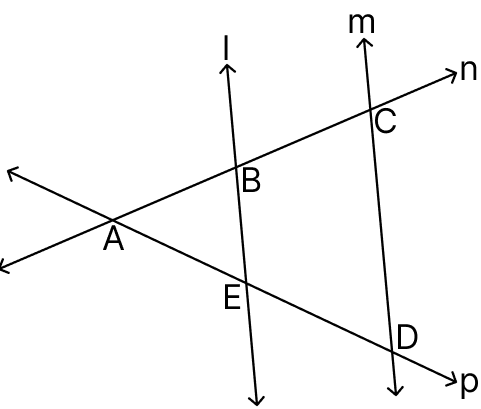
(i) all pairs of parallel lines.
(ii) all pairs of intersecting lines.
(iii) lines whose point of intersection is E.
(iv) collinear points.
In the adjoining figure:
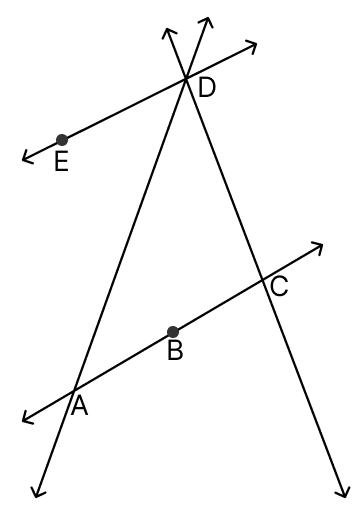
(a) Name:
(i) parallel lines.
(ii) all pairs of intersecting lines.
(iii) concurrent lines.
(b) State whether true or false:
(i) points A, B and D are collinear.
(ii) lines AB and ED intersect at C.