
Mathematics
Statement I: The essential component of the sector and the segment of a circle is the arc.
Statement II: A chord which passes through the centre of a circle is its diameter.
Statement I is true but statement II is false.
Statement I is false but statement II is true.
Both Statement I and statement II are true.
Both Statement I and statement II are false.
Geometrical Concepts
3 Likes
Answer
Both Statement I and Statement II are true.
Explanation
A sector of a circle is the part of the circular region enclosed by an arc of the circle and its two bounding radii. A segment of a circle is the part of the circular region cut off by a chord, and it is bounded by the chord and an arc. So, in both a sector and a segment, an arc is an essential (common) component. Statement I is true.
A chord is a line segment joining any two points of a circle. When a chord passes through the centre of the circle, it becomes the longest chord — called the diameter — and its length is equal to 2 × radius. So, Statement II is also true.
Hence, option 3 is the correct option.
Answered By
1 Like
Related Questions
Statement I: If r is the radius of a circle and l is the length of any chord then 0 ≤ l ≤ 2r.
Statement II: A chord is formed by joining any two points on a circle.
Statement I is true but statement II is false.
Statement I is false but statement II is true.
Both Statement I and statement II are true.
Both Statement I and statement II are false.
Statement I: The terms circle and circular region have the same meaning.
Statement II: The interior of a circle together with its boundary is called the circular region.
Statement I is true but statement II is false.
Statement I is false but statement II is true.
Both Statement I and statement II are true.
Both Statement I and statement II are false.
(i) Name all the rays shown in the given figure whose initial point is A.
(ii) Is ray different from ray ?
(iii) Is ray different from ray ?
(iv) Is ray different from ray ?
(v) Is ray different from ray ?

From the adjoining figure, write
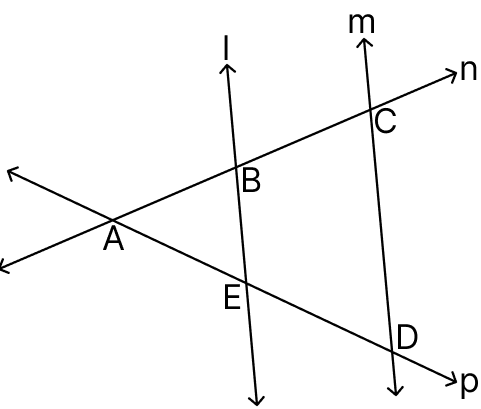
(i) all pairs of parallel lines.
(ii) all pairs of intersecting lines.
(iii) lines whose point of intersection is E.
(iv) collinear points.