Commercial Applications
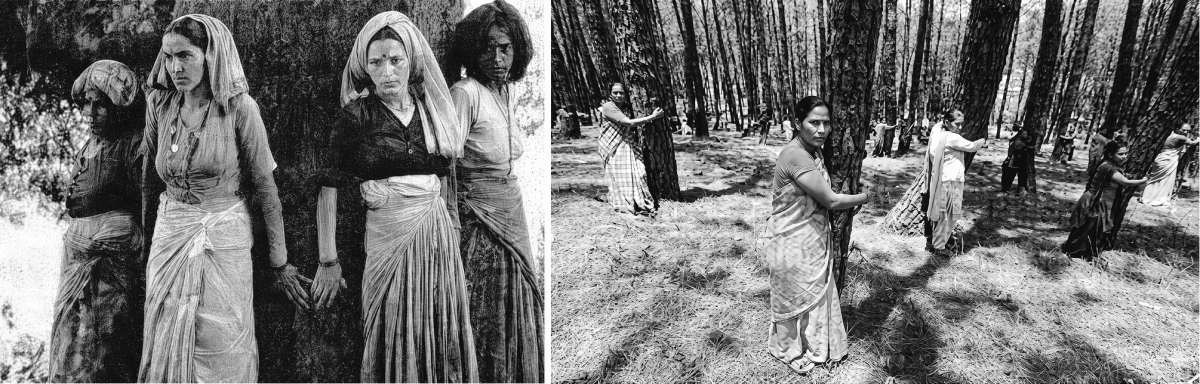
Study the pictures given below and describe the movement.
Environmental Issues
1 Like
Answer
The pictures show women hugging trees, depicting the Chipko Andolan (Chipko Movement).
In the 1970s, an organised resistance to the destruction of forests spread throughout India, which came to be known as Chipko Andolan. Chipko literally means "hug the trees". The movement was a grassroots effort aimed at:
Raising Awareness about Deforestation — It highlighted the dangers of rampant deforestation in the Himalayan region.
Promoting Sustainable Forest Management — It advocated for the protection and sustainable use of forest resources.
Advocating Rights of Local Communities — It supported the rights of local villagers whose livelihood depended on the forests.
The movement was a response to rampant deforestation and commercial logging activities that were negatively impacting the livelihood of local villagers and the fragile Himalayan ecosystem.
Key Leaders:
- Sunderlal Bahuguna — Led the movement, undertook a 5000-kilometre foot march to spread the Chipko message, and coined the slogan "Ecology is permanent economy".
- Chandi Prasad Bhatt — An activist who went into the forests and formed circles around trees, preventing them from being cut.
- Ghanshyam Raturi — The Chipko poet who wrote the famous poem: "Embrace the trees and save them from being felled; The property of our hills, save them from being looted."
- Dhoom Singh Negi — Along with village women, coined the slogan: "What do the forests bear? Soil, water and pure air."
Impact of the Movement:
- The Chipko Andolan drew worldwide attention and inspired environmentalists in India and abroad.
- It made a substantial contribution to eco-feminism, deep ecology, community-based conservation and sustainable development.
- The Chipko movement led to a ban on the felling of green trees in the Himalayan forests.
Answered By
2 Likes
Related Questions
Write a short note on the five beliefs of environmental ethics.
Acid rain essentially an outcome of aggressive industrialisation in the developed countries. In view of the above statement explain any two impacts of Acid Rain on the environment.
Case Study
With the advancement in technology and the goal to scale its business, JK Tyre & Industries has been working on a two-pronged strategy to add 'significant relevance' to its overall business. Along with the mainstream tyres, the Delhi based company is also running a fleet operating management business and a mobility business vertical.
"In the fleet management business, from selling a tyre as a commodity, it becomes a kind of service. We have tied up with 1300 of the 1800 large fleets across India. We provide all the services and the customer pays for the tyre's upfront cost." Anuj Kathuria, India President, JK Tyres, said. Any fleet of 100 trucks/buses, or more, is considered a 'large fleet'.
An initiative like the fleet management service also contributes to sustained relationship with customers, leading to repeat purchases of tyres by them. The customer base of 1300 fleet operators hasn't come easily for JK Tyres, an early mover with such a business intervention in the industry. The customer base has been built over the past two decades.
Under the fleet management business, JK Tyres is also offering tyre-as-a-service. It has about 250 pit stops, and close to 100 truck wheel centres, where its services are provided.
The company, which has also developed a tyre with 80% biodegradable materials, says that the 'green tyre' is close to a market launch. The tyre major has a target to achieve net zero emissions by 2050.
Source: auto.economictimes.indiatimes.com, February 9, 2024.
With reference to the above case study answer the following question:
Explain how 'Industrialisation' and 'Transport' cause ecological damage.
Study the pictures below. Give the reason for the corrosion of these statues and state its causes created by nature and human activities.