History & Civics
Answer
Three main provisions of the Indian Independence Act were-
- Two New Dominions — India would be partitioned and two independent Dominions — India and Pakistan — would be created from August 15, 1947. The Act provided legislative supremacy of both the Dominions. The territories of the two Dominions were divided in such terms that Pakistan would comprise Sindh, British Baluchistan, North West Frontier Province, the West Punjab and East Bengal. India was to comprise all the remaining territories included in the British India. The exact boundaries of the Dominions would be determined by a Boundary Commission.
- Governor-General for Each Dominion — There would be a Governor-General who would be appointed by the British King on the advice of the Cabinet of the concerned Dominion. This arrangement would work till the framing of the Constitutions.
- Constituent Assemblies to Serve as Central Legislatures — The Constituent Assemblies of both the dominions were to act as the Central Legislatures and would have full powers to make laws for their respective Dominion. They would act as sovereign bodies for legislative purposes.
Related Questions
The Cabinet Mission proposed a two-tier federal plan which was expected to maintain national unity while conceding the largest measure of regional autonomy.
With reference to the above, state the composition of the Constituent Assembly.
What was the immediate impact of the given incident?
- Appointment of Lord Mountbatten as the first Governor-General of independent India
- Appointment of J.L. Nehru as the first Prime Minister of Sovereign, Socialist Republic of India
- Appointment of J.L. Nehru as the first Prime Minister of Dominion of India.
- Either (2) or (3)
The acronym 'NWFP' stands for
- North West Frontier Parliament
- North-Western Forum Province
- North-West Far Province
- North-West Frontier Province
With reference to the newspaper article answer the questions that follow:
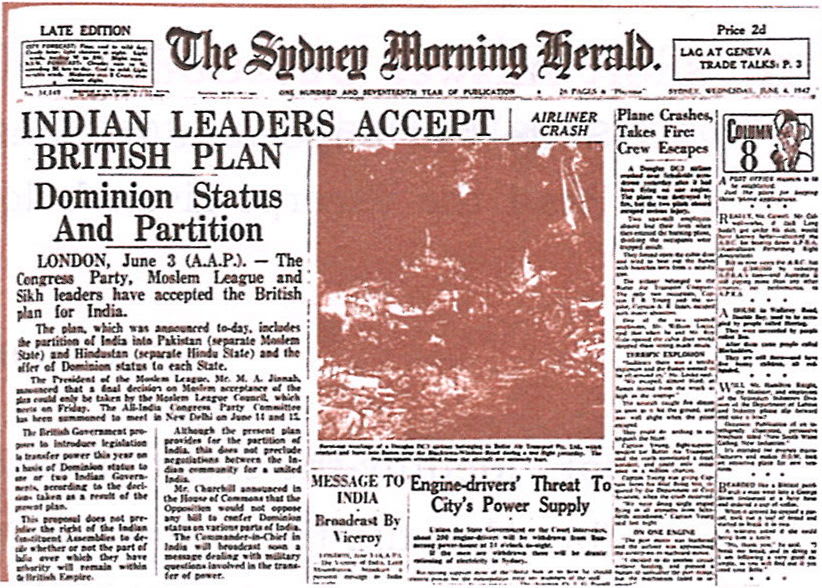
(a) Which Plan is referred to in the given newspaper article? State any two features of this Plan.
(b) How was the Plan supposed to solve the communal problem existing in India?
(c) Why did the Congress accept the Plan? State three reasons to justify its acceptance.