Biology
The apparatus shown in the following diagram is Garreau's potometer designed to demonstrate unequal transpiration from the two surfaces of a dorsiventral leaf. Equal amounts of calcium chloride (CaCl2) was taken in two vials, which were placed in two cups. The leaf was placed between the cups. The ends of the cups were closed with corks through which two mercury manometers were connected. After few hours, CaCl2 vials were taken out and weighed again.
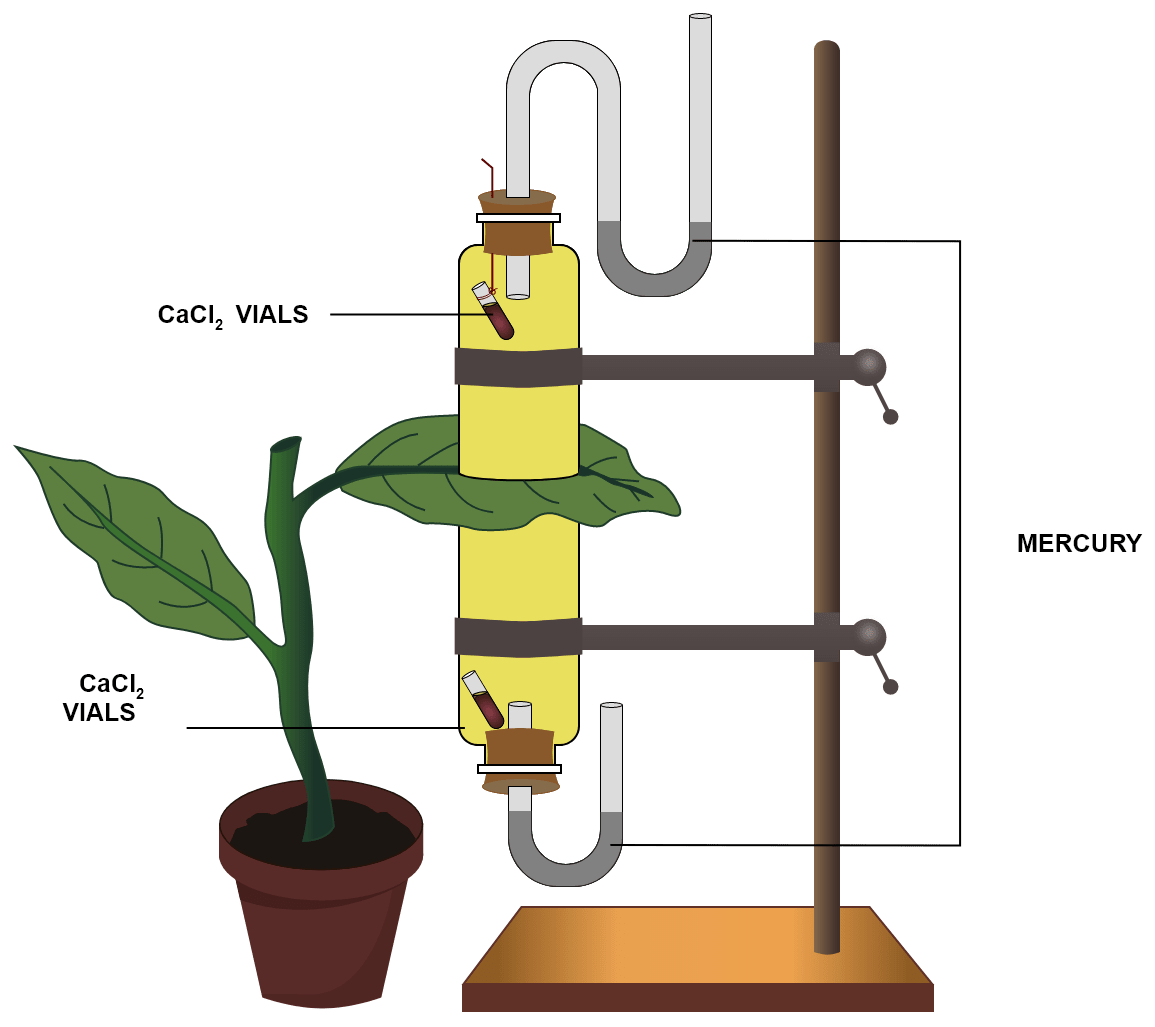
(a) What is the purpose of keeping CaCl2 vials inside the cup?
(b) After few hours CaCl2 vials were taken out and weighed again. Will you expect any difference in weight? If so, give reason.
(c) What is the purpose of using a manometer?
(d) What do you mean by transpiration?
Answer
(a) CaCl2 is a hygroscopic compound that absorbs moisture/water without changing its state. CaCl2 vials are placed inside the cup to absorb water.
(b) Yes, after few hours the weight of the CaCl2 vials will increase because they will absorb water lost by the leaf of the plant due to transpiration.
(c) Manometer is used to measure the pressure exerted by the water vapour that is released by the leaf through Transpiration. A change in vapour pressure within the cups shown by the manometers is indicative of the fact that either the connections are not air-tight or that all the vapour given out by the leaf surface is not being absorbed by the CaCl2 within the vials.
(d) Transpiration is the loss of water in the form of water vapour from the aerial parts (leaves and stem) of the plant.
Related Questions
The figure given below represents an experimental set up with a weighing machine to demonstrate a particular process in plants. The experimental set up was placed in bright sunlight. Study the diagram and answer the following questions.

(a) Name the process intended for study.
(b) Define the above mentioned process.
(c) When the weight of the test tubes A and B is taken before and after the experiment, what change is observed? Justify.
(d) What is the purpose of keeping the test tube B in the experimental setup?
(e) What is the purpose of putting oil in the test tube?
An apparatus as shown below was set up to investigate a physiological process in plants. The setup was kept in sunlight for two hours. Droplets of water were then seen inside the bell jar. Answer the questions that follow:

(a) Name the process being studied.
(b) Explain the process named above in (a).
(c) Why was the pot covered with a plastic sheet?
(d) Suggest a suitable control for this experiment.
(e) Mention two ways in which this process is beneficial to plants.
(f) List three adaptations in plants to reduce the above mentioned process.
Given below is the figure of a stoma. Study the same and answer the following questions:

(a) Label the guidelines A and B.
(b) Write the exact location of the above mentioned structures.
(c) Mention one important role of structure A.
(d) Write three important roles of structure B.
(e) Redraw the same figure when structures A are in flaccid condition. When does flaccid condition occur ?
The figure given below is a transverse section of an old woody stem. It shows very minute openings labelled - A on its surface.
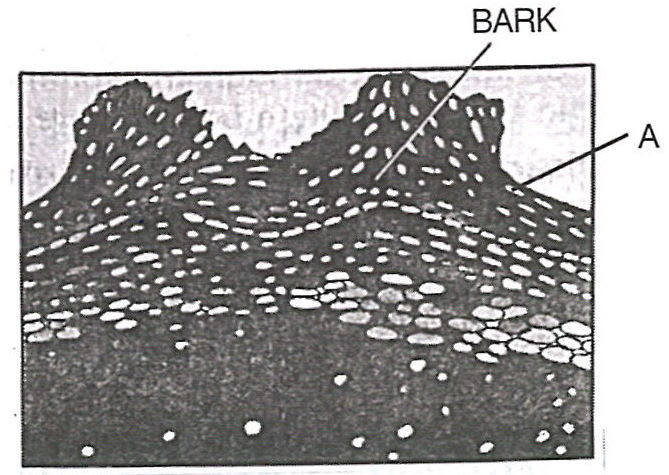
(a) What are these tiny openings called?
(b) Mention two significant functions of these openings.
(c) Name two other tiny openings which can be found on the surface or margins of leaves.