Mathematics
The bisectors of the equal angles B and C of an isosceles triangle ABC meet at O. Prove that AO bisects angle A.
Answer
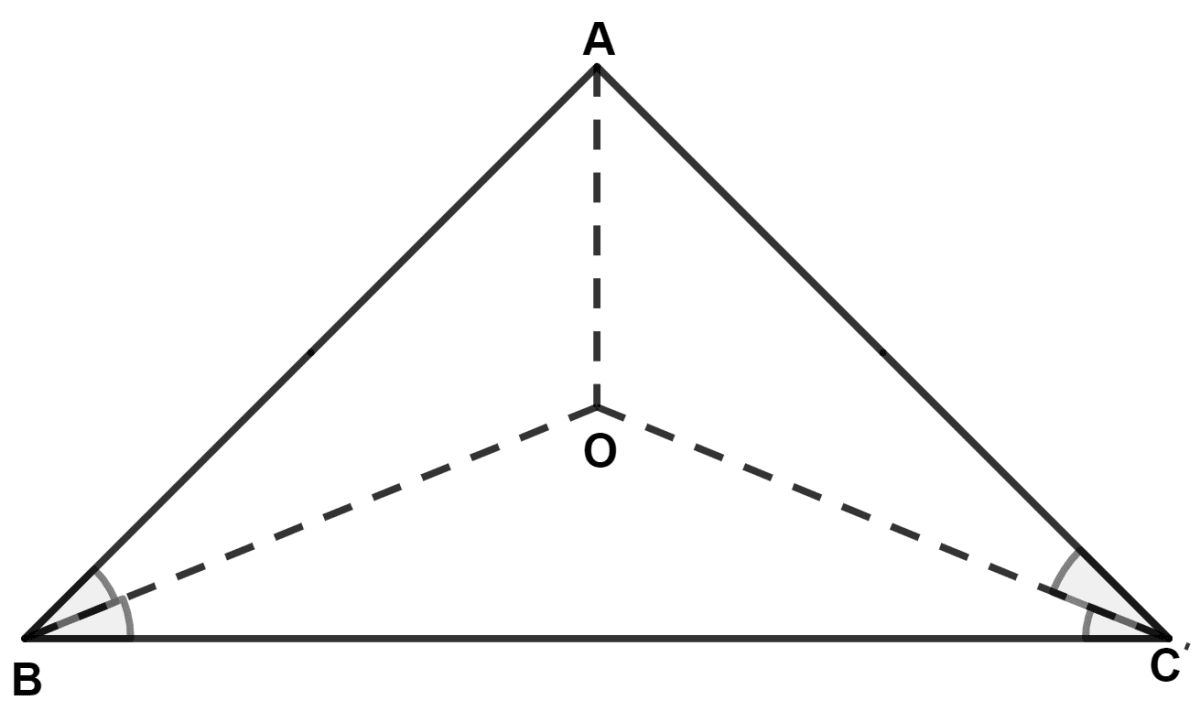
Isosceles triangle ABC is shown in the figure below:
Given,
B and C are equal angles.
∴ AB = AC (Sides opposite to equal angles are equal)
Given,
Bisectors of the equal angles B and C of an isosceles triangle ABC meet at O.
Since, OB and OC are bisectors of equal angles B and C respectively.
∴ ∠OBC = ∠OCB
⇒ OC = OB (Sides opposite to equal angles are equal)
In △ OAB and △ OAC,
⇒ OA = OA (Common side)
⇒ AB = AC (Proved above)
⇒ OB = OC (Proved above)
∴ △ OAB ≅ △ ∠OAC (By S.S.S. axiom)
We know that,
Corresponding parts of congruent triangles are equal.
∴ ∠OAB = ∠OAC
Hence, proved that AO bisects angle A.
Related Questions
In quadrilateral ABCD, side AB is the longest and side DC is the shortest. Prove that :
(i) ∠C > ∠A
(ii) ∠D > ∠B
In triangle ABC, side AC is greater than side AB. If the internal bisector of angle A meets the opposite side at point D, prove that : ∠ADC is greater than ∠ADB.
In isosceles triangle ABC, sides AB and AC are equal. If point D lies in base BC and point E lies on BC produced (BC being produced through vertex C), prove that :
(i) AC > AD
(ii) AE > AC
(iii) AE > AD
Given : ED = EC
Prove : AB + AD > BC.