History & Civics
Answer
Gandhiji's doctrine of Satyagraha was an effective method of the National Movement.
- The term Satyagraha is made up of two Sanskrit words—Satya (truth) and Agraha (insistence to hold fast).
- To Gandhiji, satyagraha was a moral force born of truth and non-violence.
- It meant to be fearless, truthful as well as peaceful, suffering willingly while refusing to submit to what is wrong.
- But even while resisting evil, it would not involve hatred towards the evil-doer.
- Gandhiji's Satyagraha Movement was directed against the British system of exploitation and not the British people individually or collectively.
- Gandhiji made a distinction between Satyagraha and passive resistance.
- Passive resistance does not exclude the use of physical force for the purpose of gaining one's end, whereas Satyagraha excludes the use of violence.
Related Questions
The issue on which the Civil Disobedience Movement of 1930 was launched was …………… .
- equal employment opportunities for Indians
- the proposed execution of Bhagat Singh.
- salt monopoly exercised by the British Government.
- complete freedom.
Assertion (A): Gandhiji called off the Non-Cooperation Movement in 1922.
Reason (R): An unruly crowd burnt down a police station at Chauri-Chaura in 1922.
- Both A and R are true, and R is the correct explanation of A.
- Both A and R are true, but R is not the correct explanation of A.
- A is true, but R is false.
- A is false, but R is true.
The Manchester Guardian was the first to publish a report on the massacre, eight months later on December 13, 1919. The headline of this report read: "An Astonishing Story From India."
Which massacre is being talked about in the above newspaper report? When and where did this massacre take place?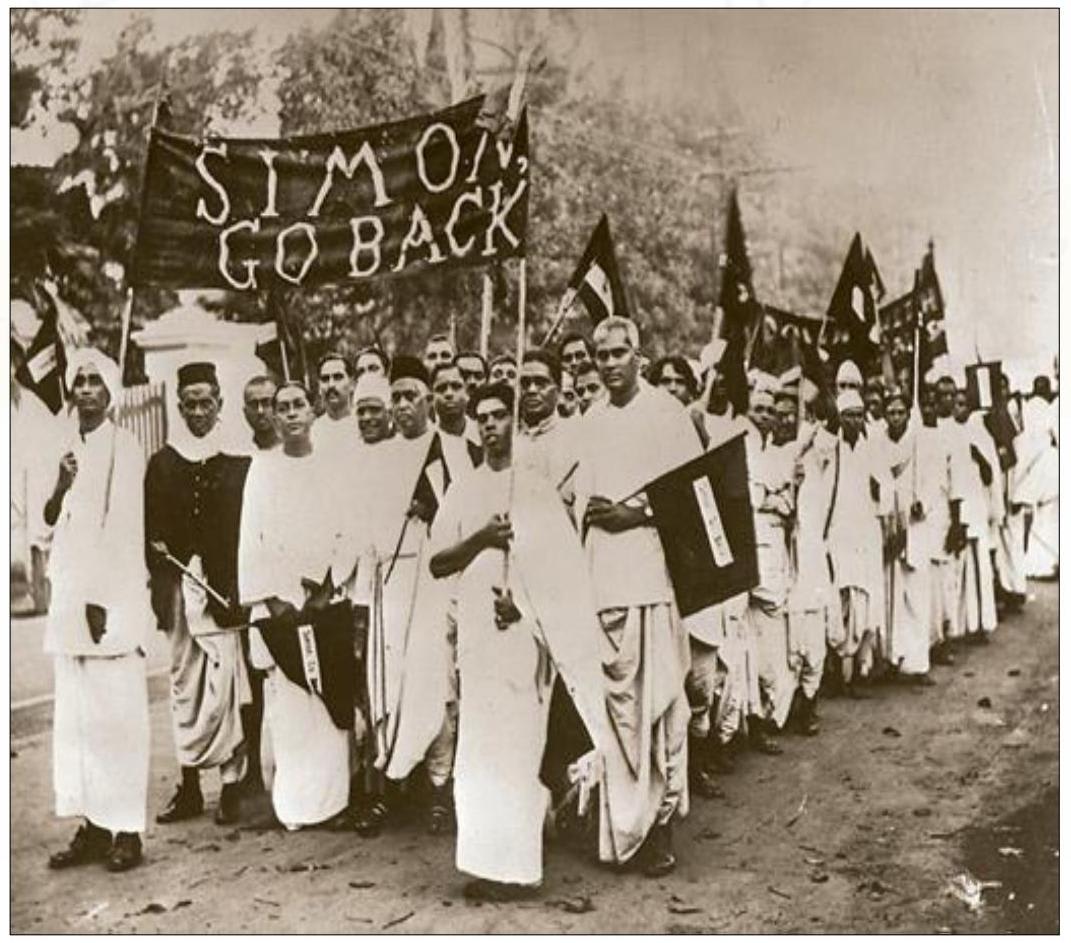
(a) Identify the event associated with the above-mentioned slogan.
(b) Why did the Indian leaders decide to boycott the event?