Chemistry
Assertion (A): Ionic compounds conduct electricity in molten or aqueous state.
Reason (R): Ionic compounds consist of molecules.
- Both A and R are true and R is the correct explanation of A.
- Both A and R are true but R is not the correct explanation of A.
- A is true but R is false.
- A is false but R is true.
Answer
A is true but R is false.
Explanation — Ionic compounds when in molten or aqueous state dissociate into free moving ions, which carry electric current. That is why substances like NaCl conduct electricity when dissolved in water or melted. Hence Assertion (A) is true.
Reason (R) is false because ionic compounds consist of positive and negatively charged ions bound by strong electrostatic forces.
Related Questions
Draw an electron dot diagram of the structure of — hydronium ion. State the type of bonding present in it.
By drawing an electron dot diagram, show the lone pair effect leading to the formation of — ammonium ion from ammonia gas and hydrogen ion.
Study the extract of the Periodic table given below and answer the questions that follow. Give the alphabet corresponding to the element in question: DO NOT repeat an element.
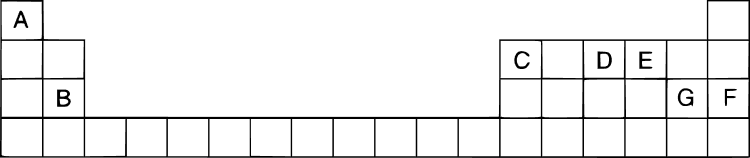
(a) Which element forms an electrovalent compound with G?
(b) The ion of which element will migrate towards the cathode during electrolysis?
(c) Which non metallic element has the valency 2?
(d) Which is the inert gas?
The following table shows the electronic configuration of the elements W, X, Y, Z :
Element W X Y Z Electronic
Configurations2, 8, 1 2, 8, 7 2, 5 1 Answer the following questions based on the table above:
(i) What type of bond is formed between:
- W and X
- Y and Z
(ii) What is the formula of the compound formed between :
- X and Z
- W and X