Mathematics
Answer
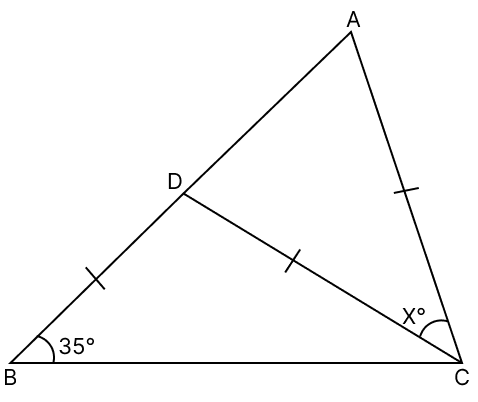
In △BDC,
BD = CD
⇒ ∠DBC = ∠DCB = 35° (Angles opposite to equal sides in a triangle are equal)
By angle sum property of triangle,
⇒ ∠DBC + ∠DCB + ∠BDC = 180°
⇒ 35° + 35° + ∠BDC = 180°
⇒ 70° + ∠BDC = 180°
⇒ ∠BDC = 180° - 70°
⇒ ∠BDC = 110°.
From figure,
⇒ ∠BDC + ∠ADC = 180° (Linear pair)
⇒ 110° + ∠ADC = 180°
⇒ ∠ADC = 180° - 110°
⇒ ∠ADC = 70°
In △ADC,
CA = CD
⇒ ∠ADC = ∠CAD = 70° (Angles opposite to equal sides are equal)
By angle sum property of triangle,
⇒ ∠ADC + ∠CAD + ∠ACD = 180°
⇒ 70° + 70° + x° = 180°
⇒ 140° + x° = 180°
⇒ x° = 180° - 140°
⇒ x° = 40°
⇒ x = 40.
Hence, the value of x = 40.
Related Questions
If the base of an isosceles triangle is produced on both sides, prove that the exterior angles so formed are equal to each other.
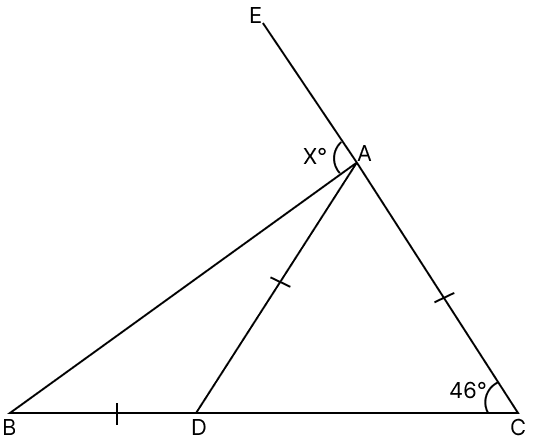
In the given figure, side CA of △ABC has been produced to E. If AC = AD = BD; ∠ACD = 46° and ∠BAE = x°; find the value of x.
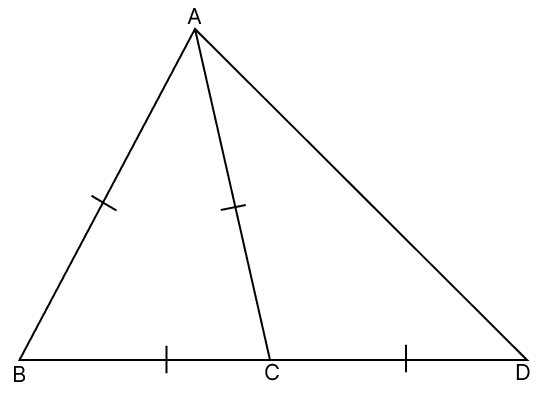
In the given figure, △ABC is an equilateral triangle whose base BC is produced to D such that BC = CD. Calculate :
(i) ∠ACD
(ii) ∠ADC
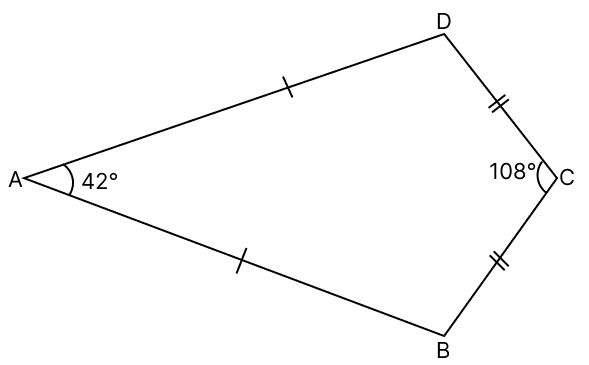
In the given figure, AB = AD; CB = CD; ∠A = 42° and ∠C = 108°, find ∠ABC.