History & Civics
Mahatma Gandhi said, "Communal harmony could not be permanently established in our country so long as highly distorted versions of history were taught in her schools." State your views on this statement and justify it by giving examples.
Answer
The manner in which Indian history was interpreted in those days contributed to the growth of communal thinking among the Hindus and the Muslims.
- Some British and communal historians divided Indian history into the Hindu and the Muslim periods. The rule of Turks, Afghans and Mughals was called the Muslim rule, where the rulers were said to be the followers of Islam and their subjects, the followers of other religions. In the so-called Hindu period, Muslim rulers were dubbed as foreign invaders who had settled in India.
- The British and communal historians ignored the notion of a composite culture in India and tried to create a rift between the two communities. They failed to interpret that the diversity was primarily class-wise and region-wise and not religion-wise.
- Some communal historians highlighted the myth that Indian society and culture had reached great heights during the ancient period but was declining during the medieval period which was dominated by Mughal rulers. They did not give much importance to the contribution of the medieval period to the development of Indian economy, religion, art, literature, culture and society.
- The communal bias was propagated through poetry, drama, novels, short stories, newspapers, etc.
Related Questions
The growth of communalism in India was encouraged by the British authorities as well as certain trends in Indian society. In the light of this observation, explain:
(a) The Divide and Rule Policy of the British.
(b) The writings and speeches of the Assertive Nationalists.
(c) The erroneous interpretation of Indian History.
(a) Identify the persons in the given picture. Which agreement for a joint scheme of political reforms was signed by these two persons? The agreement was signed post which international event?
(b) Mention any three factors that led to the signing of this agreement.
(c) State any two significant outcomes of this agreement.
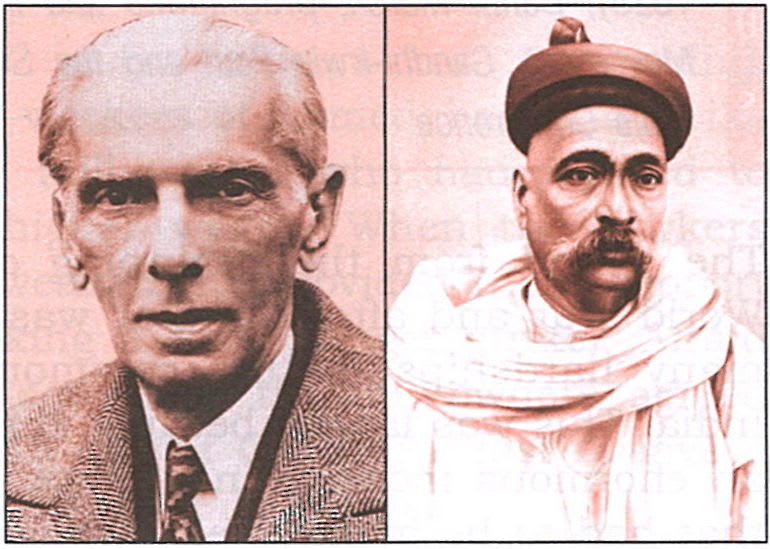
Realising the aims and objectives of the Muslim League when it was formed in 1906, do you think that more than the Muslim League, it was the British policy of Divide and Rule, that encouraged the communal forces to create a rift between the two communities in India.
Not many people are aware of the friendship built on mutual respect that was a symbol of Hindu-Muslim unity of India—the friendship between Lokmanya Tilak and Mohammed Ali Jinnah. When Tilak, as the President of Home Rule League, was leaving for England to press for India’s demand for Swaraj, Jinnah had proclaimed that there was no man more fitted to voice the opinions of Indians other than Tilak who had devoted his whole life to the cause of his country. Trace the events that led to Jinnah demanding Partition of the country and the establishment of Pakistan. The relationship between the two countries till date is a proof of the discord sowed by the British. What in your opinion, can be done to improve relations between the two countries.