Chemistry
Ramu makes a detailed study on the values of electronegativity and the formation of compounds. Accordingly, he draws the following conclusion:
The larger the electronegativity (EN) difference between the combining atoms, the more ionic bonds will form.
If the EN difference is negligible, covalent bonds will form. So, which of the following values refers to covalent bonds?
P: 3.0 and 3.0
Q: 0.9 and 3.0
- Only P
- Only Q
- Both P and Q
- Neither P nor Q
Answer
Only P
Reason — The condition for the formation of a covalent bond is the electronegative difference between the combining atoms should either be zero or negligible.
P: 3.0 and 3.0, the electronegative difference is zero, leading to covalent bond formation.
Q: 0.9 and 3.0, the electronegative difference is 2.1, NO covalent bond formation.
Related Questions
A distinctive reaction that takes place when ethanol is treated with acetic acid in the presence of concentrated sulphuric acid to give a fruity smell.
P: The reaction is called esterification.
Q: The reaction is called hydration.- Only P
- Only Q
- Both P and Q
- Both P and Q are wrong
The pH of the soil is tested, and for the better growth of crops, slightly alkaline soil is required. Which ion in the fertiliser will increase the alkalinity of the soil?
- Hydronium ion
- Hydroxyl ion
- Hydrogen ion
- Both hydroxyl and hydrogen
10g of magnesium carbonate reacts completely with excess dilute hydrochloric acid. What volume of carbon dioxide is formed at room temperature and pressure? [Mg=24, C=12, O=16] The equation for the reaction is:
MgCO3 + 2HCl ⟶ MgCl2 + H2O + CO2
- 2.8 dm3
- 2.6 dm3
- 2.2 dm3
- 2.4 dm3
The diagram shown is a wrong attempt to electroplate a pan with copper:
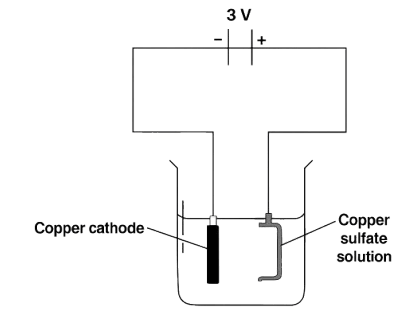
Which of the following could have been done to copper plate a pan?
- To change DC to AC.
- To change the electrolyte from copper sulphate to cobalt sulphate.
- Connect the pan to the negative electrode.
- To induce a higher current.