History & Civics
Why was the Simon Commission appointed by the British Government? Why did the Congress boycott the Commission?
Answer
In November 1927, the British Government appointed the Indian Statutory Commission, popularly known as the Simon Commission, to investigate the need for further constitutional reforms. The Commission was composed of seven British members of Parliament.
The commission had no Indian member. This was seen as a violation of the principle of self-determination and a deliberate insult to the self-respect of the Indians. Hence, at its Madras session in 1927, presided over by Dr. Ansari, the National Congress decided to boycott the commission 'at every stage and in every form'.
Related Questions
Name two leaders linked with the Home Rule Leagues.
Replace the underlined phrase with the correct option:
The objective of the Non-Cooperation Movement was to demobilise public opinion all over the country.
- to make the movement rare and unique.
- to provide an international base for Congress.
- to generate a wedge between Hindu-Muslim unity.
- to attain self-governance.
The issue on which the Civil Disobedience Movement of 1930 was launched was …………… .
- equal employment opportunities for Indians
- the proposed execution of Bhagat Singh.
- salt monopoly exercised by the British Government.
- complete freedom.
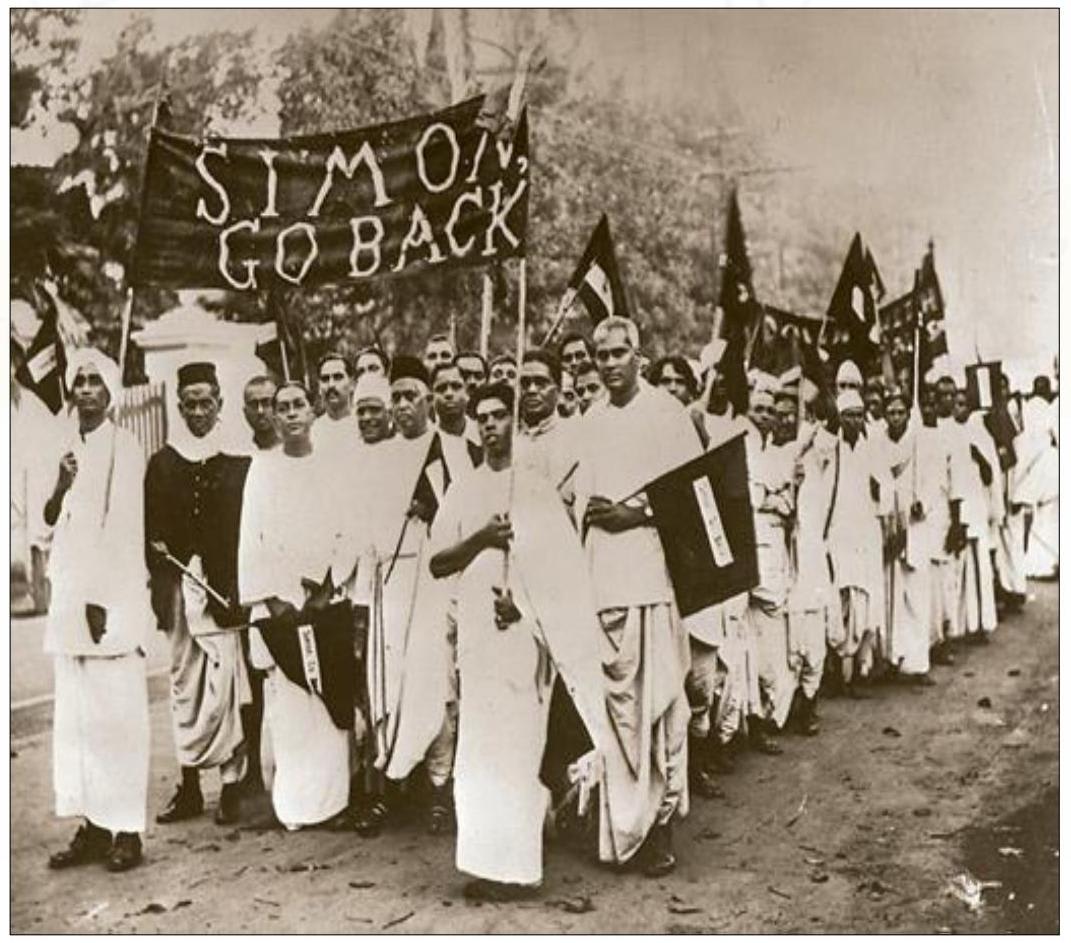
(a) Identify the event associated with the above-mentioned slogan.
(b) Why did the Indian leaders decide to boycott the event?