Physics
The adjacent diagram shows four solid plastic balls with wires fitted on a wooden base. A person shakes the wooden base to and fro (forward and backward) periodically. It is observed that even the balls start vibrating. It is also observed that all balls vibrate, but only one ball vibrates vigorously.
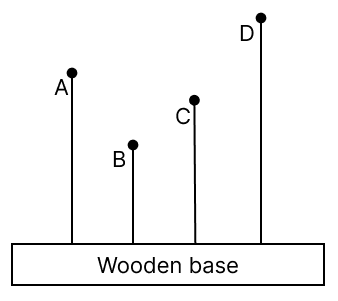
(a) Explain why only one ball vibrates vigorously.
(b) If fA, fB, fC, and fD are the natural frequencies of vibration of the wires, then arrange them in the increasing order of their frequencies and give reasons for the same.
Answer
(a) Each wire-ball system has its own natural frequency depending on the wire's length, tension, and mass distribution. The ball that vibrates vigorously is the one whose natural frequency matches the driving frequency. When the frequency of external vibrations matches an object's natural frequency, the object absorbs energy and vibrates with large amplitude due to resonance.
(b) fD < fA < fC < fB
Frequency of vibration is inversely proportional to the vibrating length. Shorter wires have higher natural frequencies, while longer ones have lower frequencies.
Related Questions
Shan is utilising a dynamometer to measure the force, expressed in newtons, on a bowstring. He records both the force and displacement of the bowstring and plots the data on a graph that shows the relationship between force in newtons and displacement in centimetres. Shan is interested in determining the highest point that the arrow reaches. He knows he can calculate the work done by finding the area under the graph.
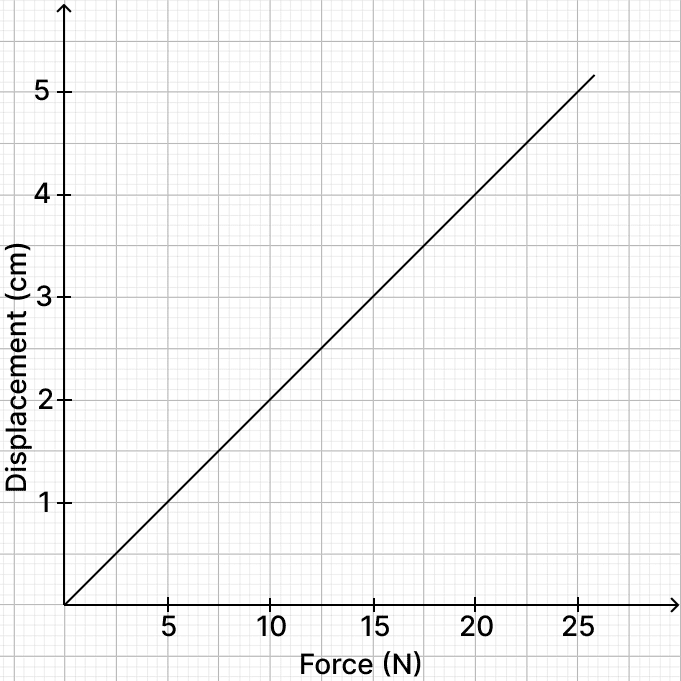
(a) What is the potential energy stored in the bow string, when the force is 25 N?
(b) If the mass of the arrow is 31.25 g, calculate the maximum velocity attained by the arrow.
(c) Calculate the maximum height reached by the arrow.
The graph illustrates the correlation between the number of protons (x-axis) and the number of neutrons (y-axis) for element C in the periodic table. The element is denoted by letters rather than their conventional symbols. When element C, depicted in the graph, undergoes radioactive decay, it releases radioactive rays.
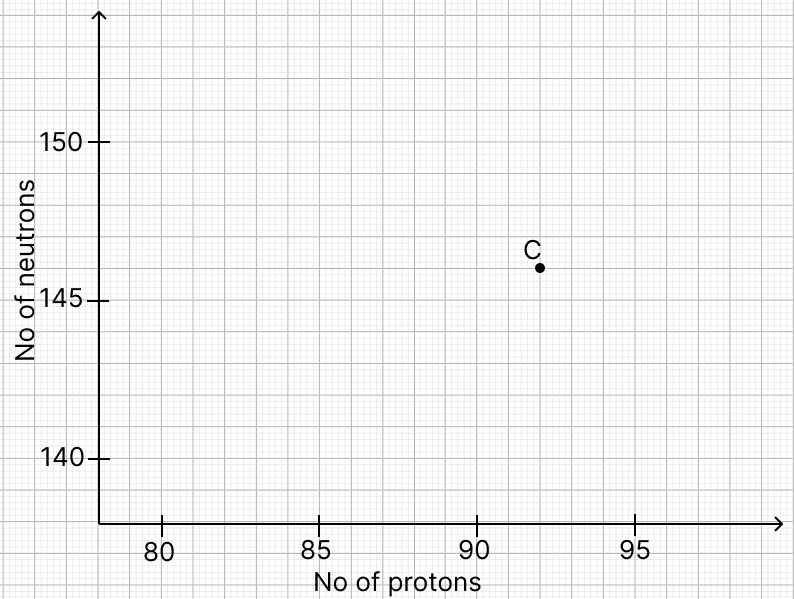
(a) Write the chemical symbol along with the mass number and atomic number for the element denoted as ‘C’.
(b) Plot on the graph,
i. The daughter element after the emission of beta radiation by the element ‘C’.
ii. The daughter element, as indicated in the previous answer, if it undergoes alpha decay.
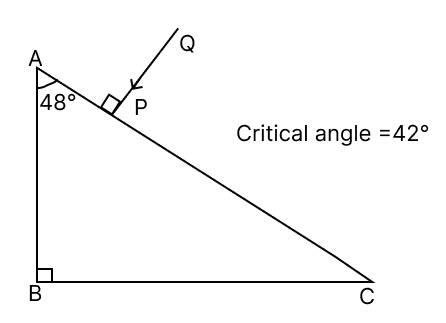
The above diagram shows a glass prism of a critical angle 42°.
(a) Redraw the diagram and complete the path of the light ray PQ till it emerges out of the prism.
(b) Also, calculate the net angle of deviation of the ray PQ when it emerges from the prism.
The circuit depicted in the figure is employed to study Ohm's Law. Rather than employing a conventional resistor, a glass tube of length ‘l’ and cross-sectional area ‘a’, which is half-filled with mercury of resistivity ‘d’, is connected to the circuit via two electrodes, E1 and E2. These electrodes are linked to a battery with an emf of ‘E’ and negligible internal resistance. Provide the answer in terms of ‘a’, ‘l’, ‘d’, and ‘E’.
(a) Resistance of mercury in the tube.
(b) The ammeter reading.
(c) Voltmeter reading.
(d) Which of the measurements are altered when the tube is entirely filled with mercury?
