Physics
The diagram below shows two parallel wires carrying current in the downward direction. The magnitude of the current in wire A is greater than in wire B. It is also observed that the wires exert force on each other.
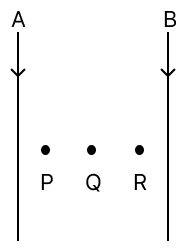
(a) State the direction of the force experienced by wire A.
(b) Name the law/laws used to come to the conclusion in (a).
(c) When a compass is placed in between the two wires, it does not remain along the direction of the magnetic field of wire A or wire B at one of the points P, Q, or R. State with a reason at which point you will observe this.
Answer
(a) Since both wires carry current downward and are parallel, they attract each other. So, wire A pulls toward wire B, and vice versa.
(b) Right hand thumb rule and Fleming’s left-hand rule.
(c) At point R
Since, the magnitude of the current in wire A is greater than in wire B, neutral point will always be formed near the weaker current wire.
Explanation:
(a) To find the direction of the force experienced by wire A:
Using the Right-Hand Thumb Rule (to find magnetic field):
For wire B, on pointing the right thumb in the direction of current (downwards), the fingers curl around the wire in the direction of the magnetic field. Hence, at the position of wire A (to the left of B), the magnetic field due to B is into the page.
Using Fleming’s Left-Hand Rule (to find force):
Applying Fleming's Left-Hand Rule to wire A:
- Magnetic field due to wire B at the location of wire A is into the page (first finger).
- Current in wire A is downward (second finger).
- Using Fleming's Left-Hand Rule, the thumb will point to the right.
Therefore, wire A experiences a force to the right, i.e., towards wire B.
(b) Right hand thumb rule and Fleming’s left-hand rule as explained above.
(c) The compass will not remain along the direction of the magnetic field of wire A or wire B at point R.
Point P: At this point, the magnetic field due to wire A is stronger than that due to wire B. As a result, the net magnetic field is in the direction of wire A’s magnetic field. Therefore, the magnetic compass will align itself along the direction of the magnetic field produced by wire A.
Point Q: This point lies midway between the two wires, equidistant from each. However, the magnetic field produced by wire A is stronger than that of wire B because the current in wire A is greater. As a result, the magnetic compass at this location will align itself with the direction of the magnetic field created by wire A.
Point R: Since the current in wire A is greater than that in wire B, the neutral point,where the magnetic fields from both wires cancel each other—will be located closer to wire B, the weaker current source. Therefore, point R is the most probable location of the neutral point resulting from the magnetic fields of both wires.
Related Questions
Shan is utilising a dynamometer to measure the force, expressed in newtons, on a bowstring. He records both the force and displacement of the bowstring and plots the data on a graph that shows the relationship between force in newtons and displacement in centimetres. Shan is interested in determining the highest point that the arrow reaches. He knows he can calculate the work done by finding the area under the graph.
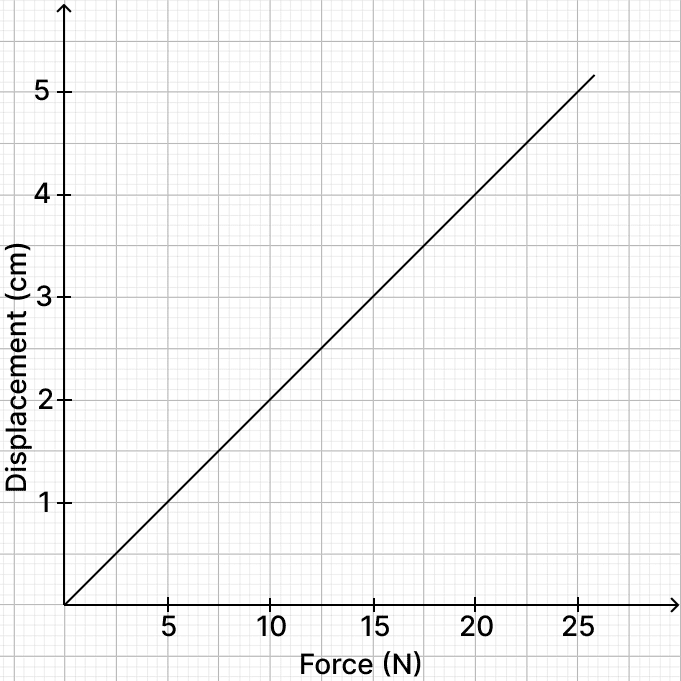
(a) What is the potential energy stored in the bow string, when the force is 25 N?
(b) If the mass of the arrow is 31.25 g, calculate the maximum velocity attained by the arrow.
(c) Calculate the maximum height reached by the arrow.
The graph illustrates the correlation between the number of protons (x-axis) and the number of neutrons (y-axis) for element C in the periodic table. The element is denoted by letters rather than their conventional symbols. When element C, depicted in the graph, undergoes radioactive decay, it releases radioactive rays.
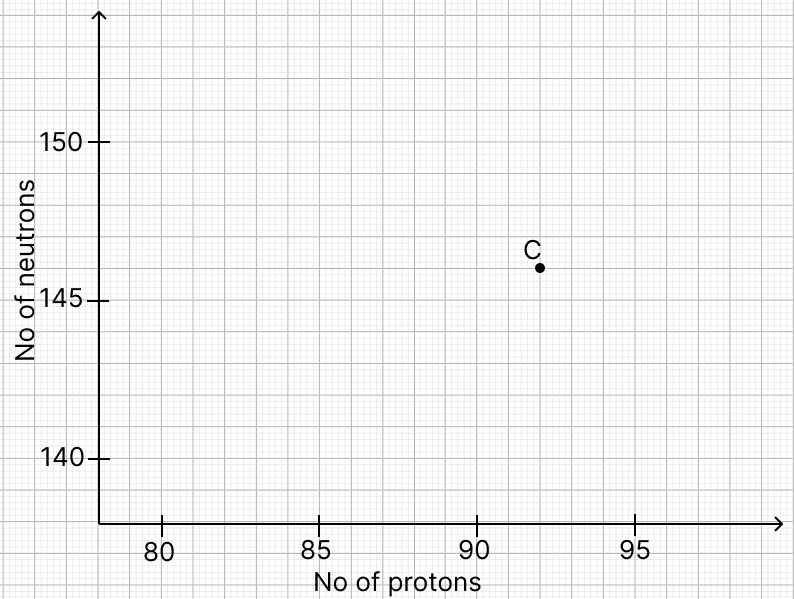
(a) Write the chemical symbol along with the mass number and atomic number for the element denoted as ‘C’.
(b) Plot on the graph,
i. The daughter element after the emission of beta radiation by the element ‘C’.
ii. The daughter element, as indicated in the previous answer, if it undergoes alpha decay.
The adjacent diagram shows four solid plastic balls with wires fitted on a wooden base. A person shakes the wooden base to and fro (forward and backward) periodically. It is observed that even the balls start vibrating. It is also observed that all balls vibrate, but only one ball vibrates vigorously.
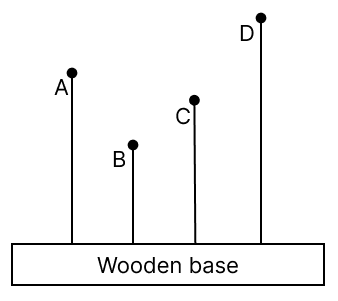
(a) Explain why only one ball vibrates vigorously.
(b) If fA, fB, fC, and fD are the natural frequencies of vibration of the wires, then arrange them in the increasing order of their frequencies and give reasons for the same.
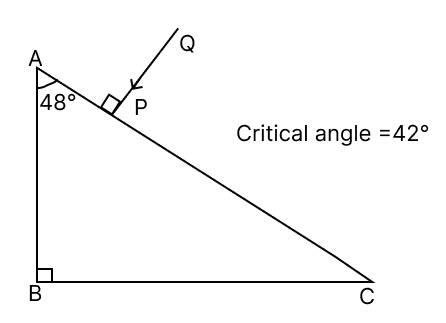
The above diagram shows a glass prism of a critical angle 42°.
(a) Redraw the diagram and complete the path of the light ray PQ till it emerges out of the prism.
(b) Also, calculate the net angle of deviation of the ray PQ when it emerges from the prism.