Chemistry
| Group number | 1A 1 | IIA 2 | IIIA 13 | IVA 14 | VA 15 | VIA 16 | VIIA 17 | VIIIA 18 |
|---|---|---|---|---|---|---|---|---|
| Li | D | O | J | Ne | ||||
| A | Mg | E | Si | H | K | |||
| B | C | F | G | L |
With reference to the portion of the periodic table given above, identify the element having the largest atomic size:
- Li
- B
- K
- L
Answer
B
Reason — B has the largest atomic size, because,
Down the group — The size of an atom increases as one proceeds from top to bottom. Since B is present at third position of first group, it has larger size due to the successive addition of shells.
Across the period — The size of the atom decreases from left to right. Since B is the first element of third period, it has largest atomic size.
Related Questions
Thermite mixture is used to weld the broken ends of the iron girders. This mixture consists of ferric oxide and aluminium powder, which, when heated, produces molten iron. In this reaction, the aluminium powder acts as a/an …………… agent.
- oxidising
- reducing
- dehydrating
- corroding
The below diagram represents the electrolysis of acidulated water. The reaction occurring at the anode is:
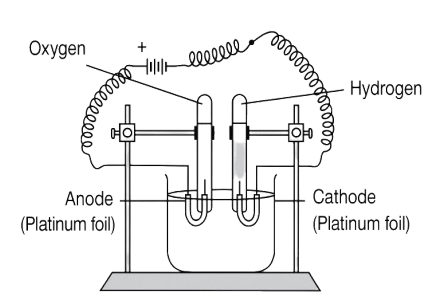
- H2SO4 ⟶ 2H+ + SO42-
- H2O ⟶ H+ + OH-
- H+ + e- ⟶ H, 2[H] + 2[H] ⟶ H2
- OH- - e- → OH, [4OH] ⟶ 2H2O + O2
The picture given below shows an apparatus that a teacher used for demonstrating the properties of ionic substances. The teacher heats a sample of lead bromide in a crucible which contains two electrodes which are part of the circuit shown. The bulb does not light up. What is the best explanation for this?
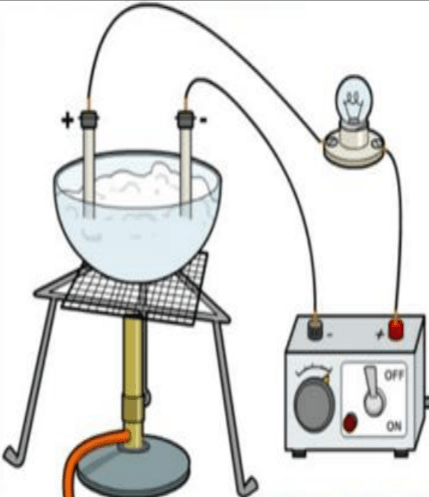
- The circuit is complete.
- Molten lead bromide does not conduct electricity.
- The sample of lead bromide was not heated up to the melting point by the teacher.
- The DC power supply was set up correctly.
Element Y is in Group IIA of the Periodic Table. Y reacts with element Q to form an ionic compound. Which equation shows the process that takes place when Y forms ions?
- Y + 2e- ⟶ Y2+
- Y - 2e- ⟶ Y2-
- Y + 2e- ⟶ Y2-
- Y - 2e- ⟶ Y2+