Biology
Name the following:
(a) A monocotyledonous endospermic seed.
(b) A chemical used in experiments which absorbs oxygen.
(c) Part of the plumule above the embryonic axis of the seed.
(d) A plant which shows viviparous germination.
(e) The layer of endosperm of maize rich in protein.
(f) A seed with folded plumule leaves.
Related Questions
Seeds germinate in two ways. The type in which the cotyledons remain underground is called (P) …………… germination. During this type of germination, the (Q) …………… elongates faster.
- P — Epigeal, Q — Hypocotyl
- P — Epigeal, Q — Epicotyl
- P — Hypogeal, Q — Epicotyl
- P — Hypogeal, Q — Hypocotyl
Correct the following false statements by changing the first/last word only.
(a) Plumule develops into the root system.
(b) Testa is the thin inner layer of the seed coat.
(c) Endothelium separates the endosperm and embryonic region in the maize grain.
(d) Hypocotyl elongates faster in hypogeal germination.
(e) Germination is the period of rest in a seed.
Give two examples of each of the following :
(a) Monocot albuminous seed.
(b) Dicot albuminous seed.
(c) Monocot non-endospermic seed.
(d) Dicot non-endospermic seed.
(e) Viviparous plant.
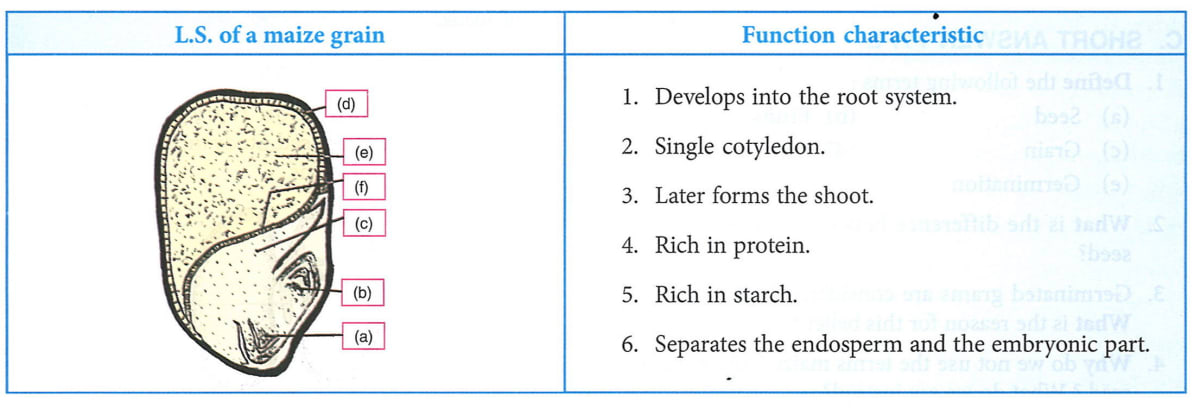
Given below is the longitudinal section of a maize grain. Match the structures marked (a) to (e) with their correct functions/characteristics.
Example: (f)-6: Separates the endosperm and the embryonic part.