
Biology
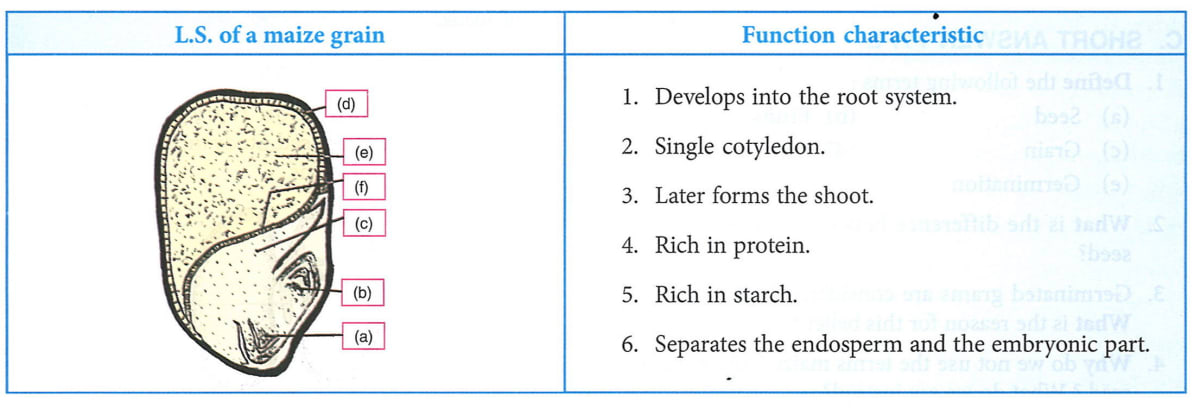
Given below is the longitudinal section of a maize grain. Match the structures marked (a) to (e) with their correct functions/characteristics.
Example: (f)-6: Separates the endosperm and the embryonic part.
Seeds
60 Likes
Answer
| L.S. of maize grain | Function characteristic |
|---|---|
| (a) Radicle | 1. Develops into root system. |
| (b) Plumule | 3. Later forms the shoot. |
| (c) Scutellum (cotyledon) | 2. Single cotyledon. |
| (d) Aleurone layer | 4. Rich in protein. |
| (e) Endosperm | 5. Rich in starch. |
| (f) Epithelium | 6. Separates the endosperm and the embryonic part. |
Answered By
36 Likes
Related Questions
Name the following:
(a) A monocotyledonous endospermic seed.
(b) A chemical used in experiments which absorbs oxygen.
(c) Part of the plumule above the embryonic axis of the seed.
(d) A plant which shows viviparous germination.
(e) The layer of endosperm of maize rich in protein.
(f) A seed with folded plumule leaves.
Give two examples of each of the following :
(a) Monocot albuminous seed.
(b) Dicot albuminous seed.
(c) Monocot non-endospermic seed.
(d) Dicot non-endospermic seed.
(e) Viviparous plant.
Fill in the blanks:
(a) In bean seeds, …………… grows faster and the seeds are brought …………… ground.
(b) …………… is a protective layer of radicle and …………… protects the rolled plumule.
(c) A seed is protected by …………… and…………….
(d) Seeds absorb water through …………… which also helps in diffusion of respiratory gases.
(e) Rice, wheat and maize are rich in …………… food.
Arrange the following set of terms in order, so as to be in logical sequence. Rewrite the correct order.
- Embryo, 1st male gamete, zygote, egg cell, micropyle.
- Zygote, embryo, seed, allogamy, fusion of gametes.
- Tegmen, Embryonic axis, Cotyledons, Testa
(arrange with respect to their position in a seed from outer to inner).