Biology
Rima is playing music.

(a) Trace the path of sound of music using following terms:
Pinna, Ossicles, Hammer, Oval window, Cochlea, Eardrum,
(b) Name the nerve that carries the impulse of sound to brain.
Answer
a → Pinna → Eardrum → Hammer → Ossicles → Oval window → Cochlea, b → Auditory nerve
Reason — Sound waves enter the ear through the pinna (the visible part of the ear) and travel through the ear canal (auditory canal). It strikes the eardrum, causing it to vibrate. These vibrations are transmitted to three tiny bones in the middle ear called the ossicles (malleus, incus, and stapes), which amplify the sound. Vibrations pass through the oval window into the fluid-filled cochlea in the inner ear. The movement of fluid in the cochlea stimulates tiny hair cells, which convert the vibrations into electrical signals. These electrical signals are transmitted via the auditory nerve to the brain, where they are interpreted as sound.
Related Questions
Rahul inserted a hairpin into his right ear to remove ear wax. He felt a sudden sharp pain with loss of hearing. This was due to:
- Rupture of eardrum
- Rupture of vestibule
- Rupture of cornea
- Rupture of pinna
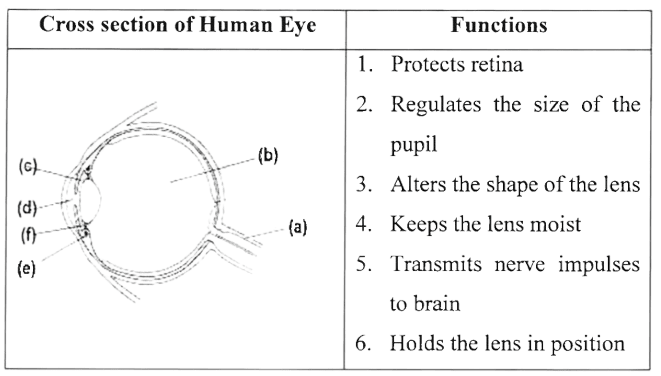
Given below is a cross section of the human eye. Match the structures marked (a) to (e) with their correct functions:
Example: (f) - 6. Holds the lens in position
Assertion (A): Rods and Cones are photoreceptors in the sclera of eyeball.
Reason (R): Rods are sensitive to dim light.
- A is True and R is False.
- A is False and R is True.
- Both A and R are True.
- Both A and R are False.
A teacher drew the diagram of heart on the blackboard and told the students to copy it in their notebooks. Mahesh couldn’t see the diagram clearly as it appeared blurred to him.
(a) Name the defect of the eye Mahesh is suffering from.
(b) Where is the image formed in this defect?
(c) Mahesh consults an eye doctor and is prescribed suitable lenses to correct the defect. Which type of lens do his spectacles have?