Chemistry
Name :
(a) a black metallic oxide which reacts with hydrochloric acid to give a coloured solution.
(b) two colourless gases, which when mixed produce a white solid
(c) two gases which chemically combine to form a liquid.
(d) a chloride which is soluble in excess of ammonium hydroxide.
(e) the chemical in which gold can be dissolved.
(f) the experiment which demonstrates that hydrogen chloride is soluble in water.
(g) the gas produced when chlorine water is exposed to sunlight.
Answer
(a) Black copper oxide reacts with hydrochloric acid to give a coloured solution.
CuO + 2HCl ⟶ CuCl2 + H2O
(b) Hydrogen chloride and ammonia, when mixed, produce ammonium chloride.
NH3 (g) + HCl (g) ⟶ NH4Cl
(c) Hydrogen and oxygen combine to form water. This can be shown as:
2H2 (g) + O2 (g) ⟶ 2H2O
(d) Silver chloride
(e) Aqua Regia
Aqua regia : 1 part of conc. HNO3 and 3 parts of conc. HCl
(f) Fountain experiment
(g) Oxygen gas
Related Questions
Study the figure given below and answer the questions that follow :
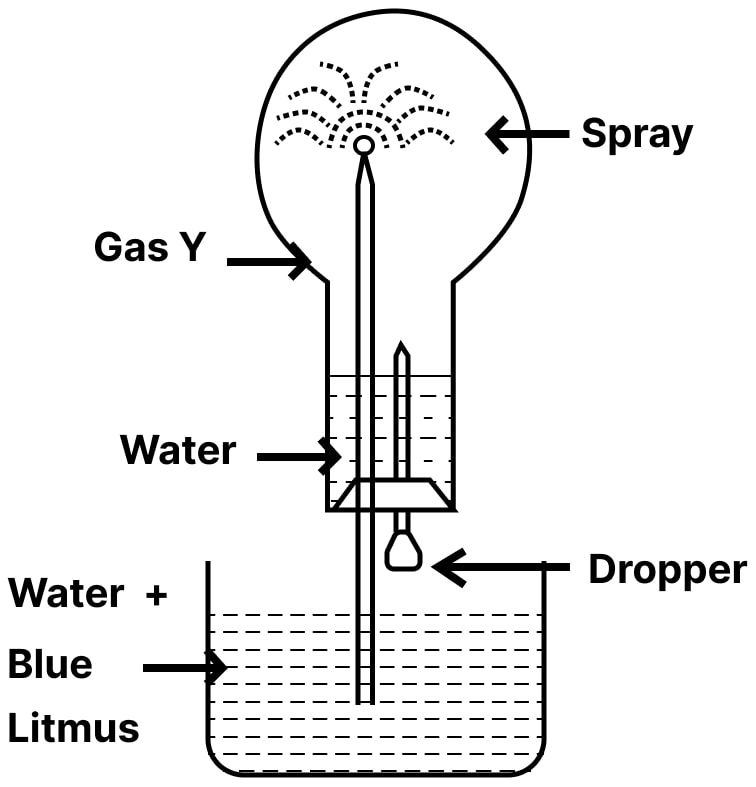
(i) Identify the gas Y.
(ii) What property of gas Y does this experiment demonstrate?
(iii) Name another gas which has the same property and can be demonstrated through this experiment.
Identify the gas evolved and give the chemical test in each of the following cases.
Dilute hydrochloric acid reacts with:
(i) Iron [II] sulphide.
(ii) Sodium sulphite.
State your observations:
(a) HCl gas is passed through lead nitrate solution and the mixture is heated.
(b) Hydrochloric acid is added to silver nitrate solution.
(c) Ammonium hydroxide solution is added to the resultant product of part (b).
Refer to the diagram given below and write balanced equations with conditions, if any, for the following conversions P to S.