
Book keeping is a part of accounting, therefore its scope is ............... where as scope of accounting is ...............
- Wider, narrow
- Narrow, wider
- More, less
- None of these
Answer
Narrow, wider
Reason — Book-keeping is concerned only with identifying, measuring, recording and classifying financial transactions, so its scope is narrow. Accounting, on the other hand, is a wider term as it also includes summarising, interpreting and communicating the recorded information to interested parties.
............... is the art and science of recording transactions while ............... is the art and science of recording, classifying and summarising transactions.
- Book keeping, accounting
- Accounting, book keeping
- Financial recording, accounting
- Accounting, journalising
Answer
Book keeping, accounting
Reason — Book-keeping is the art of recording financial transactions in the books of accounts in a regular and systematic manner. Accounting is the art and science of recording, classifying and summarising of financial transactions and interpreting the results thereof.
Which of the following is/are correct statement(s)?
Statement 1: The Money Measurement Concept allows for the recording of all significant events, irrespective of their monetary value.
Statement 2: The Dual Aspect Principle ensures that every financial transaction is recorded twice in the accounting records.
- Only Statement 1 is correct
- Only Statement 2 is correct
- Both Statements 1 and 2 are correct
- Both Statements 1 and 2 are false
Answer
Only Statement 2 is correct
Reason — Statement 1 is false because the Money Measurement Concept records only those transactions which can be expressed in terms of money — significant events that cannot be measured in monetary terms (e.g., retirement of a manager) are not recorded. Statement 2 is true because the Dual Aspect Principle states that every transaction has two effects — a debit and an equal credit — giving rise to the double entry system.
Which of these is not a purpose of financial recordings?
- Ascertaining financial position
- Making accounting information available to stakeholders
- Journal
- None of these
Answer
Journal
Reason — Ascertaining financial position and making accounting information available to stakeholders/users are recognised purposes of financial recording. Journal is not a purpose — it is a book of original entry used in the accounting process.
The accounting cycle consists of
- Journal
- Ledger
- Trial balance
- All of these
Answer
All of these
Reason — The accounting cycle consists of recording transactions in the journal, posting entries in the ledger, preparing the trial balance, preparing the income statement and balance sheet, and opening new books in the next year. Therefore, journal, ledger and trial balance are all stages of the accounting cycle.
A company decides to change its method of depreciation from the straight-line method to the reducing balance method without disclosing this change in the financial statements. Which principle has been violated?
- Matching Principle
- Consistency Principle
- Dual Aspect Principle
- Going Concern Concept
Answer
Consistency Principle
Reason — The Principle of Consistency states that accounting procedures and methods should remain consistent from one year to another. When a change becomes necessary, the change and its effect must be clearly disclosed. Changing the depreciation method without disclosing the change violates this principle.
It is the second stage and provides conclusions.
- Accounting
- Book keeping
- Book maintaining
- Book recording
Answer
Accounting
Reason — Book-keeping is the first (primary) stage and provides no conclusions. Accounting starts where book-keeping ends. Accounting is the second (secondary) stage and provides conclusions by summarising, interpreting and communicating the recorded information.
A company values its machinery at its original purchase cost minus accumulated depreciation. This valuation method is based on which of the following assumptions?
- Money Measurement Concept
- Going Concern Concept
- Realisation Principle
- Dual Aspect Principle
Answer
Going Concern Concept
Reason — Under the Going Concern Concept, fixed assets are recorded at their original cost less depreciation, since the business is assumed to continue for an indefinite period and the assets are not meant to be sold in the near future. Hence the market value of fixed assets is not recorded.
The Money Measurement Concept allows the recording of non-monetary transactions, such as the reputation of a company, as long as they are significant to the business.
- True
- False
Answer
False
Reason — According to the Money Measurement Concept, only those transactions that can be expressed in terms of money are recorded in the books of accounts. Non-monetary items like reputation, quality of management, employee loyalty, etc., however important they may be, cannot be recorded as their monetary effect cannot be measured.
Accounting cycle ends with the ...............
- Recording of transactions in journal
- Preparing income statement
- Posting entries in ledger
- Preparation of balance sheet
Answer
Preparation of balance sheet
Reason — The accounting cycle begins with recording of transactions in the journal and ends with the preparation of the Balance Sheet. The balances appearing in the Balance Sheet are then transferred to the new journal of the next year, and the cycle continues.
Which of the following statement(s) is/are correct?
Statement 1: The Going Concern Concept assumes that a business will not cease operations in the near future.
Statement 2: The Business Entity Concept implies that the business and its owner are separate entities, and the owner's personal transactions should be recorded in the business books.
- Only Statement 1 is correct
- Only Statement 2 is correct
- Both Statements 1 and 2 are correct
- Both Statements 1 and 2 are false
Answer
Only Statement 1 is correct
Reason — Statement 1 is true — the Going Concern Concept assumes the business will continue to exist for an indefinite period of time. Statement 2 is false because, although the Business Entity Concept treats the business and its owner as separate entities, the owner's personal transactions should NOT be recorded in the business books — only business transactions are recorded.
Accounting principles are necessary due to which of the following reasons?
- To identify and classify economic transactions for meaningful presentation.
- To ensure uniformity in accounting records.
- These principles represent a scientific approach to financial statements.
- All of these
Answer
All of these
Reason — Accounting principles are necessary to (a) identify and classify economic transactions for meaningful presentation, (b) ensure uniformity in accounting records so that financial statements of different firms become comparable, (c) serve as a guide to accountants and (d) represent a scientific approach to financial statements that creates confidence in accounting information.
Regarding fundamental accounting principles, which statement accurately reflects the "Entity Concept"?
(1) The Entity Concept emphasizes that a business's financial activities should be reported separately from the personal finances of its owners.
(2) The Entity Concept dictates that all transactions should be recorded using a single currency.
(3) The Entity Concept suggests that the money withdrawn by the proprietor from the firm for his personal use should be treated as drawings.
(4) The Entity Concept focuses on matching revenues and expenses to determine net income.
- Only 1
- 2 & 3
- Only 4
- 1 and 3
Answer
1 and 3
Reason — Statements 1 and 3 correctly describe the Business Entity Concept — the business is treated as a unit separate and distinct from its owner, and money withdrawn by the proprietor for personal use is treated as drawings. Statement 2 refers to the Money Measurement Concept, while statement 4 describes the Matching Principle.
Ms. Mira is auditing a company's financial statements and notices that no footnotes have been provided for significant liabilities. Which accounting principle is most likely being violated?
- Matching Principle
- Revenue Recognition Principle
- Principle of Full Disclosure
- Conservatism Principle
Answer
Principle of Full Disclosure
Reason — The Principle of Full Disclosure requires that accounts should be prepared in such a way that all material information required by users of financial statements is clearly disclosed, including by way of footnotes or annexures. Failure to provide footnotes for significant liabilities (e.g., contingent liabilities) violates this principle.
On the basis of this concept, only those transactions are recorded in accounts which can be expressed in terms of money.
- Money measurement concept
- Accounting period concept
- Business entity concept
- Realisation concept
Answer
Money measurement concept
Reason — The Money Measurement Concept states that only those transactions which can be expressed in terms of money are recorded in the books of accounts. Money serves as a common denominator that makes accounting records homogeneous, relevant, simple and understandable.
This concept assumes that the business will continue to exist for a long time in the future.
- Money measurement concept
- Going concern concept
- Business entity concept
- Realisation concept
Answer
Going concern concept
Reason — The Going Concern Concept assumes that the business will continue to exist for an indefinite period of time. There is neither the intention nor the necessity to wind up its affairs in the near future. This is why fixed assets are recorded at cost less depreciation rather than at market value.
It is due to this concept that financial statements are prepared at regular intervals, generally one year.
- Money measurement concept
- Accounting period concept
- Business entity concept
- Realisation concept
Answer
Accounting period concept
Reason — The Accounting Period Concept divides the entire life of the firm into time intervals (usually one year) for the purpose of financial reporting. This enables interested parties to judge the progress of the business at regular intervals.
This principle suggests that every debit has a corresponding and equal credit.
- Matching principle
- Principle of full disclosure
- Dual aspect principle
- Realisation concept
Answer
Dual aspect principle
Reason — The Dual Aspect Principle states that every transaction has two effects — there must be a giver of benefit and a receiver of the same. Hence every debit has a corresponding and equal credit. This principle gave rise to the Double Entry System.
According to this principle, accounts should be prepared in such a way that all the material information required by users of financial statements is clearly disclosed.
- Matching principle
- Principle of full disclosure
- Dual aspect principle
- Realisation concept
Answer
Principle of full disclosure
Reason — The Principle of Full Disclosure requires complete and understandable reporting of all significant information relating to the economic affairs of the firm. Material facts must not be concealed and may be disclosed via footnotes or annexures to financial statements.
According to this principle, cost of a particular period should be charged from the revenue of same period only.
- Matching principle
- Principle of full disclosure
- Dual aspect principle
- Realisation concept
Answer
Matching principle
Reason — The Matching Principle states that the cost of a particular period should be matched against the revenue of the same period to reveal the true profit or loss. All costs applicable to the revenue of a period must be charged against that revenue.
Assertion (A): According to the Prudence Principle, the valuation of Closing Stock is based on either its cost price or its net realizable value, whichever is lower.
Reason (R): This practice ensures that a business firm does not present a more favourable financial position than what it actually is.
- A is true but R is false
- A is false but R is true
- Both A and R are true and R explains A.
- Both A and R are true but R does not explain A.
Answer
Both A and R are true and R explains A.
Reason — Both statements are true. The Prudence (Conservatism) Principle requires recording all anticipated losses but ignoring all anticipated gains. Valuing closing stock at cost price or market price (whichever is lower) is a direct application of this principle, ensuring that profits and assets are not overstated and the firm does not show a more favourable financial position than the actual one.
This principle states that accounting procedures and methods should remain consistent from one year to another.
- Materiality
- Consistency
- Conservatism
- Timeliness
Answer
Consistency
Reason — The Principle of Consistency requires that accounting methods and procedures (e.g., method of depreciation, method of stock valuation) should remain the same from one year to another so that the net profits of different years are comparable.
The Accounting Period Concept requires that financial statements be prepared at regular intervals, even if the business is expected to close soon.
- True
- False
Answer
False
Reason — The Accounting Period Concept rests on the Going Concern assumption that the business will continue indefinitely. The entire life of the firm is divided into time intervals because the firm is expected to operate for a long time. If a business is expected to close soon, the going concern assumption no longer holds and the basis for the accounting period concept is undermined.
Assertion (A): The Going Concern Principle assumes that a company will continue its operations for the foreseeable future.
Reason (R): This principle allows fixed assets and liabilities to be reported at their historical cost rather than their liquidation value.
- A is true but R is false
- A is false but R is true
- Both A and R are true and R explains A.
- Both A and R are true but R does not explain A.
Answer
Both A and R are true and R explains A.
Reason — Both statements are true. The Going Concern Principle assumes that the business will continue indefinitely, and it is precisely because of this assumption that fixed assets are recorded at their original (historical) cost less depreciation rather than at liquidation/market value, since the assets are not meant to be sold in the near future. Reason (R) correctly explains Assertion (A).
This principle is an exception to the principle of full disclosure.
- Materiality
- Consistency
- Conservatism
- Timeliness
Answer
Materiality
Reason — The Principle of Materiality is an exception to the Principle of Full Disclosure. It states that items having an insignificant or irrelevant effect on the user need not be disclosed. Only material facts that influence the decisions of informed users need to be disclosed.
According to Business Entity Concept:
- Distinction should be made between fixed assets and current assets.
- Distinction should be made between business transactions and personal transactions.
- Distinction should be made between Capital expenditure and revenue expenditure.
- Accounting equation is always true.
Answer
Distinction should be made between business transactions and personal transactions.
Reason — The Business Entity Concept treats the business as a unit separate and distinct from its owner. Therefore, a clear distinction is made between business transactions and the owner's personal transactions. Personal assets and personal expenses of the owner are not recorded in the business books.
Accounting means ...............
- Keeping an account of money received
- Keeping an account of money spent
- Keeping an account of money spent and loan received.
- Keeping an account of money received and money spent.
Answer
Keeping an account of money received and money spent.
Reason — Accounting simply means keeping an account of money received and money spent. It is the process of recording, classifying, summarising and interpreting financial transactions of a business in terms of money.
According to the ............... principle of accounting, transactions are recorded on the assumption that the business will exist for an indefinite period of time.
- Business Entity Concept
- Dual Aspect
- Going Concern Concept
- Money Measurement Concept
Answer
Going Concern Concept
Reason — The Going Concern Concept assumes that the business will continue to exist for an indefinite period in the future. Transactions are recorded on this assumption, which justifies the distinction between capital and revenue expenditure and the recording of fixed assets at cost less depreciation.
Ledger is also called the ...............
- Journal book
- Principal book
- Account book
- Subsidiary book
Answer
Principal book
Reason — Ledger is called the 'Principal Book' of accounting because all entries from the journal are posted into it, where transactions of one nature are grouped under one account. This results in classification of transactions and forms the basis for preparing the trial balance and final accounts.
The retirement of manager of the company cannot be recorded in the book of accounts, because it is not possible to estimate the financial effect of retirement. Which accounting principle would be applicable for the above statement?
- The Going Concern Concept
- The Business Entity Concept
- Money Measurement Concept
- The Dual Aspect Concept
Answer
Money Measurement Concept
Reason — According to the Money Measurement Concept, only those transactions are recorded in the books of accounts which can be expressed in terms of money. The retirement of the manager, however significant, cannot be recorded because its monetary effect (apart from gratuity and other benefits) cannot be measured with a fair degree of accuracy.
With reference to the Dual Aspect Principle identify the correct option:
- Assets = Capital - Liabilities
- Liabilities = Assets + Capital
- Capital = Assets + Liabilities
- Capital = Assets - Liabilities
Answer
Capital = Assets - Liabilities
Reason — The Dual Aspect Principle gives rise to the accounting equation: Assets = Liabilities + Capital. Rearranging this equation gives Capital = Assets − Liabilities. This equation always holds true at any point of time and ensures that both sides of the Balance Sheet are always equal.
Which accounting principle specifies that business will exist for an indefinite period of time?
- The Money measurement principle
- The Business entity principle
- The Dual aspect principle
- The Going concern principle
Answer
The Going concern principle
Reason — The Going Concern Principle assumes that the business will continue to exist for an indefinite period of time. There is neither the intention nor the necessity to wind up its affairs, and this assumption justifies the recording of fixed assets at cost less depreciation.
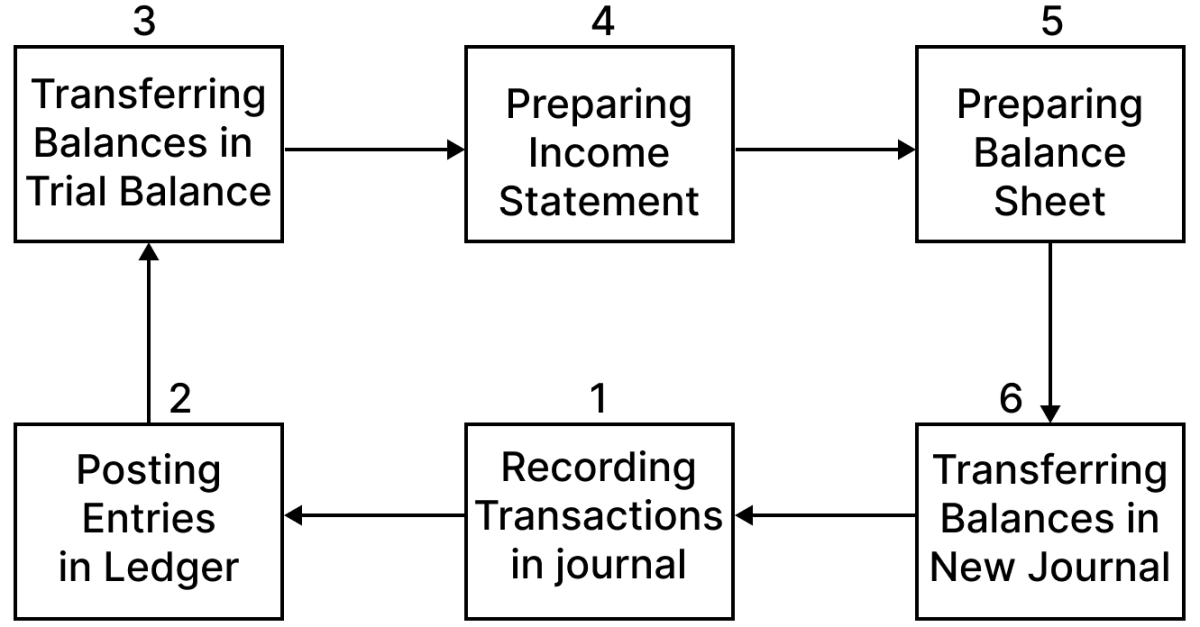
What is accounting cycle?
Answer
Accounting cycle refers to a complete sequence of accounting activities. It begins with the recording of financial transactions and ends with the preparation of the Balance Sheet. The accounting cycle consists of the following stages: (i) recording financial transactions in the journal (journalising), (ii) posting entries in the ledger, (iii) preparing the trial balance, (iv) preparing the income statement (Trading and Profit & Loss Account), (v) preparing the Balance Sheet, and (vi) opening new books in the next year by transferring the balances of assets and liabilities. The same process is repeated year after year, making accounting cycle an ongoing process.
What is business entity concept of accounting?
Answer
According to the Business Entity Concept, a business firm is treated as a unit separate and distinct from its owner. A completely separate set of books is kept for the firm and business transactions are recorded from the firm's point of view. The capital provided by the owner is treated as a liability of the firm, interest on capital is treated as an expense of the business, and money/goods withdrawn by the proprietor for personal use are treated as drawings. This distinction between business transactions and personal transactions is necessary to ascertain the true net profit and financial position of the firm. The concept applies to all forms of business — sole proprietorship, partnership and company.
"Firms live forever." Explain with reference to the concept of accounting.
Answer
The statement "Firms live forever" is based on the Going Concern Concept of accounting. It is assumed that a business will continue to exist for an indefinite period of time and that there is neither the intention nor the necessity to wind up its affairs in the near future. Transactions are recorded on this assumption.
This assumption has important implications: (a) fixed assets are recorded at original cost less depreciation rather than at market value, since they are not meant to be sold in the near future; (b) a distinction is made between capital expenditure and revenue expenditure; (c) outsiders are willing to enter into long-term contracts with the firm; and (d) existing liabilities are assumed to be paid at maturity, while unsold stock is carried over to the next year.
"Closing stock is always valued at market price." Justify for or against by citing two reasons.
Answer
AGAINST — The statement is incorrect. Closing stock is always valued at cost price or market price, whichever is lower, not always at market price.
Reasons:
Principle of Conservatism (Prudence) — This principle requires that all anticipated losses must be recorded but anticipated gains should be ignored. Valuing closing stock at the lower of cost or market price ensures that profits and assets are not overstated and that the firm does not present a more favourable financial position than what it actually is.
Avoidance of Secret Reserves and Unrealised Profits — If closing stock were always valued at market price (when market price is higher than cost), the firm would be recognising unrealised profits, which violates the Realisation Principle. Valuing at lower of cost or market price avoids the recognition of profits that have not yet been earned through actual sales.
What is meant by going concern concept of Accounting.
Answer
The Going Concern Concept assumes that the business will continue to exist for an indefinite period of time in the future. Transactions are recorded on the assumption that there is neither the intention nor the necessity to wind up the business affairs in the near future. Because of this assumption, fixed assets are recorded at their original cost less depreciation rather than at market value, a distinction is made between capital and revenue expenditure, existing liabilities are assumed to be paid at maturity, and unsold stock is carried forward to the next year. This concept also enables outsiders to enter into long-term contracts with the firm.
"Every transaction has four effects on accounting records." Give two reasons either for or against.
Answer
AGAINST — The statement is incorrect. Every transaction has only two effects on accounting records, not four.
Reasons:
Dual Aspect Principle — According to this principle, every transaction has a dual (two) effect — there must be a giver of benefit and an equal receiver of the same. Hence one account is debited and another account is credited with an equal amount.
Double Entry System — It is because of the dual effect that the accounting equation Assets = Liabilities + Capital always holds true and both sides of the Balance Sheet are always equal. The Double Entry System, which is the foundation of accounting, is built on the principle that every transaction has only two equal and opposite effects.
State any three stages of Accounting cycle.
Answer
Three stages of the accounting cycle are:
Recording Financial Transactions in Journal (Journalising) — The first step in which financial transactions are recorded in the books of original entry, i.e., the journal, in chronological order.
Posting in Ledger — Entries recorded in the journal are transferred periodically to appropriate accounts in the ledger. All transactions of one nature are posted in one account, resulting in classification of transactions.
Trial Balance — The balances of various accounts in the ledger are transferred to the trial balance, which is a statement containing balances of all the ledger accounts. The total of debit balances must equal the total of credit balances.
"Accounts should disclose all material information" (with reference to the concept of accounting). Justify either for or against by giving two reasons.
Answer
FOR — The statement is correct and is based on the Principle of Full Disclosure.
Reasons:
True and Fair View of Financial Statements — Accounts are considered true and fair only when all material information is clearly disclosed. Information such as change in method of depreciation, change in method of stock valuation, market value of investments and contingent liabilities must be disclosed (by way of footnotes or annexures) so that the financial statements give a complete and understandable picture of the economic affairs of the firm.
Protection of Stakeholders' Interest — Different users — owners, investors, creditors, employees, government, etc. — rely on financial statements to make important decisions. Concealing material facts may mislead them.The Companies Act has also prescribed the proforma and contents of the Balance Sheet and Profit & Loss Account to ensure full disclosure.
With reference to the concept of accounting only those transactions are recorded in accounts which can be expressed in terms of money. Justify either for or against.
Answer
FOR — The statement is correct and is based on the Money Measurement Concept.
Reasons:
Money is a Common Denominator — Money is the only common unit that allows diverse items such as raw materials, machinery, land and buildings, furniture and fixtures to be added together and compared. Without a common denominator, accounting records would not be homogeneous, relevant, simple or understandable.
Objectivity and Accuracy — An event, however important, will not be recorded unless its monetary effect can be measured with a fair degree of accuracy. For example, the retirement of the chairman of a company cannot be recorded because its monetary effect cannot be objectively measured (except in terms of gratuity and other benefits payable).
"Every transaction has two effects." (with reference to the concept of Accounting). Give a reason either for or against.
Answer
FOR — The statement is correct and is based on the Dual Aspect Principle of accounting.
Reason — According to the Dual Aspect Principle, every business transaction has a double (two-fold) effect on the business — there must be a giver of benefit and an equal receiver of the same. For example, if X purchases a car for ₹3,00,000 in cash, one account (Car A/c) is debited and another account (Cash A/c) is credited with the same amount. This principle gave rise to the Double Entry System of book-keeping. It is because of this principle that the accounting equation Assets = Liabilities + Capital always holds true and both sides of the Balance Sheet are always equal.
"The capital provided by the owner is a liability of the firm." Answer with reference to the concept of Accounting.
Answer
The statement is based on the Business Entity Concept of accounting. The business and its owner are treated as two separate and distinct entities. A completely separate set of books is kept for the business, and transactions are recorded from the firm's point of view, not from the owner's point of view.
When the owner contributes capital to the business, the business "owes" this amount back to the owner. From the firm's perspective, the owner is an outsider who has supplied funds. Therefore, capital is treated as a liability of the firm towards the owner. Similarly, interest on capital is treated as an expense of the business, and money/goods withdrawn by the proprietor for personal use are treated as drawings (a reduction in capital).
"Every transaction is recorded in at least three accounts." Justify this statement.
Answer
AGAINST — The statement is incorrect. According to the Dual Aspect Principle, every transaction is recorded in at least two accounts, not three.
Justification — Every transaction has two equal and opposite effects — one account is debited and another account is credited with the same amount. There must be a giver of benefit (credit) and a receiver of the same (debit). For example, if goods worth ₹10,000 are purchased for cash, Purchases A/c is debited and Cash A/c is credited with ₹10,000. This is the basis of the Double Entry System and ensures that the accounting equation Assets = Liabilities + Capital always holds true. Hence the correct statement is "Every transaction is recorded in at least two accounts."
Explain the concept of the Matching Principle.
Answer
According to the Matching Principle, the cost of a particular period should be charged from (matched against) the revenue of the same period only. Only such matching of cost and revenue can reveal the true profit or loss for that period. Revenue must first be ascertained for the period, and then the costs incurred in earning that revenue must be charged against it. The matching of costs with revenue is based on the accrual system of accounting.
While matching costs with revenues, the following points must be considered:
- All expenses relating to the accounting period — whether paid or not — must be taken in the account.
- Expenses paid in advance should be taken in the account.
- All incomes earned during the accounting period, recieved or not should be taken into account.
- Income received in advance must not be taken into accounts.
What does GAAP stand for? Explain 'Matching Concept of GAAP'.
Answer
GAAP stands for Generally Accepted Accounting Principles. These are the concepts, conventions, rules and standards which are widely accepted and adopted by accountants. According to Robert Anthony, "the rules and conventions of accounting are commonly referred to as principles." GAAP makes financial statements comparable and useful to various users.
Matching Concept of GAAP — According to the Matching Principle, the cost of a particular period should be charged from the revenue of the same period only. Only such matching of cost with revenue can reveal the true profit or loss for that period. Revenue must be ascertained first for a period, and then the costs of that period should be charged against it. When cost is associated with a particular product or service, the revenue earned from that product or service should be matched to its cost. The matching of costs with revenues is based on the accrual system of accounting.
While matching costs with revenues, the following points must be considered:
- When an item of revenue is included in the Profit & Loss Account, all expenses incurred on it — whether paid or not — should be included. Outstanding expenses are therefore debited in the Profit & Loss Account.
- If an amount has been spent but the revenue from it will be earned in the next year, the amount should be carried forward as a prepaid expense (asset).
- Cost of goods remaining unsold at the end of the year must be carried forward as closing stock to the next year.
- Incomes received in advance must be treated as a liability, while income earned but not received must be recognised as revenue.
Discuss in brief the basic principles of accounting.
Answer
The basic principles of accounting (GAAP) are as follows:
Business Entity Concept — Business is treated as a unit separate and distinct from its owner. Capital provided by the owner is treated as a liability of the firm.
Going Concern Concept — It is assumed that the business will continue to exist for an indefinite period in the future. Hence fixed assets are recorded at cost less depreciation rather than at market value.
Money Measurement Concept — Only those transactions which can be expressed in terms of money are recorded. Money is a common denominator that makes records homogeneous and comparable.
Accounting Period Concept — Financial statements are prepared at regular intervals (usually one year), called the accounting period.
Matching Principle — Cost of a particular period is matched against the revenue of the same period to ascertain the true profit or loss.
Dual Aspect Principle — Every transaction has two equal and opposite effects (debit and credit). This gives rise to the Double Entry System and the equation: Assets = Liabilities + Capital.
Complete (Full) Disclosure Principle — All material information required by users must be clearly disclosed in the financial statements (or by footnotes/annexures).
Revenue Principle — Revenue should be treated as realised whenever the ownership of goods changes, whether or not cash is received.
Expense Principle — Every cost incurred to earn revenue is an expense and must be recognised when incurred, irrespective of whether cash is paid.
Realisation Principle — Revenue is deemed realised when goods are transferred or services are rendered to a customer, not when cash is received.
Name and explain the accounting convention which says record all anticipated losses but ignore all anticipated gains.
Answer
The accounting convention is the Principle of Conservatism (or Prudence).
According to this principle, all anticipated losses must be recorded, but all anticipated gains should be ignored. Conservatism is the policy of "playing safe".
Examples of the application of this principle:
(a) Closing stock is valued at cost price or market price, whichever is lower — losses due to fall in market price are recognised, but gains due to rise in market price are ignored.
(b) Provision for doubtful debts is created in anticipation of actual bad debts, even though the actual loss has not yet occurred.
(c) Joint life insurance policy is shown at its surrender value rather than at the total premiums paid.
However, the principle of conservatism should be applied carefully. Excessive conservatism may result in the creation of secret reserves, which is against the Principle of Full Disclosure.
Explain the money measurement principle of accounting.
Answer
According to the Money Measurement Concept, only those transactions are recorded in the books of accounts which can be expressed in terms of money. In other words, an event — howsoever important it may be to the business — will not be recorded unless its monetary effect can be measured with a fair degree of accuracy.
For example, the retirement of the chairman of a company cannot be recorded because it is not possible to measure the monetary effect of retirement (except in terms of gratuity and other benefits payable).
Importance — Money is a common denominator. With the help of money, diverse items such as raw materials, machinery, land and buildings, furniture and fixtures, etc., can be added together and compared. Thus, the money measurement concept helps to make accounting records homogeneous, relevant, simple and understandable.
Explain any two basic concepts of accounting.
Answer
(i) Business Entity Concept — According to this concept, a business is treated as a unit separate and distinct from its owner. A completely separate set of books is kept for the firm and transactions are recorded from the firm's point of view. The capital provided by the owner is treated as a liability of the firm; interest on capital is treated as an expense of the business; and money or goods withdrawn by the proprietor for personal use are treated as drawings. This concept is necessary to ascertain the true net profit and the true financial position of the firm. It applies equally to sole proprietorships, partnerships and companies.
(ii) Money Measurement Concept — According to this concept, only those transactions which can be expressed in terms of money are recorded in the books of accounts. An event, howsoever important, will not be recorded if its monetary effect cannot be measured with reasonable accuracy. For example, the retirement of the chairman cannot be recorded. Money serves as a common denominator that allows diverse items (machinery, land, raw materials, etc.) to be added together, making accounting records homogeneous, relevant, simple and understandable.
Explain (i) The Dual Aspect Principle (ii) The Going concern concept.
Answer
(i) The Dual Aspect Principle — This principle states that every transaction has two equal and opposite effects — there must be a giver of benefit and a receiver of the same. Hence every debit has a corresponding and equal credit. For example, if X purchases a car for ₹3,00,000, one account (Car A/c) is debited and another account (Cash A/c) is credited with ₹3,00,000. This principle gave rise to the Double Entry System of book-keeping. It is because of this principle that both sides of the Balance Sheet are always equal and the accounting equation always holds true:
Assets = Liabilities + Capital or Capital = Assets − Liabilities
(ii) The Going Concern Concept — It is assumed that the business will continue to exist for an indefinite period of time. Transactions are recorded on this assumption. Because of this assumption: (a) fixed assets are recorded at original cost less depreciation, not at market value, since they are not meant to be sold in the near future; (b) a distinction is made between capital and revenue expenditure; (c) outsiders are willing to enter into long-term contracts with the firm; (d) existing liabilities are assumed to be paid at maturity; and (e) unsold stock is carried over to the next year. A firm is said to be a going concern when there is neither the intention nor the necessity to wind up its affairs.
Explain Accounting Period Concept.
Answer
It is due to the Accounting Period Concept that financial statements are prepared at regular intervals — generally one year. This period is called the accounting period. The net profit/net loss of the business is ascertained separately for each accounting period, and the financial position is ascertained on the last day of the accounting period. Under tax laws in India, the accounting period starts from 1st April and ends on 31st March of the next year.
The Going Concern Concept implies that the business will continue indefinitely. As such, the true results of business operations could only be ascertained after liquidation. But measurement of profit and financial position after a very long period would be of little use to owners, managers, investors and others, who need periodical reports on the performance of the business. Therefore, the entire life of the firm is divided into time intervals (called accounting periods) for the purpose of financial reporting.
This assumption requires that any expenditure whose benefit will accrue over a long period should be apportioned suitably over each year.
Explain Matching Principle of Accounting.
Answer
According to the Matching Principle, the cost of a particular period should be charged against the revenue of the same period only. Only such matching of cost and revenue can reveal the true profit or loss for the period. Revenue must be ascertained first for a period, and then the costs of that period should be charged to it. When cost is associated with a particular product or service, the revenue earned from that product or service should be matched to its cost.
The matching of costs with revenue is based on the accrual system of accounting. While matching costs with revenue, the following points must be considered:
(a)All expenses related to accounting — whether paid or not — should be included. Outstanding expenses are debited in the P&L Account on this basis.
(b) Expenses paid in advance should be carried forward as prepaid expenses and shown as assets in the Balance Sheet.
(c) Cost of goods remaining unsold at the end of the year (along with related expenses) must be carried forward to the next year as closing stock.
(d) Incomes received in advance must be treated as liabilities, while income earned but not received should be recognised as revenue.
This principle ensures that the income statement reflects the true profitability of the business for that period.
Write short notes on : (i) The Business Entity Concept (ii) The Going Concern Concept.
Answer
(i) The Business Entity Concept — According to this concept, a business firm is treated as a unit separate and distinct from its owner(s). A completely separate set of books is maintained for the firm, and all transactions are recorded from the firm's point of view. The capital introduced by the owner is treated as a liability of the firm towards the owner; interest on capital is treated as an expense of the business; and money or goods withdrawn by the proprietor for personal use are treated as drawings. The concept is necessary to ascertain the true net profit and financial position of the firm.
(ii) The Going Concern Concept — It is assumed that the business will continue to exist for an indefinite period of time, with neither the intention nor the necessity to wind up its affairs. Transactions are recorded on this assumption. Therefore: (a) fixed assets are recorded at original cost less depreciation, since they are not meant to be sold in the near future; (b) a distinction is made between capital and revenue expenditure; (c) outsiders are willing to supply funds and goods on long-term basis; (d) existing liabilities are paid at maturity; and (e) unsold stock is carried over to the next year. This concept also justifies the distinction between fixed assets and current assets.
Explain the following: (a) The Business entity concept (b) The dual aspect concept.
Answer
(a) The Business Entity Concept — According to this concept, the business is treated as a separate and distinct entity from its owner. A separate set of books is kept for the business, and transactions are recorded from the firm's point of view. Capital provided by the owner is a liability of the firm; interest on capital is an expense of the business; and money/goods withdrawn by the proprietor for personal use are treated as drawings. For example, if A owns property worth ₹20 lakhs and invests ₹10 lakhs in his business, then ₹10 lakhs is his private property and ₹10 lakhs is business property.
(b) The Dual Aspect Concept — According to this principle, every transaction has a dual effect on the business — one is a debit and the other is an equal credit. There must be a giver of benefit and a receiver of the same. For example, if goods worth ₹10,000 are purchased for cash, Purchases A/c is debited and Cash A/c is credited with ₹10,000. This principle gave rise to the Double Entry System.
Assets = Liabilities + Capital or Capital = Assets − Liabilities
With reference to the basic principles of accounting, explain any two principles.
Answer
(i) Matching Principle — According to this principle, the cost of a particular period should be charged against the revenue of the same period only. Only such matching of cost and revenue can reveal the true profit or loss for the period. The principle is based on the accrual system of accounting. All expenses relating to the accounting period — whether paid or not — must be charged against the revenue of that period (e.g., outstanding expenses are debited to the Profit and Loss A/c). Similarly, prepaid expenses, closing stock, accrued income and income received in advance are adjusted so that only those costs and revenues which belong to the current period are matched.
(ii) Principle of Full (Complete) Disclosure — According to this principle, accounts should be prepared in such a way that all the material information required by users of financial statements is clearly disclosed. Information that occurs after the preparation of the Balance Sheet should also be fully disclosed. Disclosures may be made by way of footnotes or annexures to the financial statements. For example, change in the method of depreciation, change in method of stock valuation, market value of investments and contingent liabilities are shown in footnotes.
What does GAAP stand for in accounting?
Explain (a) Business entity concept (b) Money measurement concept.
Answer
GAAP stands for Generally Accepted Accounting Principles. These are the concepts, conventions and standards widely accepted and adopted by accountants while recording and reporting financial information. They serve as guidelines for accountants and ensure uniformity and comparability of financial statements.
(a) Business Entity Concept — Business is treated as a unit separate and distinct from its owner. A separate set of books is maintained for the firm, and transactions are recorded from the firm's point of view. The capital contributed by the owner is treated as a liability of the firm towards the owner; interest on capital is an expense of the business; and money or goods withdrawn by the proprietor are treated as drawings.
(b) Money Measurement Concept — Only those transactions are recorded in the books of accounts which can be expressed in terms of money. An event, howsoever important, will not be recorded unless its monetary effect can be measured with a fair degree of accuracy. For example, the retirement of the chairman of a company cannot be recorded as such. Money is a common denominator that allows diverse items (machinery, land, raw materials, etc.) to be added together. The concept makes accounting records homogeneous, relevant, simple and understandable. Its limitation is that it assumes stability in the value of money, which is not true in reality due to changing prices.
Define the term Generally Accepted Accounting Principles (GAAP). Why accounting principles are necessary.
OR
Define the term GAAP. Explain the need of GAAP for accounting.
Answer
Definition of GAAP — Generally Accepted Accounting Principles (GAAP) refer to the concepts, conventions, rules and standards developed over a period of time which are widely accepted and adopted by accountants. According to Robert Anthony, "the rules and conventions of accounting are commonly referred to as principles." GAAP serve as general guidelines for recording and reporting financial information so that financial statements become comparable and useful to all users.
Need / Importance of GAAP — Accounting principles are necessary for the following reasons:
(a) Identification and Classification — Accounting principles are required to identify and classify economic transactions for meaningful presentation in the financial statements.
(b) Uniformity in Records — These principles ensure uniformity in accounting records. As a result, the financial statements of different firms become comparable, which is essential for investors, creditors and analysts.
(c) Guide to Accountants — Accounting principles serve as a guide to accountants in recording and reporting business transactions in a consistent and accurate manner.
(d) Scientific Approach and Confidence — True and fair financial statements based on GAAP are useful to various users and the use of accounting principles creates confidence in accounting information.
In short, GAAP makes accounting "the language of business" precise, reliable and universally understandable.
Which principle of Generally Accepted Accounting Principles (GAAP) distinguishes between Business transactions and Personal transactions? Briefly explain about it.
Answer
The principle that distinguishes between business transactions and personal transactions is the Business Entity Concept.
Explanation — According to this concept, a business firm is treated as a unit separate and distinct from its owner. A completely separate set of books is kept for the firm, and business transactions are recorded from the firm's point of view, not from the owner's point of view.
Implications of the concept:
The capital provided by the owner is treated as a liability of the firm.
Interest on capital is treated as an expense of the business, since the business is paying interest to the owner.
Money or goods withdrawn by the proprietor for his personal use are treated as drawings.
Personal assets and personal expenses of the owner are kept separate from the business books. For example, if A owns property worth ₹20 lakhs and invests ₹10 lakhs in the business, only ₹10 lakhs will be recorded as business property.
This concept is necessary to ascertain the true net profit and financial position of the firm.