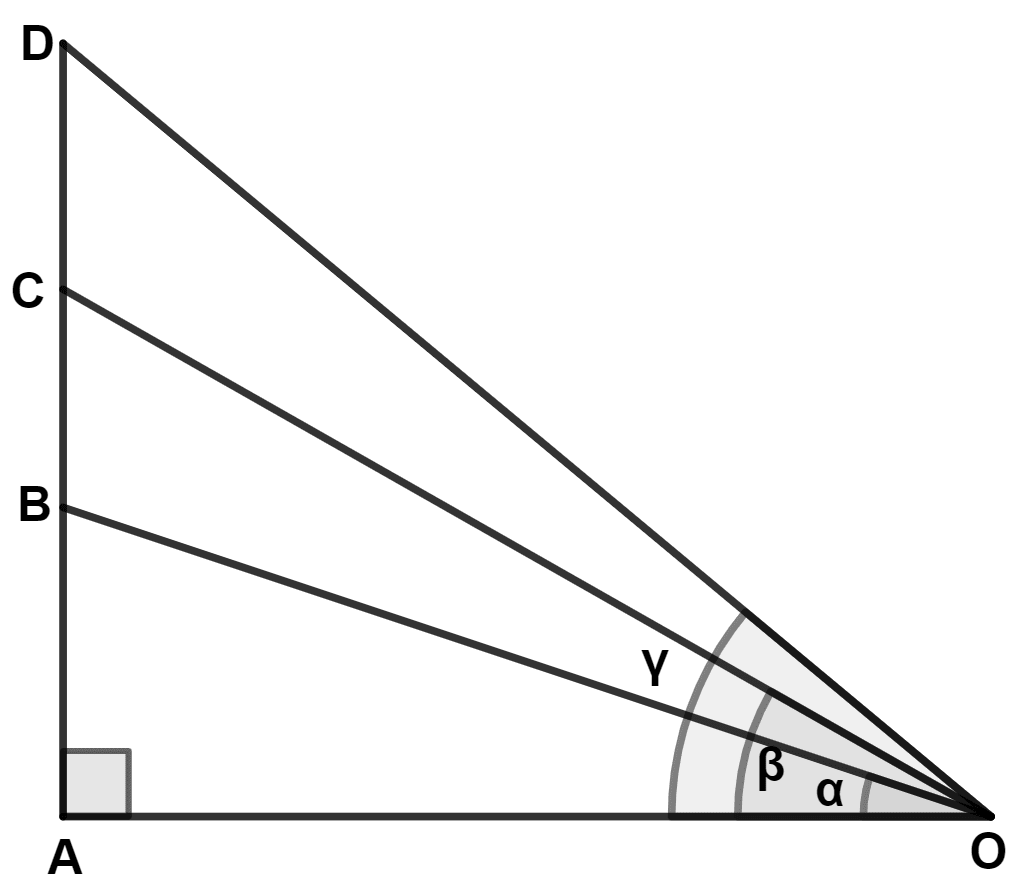
For the given figure, which of the following conditions is true :
cot γ < cot β
cot γ > cot α
cot β > cot α
cot β < cot γ
Answer
From figure,
cot α = O A A B \dfrac{OA}{AB} A B O A
cot β = O A A C \dfrac{OA}{AC} A C O A
cot γ = O A A D \dfrac{OA}{AD} A D O A
Since, AB < AC < AD
∴ cot γ < cot β < cot α
Hence, Option 1 is the correct option.
If sin A = 4 5 \dfrac{4}{5} 5 4 1 − cos (90° - A) 1 + cos (90° - A) \sqrt{\dfrac{1 - \text{cos (90° - A)}}{1 + \text{cos (90° - A)}}} 1 + cos (90° - A) 1 − cos (90° - A)
1
3
1 2 \dfrac{1}{2} 2 1
1 3 \dfrac{1}{3} 3 1
Answer
Given,
sin A = 4 5 \dfrac{4}{5} 5 4
We need to find the value of:
1 − cos (90° - A) 1 + cos (90° - A) \sqrt{\dfrac{1 - \text{cos (90° - A)}}{1 + \text{cos (90° - A)}}} 1 + cos (90° - A) 1 − cos (90° - A)
Solving,
⇒ 1 − cos (90° - A) 1 + cos (90° - A) ⇒ 1 − sin A 1 + sin A ⇒ 1 − 4 5 1 + 4 5 ⇒ 5 − 4 5 5 + 4 5 ⇒ 1 5 9 5 ⇒ 1 × 5 5 × 9 ⇒ 1 9 ⇒ 1 3 . \Rightarrow \sqrt{\dfrac{1 - \text{cos (90° - A)}}{1 + \text{cos (90° - A)}}} \\[1em] \Rightarrow \sqrt{\dfrac{1 - \text{sin A}}{1 + \text{sin A}}} \\[1em] \Rightarrow \sqrt{\dfrac{1 - \dfrac{4}{5}}{1 + \dfrac{4}{5}}} \\[1em] \Rightarrow \sqrt{\dfrac{\dfrac{5 - 4}{5}}{\dfrac{5 + 4}{5}}} \\[1em] \Rightarrow \sqrt{\dfrac{\dfrac{1}{5}}{\dfrac{9}{5}}} \\[1em] \Rightarrow \sqrt{\dfrac{1 \times 5}{5 \times 9}} \\[1em] \Rightarrow \sqrt{\dfrac{1}{9}} \\[1em] \Rightarrow \dfrac{1}{3}. ⇒ 1 + cos (90° - A) 1 − cos (90° - A) ⇒ 1 + sin A 1 − sin A ⇒ 1 + 5 4 1 − 5 4 ⇒ 5 5 + 4 5 5 − 4 ⇒ 5 9 5 1 ⇒ 5 × 9 1 × 5 ⇒ 9 1 ⇒ 3 1 .
Hence, Option 4 is the correct option.
(1 + tan2 A) × cos2 A - 1 is :
1
-2
0
2
Answer
Solving,
⇒ ( 1 + tan 2 A ) × cos 2 A − 1 ⇒ ( 1 + sin 2 A cos 2 A ) × cos 2 A − 1 ⇒ ( cos 2 A + sin 2 A cos 2 A ) × cos 2 A − 1 ⇒ 1 cos 2 A × cos 2 A − 1 ⇒ 1 − 1 ⇒ 0. \Rightarrow (1 + \text{tan}^2 A) \times \text{cos}^2 A - 1 \\[1em] \Rightarrow \Big(1 + \dfrac{\text{sin}^2 A}{\text{cos}^2 A}\Big) \times \text{cos}^2 A - 1 \\[1em] \Rightarrow \Big(\dfrac{\text{cos}^2 A + \text{sin}^2 A}{\text{cos}^2 A}\Big) \times \text{cos}^2 A - 1 \\[1em] \Rightarrow \dfrac{1}{\text{cos}^2 A} \times \text{cos}^2 A - 1 \\[1em] \Rightarrow 1 - 1 \\[1em] \Rightarrow 0. ⇒ ( 1 + tan 2 A ) × cos 2 A − 1 ⇒ ( 1 + cos 2 A sin 2 A ) × cos 2 A − 1 ⇒ ( cos 2 A cos 2 A + sin 2 A ) × cos 2 A − 1 ⇒ cos 2 A 1 × cos 2 A − 1 ⇒ 1 − 1 ⇒ 0.
Hence, Option 3 is the correct option.
sin A tan A 1 − cos 2 A \dfrac{\text{sin A tan A}}{1 - \text{cos}^2 A} 1 − cos 2 A sin A tan A
cos A
sec A
cosec A
sin A
Answer
Solving,
⇒ sin A tan A 1 − cos 2 A ⇒ sin A tan A sin 2 A ⇒ tan A sin A ⇒ sin A cos A sin A ⇒ sin A sin A × cos A ⇒ 1 cos A ⇒ sec A . \Rightarrow \dfrac{\text{sin A tan A}}{1 - \text{cos}^2 A} \\[1em] \Rightarrow \dfrac{\text{sin A tan A}}{\text{sin}^2 A} \\[1em] \Rightarrow \dfrac{\text{tan A}}{\text{sin A}} \\[1em] \Rightarrow \dfrac{\dfrac{\text{sin A}}{\text{cos A}}}{\text{sin A}} \\[1em] \Rightarrow \dfrac{\text{sin A}}{\text{sin A} \times \text{cos A}} \\[1em] \Rightarrow \dfrac{1}{\text{cos A}} \\[1em] \Rightarrow \text{sec A}. ⇒ 1 − cos 2 A sin A tan A ⇒ sin 2 A sin A tan A ⇒ sin A tan A ⇒ sin A cos A sin A ⇒ sin A × cos A sin A ⇒ cos A 1 ⇒ sec A .
Hence, Option 2 is the correct option.
For acute angles α and β, if α > β, then :
A : cos α > cos β
B : tan α > tan β
C : sin α > sin β
D : cot α > cot β
Which of the above statement/statements is/are true :
A and B
B and C
C and D
D and A
Answer
For acute angles,
Greater the angle, greater is the sine and tangent of the angle.
Since,
α > β
∴ tan α > tan β
∴ sin α > sin β.
Hence, Option 2 is the correct option.
If M = x cos A + y sin A and N = x sin A - y cos A, then M2 + N2 is :
x2 - y2
y2 - x2
x2 + y2
(x + y)2
Answer
Substituting value of M and N in M2 + N2 , we get :
⇒ (x cos A + y sin A)2 + (x sin A - y cos A)2
⇒ x2 cos2 A + y2 sin2 A + 2xy sin A cos A + x2 sin2 A + y2 cos2 A - 2xy sin A cos A
⇒ x2 cos2 A + y2 sin2 A + x2 sin2 A + y2 cos2 A
⇒ x2 cos2 A + x2 sin2 A + y2 sin2 A + y2 cos2 A
⇒ x2 (sin2 A + cos2 A) + y2 (sin2 A + cos2 A)
Substituting, sin2 A + cos2 A = 1, we get :
⇒ x2 × 1 + y2 × 1
⇒ x2 + y2 .
Hence, Option 3 is the correct option.
tan 60° - tan 30° 1 + tan 60° tan 30° \dfrac{\text{tan 60° - tan 30°}}{1 + \text{tan 60° tan 30°}} 1 + tan 60° tan 30° tan 60° - tan 30°
tan 30°
tan 45°
tan 60°
none
Answer
Solving,
⇒ tan 60° - tan 30° 1 + tan 60° tan 30° ⇒ 3 − 1 3 1 + 3 × 1 3 ⇒ 3 − 1 3 1 + 1 ⇒ 2 3 2 ⇒ 2 2 3 ⇒ 1 3 ⇒ tan 30° . \Rightarrow \dfrac{\text{tan 60° - tan 30°}}{1 + \text{tan 60° tan 30°}} \\[1em] \Rightarrow \dfrac{\sqrt{3} - \dfrac{1}{\sqrt{3}}}{1 + \sqrt{3} \times \dfrac{1}{\sqrt{3}}} \\[1em] \Rightarrow \dfrac{\dfrac{3 - 1}{\sqrt{3}}}{1 + 1} \\[1em] \Rightarrow \dfrac{\dfrac{2}{\sqrt{3}}}{2} \\[1em] \Rightarrow \dfrac{2}{2\sqrt{3}} \\[1em] \Rightarrow \dfrac{1}{\sqrt{3}} \\[1em] \Rightarrow \text{tan 30°}. ⇒ 1 + tan 60° tan 30° tan 60° - tan 30° ⇒ 1 + 3 × 3 1 3 − 3 1 ⇒ 1 + 1 3 3 − 1 ⇒ 2 3 2 ⇒ 2 3 2 ⇒ 3 1 ⇒ tan 30° .
Hence, Option 1 is the correct option.
3 sin 47° cos 43° − tan 50° cot 40° − 2 sin 2 45 ° 3\dfrac{\text{sin 47°}}{\text{cos 43°}} - \dfrac{\text{tan 50°}}{\text{cot 40°}} - \text{2 sin}^2 45° 3 cos 43° sin 47° − cot 40° tan 50° − 2 sin 2 45°
0
-1
1
2
Answer
Solving,
⇒ 3 sin 47° cos 43° − tan 50° cot 40° − 2 sin 2 45 ° ⇒ 3 sin 47° cos (90° - 47°) − tan 50° cot (90° - 50°) − 2 sin 2 45 ° ⇒ 3 sin 47° sin 47° − tan 50° tan 50° − 2 × ( 1 2 ) 2 ⇒ 3 × 1 − 1 − 2 × 1 2 ⇒ 3 − 1 − 1 ⇒ 1. \Rightarrow 3\dfrac{\text{sin 47°}}{\text{cos 43°}} - \dfrac{\text{tan 50°}}{\text{cot 40°}} - \text{2 sin}^2 45° \\[1em] \Rightarrow 3\dfrac{\text{sin 47°}}{\text{cos (90° - 47°)}} - \dfrac{\text{tan 50°}}{\text{cot (90° - 50°)}} - \text{2 sin}^2 45° \\[1em] \Rightarrow 3\dfrac{\text{sin 47°}}{\text{sin 47°}} - \dfrac{\text{tan 50°}}{\text{tan 50°}} - 2 \times \Big(\dfrac{1}{\sqrt{2}}\Big)^2 \\[1em] \Rightarrow 3 \times 1 - 1 - 2 \times \dfrac{1}{2} \\[1em] \Rightarrow 3 - 1 - 1 \\[1em] \Rightarrow 1. ⇒ 3 cos 43° sin 47° − cot 40° tan 50° − 2 sin 2 45° ⇒ 3 cos (90° - 47°) sin 47° − cot (90° - 50°) tan 50° − 2 sin 2 45° ⇒ 3 sin 47° sin 47° − tan 50° tan 50° − 2 × ( 2 1 ) 2 ⇒ 3 × 1 − 1 − 2 × 2 1 ⇒ 3 − 1 − 1 ⇒ 1.
Hence, Option 3 is the correct option.
If sin 2x = 2 sin 45° cos 45°; the value of x is :
45°
90°
30°
60°
Answer
Solving,
⇒ sin 2x = 2 sin 45° cos 45°
⇒ sin 2x = 2 × 1 2 × 1 2 2 \times \dfrac{1}{\sqrt{2}} \times \dfrac{1}{\sqrt{2}} 2 × 2 1 × 2 1
⇒ sin 2x = 2 × 1 2 2 \times \dfrac{1}{2} 2 × 2 1
⇒ sin 2x = 1
⇒ sin 2x = sin 90°
⇒ 2x = 90°
⇒ x = 90 ° 2 \dfrac{90°}{2} 2 90°
Hence, Option 1 is the correct option.
For acute angle θ, sec2 θ = 1 - tan2 θ
Assertion(A): sec2 θ = 1 - tan2 θ is not a trigonometric identity.
Reason(R): For an acute angle θ, the trigonometric equation is an identity, if it is satisfied for every value of angle θ.
A is true, R is false.
A is false, R is true.
Both A and R are true and R is correct reason for A.
Both A and R are true and R is incorrect reason for A.
Answer
The valid trigonometric identity;
sec2 θ = 1 + tan2 θ
So, assertion (A) is true.
A trigonometric identity is an equation that holds true for all values of the variable (in this case, the angle θ) within its domain.
So, reason (R) is true.
∴ Both A and R are true and R is correct reason for A.
Hence, option 3 is the correct option.
(1 + tan2 A)(1 - sin A)(1 + sin A)
Assertion(A): The value of given trigonometric expression is 0.
Reason(R): The given expression is equal to sec2 A.cos2 A
A is true, R is false.
A is false, R is true.
Both A and R are true and R is correct reason for A.
Both A and R are true and R is incorrect reason for A.
Answer
Given,
⇒ (1 + tan2 A)(1 - sin A)(1 + sin A)
⇒ (1 + tan2 A)(1 - sin2 A)
⇒ (1 + tan2 A)cos2 A
⇒ sec2 A.cos2 A
So, reason (R) are true.
⇒ 1 cos 2 A \dfrac{1}{\text{cos}^2 A} cos 2 A 1 2 A
⇒ 1.
So, assertion (A) is false.
∴ A is false, R is true.
Hence, option 2 is the correct option.
cos A = 3 2 \dfrac{\sqrt{3}}{2} 2 3 1 2 \dfrac{1}{2} 2 1
Assertion (A): tan (A + B) = 3 \sqrt{3} 3
Reason (R): cos A = 3 2 \dfrac{\sqrt{3}}{2} 2 3
sin B = 1 2 \dfrac{1}{2} 2 1
A is true, R is false.
A is false, R is true.
Both A and R are true and R is correct reason for A.
Both A and R are true and R is incorrect reason for A.
Answer
Given, cos A = 3 2 \dfrac{\sqrt{3}}{2} 2 3 1 2 \dfrac{1}{2} 2 1
⇒ cos A = cos 30° and sin B = sin 30°
⇒ A = 30° and B = 30°
So, reason (R) is true.
tan(A + B) = tan(30° + 30°) = tan 60° = 3 \sqrt{3} 3
Thus, tan (A + B) = 3 \sqrt{3} 3
So, assertion (A) is true.
∴ Both A and R are true and R is correct reason for A.
Hence, option 3 is the correct option.
x = (cosec A + cot A)(1 - cos A)
Assertion (A): x = sin A
Reason (R): x = ( 1 sin A + cos A sin A ) ( 1 − cos A ) = sin 2 A sin A = sin A \Big(\dfrac{1}{\text{sin A}} + \dfrac{\text{cos A}}{\text{sin A}}\Big)(1 - \text{cos A}) = \dfrac{\text{sin}^2 A}{\text{sin A}} = \text{sin A} ( sin A 1 + sin A cos A ) ( 1 − cos A ) = sin A sin 2 A = sin A
A is true, R is false.
A is false, R is true.
Both A and R are true and R is correct reason for A.
Both A and R are true and R is incorrect reason for A.
Answer
Given, x = (cosec A + cot A)(1 - cos A)
⇒ x = ( 1 sin A + cos A sin A ) ( 1 − cos A ) = ( 1 + cos A sin A ) ( 1 − cos A ) = ( 1 + cos A ) ( 1 − cos A ) sin A = ( 1 − cos 2 A sin A ) = ( sin 2 A sin A ) = sin A . \Rightarrow x = \Big(\dfrac{1}{\text{sin A}} + \dfrac{\text{cos A}}{\text{sin A}}\Big)(1 - \text{cos A})\\[1em] = \Big(\dfrac{1 + \text{cos A}}{\text{sin A}}\Big)(1 - \text{cos A})\\[1em] = \dfrac{(1 + \text{cos A})(1 - \text{cos A})}{\text{sin A}}\\[1em] = \Big(\dfrac{1 - \text{cos}^2 A}{\text{sin A}}\Big)\\[1em] = \Big(\dfrac{\text{sin}^2 A}{\text{sin A}}\Big)\\[1em] = \text{sin A}. ⇒ x = ( sin A 1 + sin A cos A ) ( 1 − cos A ) = ( sin A 1 + cos A ) ( 1 − cos A ) = sin A ( 1 + cos A ) ( 1 − cos A ) = ( sin A 1 − cos 2 A ) = ( sin A sin 2 A ) = sin A .
∴ Both A and R are true and R is correct reason for A.
Hence, option 3 is the correct option.
1 − sin A cos A \dfrac{1 - \text{sin A}}{\text{cos A}} cos A 1 − sin A
Statement (1): 1 − sin A cos A \dfrac{1 - \text{sin A}}{\text{cos A}} cos A 1 − sin A
⇒ 1 + sin A cos A \Rightarrow \dfrac{1 + \text{sin A}}{\text{cos A}} ⇒ cos A 1 + sin A
Statement (2): 1 − sin A cos A − 1 + sin A cos A \dfrac{1 - \text{sin A}}{\text{cos A}} - \dfrac{1 + \text{sin A}}{\text{cos A}} cos A 1 − sin A − cos A 1 + sin A
Both the statements are true.
Both the statements are false.
Statement 1 is true, and statement 2 is false.
Statement 1 is false, and statement 2 is true.
Answer
Given, 1 − sin A cos A \dfrac{1 - \text{sin A}}{\text{cos A}} cos A 1 − sin A
Taking L.H.S.
⇒ 1 − sin A cos A ⇒ 1 cos A − sin A cos A ⇒ sec A − tan A \Rightarrow \dfrac{1 - \text{sin A}}{\text{cos A}}\\[1em] \Rightarrow \dfrac{1}{\text{cos A}} - \dfrac{\text{sin A}}{\text{cos A}}\\[1em] \Rightarrow \text{sec A} - \text{tan A} ⇒ cos A 1 − sin A ⇒ cos A 1 − cos A sin A ⇒ sec A − tan A
As, L.H.S. = R.H.S., so equation is true.
Now, 1 + sin A cos A \dfrac{1 + \text{sin A}}{\text{cos A}} cos A 1 + sin A
Taking L.H.S.
⇒ 1 + sin A cos A ⇒ 1 cos A + sin A cos A ⇒ sec A + tan A \Rightarrow \dfrac{1 + \text{sin A}}{\text{cos A}}\\[1em] \Rightarrow \dfrac{1}{\text{cos A}} + \dfrac{\text{sin A}}{\text{cos A}}\\[1em] \Rightarrow \text{sec A} + \text{tan A} ⇒ cos A 1 + sin A ⇒ cos A 1 + cos A sin A ⇒ sec A + tan A
As, L.H.S. = R.H.S., so equation is true.
So, statement 1 is true.
Now, 1 − sin A cos A − 1 + sin A cos A \dfrac{1 - \text{sin A}}{\text{cos A}} - \dfrac{1 + \text{sin A}}{\text{cos A}} cos A 1 − sin A − cos A 1 + sin A
Solving L.H.S.
⇒ 1 − sin A cos A − 1 + sin A cos A \Rightarrow \dfrac{1 - \text{sin A}}{\text{cos A}} - \dfrac{1 + \text{sin A}}{\text{cos A}} ⇒ cos A 1 − sin A − cos A 1 + sin A
⇒ 1 cos A − sin A cos A − ( 1 cos A + sin A cos A ) \Rightarrow \dfrac{1}{\text{cos A}} - \dfrac{\text{sin A}}{\text{cos A}} - \Big(\dfrac{1}{\text{cos A}} + \dfrac{\text{sin A}}{\text{cos A}}\Big) ⇒ cos A 1 − cos A sin A − ( cos A 1 + cos A sin A )
⇒ (sec A - tan A) - (sec A + tan A)
⇒ sec A - tan A - sec A - tan A
⇒ -2tan A.
As, L.H.S. ≠ R.H.S.
So, statement 2 is false.
∴ Statement 1 is true and statement 2 is false.
Hence, option 3 is the correct option.
cos 2 θ + 1 1 + cot 2 θ \text{cos}^2 θ + \dfrac{1}{1 + {\text{cot}^2 θ}} cos 2 θ + 1 + cot 2 θ 1
Statement (1): x = 1
Statement (2): x = cos 2 θ + 1 cosec 2 θ \text{cos}^2 θ + \dfrac{1}{{\text{cosec}^2 θ}} cos 2 θ + cosec 2 θ 1 2 θ + sin2 θ
Both the statement are true.
Both the statement are false.
Statement 1 is true, and statement 2 is false.
Statement 1 is false, and statement 2 is true.
Answer
Given, cos 2 θ + 1 1 + cot 2 θ \text{cos}^2 θ + \dfrac{1}{1 + {\text{cot}^2 θ}} cos 2 θ + 1 + cot 2 θ 1
⇒ x = cos 2 θ + 1 1 + cot 2 θ ⇒ x = cos 2 θ + 1 cosec 2 θ ⇒ x = cos 2 θ + sin 2 θ ⇒ x = 1 \Rightarrow x = \text{cos}^2 θ + \dfrac{1}{1 + {\text{cot}^2 θ}}\\[1em] \Rightarrow x = \text{cos}^2 θ + \dfrac{1}{{\text{cosec}^2 θ}}\\[1em] \Rightarrow x = \text{cos}^2 θ + \text{sin}^2 θ\\[1em] \Rightarrow x = 1 ⇒ x = cos 2 θ + 1 + cot 2 θ 1 ⇒ x = cos 2 θ + cosec 2 θ 1 ⇒ x = cos 2 θ + sin 2 θ ⇒ x = 1
∴ Both the statements are true.
Hence, option 1 is the correct option.
sin 2 θ cos 2 θ − 1 cos 2 θ \dfrac{\text{sin}^2 θ}{\text{cos}^2 θ} - \dfrac{1}{ \text{cos}^2 θ} cos 2 θ sin 2 θ − cos 2 θ 1
Statement (1): x = 1
Statement (2): x = sin 2 θ − 1 cos 2 θ = − cos 2 θ cos 2 θ \dfrac{\text{sin}^2 θ - 1}{{\text{cos}^2 θ}} = \dfrac{-\text{cos}^2 θ}{{\text{cos}^2 θ}} cos 2 θ sin 2 θ − 1 = cos 2 θ − cos 2 θ
Both the statement are true.
Both the statement are false.
Statement 1 is true, and statement 2 is false.
Statement 1 is false, and statement 2 is true.
Answer
Given, sin 2 θ cos 2 θ − 1 cos 2 θ \dfrac{\text{sin}^2 θ}{\text{cos}^2 θ} - \dfrac{1}{ \text{cos}^2 θ} cos 2 θ sin 2 θ − cos 2 θ 1
⇒ x = sin 2 θ cos 2 θ − 1 cos 2 θ ⇒ x = sin 2 θ − 1 cos 2 θ ⇒ x = sin 2 θ − ( sin 2 θ + cos 2 θ ) cos 2 θ ⇒ x = sin 2 θ − sin 2 θ − cos 2 θ cos 2 θ ⇒ x = − cos 2 θ cos 2 θ ⇒ x = − 1 \Rightarrow x = \dfrac{\text{sin}^2 θ}{\text{cos}^2 θ} - \dfrac{1}{ \text{cos}^2 θ}\\[1em] \Rightarrow x = \dfrac{\text{sin}^2 θ - 1}{\text{cos}^2 θ}\\[1em] \Rightarrow x = \dfrac{\text{sin}^2 θ - (\text{sin}^2 θ + \text{cos}^2 θ)}{\text{cos}^2 θ} \\[1em] \Rightarrow x = \dfrac{\text{sin}^2 θ - \text{sin}^2 θ - \text{cos}^2 θ}{\text{cos}^2 θ}\\[1em] \Rightarrow x = \dfrac{- \text{cos}^2 θ}{\text{cos}^2 θ}\\[1em] \Rightarrow x = -1 ⇒ x = cos 2 θ sin 2 θ − cos 2 θ 1 ⇒ x = cos 2 θ sin 2 θ − 1 ⇒ x = cos 2 θ sin 2 θ − ( sin 2 θ + cos 2 θ ) ⇒ x = cos 2 θ sin 2 θ − sin 2 θ − cos 2 θ ⇒ x = cos 2 θ − cos 2 θ ⇒ x = − 1
∴ Statement 1 is false, and statement 2 is true.
Hence, option 4 is the correct option.
sin A = cos A and tan2 A + cot2 A + 2
Statement (1): A = 45°
tan2 A + cot2 A + 2 = 4
Statement (2): sin A = cos A ⇒ A = 45°
Both the statement are true.
Both the statement are false.
Statement 1 is true, and statement 2 is false.
Statement 1 is false, and statement 2 is true.
Answer
Given, sin A = cos A
⇒ sin A cos A \dfrac{\text{sin A}}{\text{cos A}} cos A sin A
⇒ tan A = 1
⇒ tan A = tan 45°
⇒ A = 45°
So, statement 2 is true.
Substituting value of A in tan2 A + cot2 A + 2, we get :
⇒ tan2 A + cot2 A + 2 = tan2 45° + cot2 45° + 2
= (1)2 + (1)2 + 2
= 1 + 1 + 2
= 4.
So, statement 1 is true.
∴ Both the statements are true.
Hence, option 1 is the correct option.
Prove the following identities :
1 cos A + sin A + 1 cos A - sin A = 2 cos A 2 cos 2 A − 1 \dfrac{1}{\text{cos A + sin A}} + \dfrac{1}{\text{cos A - sin A}} = \dfrac{\text{2 cos A}}{\text{2 cos}^2 A - 1} cos A + sin A 1 + cos A - sin A 1 = 2 cos 2 A − 1 2 cos A
Answer
Solving L.H.S. of the equation :
⇒ 1 cos A + sin A + 1 cos A - sin A ⇒ cos A - sin A + cos A + sin A cos 2 A − sin 2 A ⇒ 2 cos A cos 2 A − sin 2 A \Rightarrow \dfrac{1}{\text{cos A + sin A}} + \dfrac{1}{\text{cos A - sin A}} \\[1em] \Rightarrow \dfrac{\text{cos A - sin A + cos A + sin A}}{\text{cos}^2 A - \text{sin}^2 A} \\[1em] \Rightarrow \dfrac{\text{2 cos A}}{\text{cos}^2 A - \text{sin}^2 A} ⇒ cos A + sin A 1 + cos A - sin A 1 ⇒ cos 2 A − sin 2 A cos A - sin A + cos A + sin A ⇒ cos 2 A − sin 2 A 2 cos A
By formula,
sin2 A = 1 - cos2 A
⇒ 2 cos A cos 2 A − ( 1 − cos 2 A ) ⇒ 2 cos A 2 cos 2 A − 1 . \Rightarrow \dfrac{\text{2 cos A}}{\text{cos}^2 A - (1 - \text{cos}^2 A)} \\[1em] \Rightarrow \dfrac{\text{2 cos A}}{\text{2 cos}^2 A - 1}. ⇒ cos 2 A − ( 1 − cos 2 A ) 2 cos A ⇒ 2 cos 2 A − 1 2 cos A .
Since, L.H.S. = R.H.S.
Hence, proved that 1 cos A + sin A + 1 cos A - sin A = 2 cos A 2 cos 2 A − 1 \dfrac{1}{\text{cos A + sin A}} + \dfrac{1}{\text{cos A - sin A}} = \dfrac{\text{2 cos A}}{\text{2 cos}^2 A - 1} cos A + sin A 1 + cos A - sin A 1 = 2 cos 2 A − 1 2 cos A
Prove the following identities :
1 − sin 2 A 1 + cos A = cos A 1 - \dfrac{\text{sin}^2 A}{\text{1 + cos A}} = \text{cos A} 1 − 1 + cos A sin 2 A = cos A
Answer
By formula,
sin2 A = 1 - cos2 A
Solving L.H.S. of the equation :
⇒ 1 − 1 − cos 2 A 1 + cos A ⇒ 1 − (1 - cos A)(1 + cos A) 1 + cos A ⇒ 1 − ( 1 - cos A ) ⇒ 1 − 1 + cos A ⇒ cos A . \Rightarrow 1 - \dfrac{1 - \text{cos}^2 A}{\text{1 + cos A}} \\[1em] \Rightarrow 1 - \dfrac{\text{(1 - cos A)(1 + cos A)}}{\text{1 + cos A}} \\[1em] \Rightarrow 1 - (\text{1 - cos A}) \\[1em] \Rightarrow 1 - 1 + \text{cos A} \\[1em] \Rightarrow \text{cos A}. ⇒ 1 − 1 + cos A 1 − cos 2 A ⇒ 1 − 1 + cos A (1 - cos A)(1 + cos A) ⇒ 1 − ( 1 - cos A ) ⇒ 1 − 1 + cos A ⇒ cos A .
Since, L.H.S. = R.H.S.
Hence, proved that 1 − sin 2 A 1 + cos A = cos A 1 - \dfrac{\text{sin}^2 A}{\text{1 + cos A}} = \text{cos A} 1 − 1 + cos A sin 2 A = cos A
Prove the following identities :
cos A 1 + sin A + tan A = sec A \dfrac{\text{cos A}}{\text{1 + sin A}} + \text{tan A = sec A} 1 + sin A cos A + tan A = sec A
Answer
Solving L.H.S. of the equation :
⇒ cos A 1 + sin A + tan A ⇒ cos A 1 + sin A + sin A cos A ⇒ cos 2 A + sin A(1 + sin A) cos A(1 + sin A) ⇒ cos 2 A + sin A + sin 2 A cos A(1 + sin A) \Rightarrow \dfrac{\text{cos A}}{\text{1 + sin A}} + \text{tan A}\\[1em] \Rightarrow \dfrac{\text{cos A}}{\text{1 + sin A}} + \dfrac{\text{sin A}}{\text{cos A}} \\[1em] \Rightarrow \dfrac{\text{cos}^2 A + \text{sin A(1 + sin A)}}{\text{cos A(1 + sin A)}} \\[1em] \Rightarrow \dfrac{\text{cos}^2 A + \text{sin A + sin}^2 A}{\text{cos A(1 + sin A)}} ⇒ 1 + sin A cos A + tan A ⇒ 1 + sin A cos A + cos A sin A ⇒ cos A(1 + sin A) cos 2 A + sin A(1 + sin A) ⇒ cos A(1 + sin A) cos 2 A + sin A + sin 2 A
By formula,
cos2 A + sin2 A = 1
⇒ 1 + sin A cos A(1 + sin A) ⇒ 1 cos A ⇒ sec A . \Rightarrow \dfrac{\text{1 + sin A}}{\text{cos A(1 + sin A)}} \\[1em] \Rightarrow \dfrac{1}{\text{cos A}} \\[1em] \Rightarrow \text{sec A}. ⇒ cos A(1 + sin A) 1 + sin A ⇒ cos A 1 ⇒ sec A .
Since, L.H.S. = R.H.S.
Hence, proved that cos A 1 + sin A + tan A = sec A \dfrac{\text{cos A}}{\text{1 + sin A}} + \text{tan A = sec A} 1 + sin A cos A + tan A = sec A
Prove the following identities :
sin A 1 - cos A − cot A = cosec A \dfrac{\text{sin A}}{\text{1 - cos A}} - \text{cot A = cosec A} 1 - cos A sin A − cot A = cosec A
Answer
Solving L.H.S. of the equation :
⇒ sin A 1 - cos A − cot A ⇒ sin A 1 - cos A − cos A sin A ⇒ sin 2 A − cos A(1 - cos A) sin A(1 - cos A) ⇒ sin 2 A − cos A + cos 2 A sin A(1 - cos A) \Rightarrow \dfrac{\text{sin A}}{\text{1 - cos A}} - \text{cot A} \\[1em] \Rightarrow \dfrac{\text{sin A}}{\text{1 - cos A}} - \dfrac{\text{cos A}}{\text{sin A}} \\[1em] \Rightarrow \dfrac{\text{sin}^2 A - \text{cos A(1 - cos A)}}{\text{sin A(1 - cos A)}} \\[1em] \Rightarrow \dfrac{\text{sin}^2 A - \text{cos A + cos}^2 A}{\text{sin A(1 - cos A)}} ⇒ 1 - cos A sin A − cot A ⇒ 1 - cos A sin A − sin A cos A ⇒ sin A(1 - cos A) sin 2 A − cos A(1 - cos A) ⇒ sin A(1 - cos A) sin 2 A − cos A + cos 2 A
By formula,
sin2 A + cos2 A = 1
⇒ 1 - cos A sin A(1 - cos A) ⇒ 1 sin A ⇒ cosec A . \Rightarrow \dfrac{\text{1 - cos A}}{\text{sin A(1 - cos A)}} \\[1em] \Rightarrow \dfrac{1}{\text{sin A}} \\[1em] \Rightarrow \text{cosec A}. ⇒ sin A(1 - cos A) 1 - cos A ⇒ sin A 1 ⇒ cosec A .
Since, L.H.S. = R.H.S.
Hence, proved that sin A 1 - cos A − cot A = cosec A \dfrac{\text{sin A}}{\text{1 - cos A}} - \text{cot A = cosec A} 1 - cos A sin A − cot A = cosec A
Prove the following identities :
1 - cos A 1 + cos A = sin A 1 + cos A \sqrt{\dfrac{\text{1 - cos A}}{\text{1 + cos A}}} = \dfrac{\text{sin A}}{\text{1 + cos A}} 1 + cos A 1 - cos A = 1 + cos A sin A
Answer
Multiplying numerator and denominator of L.H.S. of above equation by 1 + cos A \sqrt{1 + \text{cos A}} 1 + cos A
⇒ 1 − cos A 1 + cos A × 1 + cos A 1 + cos A ⇒ 1 − cos 2 A ( 1 + cos A ) 2 \Rightarrow \sqrt{\dfrac{1 - \text{cos A}}{\text{1 + cos A}}} \times \sqrt{\dfrac{1 + \text{cos A}}{1 + \text{cos A}}} \\[1em] \Rightarrow \sqrt{\dfrac{1 - \text{cos}^2 A}{(1 + \text{cos A})^2}} ⇒ 1 + cos A 1 − cos A × 1 + cos A 1 + cos A ⇒ ( 1 + cos A ) 2 1 − cos 2 A
By formula,
1 - cos2 A = sin2 A
⇒ sin 2 A 1 + cos A ⇒ sin A 1 + cos A . \Rightarrow \dfrac{\sqrt{\text{sin}^2 A}}{1 + \text{cos A}} \\[1em] \Rightarrow \dfrac{\text{sin A}}{\text{1 + cos A}}. ⇒ 1 + cos A sin 2 A ⇒ 1 + cos A sin A .
Since, L.H.S. = R.H.S.
Hence, proved that 1 − cos A 1 + cos A = sin A 1 + cos A \sqrt{\dfrac{1 - \text{cos A}}{\text{1 + cos A}}} = \dfrac{\text{sin A}}{\text{1 + cos A}} 1 + cos A 1 − cos A = 1 + cos A sin A
Prove the following identities :
1 + (sec A - tan A) 2 cosec A (sec A - tan A) = 2 tan A \dfrac{1 + \text{(sec A - tan A)}^2}{\text{cosec A (sec A - tan A)}} = \text{2 tan A} cosec A (sec A - tan A) 1 + (sec A - tan A) 2 = 2 tan A
Answer
By formula,
sec2 - tan2 A = 1
Solving L.H.S. of the equation :
⇒ 1 + (sec A - tan A) 2 cosec A (sec A - tan A) ⇒ sec 2 A − tan 2 A + (sec A - tan A) 2 cosec A (sec A - tan A) ⇒ (sec A - tan A)(sec A + tan A) + (sec A - tan A) 2 cosec A (sec A - tan A) ⇒ (sec A - tan A)[sec A + tan A + sec A - tan A] cosec A (sec A - tan A) ⇒ 2 sec A cosec A ⇒ 2 × 1 cos A 1 sin A ⇒ 2 sin A cos A ⇒ 2 tan A . \Rightarrow \dfrac{1 + \text{(sec A - tan A)}^2}{\text{cosec A (sec A - tan A)}} \\[1em] \Rightarrow \dfrac{\text{sec}^2 A - \text{tan}^2 A + \text{(sec A - tan A)}^2}{\text{cosec A (sec A - tan A)}} \\[1em] \Rightarrow \dfrac{\text{(sec A - tan A)(sec A + tan A) + (sec A - tan A)}^2}{\text{cosec A (sec A - tan A)}} \\[1em] \Rightarrow \dfrac{\text{(sec A - tan A)[sec A + tan A + sec A - tan A]}}{\text{cosec A (sec A - tan A)}} \\[1em] \Rightarrow \dfrac{\text{2 sec A}}{\text{cosec A}} \\[1em] \Rightarrow \dfrac{2 \times \dfrac{1}{\text{cos A}}}{\dfrac{1}{\text{sin A}}} \\[1em] \Rightarrow 2\dfrac{\text{sin A}}{\text{cos A}} \\[1em] \Rightarrow \text{2 tan A}. ⇒ cosec A (sec A - tan A) 1 + (sec A - tan A) 2 ⇒ cosec A (sec A - tan A) sec 2 A − tan 2 A + (sec A - tan A) 2 ⇒ cosec A (sec A - tan A) (sec A - tan A)(sec A + tan A) + (sec A - tan A) 2 ⇒ cosec A (sec A - tan A) (sec A - tan A)[sec A + tan A + sec A - tan A] ⇒ cosec A 2 sec A ⇒ sin A 1 2 × cos A 1 ⇒ 2 cos A sin A ⇒ 2 tan A .
Since, L.H.S. = R.H.S.
Hence, proved that 1 + (sec A - tan A) 2 cosec A (sec A - tan A) = 2 tan A \dfrac{1 + \text{(sec A - tan A)}^2}{\text{cosec A (sec A - tan A)}} = \text{2 tan A} cosec A (sec A - tan A) 1 + (sec A - tan A) 2 = 2 tan A
Prove the following identities :
(cosec A - cot A) 2 + 1 sec A (cosec A - cot A) = 2 cot A \dfrac{\text{(cosec A - cot A)}^2 + 1}{\text{sec A (cosec A - cot A)}} = \text{2 cot A} sec A (cosec A - cot A) (cosec A - cot A) 2 + 1 = 2 cot A
Answer
By formula,
cosec2 A - cot2 A = 1
Solving L.H.S. of the equation :
⇒ (cosec A - cot A) 2 + 1 sec A (cosec A - cot A) ⇒ (cosec A - cot A) 2 + cosec 2 A − cot 2 A sec A (cosec A - cot A) ⇒ (cosec A - cot A) 2 + (cosec A - cot A)(cosec A + cot A) sec A (cosec A - cot A) ⇒ (cosec A - cot A)(cosec A - cot A + cosec A + cot A) sec A (cosec A - cot A) ⇒ 2 cosec A sec A ⇒ 2 sin A 1 cos A ⇒ 2 cos A sin A ⇒ 2 cot A . \Rightarrow \dfrac{\text{(cosec A - cot A)}^2 + 1}{\text{sec A (cosec A - cot A)}} \\[1em] \Rightarrow \dfrac{\text{(cosec A - cot A)}^2 + \text{cosec}^2 A - \text{cot}^2 A}{\text{sec A (cosec A - cot A)}} \\[1em] \Rightarrow \dfrac{\text{(cosec A - cot A)}^2 + \text{(cosec A - cot A)(cosec A + cot A)}}{\text{sec A (cosec A - cot A)}} \\[1em] \Rightarrow \dfrac{\text{(cosec A - cot A)(cosec A - cot A + cosec A + cot A)}}{\text{sec A (cosec A - cot A)}} \\[1em] \Rightarrow \dfrac{\text{2 cosec A}}{\text{sec A}} \\[1em] \Rightarrow \dfrac{\dfrac{2}{\text{sin A}}}{\dfrac{1}{\text{cos A}}} \\[1em] \Rightarrow \dfrac{\text{2 cos A}}{\text{sin A}} \\[1em] \Rightarrow \text{2 cot A}. ⇒ sec A (cosec A - cot A) (cosec A - cot A) 2 + 1 ⇒ sec A (cosec A - cot A) (cosec A - cot A) 2 + cosec 2 A − cot 2 A ⇒ sec A (cosec A - cot A) (cosec A - cot A) 2 + (cosec A - cot A)(cosec A + cot A) ⇒ sec A (cosec A - cot A) (cosec A - cot A)(cosec A - cot A + cosec A + cot A) ⇒ sec A 2 cosec A ⇒ cos A 1 sin A 2 ⇒ sin A 2 cos A ⇒ 2 cot A .
Since, L.H.S. = R.H.S.
Hence, proved that (cosec A - cot A) 2 + 1 sec A (cosec A - cot A) = 2 cot A \dfrac{\text{(cosec A - cot A)}^2 + 1}{\text{sec A (cosec A - cot A)}} = \text{2 cot A} sec A (cosec A - cot A) (cosec A - cot A) 2 + 1 = 2 cot A
Prove the following identities :
cot 2 A ( sec A - 1 1 + sin A ) + sec 2 A ( sin A - 1 1 + sec A ) \text{cot}^2 A \Big(\dfrac{\text{sec A - 1}}{\text{1 + sin A}}\Big) + \text{sec}^2 A \Big(\dfrac{\text{sin A - 1}}{\text{1 + sec A}}\Big) cot 2 A ( 1 + sin A sec A - 1 ) + sec 2 A ( 1 + sec A sin A - 1 )
Answer
Solving L.H.S. of above equation :
⇒ cot 2 A ( sec A - 1 1 + sin A × sec A + 1 sec A + 1 ) + sec 2 A ( sin A - 1 1 + sec A ) ⇒ cot 2 A ( sec 2 A − 1 (1 + sin A)(sec A + 1) ) + sec 2 A ( sin A - 1 1 + sec A ) \Rightarrow \text{cot}^2 A \Big(\dfrac{\text{sec A - 1}}{\text{1 + sin A}}\times \dfrac{\text{sec A + 1}}{\text{sec A + 1}}\Big) + \text{sec}^2 A \Big(\dfrac{\text{sin A - 1}}{\text{1 + sec A}}\Big) \\[1em] \Rightarrow \text{cot}^2 A \Big(\dfrac{\text{sec}^2 A - 1}{\text{(1 + sin A)(sec A + 1)}}\Big) + \text{sec}^2 A \Big(\dfrac{\text{sin A - 1}}{\text{1 + sec A}}\Big) ⇒ cot 2 A ( 1 + sin A sec A - 1 × sec A + 1 sec A + 1 ) + sec 2 A ( 1 + sec A sin A - 1 ) ⇒ cot 2 A ( (1 + sin A)(sec A + 1) sec 2 A − 1 ) + sec 2 A ( 1 + sec A sin A - 1 )
By formula,
sec2 A - 1 = tan2 A
⇒ cot 2 A tan 2 A (1 + sin A)(sec A + 1) + sec 2 A ( sin A - 1 1 + sec A ) ⇒ cot 2 A × 1 cot 2 A (1 + sin A)(sec A + 1) + sec 2 A ( sin A - 1 1 + sec A ) ⇒ 1 (1 + sin A)(sec A + 1) + sec 2 A ( sin A - 1 1 + sec A ) ⇒ 1 + sec 2 A (sin A - 1)(1 + sin A) (1 + sin A)(sec A + 1) ⇒ 1 − sec 2 A (1 - sin A)(1 + sin A) (1 + sin A)(sec A + 1) ⇒ 1 − sec 2 A (1 - sin 2 A ) (1 + sin A)(sec A + 1) ⇒ 1 − sec 2 A × cos 2 A (1 + sin A)(sec A + 1) ⇒ 1 − 1 cos 2 A × cos 2 A (1 + sin A)(sec A + 1) ⇒ 1 − 1 (1 + sin A)(sec A + 1) ⇒ 0. \Rightarrow \dfrac{\text{cot}^2 A \text{ tan}^2 A}{\text{(1 + sin A)(sec A + 1)}} + \text{sec}^2 A \Big(\dfrac{\text{sin A - 1}}{\text{1 + sec A}}\Big) \\[1em] \Rightarrow \dfrac{\text{cot}^2 A \times \dfrac{1}{\text{ cot}^2 A}}{\text{(1 + sin A)(sec A + 1)}} + \text{sec}^2 A \Big(\dfrac{\text{sin A - 1}}{\text{1 + sec A}}\Big) \\[1em] \Rightarrow \dfrac{1}{\text{(1 + sin A)(sec A + 1)}} + \text{sec}^2 A \Big(\dfrac{\text{sin A - 1}}{\text{1 + sec A}}\Big) \\[1em] \Rightarrow \dfrac{1 + \text{sec}^2 A\text{(sin A - 1)(1 + sin A)}}{\text{(1 + sin A)(sec A + 1)}} \\[1em] \Rightarrow \dfrac{1 - \text{sec}^2 A\text{(1 - sin A)(1 + sin A)}}{\text{(1 + sin A)(sec A + 1)}} \\[1em] \Rightarrow \dfrac{1 - \text{sec}^2 A\text{(1 - sin}^2 A)}{\text{(1 + sin A)(sec A + 1)}} \\[1em] \Rightarrow \dfrac{1 - \text{sec}^2 A \times \text{cos}^2 A}{\text{(1 + sin A)(sec A + 1)}} \\[1em] \Rightarrow \dfrac{1 - \dfrac{1}{\text{cos}^2 A} \times \text{cos}^2 A}{\text{(1 + sin A)(sec A + 1)}} \\[1em] \Rightarrow \dfrac{1 - 1}{\text{(1 + sin A)(sec A + 1)}} \\[1em] \Rightarrow 0. ⇒ (1 + sin A)(sec A + 1) cot 2 A tan 2 A + sec 2 A ( 1 + sec A sin A - 1 ) ⇒ (1 + sin A)(sec A + 1) cot 2 A × cot 2 A 1 + sec 2 A ( 1 + sec A sin A - 1 ) ⇒ (1 + sin A)(sec A + 1) 1 + sec 2 A ( 1 + sec A sin A - 1 ) ⇒ (1 + sin A)(sec A + 1) 1 + sec 2 A (sin A - 1)(1 + sin A) ⇒ (1 + sin A)(sec A + 1) 1 − sec 2 A (1 - sin A)(1 + sin A) ⇒ (1 + sin A)(sec A + 1) 1 − sec 2 A (1 - sin 2 A ) ⇒ (1 + sin A)(sec A + 1) 1 − sec 2 A × cos 2 A ⇒ (1 + sin A)(sec A + 1) 1 − cos 2 A 1 × cos 2 A ⇒ (1 + sin A)(sec A + 1) 1 − 1 ⇒ 0.
Since, L.H.S. = R.H.S.
Hence, proved that cot 2 A ( sec A - 1 1 + sin A ) + sec 2 A ( sin A - 1 1 + sec A ) \text{cot}^2 A \Big(\dfrac{\text{sec A - 1}}{\text{1 + sin A}}\Big) + \text{sec}^2 A \Big(\dfrac{\text{sin A - 1}}{\text{1 + sec A}}\Big) cot 2 A ( 1 + sin A sec A - 1 ) + sec 2 A ( 1 + sec A sin A - 1 )
Prove the following identities :
( 1 − 2 sin 2 A ) 2 cos 4 A − sin 4 A \dfrac{(1 - \text{2 sin}^2 A)^2}{\text{cos}^4 A - \text{sin}^4 A} cos 4 A − sin 4 A ( 1 − 2 sin 2 A ) 2 2 A - 1
Answer
Solving L.H.S. of the above equation :
⇒ ( 1 − 2 sin 2 A ) 2 cos 4 A − sin 4 A ⇒ ( 1 − 2 sin 2 A ) 2 ( cos 2 A − sin 2 A ) ( cos 2 A + sin 2 A ) \Rightarrow \dfrac{(1 - \text{2 sin}^2 A)^2}{\text{cos}^4 A - \text{sin}^4 A} \\[1em] \Rightarrow \dfrac{(1 - \text{2 sin}^2 A)^2}{(\text{cos}^2 A - \text{sin}^2 A)(\text{cos}^2 A + \text{sin}^2 A)} ⇒ cos 4 A − sin 4 A ( 1 − 2 sin 2 A ) 2 ⇒ ( cos 2 A − sin 2 A ) ( cos 2 A + sin 2 A ) ( 1 − 2 sin 2 A ) 2
By formula,
cos2 A + sin2 A = 1 and cos2 A = 1 - sin2 A.
⇒ ( 1 − 2 sin 2 A ) 2 ( 1 − sin 2 A − sin 2 A ) ⇒ ( 1 − 2 sin 2 A ) 2 ( 1 − 2 sin 2 A ) ⇒ 1 - 2 sin 2 A ⇒ 1 − 2 ( 1 - cos 2 A ) ⇒ 1 − 2 + 2 cos 2 A ⇒ 2 cos 2 A − 1. \Rightarrow \dfrac{(1 - \text{2 sin}^2 A)^2}{(1 - \text{sin}^2 A - \text{sin}^2 A)} \\[1em] \Rightarrow \dfrac{(1 - \text{2 sin}^2 A)^2}{(1 - \text{2 sin}^2 A)}\\[1em] \Rightarrow \text{1 - 2 sin}^2 A \\[1em] \Rightarrow 1 - 2(\text{1 - cos}^2 A) \\[1em] \Rightarrow 1 - 2 + \text{2 cos}^2 A \\[1em] \Rightarrow \text{2 cos}^2 A - 1. ⇒ ( 1 − sin 2 A − sin 2 A ) ( 1 − 2 sin 2 A ) 2 ⇒ ( 1 − 2 sin 2 A ) ( 1 − 2 sin 2 A ) 2 ⇒ 1 - 2 sin 2 A ⇒ 1 − 2 ( 1 - cos 2 A ) ⇒ 1 − 2 + 2 cos 2 A ⇒ 2 cos 2 A − 1.
Since, L.H.S. = R.H.S.
Hence, proved that ( 1 − 2 sin 2 A ) 2 cos 4 A − sin 4 A \dfrac{(1 - \text{2 sin}^2 A)^2}{\text{cos}^4 A - \text{sin}^4 A} cos 4 A − sin 4 A ( 1 − 2 sin 2 A ) 2 2 A - 1.
Prove the following identities :
sec4 A (1 - sin4 A) - 2 tan2 A = 1
Answer
Solving L.H.S. of the above equation :
⇒ sec4 A (1 - sin4 A) - 2 tan2 A
⇒ sec4 A (1 - sin2 A)(1 + sin2 A) - 2 tan2 A
By formula,
1 - sin2 A = cos2 A
⇒ sec4 A cos2 A (1 + sin2 A) - 2 tan2 A
⇒ sec4 A × 1 sec 2 A \times \dfrac{1}{\text{sec}^2 A} × sec 2 A 1 2 A) - 2 tan2 A
⇒ sec2 A (1 + sin2 A) - 2 tan2 A
⇒ sec2 A + sec2 A sin2 A - 2 tan2 A
⇒ sec2 A + 1 cos 2 A × \dfrac{1}{\text{cos}^2 A} \times cos 2 A 1 × 2 A - 2 tan2 A
⇒ sec2 A + tan2 A - 2 tan2 A
⇒ sec2 A - tan2 A
⇒ 1.
Since, L.H.S. = R.H.S.
Hence, proved that sec4 A (1 - sin4 A) - 2 tan2 A = 1.
Prove the following identities :
(1 + tan A + sec A)(1 + cot A - cosec A) = 2
Answer
Solving L.H.S. of the above equation :
⇒ ( 1 + sin A cos A + 1 cos A ) ( 1 + cos A sin A − 1 sin A ) ⇒ ( cos A + sin A + 1 cos A ) ( sin A + cos A - 1 sin A ) ⇒ (sin A + cos A) 2 − ( 1 ) 2 sin A cos A ⇒ sin 2 A + cos 2 A + 2 sin A cos A − 1 sin A cos A \Rightarrow \Big(1 + \dfrac{\text{sin A}}{\text{cos A}} + \dfrac{1}{\text{cos A}}\Big)\Big(1 + \dfrac{\text{cos A}}{\text{sin A}} - \dfrac{1}{\text{sin A}}\Big) \\[1em] \Rightarrow \Big(\dfrac{\text{cos A + sin A + 1}}{\text{cos A}}\Big)\Big(\dfrac{\text{sin A + cos A - 1}}{\text{sin A}}\Big) \\[1em] \Rightarrow \dfrac{\text{(sin A + cos A)}^2 - (1)^2}{\text{sin A cos A}} \\[1em] \Rightarrow \dfrac{\text{sin}^2 A + \text{cos}^2 A + \text{2 sin A cos A} - 1}{\text{sin A cos A}} ⇒ ( 1 + cos A sin A + cos A 1 ) ( 1 + sin A cos A − sin A 1 ) ⇒ ( cos A cos A + sin A + 1 ) ( sin A sin A + cos A - 1 ) ⇒ sin A cos A (sin A + cos A) 2 − ( 1 ) 2 ⇒ sin A cos A sin 2 A + cos 2 A + 2 sin A cos A − 1
By formula,
sin2 A + cos2 A = 1
⇒ 1 - 1 + 2 sin A cos A sin A cos A ⇒ 2 sin A cos A sin A cos A ⇒ 2. \Rightarrow \dfrac{\text{1 - 1 + 2 sin A cos A}}{\text{sin A cos A}}\\[1em] \Rightarrow \dfrac{\text{2 sin A cos A}}{\text{sin A cos A}} \\[1em] \Rightarrow 2. ⇒ sin A cos A 1 - 1 + 2 sin A cos A ⇒ sin A cos A 2 sin A cos A ⇒ 2.
Since, L.H.S. = R.H.S.
Hence, proved that (1 + tan A + sec A)(1 + cot A - cosec A) = 2.
If x = a cos θ and y = b cot θ, show that :
a 2 x 2 − b 2 y 2 \dfrac{a^2}{x^2} - \dfrac{b^2}{y^2} x 2 a 2 − y 2 b 2
Answer
Substituting value of x and y in L.H.S. of above equation :
⇒ a 2 a 2 cos 2 θ − b 2 b 2 cot 2 θ ⇒ 1 cos 2 θ − 1 cot 2 θ ⇒ 1 cos 2 θ − 1 cos 2 θ sin 2 θ ⇒ 1 cos 2 θ − sin 2 θ cos 2 θ ⇒ 1 − sin 2 θ cos 2 θ ⇒ cos 2 θ cos 2 θ ⇒ 1. \Rightarrow \dfrac{a^2}{a^2 \text{ cos}^2 θ} - \dfrac{b^2}{b^2 \text{ cot}^2 θ} \\[1em] \Rightarrow \dfrac{1}{\text{cos}^2 θ} - \dfrac{1}{\text{cot}^2 θ} \\[1em] \Rightarrow \dfrac{1}{\text{cos}^2 θ} - \dfrac{1}{\dfrac{\text{cos}^2 θ}{\text{sin}^2 θ}} \\[1em] \Rightarrow \dfrac{1}{\text{cos}^2 θ} - \dfrac{\text{sin}^2 θ}{\text{cos}^2 θ} \\[1em] \Rightarrow \dfrac{1 - \text{sin}^2 θ}{\text{cos}^2 θ} \\[1em] \Rightarrow \dfrac{\text{cos}^2 θ}{\text{cos}^2 θ} \\[1em] \Rightarrow 1. ⇒ a 2 cos 2 θ a 2 − b 2 cot 2 θ b 2 ⇒ cos 2 θ 1 − cot 2 θ 1 ⇒ cos 2 θ 1 − sin 2 θ cos 2 θ 1 ⇒ cos 2 θ 1 − cos 2 θ sin 2 θ ⇒ cos 2 θ 1 − sin 2 θ ⇒ cos 2 θ cos 2 θ ⇒ 1.
Since, L.H.S. = R.H.S.
Hence, proved that a 2 x 2 − b 2 y 2 \dfrac{a^2}{x^2} - \dfrac{b^2}{y^2} x 2 a 2 − y 2 b 2
If sec A + tan A = p, show that :
sin A = p 2 − 1 p 2 + 1 \dfrac{p^2 - 1}{p^2 + 1} p 2 + 1 p 2 − 1
Answer
Substituting value of p in R.H.S. of the above equation :
⇒ (sec A + tan A) 2 − 1 (sec A + tan A) 2 + 1 ⇒ sec 2 A + tan 2 A + 2 sec A tan A − 1 sec 2 A + tan 2 A + 2 sec A tan A + 1 \Rightarrow \dfrac{\text{(sec A + tan A)}^2 - 1}{\text{(sec A + tan A)}^2 + 1} \\[1em] \Rightarrow \dfrac{\text{sec}^2 A + \text{tan}^2 A + \text{2 sec A tan A} - 1}{\text{sec}^2 A + \text{tan}^2 A + \text{2 sec A tan A} + 1} ⇒ (sec A + tan A) 2 + 1 (sec A + tan A) 2 − 1 ⇒ sec 2 A + tan 2 A + 2 sec A tan A + 1 sec 2 A + tan 2 A + 2 sec A tan A − 1
By formula,
sec2 A - 1 = tan2 A and sec2 A = 1 + tan2 A
⇒ sec 2 A − 1 + tan 2 A + 2 sec A tan A sec 2 A + tan 2 A + 1 + 2 sec A tan A ⇒ tan 2 A + tan 2 A + 2 sec A tan A sec 2 A + sec 2 A + 2 sec A tan A ⇒ 2 tan 2 A + 2 sec A tan A 2 sec 2 A + 2 sec A tan A ⇒ 2 tan A ( tan A + sec A ) 2 sec A(sec A + tan A) ⇒ tan A sec A ⇒ sin A cos A 1 cos A ⇒ sin A cos A × cos A ⇒ sin A . \Rightarrow \dfrac{\text{sec}^2 A - 1 + \text{tan}^2 A + \text{2 sec A tan A}}{\text{sec}^2 A + \text{tan}^2 A + 1 + \text{2 sec A tan A}} \\[1em] \Rightarrow \dfrac{\text{tan}^2 A + \text{tan}^2 A + \text{2 sec A tan A}}{\text{sec}^2 A + \text{sec}^2 A + \text{2 sec A tan A}} \\[1em] \Rightarrow \dfrac{\text{2 tan}^2 A + \text{2 sec A tan A}}{\text{2 sec}^2 A + \text{2 sec A tan A}} \\[1em] \Rightarrow \dfrac{2\text{tan A}(\text{tan A + sec A})}{\text{2 sec A(sec A + tan A)}} \\[1em] \Rightarrow \dfrac{\text{tan A}}{\text{sec A}} \\[1em] \Rightarrow \dfrac{\dfrac{\text{sin A}}{\text{cos A}}}{\dfrac{1}{\text{cos A}}} \\[1em] \Rightarrow \dfrac{\text{sin A}}{\text{cos A}} \times \text{cos A} \\[1em] \Rightarrow \text{sin A}. ⇒ sec 2 A + tan 2 A + 1 + 2 sec A tan A sec 2 A − 1 + tan 2 A + 2 sec A tan A ⇒ sec 2 A + sec 2 A + 2 sec A tan A tan 2 A + tan 2 A + 2 sec A tan A ⇒ 2 sec 2 A + 2 sec A tan A 2 tan 2 A + 2 sec A tan A ⇒ 2 sec A(sec A + tan A) 2 tan A ( tan A + sec A ) ⇒ sec A tan A ⇒ cos A 1 cos A sin A ⇒ cos A sin A × cos A ⇒ sin A .
Since, L.H.S. = R.H.S.
Hence, proved that sin A = p 2 − 1 p 2 + 1 \dfrac{p^2 - 1}{p^2 + 1} p 2 + 1 p 2 − 1
Prove that :
tan (55° + x) = cot (35° - x)
Answer
Given equation : tan (55° + x) = cot (35° - x)
Solving L.H.S.
⇒ tan (55° + x)
⇒ tan [90° - (35° - x)]
By formula,
tan (90° - θ) = cot θ
⇒ cot (35° - x)
Since, L.H.S. = R.H.S.
Hence, proved that tan (55° + x) = cot (35° - x).
sec (70° - θ) = cosec (20° + θ)
Answer
Given equation : sec (70° - θ) = cosec (20° + θ)
Solving L.H.S.
⇒ sec (70° - θ)
⇒ sec [90° - (20° + θ)]
By formula,
sec (90° - θ) = cosec θ
⇒ cosec (20° + θ)
Since, L.H.S. = R.H.S.
Hence, proved that sec (70° - θ) = cosec (20° + θ).
sin(28° + A) = cos(62° - A)
Answer
Given equation : sin(28° + A) = cos(62° - A)
Solving L.H.S.
⇒ sin(28° + A)
⇒ sin [90° - (62° - A)]
By formula,
sin (90° - θ) = cos θ
⇒ cos (62° - A)
Since, L.H.S. = R.H.S.
Hence, proved that sin(28° + A) = cos(62° - A).
1 1 + cos (90° - A) + 1 1 - cos (90° - A) \dfrac{1}{\text{1 + cos (90° - A)}} + \dfrac{1}{\text{1 - cos (90° - A)}} 1 + cos (90° - A) 1 + 1 - cos (90° - A) 1 2 (90° - A)
Answer
By formula,
cos (90° - A) = sin A
Solving L.H.S. of above equation,
⇒ 1 1 + sin A + 1 1 − sin A ⇒ 1 - sin A + 1 + sin A (1 + sin A)(1 - sin A) ⇒ 2 1 − sin 2 A ⇒ 2 cos 2 A ⇒ 2 sec 2 A ⇒ 2 cosec 2 ( 90 ° − A ) [ ∵ sec A = cosec(90° - A) ] \Rightarrow \dfrac{1}{\text{1 + sin A}} + \dfrac{1}{1 - \text{sin A}} \\[1em] \Rightarrow \dfrac{\text{1 - sin A + 1 + sin A}}{\text{(1 + sin A)(1 - sin A)}} \\[1em] \Rightarrow \dfrac{2}{1 - \text{sin}^2 A} \\[1em] \Rightarrow \dfrac{2}{\text{cos}^2 A} \\[1em] \Rightarrow 2\text{ sec}^2 A \\[1em] \Rightarrow 2\text{ cosec}^2 (90° - A) \space [\because \text{ sec A} = \text{ cosec(90° - A)}] ⇒ 1 + sin A 1 + 1 − sin A 1 ⇒ (1 + sin A)(1 - sin A) 1 - sin A + 1 + sin A ⇒ 1 − sin 2 A 2 ⇒ cos 2 A 2 ⇒ 2 sec 2 A ⇒ 2 cosec 2 ( 90° − A ) [ ∵ sec A = cosec(90° - A) ]
Since, L.H.S. = R.H.S.
Hence, proved that 1 1 + cos (90° - A) + 1 1 - cos (90° - A) \dfrac{1}{\text{1 + cos (90° - A)}} + \dfrac{1}{\text{1 - cos (90° - A)}} 1 + cos (90° - A) 1 + 1 - cos (90° - A) 1 2 (90° - A).
If A and B are complementary angles, prove that :
(i) cot B + cos B = sec A cos B (1 + sin B)
(ii) cot A cot B - sin A cos B - cos A sin B = 0
(iii) cosec2 A + cosec2 B = cosec2 A cosec2 B
(iv) sin A + sin B sin A - sin B + cos B - cos A cos B + cos A = 2 2 sin 2 A − 1 \dfrac{\text{sin A + sin B}}{\text{sin A - sin B}} + \dfrac{\text{cos B - cos A}}{\text{cos B + cos A}} = \dfrac{2}{\text{2 sin}^2 A - 1} sin A - sin B sin A + sin B + cos B + cos A cos B - cos A = 2 sin 2 A − 1 2
Answer
Given,
A + B = 90°
B = 90° - A and A = 90° - B.
(i) Substituting value of B in L.H.S. of equation :
⇒ cot (90° - A) + cos (90° - A) ⇒ tan A + sin A ⇒ sin A cos A + sin A ⇒ sin A + sin A cos A cos A ⇒ sin A(1 + cos A) cos A ⇒ sin A sec A (1 + cos A) ⇒ sin (90° - B) sec A [1 + cos (90° - B)] \Rightarrow \text{cot (90° - A) + cos (90° - A)} \\[1em] \Rightarrow \text{tan A + sin A} \\[1em] \Rightarrow \dfrac{\text{sin A}}{\text{cos A}} + \text{sin A} \\[1em] \Rightarrow \dfrac{\text{sin A + sin A cos A}}{\text{cos A}} \\[1em] \Rightarrow \dfrac{\text{sin A(1 + cos A)}}{\text{cos A}}\\[1em] \Rightarrow \text{sin A sec A (1 + cos A)} \\[1em] \Rightarrow \text{sin (90° - B) sec A [1 + cos (90° - B)]} ⇒ cot (90° - A) + cos (90° - A) ⇒ tan A + sin A ⇒ cos A sin A + sin A ⇒ cos A sin A + sin A cos A ⇒ cos A sin A(1 + cos A) ⇒ sin A sec A (1 + cos A) ⇒ sin (90° - B) sec A [1 + cos (90° - B)]
By formula,
sin (90° - B) = cos B and cos (90° - B) = sin B
⇒ cos B sec A (1 + sin B).
Since, L.H.S. = R.H.S.
Hence, proved that cot B + cos B = sec A cos B (1 + sin B).
(ii) Substituting value of B in L.H.S. of equation :
⇒ cot A cot (90° - A) - sin A cos (90° - A) - cos A sin (90° - A)
By formula,
cot (90° - A) = tan A, cos (90° - A) = sin A and sin (90° - A) = cos A
⇒ cot A tan A - sin A sin A - cos A cos A
⇒ cot A × 1 cot A \times \dfrac{1}{\text{cot A}} × cot A 1 2 A + cos2 A)
⇒ 1 - 1
⇒ 0.
Since, L.H.S. = R.H.S.
Hence, proved that cot A cot B - sin A cos B - cos A sin B = 0.
(iii) Substituting value of B in L.H.S. of equation :
⇒ cosec2 A + cosec2 (90° - A)
By formula,
cosec (90° - A) = sec A
⇒ 1 sin 2 A \dfrac{1}{\text{sin}^2 A} sin 2 A 1 2 A
⇒ 1 sin 2 A + 1 cos 2 A \dfrac{1}{\text{sin}^2 A} + \dfrac{1}{\text{cos}^2 A} sin 2 A 1 + cos 2 A 1
⇒ cos 2 A + sin 2 A sin 2 A cos 2 A \dfrac{\text{cos}^2 A + \text{sin}^2 A}{\text{sin}^2 A \text{cos}^2 A} sin 2 A cos 2 A cos 2 A + sin 2 A
By formula,
sin2 A + cos2 A = 1 and sec (90° - A) = cosec A
⇒ 1 sin 2 A cos 2 A \dfrac{1}{\text{sin}^2 A \text{cos}^2 A} sin 2 A cos 2 A 1
⇒ cosec2 A sec2 A
⇒ cosec2 A sec2 (90° - B)
⇒ cosec2 A cosec2 B
Since, L.H.S. = R.H.S.
Hence, proved that cosec2 A + cosec2 B = cosec2 A cosec2 B.
(iv) Solving L.H.S. of the equation :
⇒ sin A + sin B sin A - sin B + cos B - cos A cos B + cos A ⇒ sin A + sin B sin A - sin B + cos (90° - A) - cos (90° - B) cos (90° - A) + cos (90° - B) \Rightarrow \dfrac{\text{sin A + sin B}}{\text{sin A - sin B}} + \dfrac{\text{cos B - cos A}}{\text{cos B + cos A}} \\[1em] \Rightarrow \dfrac{\text{sin A + sin B}}{\text{sin A - sin B}} + \dfrac{\text{cos (90° - A) - cos (90° - B)}}{\text{cos (90° - A) + cos (90° - B)}} ⇒ sin A - sin B sin A + sin B + cos B + cos A cos B - cos A ⇒ sin A - sin B sin A + sin B + cos (90° - A) + cos (90° - B) cos (90° - A) - cos (90° - B)
By formula,
cos (90° - θ) = sin θ and sin (90° - θ) = cos θ.
⇒ sin A + sin B sin A - sin B + sin A - sin B sin A + sin B ⇒ (sin A + sin B) 2 + (sin A - sin B) 2 (sin A - sin B)(sin A + sin B) ⇒ sin 2 A + sin 2 B + 2 sin A sin B + sin 2 A + sin 2 B − 2 sin A sin B sin 2 A − sin 2 B ⇒ 2 sin 2 A + sin 2 B sin 2 A − sin 2 B ⇒ 2 sin 2 A + sin 2 ( 90 ° − A ) sin 2 A − sin 2 ( 90 ° − A ) ⇒ 2 sin 2 A + cos 2 A sin 2 A − cos 2 A ⇒ 2 × 1 sin 2 A − cos 2 A ⇒ 2 sin 2 A − cos 2 A \Rightarrow \dfrac{\text{sin A + sin B}}{\text{sin A - sin B}} + \dfrac{\text{sin A - sin B}}{\text{sin A + sin B}} \\[1em] \Rightarrow \dfrac{\text{(sin A + sin B)}^2 + \text{(sin A - sin B)}^2}{\text{(sin A - sin B)(sin A + sin B)}} \\[1em] \Rightarrow \dfrac{\text{sin}^2 A + \text{sin}^2 B + \text{2 sin A sin B + sin}^2 A + \text{sin}^2 B - \text{2 sin A sin B}}{\text{sin}^2 A - \text{sin}^2 B} \\[1em] \Rightarrow 2 \dfrac{\text{sin}^2 A + \text{sin}^2 B}{\text{sin}^2 A - \text{sin}^2 B} \\[1em] \Rightarrow 2 \dfrac{\text{sin}^2 A + \text{sin}^2 (90° - A)}{\text{sin}^2 A - \text{sin}^2 (90° - A)} \\[1em] \Rightarrow 2 \dfrac{\text{sin}^2 A + \text{cos}^2 A}{\text{sin}^2 A - \text{cos}^2 A} \\[1em] \Rightarrow \dfrac{2 \times 1}{\text{sin}^2 A - \text{cos}^2 A} \\[1em] \Rightarrow \dfrac{2}{\text{sin}^2 A - \text{cos}^2 A} ⇒ sin A - sin B sin A + sin B + sin A + sin B sin A - sin B ⇒ (sin A - sin B)(sin A + sin B) (sin A + sin B) 2 + (sin A - sin B) 2 ⇒ sin 2 A − sin 2 B sin 2 A + sin 2 B + 2 sin A sin B + sin 2 A + sin 2 B − 2 sin A sin B ⇒ 2 sin 2 A − sin 2 B sin 2 A + sin 2 B ⇒ 2 sin 2 A − sin 2 ( 90° − A ) sin 2 A + sin 2 ( 90° − A ) ⇒ 2 sin 2 A − cos 2 A sin 2 A + cos 2 A ⇒ sin 2 A − cos 2 A 2 × 1 ⇒ sin 2 A − cos 2 A 2
By formula,
cos2 A = 1 - sin2 A
⇒ 2 sin 2 A − ( 1 − sin 2 A ) ⇒ 2 sin 2 A + sin 2 A − 1 ⇒ 2 2 sin 2 A − 1 . \Rightarrow \dfrac{2}{\text{sin}^2 A - (1 - \text{sin}^2 A)} \\[1em] \Rightarrow \dfrac{2}{\text{sin}^2 A + \text{sin}^2 A - 1} \\[1em] \Rightarrow \dfrac{2}{\text{2 sin}^2 A - 1}. ⇒ sin 2 A − ( 1 − sin 2 A ) 2 ⇒ sin 2 A + sin 2 A − 1 2 ⇒ 2 sin 2 A − 1 2 .
Since, L.H.S. = R.H.S.
Hence, proved that sin A + sin B sin A - sin B + cos B - cos A cos B + cos A = 2 2 sin 2 A − 1 \dfrac{\text{sin A + sin B}}{\text{sin A - sin B}} + \dfrac{\text{cos B - cos A}}{\text{cos B + cos A}} = \dfrac{2}{\text{2 sin}^2 A - 1} sin A - sin B sin A + sin B + cos B + cos A cos B - cos A = 2 sin 2 A − 1 2
Prove that :
1 sin A - cos A − 1 sin A + cos A = 2 cos A 2 sin 2 A − 1 \dfrac{1}{\text{sin A - cos A}} - \dfrac{1}{\text{sin A + cos A}} = \dfrac{\text{2 cos A}}{\text{2 sin}^2 A - 1} sin A - cos A 1 − sin A + cos A 1 = 2 sin 2 A − 1 2 cos A
Answer
Solving L.H.S. of the equation :
⇒ 1 sin A - cos A − 1 sin A + cos A ⇒ sin A + cos A - (sin A - cos A) (sin A - cos A)(sin A + cos A) ⇒ sin A - sin A + cos A + cos A sin 2 A − cos 2 A ⇒ 2 cos A sin 2 A − cos 2 A \Rightarrow \dfrac{1}{\text{sin A - cos A}} - \dfrac{1}{\text{sin A + cos A}} \\[1em] \Rightarrow \dfrac{\text{sin A + cos A - (sin A - cos A)}}{\text{(sin A - cos A)(sin A + cos A)}} \\[1em] \Rightarrow \dfrac{\text{sin A - sin A + cos A + cos A}}{\text{sin}^2 A - \text{cos}^2 A} \\[1em] \Rightarrow \dfrac{\text{2 cos A}}{\text{sin}^2 A - \text{cos}^2 A} ⇒ sin A - cos A 1 − sin A + cos A 1 ⇒ (sin A - cos A)(sin A + cos A) sin A + cos A - (sin A - cos A) ⇒ sin 2 A − cos 2 A sin A - sin A + cos A + cos A ⇒ sin 2 A − cos 2 A 2 cos A
By formula,
cos2 A = 1 - sin2 A
⇒ 2 cos A sin 2 A − ( 1 − sin 2 A ) ⇒ 2 cos A sin 2 A + sin 2 A − 1 ⇒ 2 cos A 2 sin 2 A − 1 . \Rightarrow \dfrac{\text{2 cos A}}{\text{sin}^2 A - (1 - \text{sin}^2 A)} \\[1em] \Rightarrow \dfrac{\text{2 cos A}}{\text{sin}^2 A + \text{sin}^2 A - 1} \\[1em] \Rightarrow \dfrac{\text{2 cos A}}{\text{2 sin}^2 A - 1}. ⇒ sin 2 A − ( 1 − sin 2 A ) 2 cos A ⇒ sin 2 A + sin 2 A − 1 2 cos A ⇒ 2 sin 2 A − 1 2 cos A .
Since, L.H.S. = R.H.S.
Hence, proved that 1 sin A - cos A − 1 sin A + cos A = 2 cos A 2 sin 2 A − 1 \dfrac{1}{\text{sin A - cos A}} - \dfrac{1}{\text{sin A + cos A}} = \dfrac{\text{2 cos A}}{\text{2 sin}^2 A - 1} sin A - cos A 1 − sin A + cos A 1 = 2 sin 2 A − 1 2 cos A
Prove that :
cot 2 A cosec A - 1 − 1 \dfrac{\text{cot}^2 A}{\text{cosec A - 1}} - 1 cosec A - 1 cot 2 A − 1
Answer
Solving L.H.S. of the equation :
⇒ cot 2 A cosec A - 1 − 1 ⇒ cot 2 A − (cosec A - 1) cosec A - 1 ⇒ cot 2 A + 1 − cosec A cosec A - 1 \Rightarrow \dfrac{\text{cot}^2 A}{\text{cosec A - 1}} - 1 \\[1em] \Rightarrow \dfrac{\text{cot}^2 A - \text{(cosec A - 1)}}{\text{cosec A - 1}} \\[1em] \Rightarrow \dfrac{\text{cot}^2 A + 1 - \text{cosec A}}{\text{cosec A - 1}} ⇒ cosec A - 1 cot 2 A − 1 ⇒ cosec A - 1 cot 2 A − (cosec A - 1) ⇒ cosec A - 1 cot 2 A + 1 − cosec A
By formula,
cot2 A + 1 = cosec2 A
⇒ cosec 2 A − cosec A cosec A - 1 ⇒ cosec A(cosec A - 1) cosec A - 1 ⇒ cosec A . \Rightarrow \dfrac{\text{cosec}^2 A - \text{cosec A}}{\text{cosec A - 1}} \\[1em] \Rightarrow \dfrac{\text{cosec A(cosec A - 1)}}{\text{cosec A - 1}} \\[1em] \Rightarrow \text{cosec A}. ⇒ cosec A - 1 cosec 2 A − cosec A ⇒ cosec A - 1 cosec A(cosec A - 1) ⇒ cosec A .
Since, L.H.S. = R.H.S.
Hence, proved that cot 2 A cosec A - 1 − 1 \dfrac{\text{cot}^2 A}{\text{cosec A - 1}} - 1 cosec A - 1 cot 2 A − 1
Prove that :
cos A 1 + sin A \dfrac{\text{cos A}}{\text{1 + sin A}} 1 + sin A cos A
Answer
Solving R.H.S. of the above equation :
⇒ sec A - tan A ⇒ 1 cos A − sin A cos A ⇒ 1 - sin A cos A ⇒ 1 - sin A cos A × 1 + sin A 1 + sin A ⇒ 1 - sin 2 A cos A(1+ sin A) ⇒ 1 - sin 2 A cos A(1 + sin A) ⇒ cos 2 A cos A(1 + sin A) ⇒ cos A 1 + sin A . \Rightarrow \text{sec A - tan A} \\[1em] \Rightarrow \dfrac{1}{\text{cos A}} - \dfrac{\text{sin A}}{\text{cos A}} \\[1em] \Rightarrow \dfrac{\text{1 - sin A}}{\text{cos A}} \\[1em] \Rightarrow \dfrac{\text{1 - sin A}}{\text{cos A}} \times \dfrac{\text{1 + sin A}}{\text{1 + sin A}} \\[1em] \Rightarrow \dfrac{\text{1 - sin}^2 A}{\text{cos A(1+ sin A)}} \\[1em] \Rightarrow \dfrac{\text{1 - sin}^2 A}{\text{cos A(1 + sin A)}} \\[1em] \Rightarrow \dfrac{\text{cos}^2 A}{\text{cos A(1 + sin A)}} \\[1em] \Rightarrow \dfrac{\text{cos A}}{\text{1 + sin A}}. ⇒ sec A - tan A ⇒ cos A 1 − cos A sin A ⇒ cos A 1 - sin A ⇒ cos A 1 - sin A × 1 + sin A 1 + sin A ⇒ cos A(1+ sin A) 1 - sin 2 A ⇒ cos A(1 + sin A) 1 - sin 2 A ⇒ cos A(1 + sin A) cos 2 A ⇒ 1 + sin A cos A .
Since, L.H.S. = R.H.S.
Hence, proved that cos A 1 + sin A \dfrac{\text{cos A}}{\text{1 + sin A}} 1 + sin A cos A
Prove that :
cos A(1 + cot A) + sin A(1 + tan A) = sec A + cosec A
Answer
Solving L.H.S. of the above equation :
⇒ cos A(1 + cot A) + sin A(1 + tan A)
⇒ cos A + cos A cot A + sin A + sin A tan A
⇒ cos A + cos A × cos A sin A + sin A + sin A × sin A cos A \times \dfrac{\text{cos A}}{\text{sin A}} + \text{sin A} + \text{sin A} \times \dfrac{\text{sin A}}{\text{cos A}} × sin A cos A + sin A + sin A × cos A sin A
⇒ cos A + sin 2 A cos A + sin A + cos 2 A sin A \dfrac{\text{sin}^2 A}{\text{cos A}} + \text{ sin A } + \dfrac{\text{cos}^2 A}{\text{sin A}} cos A sin 2 A + sin A + sin A cos 2 A
⇒ cos 2 A + sin 2 A cos A + sin 2 A + cos 2 A sin A \dfrac{\text{cos}^2 A + \text{sin}^2 A}{\text{cos A}} + \dfrac{\text{sin}^2 A + \text{cos}^2 A}{\text{sin A}} cos A cos 2 A + sin 2 A + sin A sin 2 A + cos 2 A
By formula,
sin2 A + cos2 A = 1.
⇒ 1 cos A + 1 sin A \dfrac{1}{\text{cos A}} + \dfrac{1}{\text{sin A}} cos A 1 + sin A 1
⇒ sec A + cosec A.
Since, L.H.S. = R.H.S.
Hence, proved that cos A(1 + cot A) + sin A(1 + tan A) = sec A + cosec A.
sec 2 A + cosec 2 A \sqrt{\text{sec}^2 A + \text{cosec}^2 A} sec 2 A + cosec 2 A
Answer
Solving L.H.S. of the above equation :
⇒ ( 1 cos A ) 2 + ( 1 sin A ) 2 ⇒ 1 cos 2 A + 1 sin 2 A ⇒ sin 2 A + cos 2 A cos 2 A sin 2 A \Rightarrow \sqrt{\Big(\dfrac{1}{\text{cos A}}\Big)^2 + \Big(\dfrac{1}{\text{sin A}}\Big)^2} \\[1em] \Rightarrow \sqrt{\dfrac{1}{\text{cos}^2 A} + \dfrac{1}{\text{sin}^2 A}} \\[1em] \Rightarrow \sqrt{\dfrac{\text{sin}^2 A + \text{cos}^2 A}{\text{cos}^2 A\text{ sin}^2 A}} ⇒ ( cos A 1 ) 2 + ( sin A 1 ) 2 ⇒ cos 2 A 1 + sin 2 A 1 ⇒ cos 2 A sin 2 A sin 2 A + cos 2 A
By formula,
sin2 A + cos2 A = 1
⇒ 1 cos 2 A sin 2 A ⇒ 1 sin A cos A . \Rightarrow \sqrt{\dfrac{1}{\text{cos}^2 A\text{ sin}^2 A}} \\[1em] \Rightarrow \dfrac{1}{\text{sin A}\text{ cos A}}. ⇒ cos 2 A sin 2 A 1 ⇒ sin A cos A 1 .
Solving R.H.S. of the equation :
⇒ tan A + cot A ⇒ sin A cos A + cos A sin A ⇒ sin 2 A + cos 2 A cos A sin A ⇒ 1 sin A cos A . \Rightarrow \text{tan A + cot A} \\[1em] \Rightarrow \dfrac{\text{sin A}}{\text{cos A}} + \dfrac{\text{cos A}}{\text{sin A}} \\[1em] \Rightarrow \dfrac{\text{sin}^2 A + \text{cos}^2 A}{\text{cos A sin A}} \\[1em] \Rightarrow \dfrac{1}{\text{sin A cos A}}. ⇒ tan A + cot A ⇒ cos A sin A + sin A cos A ⇒ cos A sin A sin 2 A + cos 2 A ⇒ sin A cos A 1 .
Since, L.H.S. = R.H.S.
Hence, proved that sec 2 A + cosec 2 A \sqrt{\text{sec}^2 A + \text{cosec}^2 A} sec 2 A + cosec 2 A
(sin A + cos A)(sec A + cosec A) = 2 + sec A cosec A
Answer
Solving L.H.S. of the above equation :
⇒ sin A sec A + sin A cosec A + cos A sec A + cos A cosec A ⇒ sin A × 1 cos A + sin A × 1 sin A + cos A × 1 cos A + cos A × 1 sin A ⇒ sin A cos A + 1 + 1 + cos A sin A ⇒ 2 + sin 2 A + cos 2 A sin A cos A ⇒ 2 + 1 sin A cos A ⇒ 2 + cosec A sec A . \Rightarrow \text{sin A sec A + sin A cosec A + cos A sec A + cos A cosec A} \\[1em] \Rightarrow \text{sin A} \times \dfrac{1}{\text{cos A}} + \text{sin A} \times \dfrac{1}{\text{sin A}} + \text{cos A} \times \dfrac{1}{\text{cos A}} + \text{cos A} \times \dfrac{1}{\text{sin A}} \\[1em] \Rightarrow \dfrac{\text{sin A}}{\text{cos A}} + 1 + 1 + \dfrac{\text{cos A}}{\text{sin A}} \\[1em] \Rightarrow 2 + \dfrac{\text{sin}^2 A + \text{cos}^2 A}{\text{sin A cos A}} \\[1em] \Rightarrow 2 + \dfrac{1}{\text{sin A cos A}} \\[1em] \Rightarrow 2 + \text{cosec A sec A}. ⇒ sin A sec A + sin A cosec A + cos A sec A + cos A cosec A ⇒ sin A × cos A 1 + sin A × sin A 1 + cos A × cos A 1 + cos A × sin A 1 ⇒ cos A sin A + 1 + 1 + sin A cos A ⇒ 2 + sin A cos A sin 2 A + cos 2 A ⇒ 2 + sin A cos A 1 ⇒ 2 + cosec A sec A .
Since, L.H.S. = R.H.S.
Hence, proved that (sin A + cos A)(sec A + cosec A) = 2 + sec A cosec A.
(tan A + cot A)(cosec A - sin A)(sec A - cos A) = 1
Answer
Solving L.H.S. of the above equation :
⇒ (tan A + cot A)(cosec A - sin A)(sec A - cos A) ⇒ ( sin A cos A + cos A sin A ) ( 1 sin A − sin A ) ( 1 cos A − cos A ) ⇒ ( sin 2 A + cos 2 A sin A cos A ) ( 1 − sin 2 A sin A ) ( 1 − cos 2 A cos A ) \Rightarrow \text{(tan A + cot A)(cosec A - sin A)(sec A - cos A)} \\[1em] \Rightarrow \Big(\dfrac{\text{sin A}}{\text{cos A}} + \dfrac{\text{cos A}}{\text{sin A}}\Big)\Big(\dfrac{1}{\text{sin A}} - \text{sin A}\Big)\Big(\dfrac{1}{\text{cos A}} - \text{cos A}\Big) \\[1em] \Rightarrow \Big(\dfrac{\text{sin}^2 A + \text{cos}^2 A}{\text{sin A cos A}}\Big)\Big(\dfrac{1 - \text{sin}^2 A}{\text{sin A}}\Big)\Big(\dfrac{1 - \text{cos}^2 A}{\text{cos A}}\Big) ⇒ (tan A + cot A)(cosec A - sin A)(sec A - cos A) ⇒ ( cos A sin A + sin A cos A ) ( sin A 1 − sin A ) ( cos A 1 − cos A ) ⇒ ( sin A cos A sin 2 A + cos 2 A ) ( sin A 1 − sin 2 A ) ( cos A 1 − cos 2 A )
By formula,
sin2 A + cos2 A = 1, 1 - sin2 A = cos2 A and 1 - cos2 A = sin2 A.
⇒ 1 sin A cos A × cos 2 A sin A × sin 2 A cos A ⇒ sin 2 A cos 2 A sin 2 A cos 2 A ⇒ 1. \Rightarrow \dfrac{1}{\text{sin A cos A}} \times \dfrac{\text{cos}^2 A}{\text{sin A}} \times \dfrac{\text{sin}^2 A}{\text{cos A}} \\[1em] \Rightarrow \dfrac{\text{sin}^2 A \text{cos}^2 A}{\text{sin}^2 A \text{cos}^2 A} \\[1em] \Rightarrow 1. ⇒ sin A cos A 1 × sin A cos 2 A × cos A sin 2 A ⇒ sin 2 A cos 2 A sin 2 A cos 2 A ⇒ 1.
Since, L.H.S. = R.H.S.
Hence, proved that (tan A + cot A)(cosec A - sin A)(sec A - cos A) = 1.
cot2 A - cot2 B = cos 2 A − cos 2 B sin 2 A sin 2 B \dfrac{\text{cos}^2 \text{A} - \text{cos}^2 \text{B}}{\text{sin}^2 \text{A} \text{ sin}^2 \text{B}} sin 2 A sin 2 B cos 2 A − cos 2 B 2 A - cosec2 B
Answer
Solving,
⇒ cot 2 A − cot 2 B ⇒ cos 2 A sin 2 A − cos 2 B sin 2 B ⇒ cos 2 A sin 2 B − cos 2 B sin 2 A sin 2 A sin 2 B \Rightarrow \text{cot}^2 A - \text{cot}^2 B \\[1em] \Rightarrow \dfrac{\text{cos}^2 A}{\text{sin}^2 A} - \dfrac{\text{cos}^2 B}{\text{sin}^2 B} \\[1em] \Rightarrow \dfrac{\text{cos}^2 A \text{ sin}^2 B - \text{cos}^2 B \text{ sin}^2 A}{\text{sin}^2 A \text{ sin}^2 B} \\[1em] ⇒ cot 2 A − cot 2 B ⇒ sin 2 A cos 2 A − sin 2 B cos 2 B ⇒ sin 2 A sin 2 B cos 2 A sin 2 B − cos 2 B sin 2 A
By formula,
sin2 θ = 1 - cos2 θ
⇒ cos 2 A ( 1 − cos 2 B ) − cos 2 B ( 1 − cos 2 A ) sin 2 A sin 2 B ⇒ cos 2 A − cos 2 A cos 2 B − cos 2 B + cos 2 A cos 2 B sin 2 A sin 2 B ⇒ cos 2 A − cos 2 B sin 2 A sin 2 B ⇒ 1 - sin 2 A − ( 1 − sin 2 B ) sin 2 A sin 2 B ⇒ 1 − 1 − sin 2 A + sin 2 B sin 2 A sin 2 B ⇒ − sin 2 A + sin 2 B sin 2 A sin 2 B ⇒ − sin 2 A sin 2 A sin 2 B + sin 2 B sin 2 A sin 2 B ⇒ − 1 sin 2 B + 1 sin 2 A ⇒ − cosec 2 B + cosec 2 A ⇒ cosec 2 A − cosec 2 B . \Rightarrow \dfrac{\text{cos}^2 A (1 - \text{ cos}^2 B) - \text{cos}^2 B (1 - \text{ cos}^2 A)}{\text{sin}^2 A \text{ sin}^2 B} \\[1em] \Rightarrow \dfrac{\text{cos}^2 A - \text{cos}^2 A \text{cos}^2 B - \text{cos}^2 B + \text{cos}^2 A \text{cos}^2 B}{\text{sin}^2 A \text{ sin}^2 B} \\[1em] \Rightarrow \dfrac{\text{cos}^2 A - \text{cos}^2 B}{\text{sin}^2 A \text{ sin}^2 B} \\[1em] \Rightarrow \dfrac{\text{1 - sin}^2 A - (1 - \text{sin}^2 B)}{\text{sin}^2 A \text{ sin}^2 B} \\[1em] \Rightarrow \dfrac{1 - 1 - \text{sin}^2 A + \text{sin}^2 B}{\text{sin}^2 A \text{ sin}^2 B} \\[1em] \Rightarrow \dfrac{-\text{sin}^2 A + \text{sin}^2 B}{\text{sin}^2 A \text{ sin}^2 B} \\[1em] \Rightarrow -\dfrac{\text{sin}^2 A}{\text{sin}^2 A \text{ sin}^2 B} + \dfrac{\text{sin}^2 B}{\text{sin}^2 A \text{ sin}^2 B} \\[1em] \Rightarrow -\dfrac{1}{\text{sin}^2 B} + \dfrac{1}{\text{sin}^2 A} \\[1em] \Rightarrow -\text{cosec}^2 B + \text{cosec}^2 A \\[1em] \Rightarrow \text{cosec}^2 A - \text{cosec}^2 B. ⇒ sin 2 A sin 2 B cos 2 A ( 1 − cos 2 B ) − cos 2 B ( 1 − cos 2 A ) ⇒ sin 2 A sin 2 B cos 2 A − cos 2 A cos 2 B − cos 2 B + cos 2 A cos 2 B ⇒ sin 2 A sin 2 B cos 2 A − cos 2 B ⇒ sin 2 A sin 2 B 1 - sin 2 A − ( 1 − sin 2 B ) ⇒ sin 2 A sin 2 B 1 − 1 − sin 2 A + sin 2 B ⇒ sin 2 A sin 2 B − sin 2 A + sin 2 B ⇒ − sin 2 A sin 2 B sin 2 A + sin 2 A sin 2 B sin 2 B ⇒ − sin 2 B 1 + sin 2 A 1 ⇒ − cosec 2 B + cosec 2 A ⇒ cosec 2 A − cosec 2 B .
Hence, proved that cot2 A - cot2 B = cos 2 A − cos 2 B sin 2 A sin 2 B \dfrac{\text{cos}^2 \text{A} - \text{cos}^2 \text{B}}{\text{sin}^2 \text{A} \text{ sin}^2 \text{B}} sin 2 A sin 2 B cos 2 A − cos 2 B 2 A - cosec2 B.
Prove that :
cot A - 1 2 - sec 2 A = cot A 1 + tan A \dfrac{\text{cot A - 1}}{\text{2 - sec}^2 A} = \dfrac{\text{cot A}}{\text{1 + tan A}} 2 - sec 2 A cot A - 1 = 1 + tan A cot A
Answer
Solving L.H.S. of the above equation :
⇒ 1 tan A − 1 2 - (1 + tan 2 A ) ⇒ 1 - tan A tan A 2 − 1 − tan 2 A ⇒ 1 - tan A tan A(1 - tan 2 A ) ⇒ 1 - tan A tan A(1 - tan A)(1 + tan A) ⇒ 1 tan A(1 + tan A) ⇒ 1 1 cot A (1 + tan A) ⇒ cot A 1 + tan A . \Rightarrow \dfrac{\dfrac{1}{\text{tan A}} - 1}{\text{2 - (1 + tan}^2 A)} \\[1em] \Rightarrow \dfrac{\dfrac{\text{1 - tan A}}{\text{tan A}}}{2 - 1 - \text{tan}^2 A} \\[1em] \Rightarrow \dfrac{\text{1 - tan A}}{\text{tan A(1 - tan}^2 A)} \\[1em] \Rightarrow \dfrac{\text{1 - tan A}}{\text{tan A(1 - tan A)(1 + tan A)}} \\[1em] \Rightarrow \dfrac{1}{\text{tan A(1 + tan A)}} \\[1em] \Rightarrow \dfrac{1}{\dfrac{1}{\text{cot A}} \text{(1 + tan A)}} \\[1em] \Rightarrow \dfrac{\text{cot A}}{\text{1 + tan A}}. ⇒ 2 - (1 + tan 2 A ) tan A 1 − 1 ⇒ 2 − 1 − tan 2 A tan A 1 - tan A ⇒ tan A(1 - tan 2 A ) 1 - tan A ⇒ tan A(1 - tan A)(1 + tan A) 1 - tan A ⇒ tan A(1 + tan A) 1 ⇒ cot A 1 (1 + tan A) 1 ⇒ 1 + tan A cot A .
Since, L.H.S. = R.H.S.
Hence, proved that cot A - 1 2 - sec 2 A = cot A 1 + tan A \dfrac{\text{cot A - 1}}{\text{2 - sec}^2 A} = \dfrac{\text{cot A}}{\text{1 + tan A}} 2 - sec 2 A cot A - 1 = 1 + tan A cot A
If 4 cos2 A - 3 = 0 and 0° ≤ A ≤ 90°; then prove that :
(i) sin 3A = 3 sin A - 4 sin3 A
(ii) cos 3A = 4 cos3 A - 3 cos A
Answer
Given,
⇒ 4 cos2 A - 3 = 0
⇒ 4 cos2 A = 3
⇒ cos2 A = 3 4 \dfrac{3}{4} 4 3
⇒ cos A = 3 4 = 3 2 \sqrt{\dfrac{3}{4}} = \dfrac{\sqrt{3}}{2} 4 3 = 2 3
⇒ cos A = cos 30°
⇒ A = 30°.
(i) To prove:
sin 3A = 3 sin A - 4 sin3 A
Solving L.H.S. of the equation :
⇒ sin 3A = sin 3(30°)
= sin 90° = 1.
Solving R.H.S. of the equation :
⇒ 3 sin A - 4 sin3 A
⇒ 3 sin 30° - 4 sin3 30°
⇒ 3 × 1 2 − 4 × ( 1 2 ) 3 \times \dfrac{1}{2} - 4 \times \Big(\dfrac{1}{2}\Big)^3 × 2 1 − 4 × ( 2 1 ) 3
⇒ 3 2 − 4 × 1 8 \dfrac{3}{2} - 4 \times \dfrac{1}{8} 2 3 − 4 × 8 1
⇒ 3 2 − 1 2 \dfrac{3}{2} - \dfrac{1}{2} 2 3 − 2 1
⇒ 2 2 \dfrac{2}{2} 2 2
⇒ 1.
Since, L.H.S. = R.H.S.
Hence, proved that sin 3A = 3 sin A - 4 sin3 A.
(ii) To prove:
cos 3A = 4 cos3 A - 3 cos A
Solving L.H.S.
⇒ cos 3A = cos 3(30°) = cos 90° = 0.
Solving R.H.S.
⇒ 4 cos3 A - 3 cos A
⇒ 4 cos3 30° - 3 cos 30°
⇒ 4 × ( 3 2 ) 3 − 3 × 3 2 \times \Big(\dfrac{\sqrt{3}}{2}\Big)^3 - 3 \times \dfrac{\sqrt{3}}{2} × ( 2 3 ) 3 − 3 × 2 3
⇒ 4 × 3 3 8 − 3 3 2 \times \dfrac{3\sqrt{3}}{8} - \dfrac{3\sqrt{3}}{2} × 8 3 3 − 2 3 3
⇒ 3 3 2 − 3 3 2 \dfrac{3\sqrt{3}}{2} - \dfrac{3\sqrt{3}}{2} 2 3 3 − 2 3 3
⇒ 0.
Since, L.H.S. = R.H.S.
Hence, proved that cos 3A = 4 cos3 A - 3 cos A
Find A, if 0° ≤ A ≤ 90° and :
(i) 2 cos2 A - 1 = 0
(ii) sin 3A - 1 = 0
(iii) 4 sin2 A - 3 = 0
(iv) cos2 A - cos A = 0
(v) 2 cos2 A + cos A - 1 = 0
Answer
(i) Solving,
⇒ 2 cos2 A - 1 = 0
⇒ 2 cos2 A = 1
⇒ cos2 A = 1 2 \dfrac{1}{2} 2 1
⇒ cos A = 1 2 \sqrt{\dfrac{1}{2}} 2 1
⇒ cos A = 1 2 \dfrac{1}{\sqrt{2}} 2 1
⇒ cos A = cos 45°
⇒ A = 45°.
Hence, A = 45°.
(ii) Solving,
⇒ sin 3A - 1 = 0
⇒ sin 3A = 1
⇒ sin 3A = sin 90°
⇒ 3A = 90°
⇒ A = 30°.
Hence, A = 30°.
(iii) Solving,
⇒ 4 sin2 A - 3 = 0
⇒ 4 sin2 A = 3
⇒ sin2 A = 3 4 \dfrac{3}{4} 4 3
⇒ sin A = 3 4 \sqrt{\dfrac{3}{4}} 4 3
⇒ sin A = 3 2 \dfrac{\sqrt{3}}{2} 2 3
⇒ sin A = sin 60°
⇒ A = 60°.
Hence, A = 60°.
(iv) Solving,
⇒ cos2 A - cos A = 0
⇒ cos A(cos A - 1) = 0
⇒ cos A = 0 or cos A - 1 = 0
⇒ cos A = 0 or cos A = 1
⇒ cos A = cos 90° or cos A = cos 0°
⇒ A = 90° or A = 0°.
Hence, A = 0° or 90°.
(v) Solving,
⇒ 2 cos2 A + cos A - 1 = 0
⇒ 2 cos2 A + 2 cos A - cos A - 1 = 0
⇒ 2 cos A(cos A + 1) - 1(cos A + 1) = 0
⇒ (2 cos A - 1)(cos A + 1) = 0
⇒ 2 cos A = 1 or cos A = -1
⇒ cos A = 1 2 \dfrac{1}{2} 2 1
Since, cos A cannot be negative in the range 0° ≤ A ≤ 90°.
∴ cos A = 1 2 \dfrac{1}{2} 2 1
⇒ cos A = cos 60°
⇒ A = 60°
Hence, A = 60°.
If 0° < A < 90°; find A if :
(i) cos A 1 - sin A + cos A 1 + sin A = 4 \dfrac{\text{cos A}}{\text{1 - sin A}} + \dfrac{\text{cos A}}{\text{1 + sin A}} = 4 1 - sin A cos A + 1 + sin A cos A = 4
(ii) sin A sec A - 1 + sin A sec A + 1 \dfrac{\text{sin A}}{\text{sec A - 1}} + \dfrac{\text{sin A}}{\text{sec A + 1}} sec A - 1 sin A + sec A + 1 sin A
Answer
(i) Solving L.H.S. of the equation :
⇒ cos A 1 - sin A + cos A 1 + sin A = 4 ⇒ cos A(1 + sin A) + cos A(1 - sin A) (1 + sin A)(1 - sin A) ⇒ cos A + cos A sin A + cos A - cos A sin A 1 - sin 2 A \Rightarrow \dfrac{\text{cos A}}{\text{1 - sin A}} + \dfrac{\text{cos A}}{\text{1 + sin A}} = 4 \\[1em] \Rightarrow \dfrac{\text{cos A(1 + sin A) + cos A(1 - sin A)}}{\text{(1 + sin A)(1 - sin A)}} \\[1em] \Rightarrow \dfrac{\text{cos A + cos A sin A + cos A - cos A sin A}}{\text{1 - sin}^2 A} ⇒ 1 - sin A cos A + 1 + sin A cos A = 4 ⇒ (1 + sin A)(1 - sin A) cos A(1 + sin A) + cos A(1 - sin A) ⇒ 1 - sin 2 A cos A + cos A sin A + cos A - cos A sin A
By formula,
1 - sin2 A = cos2 A
⇒ 2 cos A cos 2 A ⇒ 2 cos A ⇒ 2 sec A . \Rightarrow \dfrac{\text{2 cos A}}{\text{cos}^2 A} \\[1em] \Rightarrow \dfrac{2}{\text{cos A}} \\[1em] \Rightarrow 2\text{ sec A}. ⇒ cos 2 A 2 cos A ⇒ cos A 2 ⇒ 2 sec A .
Given, R.H.S. = 4
∴ 2 sec A = 4
⇒ sec A = 2
⇒ sec A = sec 60°
⇒ A = 60°.
Hence, A = 60°.
(ii) Solving L.H.S. of the equation :
⇒ sin A sec A - 1 + sin A sec A + 1 = 2 ⇒ sin A(sec A + 1) + sin A(sec A - 1) (sec A - 1)(sec A + 1) ⇒ sin A sec A + sin A + sin A sec A - sin A sec 2 A − 1 ⇒ 2 sin A sec A sec 2 A − 1 \Rightarrow \dfrac{\text{sin A}}{\text{sec A - 1}} + \dfrac{\text{sin A}}{\text{sec A + 1}} = 2 \\[1em] \Rightarrow \dfrac{\text{sin A(sec A + 1) + sin A(sec A - 1)}}{\text{(sec A - 1)(sec A + 1)}} \\[1em] \Rightarrow \dfrac{\text{sin A sec A + sin A + sin A sec A - sin A}}{\text{sec}^2 A - 1} \\[1em] \Rightarrow \dfrac{\text{2 sin A sec A}}{\text{sec}^2 A - 1} ⇒ sec A - 1 sin A + sec A + 1 sin A = 2 ⇒ (sec A - 1)(sec A + 1) sin A(sec A + 1) + sin A(sec A - 1) ⇒ sec 2 A − 1 sin A sec A + sin A + sin A sec A - sin A ⇒ sec 2 A − 1 2 sin A sec A
By formula,
sec2 A - 1 = tan2 A
⇒ 2 sin A × 1 cos A tan 2 A ⇒ 2 tan A tan 2 A ⇒ 2 tan A ⇒ 2 cot A . \Rightarrow \dfrac{\text{2 sin A} \times \dfrac{1}{\text{cos A}}}{\text{tan}^2 A} \\[1em] \Rightarrow \dfrac{\text{2 tan A}}{\text{tan}^2 A} \\[1em] \Rightarrow \dfrac{2}{\text{tan A}} \\[1em] \Rightarrow \text{2 cot A}. ⇒ tan 2 A 2 sin A × cos A 1 ⇒ tan 2 A 2 tan A ⇒ tan A 2 ⇒ 2 cot A .
Given, R.H.S. = 2
∴ 2 cot A = 2
⇒ cot A = 1
⇒ cot A = cot 45°
⇒ A = 45°.
Hence, A = 45°.
Prove that :
(cosec A - sin A)(sec A - cos A) sec2 A = tan A
Answer
Solving L.H.S. of the equation :
⇒ ( 1 sin A − sin A ) ( 1 cos A − cos A ) sec 2 A ⇒ ( 1 - sin 2 A sin A ) × ( 1 - cos 2 A cos A ) × sec 2 A \Rightarrow \Big(\dfrac{1}{\text{sin A}} - \text{sin A}\Big) \Big(\dfrac{1}{\text{cos A}} - \text{cos A}\Big)\text{sec}^2 \text{A} \\[1em] \Rightarrow \Big(\dfrac{\text{1 - sin}^2 A}{\text{sin A}}\Big) \times \Big(\dfrac{\text{1 - cos}^2 A}{\text{cos A}}\Big) \times \text{sec}^2 A ⇒ ( sin A 1 − sin A ) ( cos A 1 − cos A ) sec 2 A ⇒ ( sin A 1 - sin 2 A ) × ( cos A 1 - cos 2 A ) × sec 2 A
By formula,
1 - sin2 A = cos2 A and 1 - cos2 A = sin2 A
⇒ cos 2 A sin A × sin 2 A cos A × 1 cos 2 A ⇒ sin A cos A ⇒ tan A . \Rightarrow \dfrac{\text{cos}^2 A}{\text{sin A}} \times \dfrac{\text{sin}^2 A}{\text{cos A}} \times \dfrac{1}{\text{cos}^2 A} \\[1em] \Rightarrow \dfrac{\text{sin A}}{\text{cos A}} \\[1em] \Rightarrow \text{tan A}. ⇒ sin A cos 2 A × cos A sin 2 A × cos 2 A 1 ⇒ cos A sin A ⇒ tan A .
Since, L.H.S. = R.H.S.
Hence, proved that (cosec A - sin A)(sec A - cos A) sec2 A = tan A
Prove that :
(sin θ + cos θ)(tan θ + cot θ) = sec θ + cosec θ.
Answer
Given equation,
⇒ (sin θ + cos θ)(tan θ + cot θ) = sec θ + cosec θ.
Solving L.H.S. of the equation :
⇒ (sin θ + cos θ)(tan θ + cot θ) ⇒ (sin θ + cos θ) ( sin θ cos θ + cos θ sin θ ) ⇒ (sin θ + cos θ) ( sin 2 θ + cos 2 θ cos θ sin θ ) \Rightarrow \text{(sin θ + cos θ)(tan θ + cot θ)} \\[1em] \Rightarrow \text{(sin θ + cos θ)}\Big(\dfrac{\text{sin θ}}{\text{cos θ}} + \dfrac{\text{cos θ}}{\text{sin θ}}\Big) \\[1em] \Rightarrow \text{(sin θ + cos θ)}\Big(\dfrac{\text{sin}^2 θ + \text{cos}^2 θ}{\text{cos θ sin θ}}\Big) ⇒ (sin θ + cos θ)(tan θ + cot θ) ⇒ (sin θ + cos θ) ( cos θ sin θ + sin θ cos θ ) ⇒ (sin θ + cos θ) ( cos θ sin θ sin 2 θ + cos 2 θ )
By formula,
sin2 θ + cos2 θ = 1.
⇒ (sin θ + cos θ) × 1 cos θ sin θ ⇒ sin θ cos θ sin θ + cos θ cos θ sin θ ⇒ 1 cos θ + 1 sin θ ⇒ sec θ + cosec θ . \Rightarrow \text{(sin θ + cos θ)} \times \dfrac{1}{\text{cos θ sin θ}} \\[1em] \Rightarrow \dfrac{\text{sin θ}}{\text{cos θ sin θ}} + \dfrac{\text{cos θ}}{\text{cos θ sin θ}} \\[1em] \Rightarrow \dfrac{1}{\text{cos θ}} + \dfrac{1}{\text{sin θ}} \\[1em] \Rightarrow \text{sec θ + cosec θ}. ⇒ (sin θ + cos θ) × cos θ sin θ 1 ⇒ cos θ sin θ sin θ + cos θ sin θ cos θ ⇒ cos θ 1 + sin θ 1 ⇒ sec θ + cosec θ .
Hence, proved that (sin θ + cos θ)(tan θ + cot θ) = sec θ + cosec θ.
Evaluate without using trigonometric tables,
sin2 28° + sin2 62° + tan2 38° - cot2 52° + 1 4 sec 2 30 ° \dfrac{1}{4} \text{sec}^2 \space 30° 4 1 sec 2 30°
Answer
Solving,
⇒ sin2 28° + sin2 62° + tan2 38° - cot2 52° + 1 4 sec 2 30 ° \dfrac{1}{4} \text{sec}^2 \space 30° 4 1 sec 2 30°
⇒ sin2 28° + sin2 (90° - 28°) + tan2 (90° - 52°) - cot2 52° + 1 4 × ( 2 3 ) 2 \dfrac{1}{4} \times \Big(\dfrac{2}{\sqrt{3}}\Big)^2 4 1 × ( 3 2 ) 2
By formula,
sin(90° - θ) = cos θ and tan(90° - θ) = cot θ
⇒ sin2 28° + cos2 28° + cot2 52° - cot2 52° + 1 4 × 4 3 \dfrac{1}{4} \times \dfrac{4}{3} 4 1 × 3 4
By formula,
sin2 θ + cos2 θ = 1
⇒ 1 + 1 3 \dfrac{1}{3} 3 1
⇒ 1 1 3 1\dfrac{1}{3} 1 3 1
Hence, sin2 28° + sin2 62° + tan2 38° - cot2 52° + 1 4 sec 2 30 ° = 1 1 3 \dfrac{1}{4} \text{sec}^2 30° = 1\dfrac{1}{3} 4 1 sec 2 30° = 1 3 1
Prove that :
(i) (1 + cot2 A)(1 - cos A)(1 + cos A) = 1
(ii) sin 4 A + cos 4 A sin 2 A . cos 2 A \dfrac{\text{sin}^4 A + \text{cos}^4 A}{\text{sin}^2 A. \text{cos}^2 A} sin 2 A . cos 2 A sin 4 A + cos 4 A 2 A + cot2 A
(iii) cosec A(1 - cos A)(cosec A + cot A) = 1
(iv) cos 2 A 1 - tan A + sin 3 A sin A - cos A \dfrac{\text{cos}^2 A}{\text{1 - tan A}} + \dfrac{\text{sin}^3 A}{\text{sin A - cos A}} 1 - tan A cos 2 A + sin A - cos A sin 3 A
(v) sin A + 1 - cos A cos A - 1 + sin A = 1 + sin A cos A \dfrac{\text{sin A + 1 - cos A}}{\text{cos A - 1 + sin A}} = \dfrac{\text{1 + sin A}}{\text{cos A}} cos A - 1 + sin A sin A + 1 - cos A = cos A 1 + sin A
Answer
(i) Solving L.H.S. of the equation :
⇒ (1 + cot2 A)(1 - cos A)(1 + cos A)
⇒ (1 + cot2 A)(1 - cos2 A)
By formula,
1 + cot2 A = cosec2 A and 1 - cos2 A = sin2 A.
⇒ cosec 2 A × sin 2 A ⇒ 1 sin 2 A × sin 2 A ⇒ 1. \Rightarrow \text{cosec}^2 A \times \text{sin}^2 A \\[1em] \Rightarrow \dfrac{1}{\text{sin}^2 A} \times \text{sin}^2 A \\[1em] \Rightarrow 1. ⇒ cosec 2 A × sin 2 A ⇒ sin 2 A 1 × sin 2 A ⇒ 1.
Since, L.H.S. = R.H.S.
Hence, proved that (1 + cot2 A)(1 - cos A)(1 + cos A) = 1.
(ii) Solving L.H.S. of the equation :
⇒ sin 4 A + cos 4 A sin 2 A . cos 2 A ⇒ sin 4 A sin 2 A . cos 2 A + cos 4 A sin 2 A . cos 2 A ⇒ sin 2 A cos 2 A + cos 2 A sin 2 A ⇒ tan 2 A + cot 2 A . \Rightarrow \dfrac{\text{sin}^4 A + \text{cos}^4 A}{\text{sin}^2 A. \text{cos}^2 A} \\[1em] \Rightarrow \dfrac{\text{sin}^4 A}{\text{sin}^2 A. \text{cos}^2 A} + \dfrac{\text{cos}^4 A}{\text{sin}^2 A. \text{cos}^2 A} \\[1em] \Rightarrow \dfrac{\text{sin}^2 A}{\text{cos}^2 A} + \dfrac{\text{cos}^2 A}{\text{sin}^2 A} \\[1em] \Rightarrow \text{tan}^2 A + \text{cot}^2 A. ⇒ sin 2 A . cos 2 A sin 4 A + cos 4 A ⇒ sin 2 A . cos 2 A sin 4 A + sin 2 A . cos 2 A cos 4 A ⇒ cos 2 A sin 2 A + sin 2 A cos 2 A ⇒ tan 2 A + cot 2 A .
Since, L.H.S. = R.H.S.
Hence, proved that sin 4 A + cos 4 A sin 2 A . cos 2 A \dfrac{\text{sin}^4 A + \text{cos}^4 A}{\text{sin}^2 A. \text{cos}^2 A} sin 2 A . cos 2 A sin 4 A + cos 4 A 2 A + cot2 A.
(iii) Solving L.H.S. of the equation :
⇒ cosec A(1 - cos A)(cosec A + cot A) ⇒ 1 sin A ( 1 − cos A ) ( 1 sin A + cos A sin A ) ⇒ 1 sin A ( 1 − cos A ) × 1 + cos A sin A ⇒ (1 - cos A)(1 + cos A) sin 2 A ⇒ 1 − cos 2 A sin 2 A \Rightarrow \text{cosec A(1 - cos A)(cosec A + cot A)} \\[1em] \Rightarrow \dfrac{1}{\text{sin A}}(1 - \text{cos A})\Big(\dfrac{1}{\text{sin A}} + \dfrac{\text{cos A}}{\text{sin A}}\Big) \\[1em] \Rightarrow \dfrac{1}{\text{sin A}}(1 - \text{cos A}) \times \dfrac{\text{1 + cos A}}{\text{sin A}} \\[1em] \Rightarrow \dfrac{\text{(1 - cos A)(1 + cos A)}}{\text{sin}^2 A} \\[1em] \Rightarrow \dfrac{1 - \text{cos}^2 A}{\text{sin}^2 A} ⇒ cosec A(1 - cos A)(cosec A + cot A) ⇒ sin A 1 ( 1 − cos A ) ( sin A 1 + sin A cos A ) ⇒ sin A 1 ( 1 − cos A ) × sin A 1 + cos A ⇒ sin 2 A (1 - cos A)(1 + cos A) ⇒ sin 2 A 1 − cos 2 A
By formula,
1 - cos2 A = sin2 A.
⇒ sin 2 A sin 2 A ⇒ 1. \Rightarrow \dfrac{\text{sin}^2 A}{\text{sin}^2 A} \\[1em] \Rightarrow 1. ⇒ sin 2 A sin 2 A ⇒ 1.
Since, L.H.S. = R.H.S.
Hence, proved that cosec A(1 - cos A)(cosec A + cot A) = 1.
(iv) Solving L.H.S. of the equation :
⇒ cos 2 A 1 - tan A + sin 3 A sin A - cos A ⇒ cos 2 A 1 − sin A cos A + sin 3 A sin A - cos A ⇒ cos 2 A cos A - sin A cos A + sin 3 A sin A - cos A ⇒ cos 3 A cos A - sin A + sin 3 A sin A - cos A ⇒ − cos 3 A sin A - cos A + sin 3 A sin A - cos A ⇒ sin 3 A − cos 3 A sin A - cos A \Rightarrow \dfrac{\text{cos}^2 A}{\text{1 - tan A}} + \dfrac{\text{sin}^3 A}{\text{sin A - cos A}} \\[1em] \Rightarrow \dfrac{\text{cos}^2 A}{1 - \dfrac{\text{sin A}}{\text{cos A}}} + \dfrac{\text{sin}^3 A}{\text{sin A - cos A}} \\[1em] \Rightarrow \dfrac{\text{cos}^2 A}{\dfrac{\text{cos A - sin A}}{\text{cos A}}} + \dfrac{\text{sin}^3 A}{\text{sin A - cos A}} \\[1em] \Rightarrow \dfrac{\text{cos}^3 A}{\text{cos A - sin A}} + \dfrac{\text{sin}^3 A}{\text{sin A - cos A}} \\[1em] \Rightarrow -\dfrac{\text{cos}^3 A}{\text{sin A - cos A}} + \dfrac{\text{sin}^3 A}{\text{sin A - cos A}} \\[1em] \Rightarrow \dfrac{\text{sin}^3 A - \text{cos}^3 A}{\text{sin A - cos A}} ⇒ 1 - tan A cos 2 A + sin A - cos A sin 3 A ⇒ 1 − cos A sin A cos 2 A + sin A - cos A sin 3 A ⇒ cos A cos A - sin A cos 2 A + sin A - cos A sin 3 A ⇒ cos A - sin A cos 3 A + sin A - cos A sin 3 A ⇒ − sin A - cos A cos 3 A + sin A - cos A sin 3 A ⇒ sin A - cos A sin 3 A − cos 3 A
By formula,
a3 - b3 = (a - b)(a2 + ab + b2 )
⇒ (sin A - cos A)(sin 2 A + sin A cos A + cos 2 A ) sin A - cos A ⇒ sin 2 A + cos 2 A + sin A cos A \Rightarrow \dfrac{\text{(sin A - cos A)(sin}^2 A + \text{sin A cos A} + \text{cos}^2 A)}{\text{sin A - cos A}} \\[1em] \Rightarrow \text{sin}^2 A + \text{cos}^2 A + \text{sin A cos A} ⇒ sin A - cos A (sin A - cos A)(sin 2 A + sin A cos A + cos 2 A ) ⇒ sin 2 A + cos 2 A + sin A cos A
By formula,
sin2 A + cos2 A = 1.
⇒ 1 + sin A cos A.
Since, L.H.S. = R.H.S.
Hence, proved that cos 2 A 1 - tan A + sin 3 A sin A - cos A \dfrac{\text{cos}^2 A}{\text{1 - tan A}} + \dfrac{\text{sin}^3 A}{\text{sin A - cos A}} 1 - tan A cos 2 A + sin A - cos A sin 3 A
(v) Solving L.H.S. of the equation :
⇒ 1 + sin A - cos A sin A + cos A - 1 \Rightarrow \dfrac{\text{1 + sin A - cos A}}{\text{sin A + cos A - 1}} ⇒ sin A + cos A - 1 1 + sin A - cos A
Multiplying numerator and denominator by (1 + sin A + cos A) :
⇒ (1 + sin A - cos A)(1 + sin A + cos A) (sin A + cos A - 1)(sin A + cos A + 1) ⇒ (1 + sin A) 2 − cos 2 A (sin A + cos A) 2 − 1 ⇒ 1 + 2 sin A + sin 2 A − cos 2 A sin 2 A + cos 2 A + 2 sin A cos A − 1 \Rightarrow \dfrac{\text{(1 + sin A - cos A)(1 + sin A + cos A)}}{\text{(sin A + cos A - 1)(sin A + cos A + 1)}} \\[1em] \Rightarrow \dfrac{\text{(1 + sin A)}^2 - \text{cos}^2 A}{\text{(sin A + cos A)}^2 - 1} \\[1em] \Rightarrow \dfrac{1 + \text{2 sin A} + \text{sin}^2 A - \text{cos}^2 A}{\text{sin}^2 A + \text{cos}^2 A + \text{2 sin A cos A} - 1} ⇒ (sin A + cos A - 1)(sin A + cos A + 1) (1 + sin A - cos A)(1 + sin A + cos A) ⇒ (sin A + cos A) 2 − 1 (1 + sin A) 2 − cos 2 A ⇒ sin 2 A + cos 2 A + 2 sin A cos A − 1 1 + 2 sin A + sin 2 A − cos 2 A
By formula,
cos2 A = 1 - sin2 A and sin2 A + cos2 A = 1.
⇒ 1 + 2 sin A + sin 2 A − ( 1 − sin 2 A ) 1 + 2 sin A cos A − 1 ⇒ 2 sin A + 2 sin 2 A 2 sin A cos A ⇒ 2 sin A(1 + sin A) 2 sin A cos A ⇒ 1 + sin A cos A . \Rightarrow \dfrac{1 + \text{2 sin A} + \text{sin}^2 A - (1 - \text{sin}^2 A)}{1 + \text{2 sin A cos A} - 1} \\[1em] \Rightarrow \dfrac{\text{2 sin A} + \text{2 sin}^2 A}{\text{2 sin A cos A}} \\[1em] \Rightarrow \dfrac{\text{2 sin A(1 + sin A)}}{\text{2 sin A cos A}} \\[1em] \Rightarrow \dfrac{\text{1 + sin A}}{\text{cos A}}. ⇒ 1 + 2 sin A cos A − 1 1 + 2 sin A + sin 2 A − ( 1 − sin 2 A ) ⇒ 2 sin A cos A 2 sin A + 2 sin 2 A ⇒ 2 sin A cos A 2 sin A(1 + sin A) ⇒ cos A 1 + sin A .
Since, L.H.S. = R.H.S.
Hence, proved that sin A + 1 - cos A cos A - 1 + sin A = 1 + sin A cos A \dfrac{\text{sin A + 1 - cos A}}{\text{cos A - 1 + sin A}} = \dfrac{\text{1 + sin A}}{\text{cos A}} cos A - 1 + sin A sin A + 1 - cos A = cos A 1 + sin A
If sin A + cos A = 3 \sqrt{3} 3
tan A + cot A = 1
Answer
Given,
⇒ sin A + cos A = 3 \sqrt{3} 3
Squaring both sides :
⇒ (sin A + cos A)2 = ( 3 ) 2 (\sqrt{3})^2 ( 3 ) 2
⇒ sin2 A + cos2 A + 2 sin A cos A = 3
By formula,
sin2 A + cos2 A = 1.
⇒ 1 + 2 sin A cos A = 3
⇒ 2 sin A cos A = 2
⇒ sin A cos A = 1.
Now, solving tan A + cot A :
⇒ tan A + cot A ⇒ sin A cos A + cos A sin A ⇒ sin 2 A + cos 2 A sin A cos A ⇒ 1 sin A cos A ⇒ 1 1 ⇒ 1. \Rightarrow \text{tan A + cot A} \\[1em] \Rightarrow \dfrac{\text{sin A}}{\text{cos A}} + \dfrac{\text{cos A}}{\text{sin A}} \\[1em] \Rightarrow \dfrac{\text{sin}^2 A + \text{cos}^2 A}{\text{sin A cos A}} \\[1em] \Rightarrow \dfrac{1}{\text{sin A cos A}} \\[1em] \Rightarrow \dfrac{1}{1} \\[1em] \Rightarrow 1. ⇒ tan A + cot A ⇒ cos A sin A + sin A cos A ⇒ sin A cos A sin 2 A + cos 2 A ⇒ sin A cos A 1 ⇒ 1 1 ⇒ 1.
Since, L.H.S. = R.H.S.
Hence, proved that tan A + cot A = 1.
Prove that :
(i) sin A sin (90° - A) + cos A cos (90° - A) \dfrac{\text{sin A}}{\text{sin (90° - A)}} + \dfrac{\text{cos A}}{\text{cos (90° - A)}} sin (90° - A) sin A + cos (90° - A) cos A
(ii) 2 cos 2 A + 2 1 + cot 2 A \text{2 cos}^2 A + \dfrac{2}{\text{1 + cot}^2 A} 2 cos 2 A + 1 + cot 2 A 2
Answer
(i) By formula,
sin (90° - A) = cos A and cos (90° - A) = sin A.
Substituting above values in L.H.S. :
⇒ sin A cos A + cos A sin A ⇒ sin 2 A + cos 2 A sin A cos A \Rightarrow \dfrac{\text{sin A}}{\text{cos A}} + \dfrac{\text{cos A}}{\text{sin A}} \\[1em] \Rightarrow \dfrac{\text{sin}^2 A + \text{cos}^2 A}{\text{sin A cos A}} ⇒ cos A sin A + sin A cos A ⇒ sin A cos A sin 2 A + cos 2 A
By formula,
sin2 A + cos2 A = 1.
⇒ 1 sin A cos A ⇒ 1 sin A × 1 cos A ⇒ cosec A sec A . \Rightarrow \dfrac{1}{\text{sin A cos A}} \\[1em] \Rightarrow \dfrac{1}{\text{sin A}} \times \dfrac{1}{\text{cos A}} \\[1em] \Rightarrow \text{cosec A sec A}. ⇒ sin A cos A 1 ⇒ sin A 1 × cos A 1 ⇒ cosec A sec A .
Since, L.H.S. = R.H.S.
Hence, proved that sin A sin (90° - A) + cos A cos (90° - A) \dfrac{\text{sin A}}{\text{sin (90° - A)}} + \dfrac{\text{cos A}}{\text{cos (90° - A)}} sin (90° - A) sin A + cos (90° - A) cos A
(ii) Solving L.H.S. of the equation :
⇒ 2 cos 2 A + 2 1 + cot 2 A \Rightarrow \text{2 cos}^2 A + \dfrac{2}{\text{1 + cot}^2 A} ⇒ 2 cos 2 A + 1 + cot 2 A 2
By formula,
1 + cot2 A = cosec2 A.
⇒ 2 cos 2 A + 2 cosec 2 A ⇒ 2 cos 2 A + 2 sin 2 A ⇒ 2 ( cos 2 A + sin 2 A ) \Rightarrow \text{2 cos}^2 A + \dfrac{2}{\text{cosec}^2 A} \\[1em] \Rightarrow \text{2 cos}^2 A + \text{2 sin}^2 A \\[1em] \Rightarrow 2(\text{cos}^2 A + \text{sin}^2 A) ⇒ 2 cos 2 A + cosec 2 A 2 ⇒ 2 cos 2 A + 2 sin 2 A ⇒ 2 ( cos 2 A + sin 2 A )
By formula,
sin2 A + cos2 A = 1.
⇒ 2 × 1
⇒ 2.
Since, L.H.S. = R.H.S.
Hence, proved that 2 cos 2 A + 2 1 + cot 2 A \text{2 cos}^2 A + \dfrac{2}{\text{1 + cot}^2 A} 2 cos 2 A + 1 + cot 2 A 2
Evaluate :
(i) sec2 A(1 + sin A)(1 - sin A)
(ii) x 2 − 1 x 2 x^2 - \dfrac{1}{x^2} x 2 − x 2 1 x 2 \dfrac{x}{2} 2 x
Answer
(i) Solving,
⇒ sec2 A(1 + sin A)(1 - sin A)
⇒ sec2 A(1 - sin2 A)
By formula,
1 - sin2 A = cos2 A.
⇒ sec 2 A cos 2 A ⇒ 1 cos 2 A × cos 2 A ⇒ 1. \Rightarrow \text{sec}^2 A \text{ cos}^2 A \\[1em] \Rightarrow \dfrac{1}{\text{cos}^2 A} \times \text{cos}^2 A \\[1em] \Rightarrow 1. ⇒ sec 2 A cos 2 A ⇒ cos 2 A 1 × cos 2 A ⇒ 1.
Hence, sec2 A(1 + sin A)(1 - sin A) = 1.
(ii) Given,
cosec A = 2x and tan A = x 2 \dfrac{x}{2} 2 x
⇒ cot A = 1 tan A = 2 x \dfrac{1}{\text{tan A}} = \dfrac{2}{x} tan A 1 = x 2
By formula,
cosec2 A - cot2 A = 1
⇒ ( 2 x ) 2 − ( 2 x ) 2 = 1 ⇒ 4 x 2 − 4 x 2 = 1 ⇒ 4 ( x 2 − 1 x 2 ) = 1 ⇒ x 2 − 1 x 2 = 1 4 . \Rightarrow (2x)^2 - \Big(\dfrac{2}{x}\Big)^2 = 1 \\[1em] \Rightarrow 4x^2 - \dfrac{4}{x^2} = 1 \\[1em] \Rightarrow 4\Big(x^2 - \dfrac{1}{x^2}\Big) = 1 \\[1em] \Rightarrow x^2 - \dfrac{1}{x^2} = \dfrac{1}{4}. ⇒ ( 2 x ) 2 − ( x 2 ) 2 = 1 ⇒ 4 x 2 − x 2 4 = 1 ⇒ 4 ( x 2 − x 2 1 ) = 1 ⇒ x 2 − x 2 1 = 4 1 .
Hence, x 2 − 1 x 2 = 1 4 x^2 - \dfrac{1}{x^2} = \dfrac{1}{4} x 2 − x 2 1 = 4 1