The slope of line is 3 \sqrt{3} 3
30°
45°
60°
90°
Answer
Given,
⇒ Slope = 3 \sqrt{3} 3
⇒ tan θ = 3 \sqrt{3} 3
⇒ tan θ = tan 60°
⇒ θ = 60°.
Hence, Option 3 is the correct option.
The slope of a line is 5, the slope of its perpendicular is :
5
-5
1 5 \dfrac{1}{5} 5 1
− 1 5 -\dfrac{1}{5} − 5 1
Answer
We know that,
Product of slope of two perpendicular lines = -1.
Let slope of perpendicular line be m.
∴ 5 × m = -1
⇒ m = − 1 5 -\dfrac{1}{5} − 5 1
Hence, Option 4 is the correct option.
The slope of the line passing through the origin and the point (-3, 4) is :
4 3 \dfrac{4}{3} 3 4
− 4 3 -\dfrac{4}{3} − 3 4
3 4 \dfrac{3}{4} 4 3
− 3 4 -\dfrac{3}{4} − 4 3
Answer
By formula,
Slope = y 2 − y 1 x 2 − x 1 \dfrac{y_2 - y_1}{x_2 - x_1} x 2 − x 1 y 2 − y 1
Substituting values we get :
Slope of line passing through (0, 0) and (-3, 4)
= 4 − 0 − 3 − 0 = 4 − 3 = − 4 3 \dfrac{4 - 0}{-3 - 0} = \dfrac{4}{-3} = -\dfrac{4}{3} − 3 − 0 4 − 0 = − 3 4 = − 3 4
Hence, Option 2 is the correct option.
The inclination of a line passing through the points (4, 3) and (5, 4) is :
1
-1
45°
60°
Answer
By formula,
Slope = y 2 − y 1 x 2 − x 1 \dfrac{y_2 - y_1}{x_2 - x_1} x 2 − x 1 y 2 − y 1
Substituting values we get :
Slope of line passing through (4, 3) and (5, 4) = 4 − 3 5 − 4 = 1 1 \dfrac{4 - 3}{5 - 4} = \dfrac{1}{1} 5 − 4 4 − 3 = 1 1
By formula,
⇒ Slope = tan θ
⇒ tan θ = 1
⇒ tan θ = tan 45°
⇒ θ = 45°.
Hence, Option 3 is the correct option.
The slope of the line which is perpendicular to the line segment joining the points (8, -5) and (-4, 7) is :
-1
1
45°
-45°
Answer
By formula,
Slope = y 2 − y 1 x 2 − x 1 \dfrac{y_2 - y_1}{x_2 - x_1} x 2 − x 1 y 2 − y 1
Substituting values we get :
Slope of line passing through (8, -5) and (-4, 7)
= 7 − ( − 5 ) − 4 − 8 = 7 + 5 − 12 = 12 − 12 \dfrac{7 - (-5)}{-4 - 8} = \dfrac{7 + 5}{-12} = \dfrac{12}{-12} − 4 − 8 7 − ( − 5 ) = − 12 7 + 5 = − 12 12
Let slope of line perpendicular to line segment joining points (8, -5) and (-4, 7) be m.
We know that,
Product of slopes of two perpendicular lines = -1.
∴ m × -1 = -1
⇒ m = − 1 − 1 \dfrac{-1}{-1} − 1 − 1
Hence, Option 2 is the correct option.
Find the slope and the inclination of the line AB if :
(i) A = (-3, -2) and B = (1, 2)
(ii) A = (0, -3 \sqrt{3} 3
(iii) A = (-1, 2 3 2\sqrt{3} 2 3 3 \sqrt{3} 3
Answer
By formula,
Slope = y 2 − y 1 x 2 − x 1 \dfrac{y_2 - y_1}{x_2 - x_1} x 2 − x 1 y 2 − y 1
(i) A = (-3, -2) and B = (1, 2)
Slope of AB = 2 − ( − 2 ) 1 − ( − 3 ) = 2 + 2 1 + 3 = 4 4 = 1. \text{Slope of AB} = \dfrac{2 - (-2)}{1 - (-3)} \\[1em] = \dfrac{2 + 2}{1 + 3} \\[1em] = \dfrac{4}{4} = 1. \\[1em] Slope of AB = 1 − ( − 3 ) 2 − ( − 2 ) = 1 + 3 2 + 2 = 4 4 = 1.
Let inclination be θ,
∴ tan θ = 1
⇒ tan θ = tan 45°
⇒ θ = 45°.
Hence, slope = 1 and inclination = 45°.
(ii) A = (0, -3 \sqrt{3} 3
Slope of AB = 0 − ( − 3 ) 3 − 0 = 3 3 = 1 3 . \text{Slope of AB} = \dfrac{0 - (-\sqrt{3})}{3 - 0} \\[1em] = \dfrac{\sqrt{3}}{3} \\[1em] = \dfrac{1}{\sqrt{3}}. \\[1em] Slope of AB = 3 − 0 0 − ( − 3 ) = 3 3 = 3 1 .
Let inclination be θ,
∴ tan θ = 1 3 \dfrac{1}{\sqrt{3}} 3 1
⇒ tan θ = tan 30°
⇒ θ = 30°.
Hence, slope = 3 3 \dfrac{\sqrt{3}}{3} 3 3
(iii) A = (-1, 2 3 2\sqrt{3} 2 3 3 \sqrt{3} 3
Slope of AB = 3 − 2 3 − 2 − ( − 1 ) = − 3 − 2 + 1 = − 3 − 1 = 3 . \text{Slope of AB} = \dfrac{\sqrt{3} - 2\sqrt{3}}{-2 - (-1)} \\[1em] = \dfrac{-\sqrt{3}}{-2 + 1} \\[1em] = \dfrac{-\sqrt{3}}{-1} = \sqrt{3}. \\[1em] Slope of AB = − 2 − ( − 1 ) 3 − 2 3 = − 2 + 1 − 3 = − 1 − 3 = 3 .
Let inclination be θ,
∴ tan θ = 3 \sqrt3{} 3
⇒ tan θ = tan 60°
⇒ θ = 60°.
Hence, slope = 3 \sqrt{3} 3
The line passing through (0, 2) and (-3, -1) is parallel to the line passing through (-1, 5) and (4, a). Find a.
Answer
By formula,
Slope = y 2 − y 1 x 2 − x 1 \dfrac{y_2 - y_1}{x_2 - x_1} x 2 − x 1 y 2 − y 1
Let m1 be the slope of line passing through (0, 2) and (-3, -1), and m2 be the slope of line passing through (-1, 5) and (4, a).
Since, lines are parallel.
∴ m1 = m2
⇒ − 1 − 2 − 3 − 0 = a − 5 4 − ( − 1 ) ⇒ − 3 − 3 = a − 5 5 ⇒ 1 = a − 5 5 ⇒ a − 5 = 5 ⇒ a = 10. \Rightarrow \dfrac{-1 - 2}{-3 - 0} = \dfrac{a - 5}{4 - (-1)} \\[1em] \Rightarrow \dfrac{-3}{-3} = \dfrac{a - 5}{5} \\[1em] \Rightarrow 1 = \dfrac{a - 5}{5} \\[1em] \Rightarrow a - 5 = 5 \\[1em] \Rightarrow a = 10. ⇒ − 3 − 0 − 1 − 2 = 4 − ( − 1 ) a − 5 ⇒ − 3 − 3 = 5 a − 5 ⇒ 1 = 5 a − 5 ⇒ a − 5 = 5 ⇒ a = 10.
Hence, a = 10.
The line passing through (-4, -2) and (2, -3) is perpendicular to the line passing through (a, 5) and (2, -1). Find a.
Answer
By formula,
Slope = y 2 − y 1 x 2 − x 1 \dfrac{y_2 - y_1}{x_2 - x_1} x 2 − x 1 y 2 − y 1
Let m1 be the slope of line passing through (-4, -2) and (2, -3), and m2 be the slope of line passing through (a, 5) and (2, -1).
Since, lines are perpendicular.
∴ m1 .m2 = -1
⇒ − 3 − ( − 2 ) 2 − ( − 4 ) × − 1 − 5 2 − a = − 1 ⇒ − 3 + 2 2 + 4 × − 6 2 − a = − 1 ⇒ − 1 6 × − 6 2 − a = − 1 ⇒ 1 2 − a = − 1 ⇒ − ( 2 − a ) = 1 ⇒ a − 2 = 1 ⇒ a = 1 + 2 = 3. \Rightarrow \dfrac{-3 - (-2)}{2 - (-4)} \times \dfrac{-1 - 5}{2 - a} = -1 \\[1em] \Rightarrow \dfrac{-3 + 2}{2 + 4} \times \dfrac{-6}{2 - a} = -1 \\[1em] \Rightarrow \dfrac{-1}{6} \times \dfrac{-6}{2 - a} = -1 \\[1em] \Rightarrow \dfrac{1}{2 - a} = -1 \\[1em] \Rightarrow -(2 - a) = 1 \\[1em] \Rightarrow a - 2 = 1 \\[1em] \Rightarrow a = 1 + 2 = 3. ⇒ 2 − ( − 4 ) − 3 − ( − 2 ) × 2 − a − 1 − 5 = − 1 ⇒ 2 + 4 − 3 + 2 × 2 − a − 6 = − 1 ⇒ 6 − 1 × 2 − a − 6 = − 1 ⇒ 2 − a 1 = − 1 ⇒ − ( 2 − a ) = 1 ⇒ a − 2 = 1 ⇒ a = 1 + 2 = 3.
Hence, a = 3.
Without using the distance formula, show that the points A(4, -2), B(-4, 4) and C(10, 6) are the vertices of a right-angled triangle.
Answer
By formula,
Slope = y 2 − y 1 x 2 − x 1 \dfrac{y_2 - y_1}{x_2 - x_1} x 2 − x 1 y 2 − y 1
Slope of AB ( m 1 ) = 4 − ( − 2 ) − 4 − 4 = 4 + 2 − 8 = − 6 8 . Slope of AC ( m 2 ) = 6 − ( − 2 ) 10 − 4 = 6 + 2 6 = 8 6 . m 1 × m 2 = − 6 8 × 8 6 = − 1. \text{Slope of AB }(m_1) = \dfrac{4 - (-2)}{-4 - 4} \\[1em] = \dfrac{4 + 2}{-8} \\[1em] = -\dfrac{6}{8}. \\[1em] \text{Slope of AC }(m_2) = \dfrac{6 - (-2)}{10 - 4} \\[1em] = \dfrac{6 + 2}{6} \\[1em] = \dfrac{8}{6}. \\[1em] m_1 \times m_2 = -\dfrac{6}{8} \times \dfrac{8}{6} = -1. Slope of AB ( m 1 ) = − 4 − 4 4 − ( − 2 ) = − 8 4 + 2 = − 8 6 . Slope of AC ( m 2 ) = 10 − 4 6 − ( − 2 ) = 6 6 + 2 = 6 8 . m 1 × m 2 = − 8 6 × 6 8 = − 1.
Since, m1 .m2 = -1.
∴ AB ⊥ AC.
Hence, proved that ABC is a right-angled triangle at A.
Without using the distance formula, show that the points A(4, 5), B(1, 2), C(4, 3) and D(7, 6) are the vertices of a parallelogram.
Answer
By formula,
Slope = y 2 − y 1 x 2 − x 1 \dfrac{y_2 - y_1}{x_2 - x_1} x 2 − x 1 y 2 − y 1
⇒ Slope of AB = 2 − 5 1 − 4 = − 3 − 3 = 1. ⇒ Slope of CD = 6 − 3 7 − 4 = 3 3 = 1. ⇒ Slope of BC = 3 − 2 4 − 1 = 1 3 . ⇒ Slope of AD = 6 − 5 7 − 4 = 1 3 . \Rightarrow \text{Slope of AB} = \dfrac{2 - 5}{1 - 4} \\[1em] = \dfrac{-3}{-3} \\[1em] = 1. \\[1em] \Rightarrow \text{Slope of CD} = \dfrac{6 - 3}{7 - 4} \\[1em] = \dfrac{3}{3} \\[1em] = 1. \\[1em] \Rightarrow \text{Slope of BC} = \dfrac{3 - 2}{4 - 1} \\[1em] = \dfrac{1}{3}. \\[1em] \Rightarrow \text{Slope of AD} = \dfrac{6 - 5}{7 - 4} \\[1em] = \dfrac{1}{3}. ⇒ Slope of AB = 1 − 4 2 − 5 = − 3 − 3 = 1. ⇒ Slope of CD = 7 − 4 6 − 3 = 3 3 = 1. ⇒ Slope of BC = 4 − 1 3 − 2 = 3 1 . ⇒ Slope of AD = 7 − 4 6 − 5 = 3 1 .
From above,
Slope of AB = Slope of CD and Slope of BC = Slope of AD.
∴ AB || CD and BC || AD.
Hence, proved ABCD is a parallelogram.
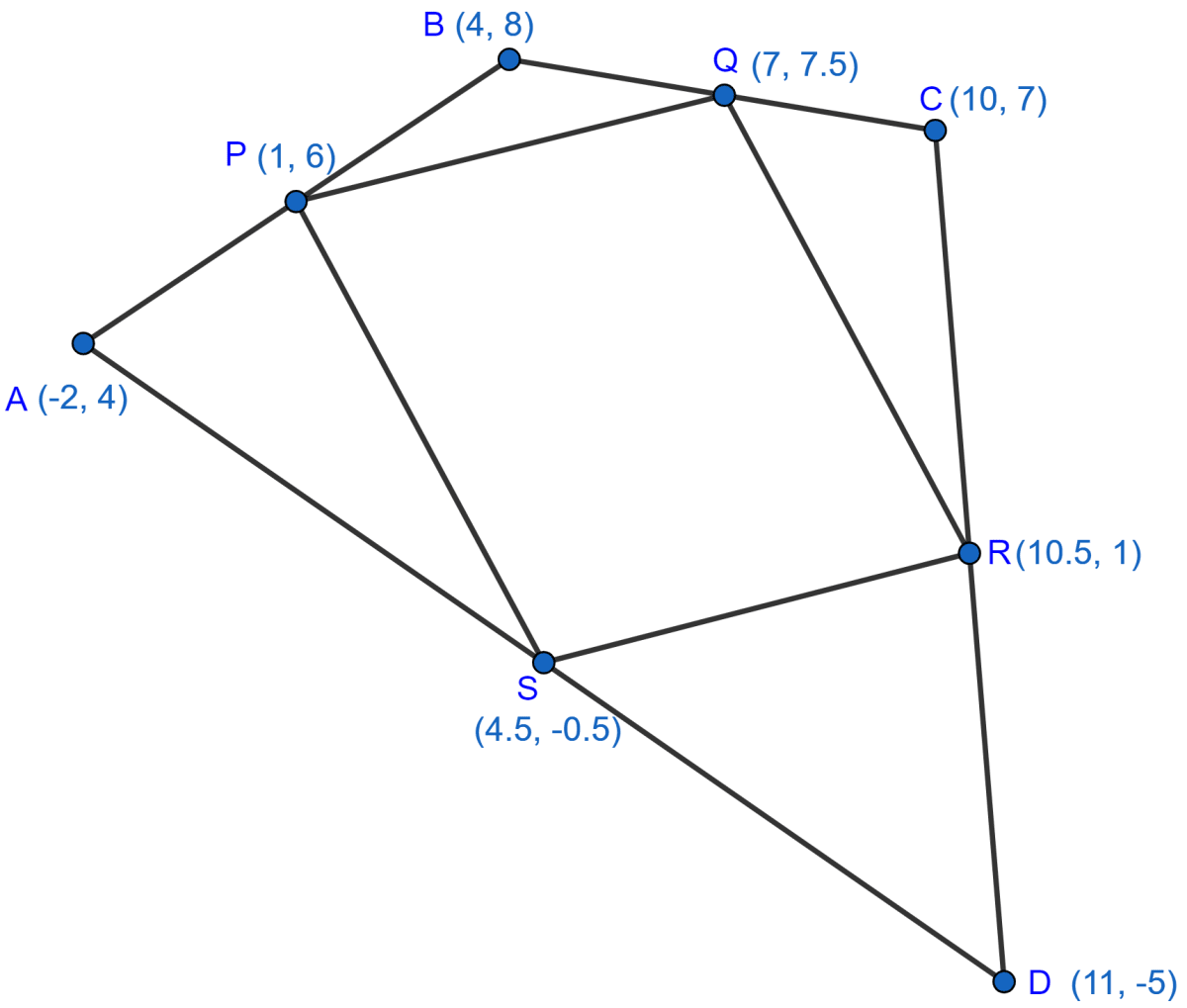
(-2, 4), (4, 8), (10, 7) and (11, -5) are the vertices of a quadrilateral. Show that the quadrilateral, obtained on joining the mid-points of its sides, is a parallelogram.
Answer
Let the given points be A(-2, 4), B(4, 8), C(10, 7) and D(11, -5).
And, let P, Q, R and S be the mid-points of AB, BC, CD and DA respectively.
By mid-point formula,
Mid-point = ( x 1 + x 2 2 , y 1 + y 2 2 ) \Big(\dfrac{x_1 + x_2}{2}, \dfrac{y_1 + y_2}{2}\Big) ( 2 x 1 + x 2 , 2 y 1 + y 2 )
So,
⇒ P = ( − 2 + 4 2 , 4 + 8 2 ) = ( 2 2 , 12 2 ) = ( 1 , 6 ) . ⇒ Q = ( 4 + 10 2 , 8 + 7 2 ) = ( 14 2 , 15 2 ) = ( 7 , 7.5 ) . ⇒ R = ( 10 + 11 2 , 7 + ( − 5 ) 2 ) = ( 21 2 , 2 2 ) = ( 10.5 , 1 ) . ⇒ S = ( 11 + ( − 2 ) 2 , − 5 + 4 2 ) = ( 4.5 , − 0.5 ) . \Rightarrow P = \Big(\dfrac{-2 + 4}{2}, \dfrac{4 + 8}{2}\Big) \\[1em] = \Big(\dfrac{2}{2}, \dfrac{12}{2}\Big) = (1, 6). \\[1em] \Rightarrow Q = \Big(\dfrac{4 + 10}{2}, \dfrac{8 + 7}{2}\Big) \\[1em] = \Big(\dfrac{14}{2}, \dfrac{15}{2}\Big) = (7, 7.5). \\[1em] \Rightarrow R = \Big(\dfrac{10 + 11}{2}, \dfrac{7 + (-5)}{2}\Big) \\[1em] = \Big(\dfrac{21}{2}, \dfrac{2}{2}\Big) = (10.5, 1). \\[1em] \Rightarrow S = \Big(\dfrac{11 + (-2)}{2}, \dfrac{-5 + 4}{2}\Big) \\[1em] = (4.5, -0.5). ⇒ P = ( 2 − 2 + 4 , 2 4 + 8 ) = ( 2 2 , 2 12 ) = ( 1 , 6 ) . ⇒ Q = ( 2 4 + 10 , 2 8 + 7 ) = ( 2 14 , 2 15 ) = ( 7 , 7.5 ) . ⇒ R = ( 2 10 + 11 , 2 7 + ( − 5 ) ) = ( 2 21 , 2 2 ) = ( 10.5 , 1 ) . ⇒ S = ( 2 11 + ( − 2 ) , 2 − 5 + 4 ) = ( 4.5 , − 0.5 ) .
By formula,
Slope = y 2 − y 1 x 2 − x 1 \dfrac{y_2 - y_1}{x_2 - x_1} x 2 − x 1 y 2 − y 1
⇒ Slope of PQ = 7.5 − 6 7 − 1 = 1.5 6 = 1 4 . ⇒ Slope of QR = 1 − 7.5 10.5 − 7 = − 6.5 3.5 = − 65 35 = − 13 7 . ⇒ Slope of RS = − 0.5 − 1 4.5 − 10.5 = − 1.5 − 6 = 1 4 . ⇒ Slope of PS = − 0.5 − 6 4.5 − 1 = − 6.5 3.5 = − 65 35 = − 13 7 . \Rightarrow \text{Slope of PQ} = \dfrac{7.5 - 6}{7 - 1} \\[1em] = \dfrac{1.5}{6} \\[1em] = \dfrac{1}{4}. \\[1em] \Rightarrow \text{Slope of QR} = \dfrac{1 - 7.5}{10.5 - 7} \\[1em] = \dfrac{-6.5}{3.5} \\[1em] = -\dfrac{65}{35} = -\dfrac{13}{7}. \\[1em] \Rightarrow \text{Slope of RS} = \dfrac{-0.5 - 1}{4.5 - 10.5} \\[1em] = \dfrac{-1.5}{-6} \\[1em] = \dfrac{1}{4}. \\[1em] \Rightarrow \text{Slope of PS} = \dfrac{-0.5 - 6}{4.5 - 1} \\[1em] = \dfrac{-6.5}{3.5} = -\dfrac{65}{35} \\[1em] = -\dfrac{13}{7}. ⇒ Slope of PQ = 7 − 1 7.5 − 6 = 6 1.5 = 4 1 . ⇒ Slope of QR = 10.5 − 7 1 − 7.5 = 3.5 − 6.5 = − 35 65 = − 7 13 . ⇒ Slope of RS = 4.5 − 10.5 − 0.5 − 1 = − 6 − 1.5 = 4 1 . ⇒ Slope of PS = 4.5 − 1 − 0.5 − 6 = 3.5 − 6.5 = − 35 65 = − 7 13 .
From above calculation we get,
Slope of PQ = Slope of RS and Slope of QR = Slope of PS
∴ PQ || RS and QR || PS.
Hence, proved that the quadrilateral, obtained on joining the mid-points of sides of quadrilateral with vertices (-2, 4), (4, 8), (10, 7) and (11, -5), is a parallelogram.
Show that the points P(a, b + c), Q(b, c + a) and R(c, a + b) are collinear.
Answer
By formula,
Slope = y 2 − y 1 x 2 − x 1 \dfrac{y_2 - y_1}{x_2 - x_1} x 2 − x 1 y 2 − y 1
Slope of PQ = c + a − ( b + c ) b − a = c + a − b − c b − a = a − b b − a = − ( b − a ) b − a = − 1. Slope of QR = a + b − ( c + a ) c − b = a + b − c − a c − b = b − c c − b = − ( c − b ) c − b = − 1. \text{Slope of PQ} = \dfrac{c + a - (b + c)}{b - a} \\[1em] = \dfrac{c + a - b - c}{b - a} \\[1em] = \dfrac{a - b}{b - a} \\[1em] = \dfrac{-(b - a)}{b - a} = -1. \\[1em] \text{Slope of QR} = \dfrac{a + b - (c + a)}{c - b} \\[1em] = \dfrac{a + b - c - a}{c - b} \\[1em] = \dfrac{b - c}{c - b} \\[1em] = \dfrac{-(c - b)}{c - b} = -1. Slope of PQ = b − a c + a − ( b + c ) = b − a c + a − b − c = b − a a − b = b − a − ( b − a ) = − 1. Slope of QR = c − b a + b − ( c + a ) = c − b a + b − c − a = c − b b − c = c − b − ( c − b ) = − 1.
Since, Slope of PQ = QR.
Hence, proved that P, Q and R are collinear.
Find x, if the slope of the line joining (x, 2) and (8, -11) is − 3 4 -\dfrac{3}{4} − 4 3
Answer
By formula,
Slope = y 2 − y 1 x 2 − x 1 \dfrac{y_2 - y_1}{x_2 - x_1} x 2 − x 1 y 2 − y 1
Given, slope of line joining (x, 2) and (8, -11) is − 3 4 -\dfrac{3}{4} − 4 3
∴ − 3 4 = − 11 − 2 8 − x ⇒ − 3 ( 8 − x ) = 4 × − 13 ⇒ − 24 + 3 x = − 52 ⇒ 3 x = − 52 + 24 ⇒ 3 x = − 28 ⇒ x = − 28 3 . \therefore -\dfrac{3}{4} = \dfrac{-11 - 2}{8 - x} \\[1em] \Rightarrow -3(8 - x) = 4 \times -13 \\[1em] \Rightarrow -24 + 3x = -52 \\[1em] \Rightarrow 3x = -52 + 24 \\[1em] \Rightarrow 3x = -28 \\[1em] \Rightarrow x = -\dfrac{28}{3}. ∴ − 4 3 = 8 − x − 11 − 2 ⇒ − 3 ( 8 − x ) = 4 × − 13 ⇒ − 24 + 3 x = − 52 ⇒ 3 x = − 52 + 24 ⇒ 3 x = − 28 ⇒ x = − 3 28 .
Hence, x = − 28 3 -\dfrac{28}{3} − 3 28
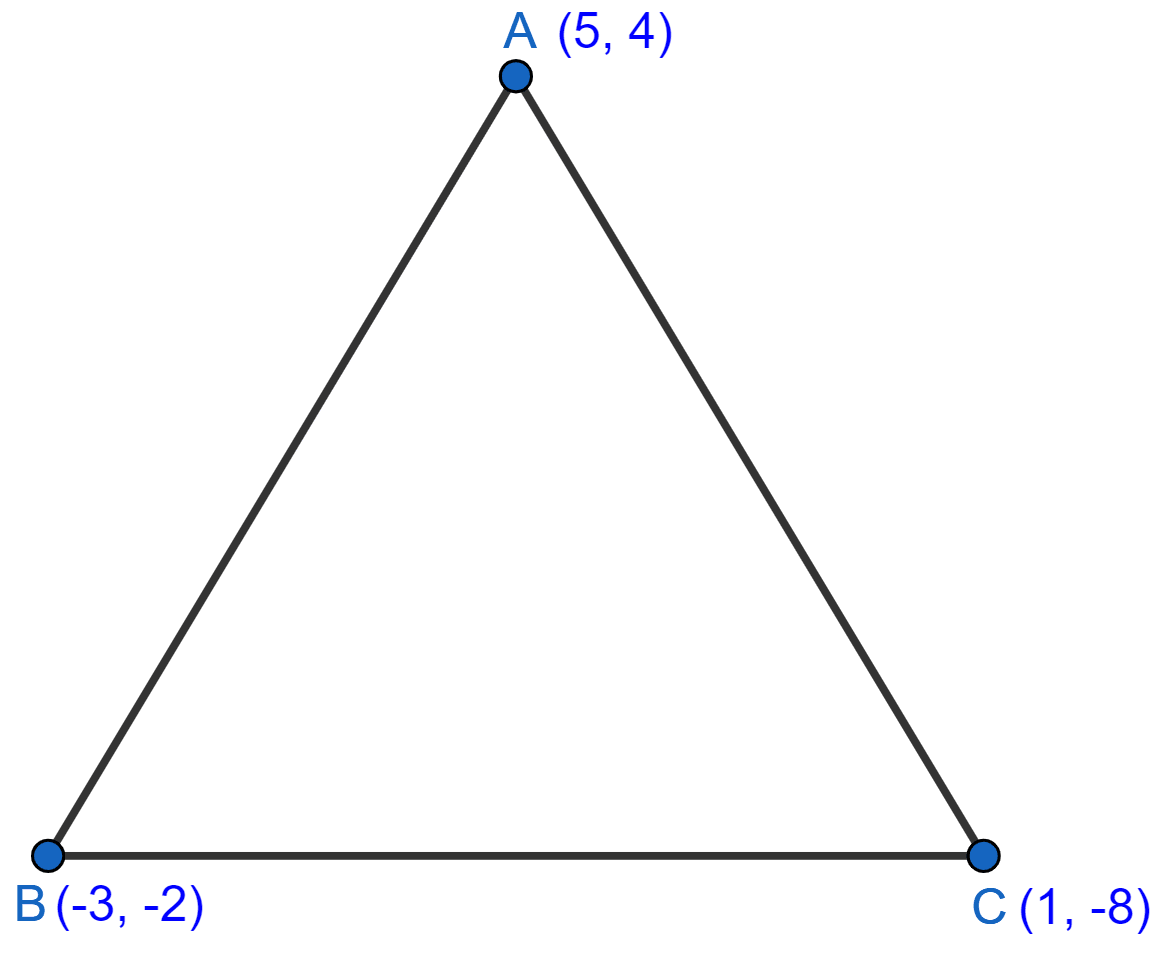
A(5, 4), B(-3, -2) and C(1, -8) are the vertices of a triangle ABC. Find :
(i) the slope of the altitude of AB,
(ii) the slope of the median AD and
(iii) the slope of the line parallel to AC.
Answer
(i) By formula,
Slope = y 2 − y 1 x 2 − x 1 \dfrac{y_2 - y_1}{x_2 - x_1} x 2 − x 1 y 2 − y 1
Slope of AB = − 2 − 4 − 3 − 5 = − 6 − 8 = 3 4 . \text{Slope of AB }= \dfrac{-2 - 4}{-3 - 5} \\[1em] = \dfrac{-6}{-8} \\[1em] = \dfrac{3}{4}. Slope of AB = − 3 − 5 − 2 − 4 = − 8 − 6 = 4 3 .
We know that,
Product of slope of perpendicular lines = -1.
∴ Slope of AB × Slope of altitude = -1
⇒ 3 4 \dfrac{3}{4} 4 3
⇒ Slope of altitude = − 4 3 -\dfrac{4}{3} − 3 4
Hence, slope of the altitude of AB = − 4 3 -\dfrac{4}{3} − 3 4
(ii) Since, AD is median. So, D is the mid-point of BC.
D = ( − 3 + 1 2 , − 2 + ( − 8 ) 2 ) = ( − 2 2 , − 10 2 ) = ( − 1 , − 5 ) . \Big(\dfrac{-3 + 1}{2}, \dfrac{-2 + (-8)}{2}\Big) = \Big(\dfrac{-2}{2}, \dfrac{-10}{2}\Big) = (-1, -5). ( 2 − 3 + 1 , 2 − 2 + ( − 8 ) ) = ( 2 − 2 , 2 − 10 ) = ( − 1 , − 5 ) .
Slope of AD = − 5 − 4 − 1 − 5 = − 9 − 6 = 3 2 . \text{Slope of AD }= \dfrac{-5 - 4}{-1 - 5} \\[1em] = \dfrac{-9}{-6} \\[1em] = \dfrac{3}{2}. Slope of AD = − 1 − 5 − 5 − 4 = − 6 − 9 = 2 3 .
Hence, slope of the median AD = 3 2 \dfrac{3}{2} 2 3
(iii) Slope of AC = − 8 − 4 1 − 5 = − 12 − 4 = 3. \text{Slope of AC }= \dfrac{-8 - 4}{1 - 5} \\[1em] = \dfrac{-12}{-4} \\[1em] = 3. Slope of AC = 1 − 5 − 8 − 4 = − 4 − 12 = 3.
Since, slope of parallel lines are equal.
Hence, slope of line parallel to AC = 3.
The slope of the side BC of a rectangle ABCD is 2 3 \dfrac{2}{3} 3 2
(i) the slope of the side AB,
(ii) the slope of the side AD.
Answer
Rectangle ABCD is shown in the figure below:
Since, product of slope of perpendicular line = -1.
Slope of AB x Slope of BC = -1
⇒ Slope of AB × 2 3 = − 1 ⇒ Slope of AB = − 3 2 . \Rightarrow \text{Slope of AB} \times \dfrac{2}{3} = -1 \\[1em] \Rightarrow \text{Slope of AB} = -\dfrac{3}{2}. ⇒ Slope of AB × 3 2 = − 1 ⇒ Slope of AB = − 2 3 .
Hence, slope of AB = − 3 2 -\dfrac{3}{2} − 2 3
(ii) AD is parallel to BC and slope of parallel lines are equal.
Hence, slope of AD = 2 3 \dfrac{2}{3} 3 2
The points (K, 3), (2, -4) and (-K + 1, -2) are collinear. Find K.
Answer
Let points be A(K, 3), B(2, -4) and C(-K + 1, -2).
Since, points are collinear.
∴ Slope of AB = Slope of BC
⇒ − 4 − 3 2 − K = − 2 − ( − 4 ) − K + 1 − 2 ⇒ − 7 2 − K = 2 − K − 1 ⇒ − 7 ( − K − 1 ) = 2 ( 2 − K ) ⇒ 7 K + 7 = 4 − 2 K ⇒ 7 K + 2 K = 4 − 7 ⇒ 9 K = − 3 ⇒ K = − 3 9 = − 1 3 . \Rightarrow \dfrac{-4 - 3}{2 - K} = \dfrac{-2 - (-4)}{-K + 1 - 2} \\[1em] \Rightarrow \dfrac{-7}{2 - K} = \dfrac{2}{-K - 1} \\[1em] \Rightarrow -7(-K - 1) = 2(2 - K) \\[1em] \Rightarrow 7K + 7 = 4 - 2K \\[1em] \Rightarrow 7K + 2K = 4 - 7 \\[1em] \Rightarrow 9K = -3 \\[1em] \Rightarrow K = -\dfrac{3}{9} = -\dfrac{1}{3}. ⇒ 2 − K − 4 − 3 = − K + 1 − 2 − 2 − ( − 4 ) ⇒ 2 − K − 7 = − K − 1 2 ⇒ − 7 ( − K − 1 ) = 2 ( 2 − K ) ⇒ 7 K + 7 = 4 − 2 K ⇒ 7 K + 2 K = 4 − 7 ⇒ 9 K = − 3 ⇒ K = − 9 3 = − 3 1 .
Hence, K = − 1 3 -\dfrac{1}{3} − 3 1
Plot the points A(1, 1), B(4, 7) and C(4, 10) on a graph paper. Join A and B, and also A and C. Which segment appears to have steeper slope, AB or AC? Justify your conclusion by calculating the slopes of AB and AC.
Answer
From graph,
AC appears to be steeper.
Slope of AB = 7 − 1 4 − 1 = 6 3 = 2. Slope of AC = 10 − 1 4 − 1 = 9 3 = 3. \text{Slope of AB } = \dfrac{7 - 1}{4 - 1} \\[1em] = \dfrac{6}{3} = 2. \\[1em] \text{Slope of AC } = \dfrac{10 - 1}{4 - 1} \\[1em] = \dfrac{9}{3} = 3. Slope of AB = 4 − 1 7 − 1 = 3 6 = 2. Slope of AC = 4 − 1 10 − 1 = 3 9 = 3.
Since, AC has greater slope.
Hence, proved AC has steeper slope.