
Three coins are tossed simultaneously the probability of getting atleast two heads is :
Answer
When three coins are tossed together; the possible outcomes are :
HHH, HHT, HTH, THH, HTT, THT, TTH and TTT.
i.e., the total number of possible outcomes = 8
Favorable outcomes for getting atleast two heads are : HHH, HHT, HTH, THH.
i.e., the number of favorable outcomes = 4
P(getting atleast two heads) : .
Hence, Option 1 is the correct option.
A card is drawn from a pack of a well shuffled cards. The probability of getting either a king or a queen is :
0
Answer
No. of kings in a pack of cards = 4 (1 of each suit)
No. of queens in a pack of cards = 4 (1 of each suit)
Total no. of cards in a pack of cards = 52
P(getting either a king or a queen) : .
Hence, Option 2 is the correct option.
Two dice are rolled together and the product (P) of their scores is obtained :
Event A : P is 6.
Event B : P is an odd number.
Event C : P is 35.
Which of the following event/events has probability equal to 0?
Events B and C
Events A and B
Event B
Event C
Answer
When two dice are rolled together, possible outcomes are :
{(1, 1), (1, 2), (1, 3), (1, 4), (1, 5), (1, 6), (2, 1), (2, 2), (2, 3), (2, 4), (2, 5), (2, 6), (3, 1), (3, 2), (3, 3), (3, 4), (3, 5), (3, 6), (4, 1), (4, 2), (4, 3), (4, 4), (4, 5), (4, 6), (5, 1), (5, 2), (5, 3), (5, 4), (5, 5), (5, 6), (6, 1), (6, 2), (6, 3), (6, 4), (6, 5), (6, 6)}.
No. of possible outcomes = 36
Maximum product of number on dices = 36 when both the dice have 6 on it.
The product one less than the maximum = 30 when one dice have 5 and the other has 6.
∴ No. of favourable outcomes for getting a product of 35 = 0.
∴ P(event C) = = 0.
Hence, Option 4 is the correct option.
A bag contains 20 red balls, 12 blue balls and 8 green balls. Three balls are drawn one by one with replacement, the probability that the third ball being green is :
1.8
Answer
Total no. of balls = 20 + 12 + 8 = 40
No. of green balls = 8
Since, balls are drawn one by one with replacement.
∴ P(third ball drawn be green) = P(ball drawn to be green)
= .
Hence, Option 3 is the correct option.
Below are given the probabilities A, B, C and D of an event. P(A) : , P(B) : 1.2, P(C) : -1.2 and P(D) = . Which of the above values of the probabilities is possible :
Event A
Event B
Event C
Event D
Answer
We know that,
Probability of an event cannot be negative or greater than 1.
∴ Only probability of event A is possible.
Hence, Option 1 is the correct option.
A letter of English alphabet is chosen at random from English alphabets.
Assertion(A): The probability that the chosen letter is not a consonant is 5 : 26.
Reason(R): The probability of an event =
A is true, R is false.
A is false, R is true.
Both A and R are true and R is the correct reason for A.
Both A and R are true and R is the incorrect reason for A.
Answer
Given, there are 26 letters in the English alphabet.
There are total 5 (a, e, i, o, u) vowels and the remaining 21 letters are consonants.
A letter that is 'not a consonant' is a vowel.
∴ Probability that the chosen letter is not a consonant = , i.e. 5 : 26.
So, assertion (A) is true.
By formula,
The probability of an event =
The relation given in reason (R) is inverted.
So, reason (R) is false.
∴ A is true and R is false.
Hence, Option 1 is the correct option.
Number x is chosen from -3, -2, -1, 0, 1, 2 and 3. Also, x2 ≤ 5.
Assertion(A): Probability for x2 ≤ 5 is .
Reason(R): Probability = .
A is true, R is false.
A is false, R is true.
Both A and R are true and R is correct reason for A.
Both A and R are true and R is incorrect reason for A.
Answer
Number x is chosen form -3, -2, -1, 0, 1, 2 and 3. Also, x2 ≤ 5.
We need to find the values of x for which x2 ≤ 5.
(-3)2 = 9 (not favourable)
(-2)2 = 4 (favourable)
(-1)2 = 1 (favourable)
02 = 0 (favourable)
12 = 1 (favourable)
22 = 4 (favourable)
32 = 9 (not favourable)
The favorable outcomes are -2, -1, 0, 1, 2 in total 5 favourable outcomes.
By formula; the probability for x2 ≤ 5 = .
∴ A is false, R is true.
Hence, option 2 is the correct option.
Face cards of spades are remove from the pack of 52 cards and the remaining cards are well shuffled. Then a card is drawn from the pack.
Statement (1): The probability of drawing a face card is .
Statement (2): Kings, queens and jacks are the three face card and so the total number of face cards in the pack of 52 card is 3 x 4 = 12.
Both the statements are true.
Both the statements are false.
Statement 1 is true, and statement 2 is false.
Statement 1 is false, and statement 2 is true.
Answer
In a standard deck of 52 playing cards, each suit (hearts, diamonds, clubs, spades) contains 3 face cards: Jack, Queen, and King. Therefore, the total number of face cards in the deck is:
3 x 4 = 12
So, statement 2 is true.
After removing the face cards of spades (Jack, Queen, King), we are left with = 12 - 3 = 9 face cards.
The total number of remaining cards in the deck = 52 - 3 = 49.
By formula; the probability of an event =
Thus, the probability of drawing a face card from the remaining 49 cards = .
So, statement 1 is false.
∴ Statement 1 is false, and statement 2 is true.
Hence, option 4 is the correct option.
In a lottery ticket, there are 20 prizes and 25 blanks.
Statement (1): Probability of not getting the prize = 1 -
Statement (2): P(getting prize) + P(blank) = 1
Both the statements are true.
Both the statements are false.
Statement 1 is true, and statement 2 is false.
Statement 1 is false, and statement 2 is true.
Answer
Given, tickets = 20 prizes and 25 blanks
total tickets = 20 + 25 = 45
By formula; the probability of an event =
P(getting prize) =
P(blank) =
Thus, P(getting prize) + P(blank) = 1
So, statement 2 is true.
⇒ P(blank) = 1 - P(getting prize)
⇒ P(blank) = 1 -
We know that,
P(not getting the prize) = P(blank)
So, statement 1 is true.
∴ Both the statements are true.
Hence, option 1 is the correct option.
From a well-shuffled deck of 52 cards, one card is drawn. Find the probability that the card drawn is :
(i) a face card
(ii) not a face card
(iii) a queen of black colour
(iv) a card with number 5 or 6
(v) a card with number less than 8
(vi) a card with number between 2 and 9
Answer
There are 52 cards in a deck.
We have, the total number of possible outcomes = 52
(i) No. of face cards in a deck of 52 cards = 12 (4 kings, 4 queens and 4 jacks)
∴ No. of favourable outcomes = 12
P(drawing a face card) = .
Hence, probability of drawing a face card = .
(ii) As, probability of drawing a face card and a non-face card are complimentary event.
∴ Probability of drawing a face card + Probability of drawing a non-face card = 1
⇒ Probability of not drawing a face card = 1 - Probability of drawing a face card
⇒ Probability of not drawing a face card = .
Hence, probability of not drawing a face card = .
(iii) There are 2 queens of black colour (1 of each club and spade).
∴ No. of favourable outcomes = 2
P(drawing a queen of black colour)
= .
Hence, probability of drawing a queen of black colour = .
(iv) There are 4 cards (1 of each suit) of each 5 and 6 number.
∴ No. of favourable outcomes = 8
P(drawing a card with number 5 or 6)
= .
Hence, probability of drawing a card with number 5 or 6 = .
(v) There are {2, 3, 4, 5, 6, 7} numbered cards of each heart, diamond, club and spades.
∴ No. of favourable outcomes = 6 × 4 = 24.
P(getting a card with number less than 8)
= .
Hence, the probability of drawing a card with number less than 8 = .
(vi) There are {3, 4, 5, 6, 7, 8} numbered cards of each heart, diamond, club and spades.
∴ No. of favourable outcomes = 6 × 4 = 24.
P(getting a card with number between 2 and 9)
= .
Hence, the probability of drawing a card with number between 2 and 9 = .
In a match between A and B;
(i) the probability of winning of A is 0.83. What is the probability of winning of B?
(ii) the probability of losing the match is 0.49 for B. What is the probability of winning of A?
Answer
(i) Since,the match is between A and B.
∴ Probability of losing of A = Probability of winning of B
We know that,
⇒ Probability of winning of A + Probability of losing of A = 1 (As winning and loosing of A are complimentary events)
⇒ Probability of winning of A + Probability of winning of B = 1
⇒ 0.83 + Probability of winning of B = 1
⇒ Probability of winning of B = 1 - 0.83 = 0.17
Hence, probability of winning of B = 0.17
(ii) Since,the match is between A and B.
∴ Probability of winning of A = Probability of loosing of B
Probability of winning of A = 0.49
A and B are friends. Ignoring the leap year, find the probability that both friends will have:
(i) different birthdays?
(ii) the same birthday?
Answer
Out of the two friends, A’s birthday can be any day of the year. Now, B’s birthday can also be any day of 365 days in the year.
We assume that these 365 outcomes are equally likely.
So,
(i) If A’s birthday is different from B’s, the number of favourable outcomes for his birthday is 365 - 1 = 364
P(A’s birthday is different from B’s birthday) = .
Hence, the probability that both friends will have different birthdays is
(ii) P(A and B have the same birthday) = 1 - P (both have different birthdays)
= 1 -
= .
Hence, the probability that both friends will have same birthday is .
A man tosses two different coins (one of ₹ 2 and another of ₹ 5) simultaneously. What is the probability that he gets :
(i) at least one head ?
(ii) at most one head ?
Answer
We know that,
When two coins are tossed simultaneously, the possible outcomes are {(H, H), (H, T), (T, H), (T, T)}
∴ No. of possible outcomes = 4.
(i) The outcomes favourable to event, 'at least one head' are {(H, H), (H, T), (T, H)}.
∴ Number of favourable outcomes = 3
P(getting at least one head) = .
Hence, the probability that he gets at least one head = .
(ii) The outcomes favourable to event, 'at most one head' are {(H, T), (T, H), (T, T)}.
∴ Number of favourable outcomes = 3
P(getting at most one head) = .
Hence, the probability that he gets at most one head = .
All the three face cards of spades are removed from a well shuffled pack of 52 cards. A card is then drawn at random from the remaining pack. Find the probability of getting :
(i) a black face card
(ii) a queen
(iii) a black card
Answer
We have,
Total number of cards = 52
If 3 face cards of spades are removed
Then, the remaining cards = 49 (52 - 3)
∴ Number of possible outcomes = 49.
(i) There are 3 black face cards of club left.
∴ Number of favourable outcomes = 3.
P(drawing a black face card) = .
Hence, the probability of drawing a black face card =
(ii) There are total 4 queens and queen of spade is removed.
Queens left = 3
∴ Number of favourable outcomes = 3.
P(drawing a queen) = .
Hence, the probability of drawing a queen = .
(iii) There are 26 black cards and 3 cards of spades are removed which are black.
Number of black cards left = 23 (26 - 3)
∴ Number of favourable outcomes = 23.
P(drawing a black card) = .
Hence, the probability of drawing a black card = .
In a musical chairs game, a person has been advised to stop playing the music at any time within 40 seconds after its start. What is the probability that the music will stop within the first 15 seconds ?
Answer
The favourable results = 0 sec to 15 sec and the total results = 0 sec to 40 sec.
∴ Number of favourable outcomes = 15
and
Number of possible outcomes = 40.
P(that music will stop within 15 seconds) = .
Hence, the probability that the music will stop within the first 15 seconds = .
In a bundle of 50 shirts, 44 are good, 4 have minor defects and 2 have major defects. What is the probability that :
(i) it is acceptable to a trader who accepts only a good shirt ?
(ii) it is acceptable to a trader who rejects only a shirt with major defects ?
Answer
We have,
Total number of shirts = 50
∴ No. of possible outcomes = 50.
(i) As, trader accepts only good shirts and number of good shirts = 44.
∴ No. of favourable outcomes = 44
P(trader will accept) = .
Hence, the probability that a shirt is acceptable to a trader who accepts only a good shirt = .
(ii) As, trader rejects shirts with major defects only and number of shirts with major defects = 2.
No. of shirts that trader will accept = 50 - 2 = 48.
∴ No. of favourable outcomes = 48
P(trader will accept) = .
Hence, the probability that a shirt is acceptable to a trader who rejects only a shirt with major defects = .
Two dice are thrown at the same time. Find the probability that the sum of the two numbers appearing on the top of the dice is :
(i) 8
(ii) 13
(iii) less than or equal to 12
Answer
When two dice are thrown simultaneously;
Number of possible outcomes = 6 × 6 = 36.
(i) For obtaining a total of 8, favourable outcomes are : {(2, 6), (3, 5), (4, 4), (5, 3), (6, 2)}.
∴ Number of favourable outcomes = 5.
P(that the sum of the two numbers appearing on the top of the dice is 8) = .
Hence, the probability that the sum of the two numbers appearing on the top of the dice is 8 = .
(ii) There is no outcome favourable to obtaining a sum of 13.
∴ Number of favourable outcomes = 0.
P(that the sum of the two numbers appearing on the top of the dice is 13) = = 0.
Hence, the probability that the sum of the two numbers appearing on the top of the dice is 13 = 0.
(iii) The sum of all the outcomes is either less than or equal to 12.
∴ Number of favourable outcomes = 36.
P(that the sum of the two numbers appearing on the top of the dice is less than or equal to 12) = = 1.
Hence, the probability that the sum of the two numbers appearing on the top of the dice is less than or equal to 12 is 1.
The probability that two boys do not have the same birthday is 0.897. What is the probability that the two boys have the same birthday ?
Answer
We know that,
Since, the boys having birthday on same date and different date are complimentary events.
∴ P(do not have the same birthday) + P(having same birthday) = 1
⇒ 0.897 + P(having same birthday) = 1
⇒ P(having same birthday) = 1 - 0.897
⇒ P(having same birthday) = 0.103
Hence, the probability that the two boys have same birthday = 0.103
A bag contains 10 red balls, 16 white balls and 8 green balls. A ball is drawn out of the bag at random. What is the probability that the ball drawn will be :
(i) not red ?
(ii) neither red nor green ?
(iii) white or green ?
Answer
Total number of possible outcomes = 10 + 16 + 8 = 34.
(i) No. of non red balls = 24 (16 white + 8 green)
∴ No. of favourable outcomes = 24.
P(drawing a not red ball) = .
Hence, the probability of drawing a not red ball = .
(ii) Since, there are only 3 different colour balls in the bag.
∴ P(drawing neither red nor green ball) = P(drawing a white ball)
No. of favourable outcomes (of getting white ball) = 16.
P(drawing a white ball) = .
∴ P(drawing neither red nor green ball) = .
Hence, the probability that the ball drawn is neither red nor green is .
(iii) No. of white or green balls = 24 (16 white + 8 green)
∴ No. of favourable outcomes = 24.
P(drawing a white or green ball)
= .
Hence, the probability of drawing a white or green ball = .
A bag contains twenty ₹ 5 coins, fifty ₹ 2 coins and thirty ₹ 1 coins. If it is equally likely that one of the coins will fall down when the bag is turned upside down, what is the probability that the coin :
(i) will be a ₹ 1 coin ?
(ii) will not be a ₹ 2 coin ?
(iii) will neither be a ₹ 5 coin nor be a ₹ 1 coin ?
Answer
We have,
Total number of coins = 20 + 50 + 30 = 100
So, the total possible outcomes = 100.
(i) Number of ₹ 1 coin = 30
∴ Number of favourable outcomes = 30
P(drawing a ₹ 1 coin) = .
Hence, the probability of drawing a ₹ 1 coin = .
(ii) Number of ₹ 5 and ₹ 1 coin = 50 (20 + 30)
Hence, no. of coins apart from ₹ 2 coins = 50.
∴ Number of favourable outcomes = 50
P(coin drawn will not be a ₹ 2 coin) = .
Hence, the probability of not drawing a ₹ 2 coin = .
(iii) No. of ₹ 2 coins = 50
No. of favourable outcomes (for drawing a ₹ 2 coin) = 50
P(drawing a ₹ 2 coin) = .
Since, there are only 3 types of coins in the bag.
∴ P(drawing neither ₹ 5 nor ₹ 1 coin) = P(drawing ₹ 2 coin) = .
Hence, the probability of drawing neither ₹ 5 nor ₹ 1 coin = .
A game consists of spinning arrow which comes to rest pointing at one of the numbers 1, 2, 3, 4, 5, 6, 7, 8, 9, 10, 11, 12; as shown below.
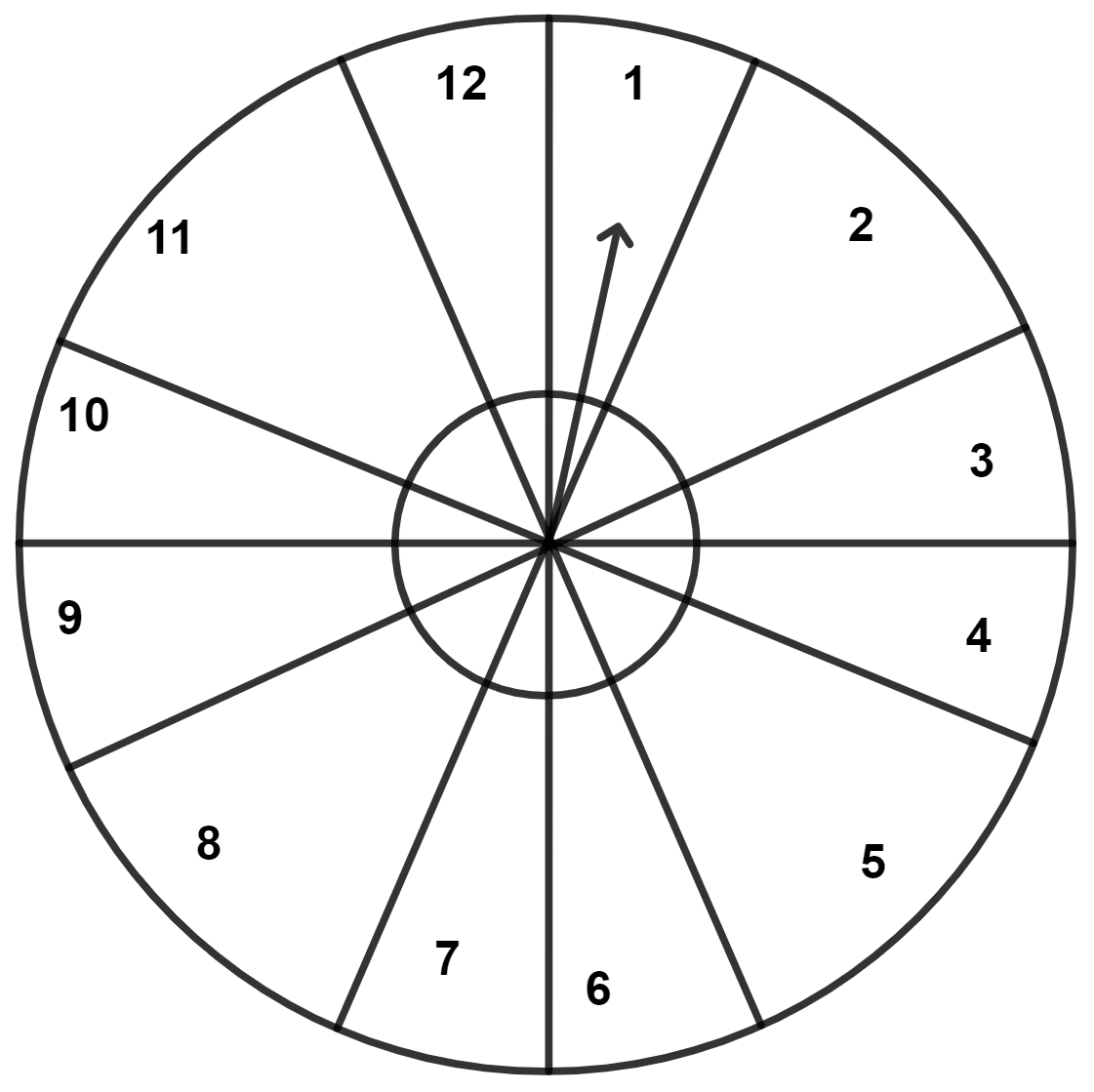
If the outcomes are equally likely, find the probability that the pointer will point at:
(i) 6
(ii) an even number
(iii) a prime number
(iv) a number greater than 8
(v) a number less than or equal to 9
(vi) a number between 3 and 11.
Answer
We have,
Total number of possible outcomes = 12
(i) Number of favorable outcomes for 6 = 1
P(that pointer points at 6) = .
Hence, the probability that pointer points at 6 = .
(ii) Favorable outcomes for an even number are 2, 4, 6, 8, 10, 12.
∴ Number of favorable outcomes = 6
P(that pointer points at an even number)
= .
Hence, the probability that pointer points at an even number = .
(iii) Favorable outcomes for a prime number are 2, 3, 5, 7, 11.
∴ Number of favorable outcomes = 5
P(that pointer points at a prime number)
= .
Hence, the probability that pointer points at a prime number = .
(iv) Favorable outcomes for a number greater than 8 are 9, 10, 11, 12.
∴ Number of favorable outcomes = 4.
P(that pointer points at a number greater than 8)
= .
Hence, the probability that pointer points at a number greater than 8 = .
(v) Favorable outcomes for a number less than or equal to 9 are 1, 2, 3, 4, 5, 6, 7, 8, 9
∴ Number of favorable outcomes = 9
P(that pointer points at a number less than or equal to 9)
= .
Hence, the probability that pointer points at a number less than or equal to 9 = .
(vi) Favorable outcomes for a number between 3 and 11 are 4, 5, 6, 7, 8, 9, 10
∴ Number of favorable outcomes = 7
P(that pointer points at a number between 3 and 11)
= .
Hence, the probability that pointer points at a number between 3 and 11 = .
One card is drawn from a well shuffled deck of 52 cards. Find the probability of getting :
(i) a queen of red color
(ii) a black face card
(iii) the jack or the queen of the hearts
(iv) a diamond
(v) a diamond or a spade
Answer
We have,
Total possible outcomes = 52
(i) Number of queens of red color = 2 (1 of each heart and diamond)
∴ Number of favorable outcomes = 2
P(drawing a queen of red colour)
= .
Hence, the probability of drawing a queen of red colour = .
(ii) Number of black face cards = 6 (3 of each club and spades)
∴ Number of favorable outcomes = 6
P(drawing a black face card)
= .
Hence, the probability of drawing a black face card = .
(iii) Favorable outcomes for jack or the queen of hearts = 2 (1 jack + 1 queen)
∴ Number of favorable outcomes = 2
P(drawing a jack or the queen of hearts)
= .
Hence, the probability of drawing a jack or the queen of hearts = .
(iv) Number of diamond cards = 13
∴ Number of favorable outcomes = 13
P(getting a diamond) = .
Hence, the probability of getting a diamond = .
(v) Number of favorable outcomes for a diamond or a spade = 13 + 13 = 26.
P(getting a diamond or spade)
= .
Hence, the probability of getting a diamond or spade = .
From a deck of 52 cards, all the face cards are removed and then the remaining cards are shuffled. Now one card is drawn from the remaining deck. Find the probability that the card drawn is :
(i) a black card
(ii) 8 of red colour
(iii) a king of black colour.
Answer
There are 12 face cards in a deck.
Remaining cards = 40 (52 - 12)
No. of possible outcomes = 40.
(i) There are 26 black cards in a deck.
Since, face cards are removed and there are 6 black face cards (a king, queen and jack of both club and spades).
No. of black cards left = 26 - 6 = 20.
∴ No. of favourable outcomes = 20.
P(drawing a black card) = .
Hence, the probability of drawing a black card = .
(ii) There are 2 number 8 red cards (1 of each heart and diamond).
∴ No. of favourable outcomes = 2.
P(drawing a 8 of red colour) = .
Hence, the probability of drawing a 8 of red colour = .
(iii) There is no king left as all face cards are removed.
∴ No. of favourable outcomes = 0.
P(drawing a king of black colour) = = 0.
Hence, the probability of drawing a king of black colour = 0.
Seven cards : the eight, the nine, the ten, jack, queen, king and ace of diamonds are well shuffled. One card is then picked up at random.
(i) What is the probability that the card drawn is the eight or the king ?
(ii) If the king is drawn and put aside, what is the probability that the second card picked up is :
(a) an ace ?
(b) a king ?
Answer
There are seven cards.
∴ No. of possible outcomes = 7.
(i) No. of favourable outcomes (of getting a eight or the king) = 2.
P(drawing an eight or the king) = .
Hence, the probability that the card drawn is the eight or the king = .
(ii) Since, king is drawn and put aside so, no. of cards left = 7 - 1 = 6.
∴ No. of possible outcomes = 6.
(a) No. of favourable outcomes (of getting an ace) = 1.
P(drawing an ace) = .
Hence, the probability that the card drawn is an ace = .
(b) Since, king is drawn aside.
∴ No. of favourable outcomes (of getting a king) = 0.
P(drawing a king) = = 0.
Hence, the probability that the card drawn is a king = 0.
(i) 4 defective pens are accidentally mixed with 16 good ones. It is not possible to just look at a pen and tell whether or not it is defective. One pen is drawn at random from the lot. What is the probability that the pen is defective ?
(ii) Suppose the pen drawn in (i) is defective and is not replaced. Now one more pen is drawn at random from the rest. What is the probability that this pen is :
(a) defective ?
(b) not defective ?
Answer
(i) No. of pens = 20 (4 + 16)
∴ No. of possible outcomes = 20.
Since, there are 4 defective pens,
∴ No. of favourable outcomes = 4.
P(drawing a defective pen) = .
Hence, probability of drawing a defective pen = .
(ii) Since, pen drawn is defective.
So, no. of pens left = 19 and no. of defective pens left = 3.
(a) No. of favourable outcomes (drawing a defective pen) = 3.
No. of possible outcomes = 19
P(drawing a defective pen) = .
Hence, probability of drawing a defective pen = .
(b) No. of favourable outcomes (drawing a good pen) = 16.
No. of possible outcomes = 19
P(drawing a good pen) = .
Hence, probability of drawing a not defective pen = .
A bag contains 100 identical marble stones which are numbered from 1 to 100. If one stone is drawn at random from the bag, find the probability that it bears :
(i) a perfect square number.
(ii) a number divisible by 4.
(iii) a number divisible by 5.
(iv) a number divisible by 4 or 5.
(v) a number divisible by 4 and 5.
Answer
There are 100 identical marble stones.
∴ No. of possible outcomes = 100.
(i) Stones containing a perfect square number are numbered :
1, 4, 9, 16, 25, 36, 49, 64, 81, 100.
No. of favourable outcomes = 10.
P(drawing a stone with perfect square number)
= .
Hence, the probability of drawing a stone bearing a perfect square number = .
(ii) Stones containing a number which is divisible by 4 are numbered :
4, 8, 12, 16, 20, 24, 28, 32, 36, 40, 44, 48, 52, 56, 60, 64, 68, 72, 76, 80, 84, 88, 92, 96, 100.
No. of favourable outcomes = 25.
P(drawing a stone with a number divisible by 4)
= .
Hence, the probability of drawing a stone with a number divisible by 4 = .
(iii) Stones containing a number which is divisible by 5 are numbered :
5, 10, 15, 20, 25, 30, 35, 40, 45, 50, 55, 60, 65, 70, 75, 80, 85, 90, 95, 100.
No. of favourable outcomes = 20.
P(drawing a stone with a number divisible by 5)
= .
Hence, the probability of drawing a stone with a number divisible by 5 = .
(iv) Stones containing a number which is divisible by 4 or 5 are numbered :
4, 8, 12, 16, 24, 28, 32, 36, 44, 48, 52, 56, 64, 68, 72, 76, 84, 88, 92, 96, 5, 10, 15, 20, 25, 30, 35, 40, 45, 50, 55, 60, 65, 70, 75, 80, 85, 90, 95, 100.
No. of favourable outcomes = 40.
P(drawing a stone with a number divisible by 4 or 5)
= .
Hence, the probability of drawing a stone with a number divisible by 4 or 5 = .
(v) Stones containing a number which is divisible by 4 and 5 are numbered :
20, 40, 60, 80, 100.
No. of favourable outcomes = 5.
P(drawing a stone with a number divisible by 4 and 5)
= .
Hence, the probability of drawing a stone with a number divisible by 4 and 5 = .
A circle with diameter 20 cm is drawn somewhere on a rectangular piece of paper with length 40 cm and width 30 cm. This paper is kept horizontal on table top and a dice, very small in size, is dropped on the rectangular paper without seeing towards it. If the dice falls and lands on the paper only, find the probability that it will fall and land :
(i) inside the circle.
(ii) outside the circle.
Answer
Diameter of circle drawn = 20 cm
Radius = = 10 cm.
Area of circle = πr2
Length of rectangular piece = 40 cm
Width of rectangular piece = 30 cm
Area of rectangular piece (Total possible outcome) = 40 × 30 = 1200 cm2
(i) No. of favourable outcome for dice landing inside circle = Area of circle = cm2.
P(dice lands inside circle)
= .
Hence, the probability that dice lands inside the circle = .
(ii) P(dice lands inside circle) + P(dice lands outside the circle) = 1
P(dice lands outside circle) = 1 - P(dice lands inside the circle)
= 1 -
=
= .
Hence, the probability that dice lands outside the circle = .
Two dice (each bearing numbers 1 to 6) are rolled together. Find the probability that the sum of the numbers on the upper-most faces of two dice is :
(i) 4 or 5
(ii) 7, 8 or 9.
(iii) between 5 and 8.
(iv) more than 10.
(v) less than 6.
Answer
When two dice are rolled together;
No. of possible outcomes = 6 × 6 = 36.
(i) Favourable outcomes for sum of numbers on the upper-most faces of two dice to be 4 or 5 are :
(1, 3), (1, 4), (2, 2), (2, 3), (3, 1), (3, 2), (4, 1).
∴ No. of favourable outcomes = 7.
P(getting a sum of 4 or 5) = .
Hence, the probability of getting sum of numbers on the upper-most faces of two dice to be 4 or 5 = .
(ii) Favourable outcomes for sum of numbers on the upper-most faces of two dice to be 7, 8 or 9 are :
(1, 6), (2, 5), (2, 6), (3, 4), (3, 5), (3, 6), (4, 3), (4, 4), (4, 5), (5, 2), (5, 3), (5, 4), (6, 1), (6, 2) and (6, 3).
∴ No. of favourable outcomes = 15.
P(getting a sum of 7, 8 or 9) = .
Hence, the probability of getting sum of numbers on the upper-most faces of two dice to be 7, 8 or 9 = .
(iii) Favourable outcomes for sum of numbers on the upper-most faces of two dice to be between 5 and 8 are :
(1, 5), (1, 6), (2, 4), (2, 5), (3, 3), (3, 4), (4, 2), (4, 3), (5, 1), (5, 2), (6, 1).
∴ No. of favourable outcomes = 11.
P(getting a sum between 5 and 8) = .
Hence, the probability of getting sum of numbers on the upper-most faces of two dice between 5 and 8 = .
(iv) Favourable outcomes for sum of numbers on the upper-most faces of two dice to be more than 10 are :
(5, 6), (6, 5), (6, 6)
∴ No. of favourable outcomes = 3.
P(getting a sum of more than 10) = .
Hence, the probability of getting sum of numbers on the upper-most faces of more than 10 = .
(v) Favourable outcomes for sum of numbers on the upper-most faces of two dice to be less than 6 are :
(1, 1), (1, 2), (1, 3), (1, 4), (2, 1), (2, 2), (2, 3), (3, 1), (3, 2), (4, 1).
∴ No. of favourable outcomes = 10.
P(getting a sum of less than 6) = .
Hence, the probability of getting sum of numbers on the upper-most faces of less than 6 = .
Three coins are tossed together. Write all the possible outcomes. Now, find the probability of getting :
(i) exactly two heads.
(ii) at least two heads.
(iii) atmost two heads.
(iv) all tails
(v) at least one tail.
Answer
When three coins are tossed simultaneously;
Possible outcomes are : {HHH, TTT, HHT, HTH, THH, TTH, THT, HTT}.
(i) Favourable outcomes for getting exactly two heads are : HHT, HTH, THH.
No. of favourable outcomes = 3
P(getting exactly two heads) = .
Hence, the probability of getting exactly two heads = .
(ii) Favourable outcomes for getting at least two heads are : HHT, HTH, THH, HHH.
No. of favourable outcomes = 4
P(getting atleast two heads) = .
Hence, the probability of getting at least two heads = .
(iii) Favourable outcomes for getting at most two heads are : TTT, HHT, HTH, THH, TTH, THT, HTT.
No. of favourable outcomes = 7
P(getting atmost two heads) = .
Hence, the probability of getting at most two heads = .
(iv) Favourable outcomes for getting all tails is : TTT.
No. of favourable outcomes = 1
P(getting all tails) = .
Hence, the probability of getting all tails = .
(v) Favourable outcomes for getting at least one tail is : TTT, HHT, HTH, THH, TTH, THT, HTT.
No. of favourable outcomes = 7
P(getting at least one tail) = .
Hence, the probability of getting at least one tail is = .
Two dice are thrown simultaneously. What is the probability that :
(i) 4 will not come up either time ?
(ii) 4 will come up at least once ?
Answer
When two dice are thrown simultaneously;
No. of possible outcomes = 6 × 6 = 36.
(i) Favourable outcomes for 4 not coming on any of the dice are : (1, 1), (1, 2), (1, 3), (1, 5), (1, 6), (2, 1), (2, 2), (2, 3), (2, 5), (2, 6), (3, 1), (3, 2), (3, 3), (3, 5), (3, 6), (5, 1), (5, 2), (5, 3), (5, 5), (5, 6), (6, 1), (6, 2), (6, 3), (6, 5), (6, 6).
No. of favourable outcomes = 25
P(such that 4 will not come up either time)
= .
Hence, the probability of not getting 4 any time = .
(ii) Favorable outcomes for 4 coming up at least once are :
(1, 4), (2, 4), (3, 4), (4, 1), (4, 2), (4, 3), (4, 4), (4, 5), (4, 6), (5, 4), (6, 4).
No. of favourable outcomes = 11
P(such that 4 will come up at least once)
= .
Hence, the probability of 4 coming up at least once = .
Offices in Delhi are open for five days in a week (Monday to Friday). Two employees of an office remain absent for one day in the same particular week. Find the probability that they remain absent on :
(i) the same day
(ii) consecutive day
(iii) different days.
Answer
Total number of possible outcomes = 5 × 5 = 25.
Let the five days of the week be denoted as Monday by M, Tuesday by T, Wednesday by W, Thursday by Th and Friday by F; then :
(i) Favourable cases for employees being absent on same day are : MM, TT, WW, Th Th and FF.
No. of favourable cases = 5.
Required probability = .
Hence, probability that employees remain absent on same day = .
(ii) Favourable cases for employees being absent on consecutive day are : MT, TM, TW, WT, W Th, Th W, Th F and F Th.
No. of favourable cases = 8.
Required probability = .
Hence, probability that employees remain absent on consecutive day = .
(iii) We know that,
Employees being absent on same day and different day are complimentary events.
∴ P(absent on different days) + P(absent on same day) = 1
⇒ P(absent on different days) = 1 - P(absent on same day)
⇒ P(absent on different days) = 1 - .
Hence, the probability that employees remain absent on different days = .
A box contains some black balls and 30 white balls. If the probability of drawing a black ball is two-fifths of a white ball; find the number of black balls in the box.
Answer
Let the box contain x black balls.
Total number of balls = x + 30
∴ No. of possible outcomes = x + 30.
No. of favourable outcomes (for drawing a black ball) = x
P(drawing a black ball) =
No. of favourable outcomes (for drawing a white ball) = 30
P(drawing a white ball) =
Given,
Probability of drawing a black ball is two-fifths of a white ball,
Hence, the number of black balls = 12.
From a pack of 52 playing cards, all cards whose numbers are multiples of 3 are removed. A card is now drawn at random. What is the probability that the card drawn is
(i) a face card (King, Jack or Queen)
(ii) an even numbered red card ?
Answer
Cards whose numbers are multiples of 3 are : 3, 6 and 9 of each heart, club, diamonds and spades.
No. of cards removed = 3 × 4 = 12.
Total cards left = 40 (52 - 12).
∴ No. of possible outcomes = 40.
(i) There are 12 face cards in a deck of 52 playing cards.
∴ No. of favourable outcomes = 12.
P(drawing a face card) = .
Hence, the probability that the card drawn is a face card = .
(ii) Favourable outcomes (for an even numbered red card) are 2, 4, 8, 10 of heart and diamond.
∴ No. of favourable outcomes = 8.
P(drawing an even numbered red card)
= .
Hence, the probability that the card drawn is an even numbered red card = .
A dice has 6 faces marked by the given numbers as shown below :
The dice is thrown once. What is the probability of getting
(i) a positive integer ?
(ii) an integer greater than -3 ?
(iii) the smallest integer ?
Answer
Since, there are 6 faces in a dice.
∴ No. of possible outcomes = 6.
(i) Favourable outcomes for getting a positive integer are 1, 2, 3.
∴ No. of favourable outcomes = 3.
P(getting a positive integer) = .
Hence, the probability of getting a positive integer = .
(ii) Favourable outcomes for getting an integer greater than -3 are -2, -1, 1, 2, 3.
∴ No. of favourable outcomes = 5.
P(getting an integer greater than -3)
= .
Hence, the probability of getting an integer greater than -3 = .
(iii) Favourable outcomes for getting smallest integer is -3.
∴ No. of favourable outcomes = 1.
P(getting smallest integer) = .
Hence, the probability of getting smallest integer = .
Sixteen cards are labelled as a, b, c, .........., m, n, o, p. They are put in a box and shuffled. A boy is asked to draw a card from the box. What is the probability that the card drawn is :
(i) a vowel
(ii) a consonant
(iii) none of the letters of the word median ?
Answer
No. of possible outcomes = 16.
(i) Vowels between a, b, c, .........., m, n, o, p are a, e, i, o.
∴ No. of favourable outcomes = 4.
P(that the card drawn is a vowel)
= .
Hence, the probability that the card drawn is a vowel = .
(ii) Since, there are 4 vowels.
∴ No. of consonants or favourable outcomes = 12 (16 - 4).
P(that the card drawn is a consonant)
= .
Hence, the probability that the card drawn is a consonant = .
(iii) Letters of the word median are 'm', 'e', 'd', 'i', 'a' and 'n'.
No. of letters left = 16 - 6 = 10.
∴ No. of favourable outcomes = 10.
P(that the card contains none of the letters of the word median)
= .
Hence, the probability that the card drawn contains none of the letters of the word median = .
A box contains a certain number of balls. On each of 60% balls, letter A is marked. On each of 30% balls, letter B is marked and on each of remaining balls, letter C is marked. A ball is drawn from the box at random. Find the probability that the ball drawn is :
(i) marked C
(ii) A or B
(iii) neither B nor C.
Answer
Given,
On each of 60% balls, letter A is marked. On each of 30% balls, letter B is marked and on each of remaining balls (i.e. 10%), letter C is marked.
Let no. of balls be x.
∴ No. of possible outcomes = x.
No. of balls marked A =
No. of balls marked B =
No. of balls marked C = .
(i) No. of balls marked C or favourable outcomes =
P(drawing a ball marked C) = .
Hence, the probability of drawing a ball marked C = .
(ii) No. of balls marked A or B = .
P(drawing a ball marked A or B) = .
Hence, the probability of drawing a ball marked A or B = .
(iii) Since, the balls are marked either A, B or C.
So, P(drawing neither B nor C) = P(drawing A marked ball)
No. of A marked balls = .
∴ No. of favourable outcomes = .
P(drawing a ball marked A) = .
∴ P(drawing neither B nor C) = .
Hence, the probability of drawing ball marked neither B nor C = .
A box contains a certain number of balls. Some of these balls are marked A, some are marked B and the remainings are marked C. When a ball is drawn at random from the box P(A) = and P(B) = . If there are 40 balls in the box which are marked C, find the number of balls in the box.
Answer
Since, A, B and C are mutually exclusive events.
∴ P(A) + P(B) + P(C) = 1
We know that,
Probability of drawing ball marked C =
Hence, there are 96 balls in the box.
A die is thrown 300 times and outcomes are noted as given below :
| Outcomes | 1 | 2 | 3 | 4 | 5 | 6 |
|---|---|---|---|---|---|---|
| Frequency | 50 | 73 | 55 | 44 | 45 | 33 |
When the same die is thrown once more, what is the probability of getting :
(i) 4 ?
(ii) 6 ?
(iii) 5 ?
(iv) 2 ?
Answer
Total number of trials = 50 + 73 + 55 + 44 + 45 + 33 = 300.
By formula,
Probability of an event =
(i) Number of times 4 appears = 44.
∴ P(getting 4) = .
Hence, P(getting 4) = .
(ii) Number of times 6 appears = 33.
∴ P(getting 6) = .
Hence, P(getting 6) = .
(iii) Number of times 5 appears = 45.
∴ P(getting 5) = .
Hence, P(getting 5) = .
(iv) Number of times 2 appears = 73.
∴ P(getting 2) = .
Hence, P(getting 2) = .
The percentage of marks obtained by a student of class X in four unit tests are given below :
| Unit test | I | II | III | IV |
|---|---|---|---|---|
| Marks secured % | 62 | 69 | 33 | 86 |
A test is selected at random. What is the probability that the student gets 69% marks in the test ?
Answer
Total number of unit tests = 4.
Number of tests in which the student secured 69% marks = 1 (Unit test II).
By formula,
Probability of an event =
∴ P(student gets 69% marks) = .
Hence, the required probability = .
The following table shows the relationship between the monthly incomes and the number of vehicles in a family. If 2000 families, in a locality, are selected, the information gathered is listed in the table below :
| Monthly income (₹) | 0 vehicle | 1 vehicle | 2 or more than 2 vehicles |
|---|---|---|---|
| Less than 10,000 | 1 | 140 | 13 |
| 10,000 - 12,000 | 2 | 285 | 17 |
| 12,000 - 14,000 | 0 | 515 | 0 |
| 14,000 - 16,000 | 0 | 449 | 9 |
| 16,000 or more | 3 | 559 | 7 |
A family is chosen, write the probability that the family chosen is :
(i) earning ₹ 10,000 - ₹ 12,000 per month and owning exactly 1 (one) vehicle.
(ii) earning ₹ 14,000 or more per month and owning 2 or more than 2 vehicles.
(iii) not owning more than 1 vehicle.
Answer
Total number of families = 2000.
By formula,
Probability of an event =
(i) Number of families earning ₹ 10,000 - ₹ 12,000 per month and owning exactly 1 vehicle = 285.
∴ Required probability = .
Hence, the required probability = .
(ii) Number of families earning ₹ 14,000 or more per month and owning 2 or more vehicles = 9 + 7 = 16.
∴ Required probability = .
Hence, the required probability = .
(iii) Families not owning more than 1 vehicle are those owning 0 or 1 vehicle.
Number of such families = (1 + 2 + 0 + 0 + 3) + (140 + 285 + 515 + 449 + 559)
= 6 + 1948 = 1954.
∴ Required probability = .
Hence, the required probability = .