A solid metallic sphere of radius 16 cm is melted to form small identical spheres each of diameter 4 cm. The number of spheres formed is :
64
252
512
1024
Answer
Given,
A solid metallic sphere of radius 16 cm is melted to form small identical spheres each of diameter 4 cm.
Larger metallic ball sphere radius (R) = 16 cm
Radius of smaller metallic sphere (r) = 4 2 \dfrac{4}{2} 2 4
Let no. of smaller spheres formed be n.
∴ Volume of larger metallic ball = n × Volume of smaller metallic ball
⇒ 4 3 π R 3 = n × 4 3 π r 3 ⇒ n = 4 3 π R 3 4 3 π r 3 ⇒ n = R 3 r 3 ⇒ n = 16 3 2 3 ⇒ n = 4096 8 = 512. \Rightarrow \dfrac{4}{3}πR^3 = n \times \dfrac{4}{3}πr^3 \\[1em] \Rightarrow n = \dfrac{\dfrac{4}{3}πR^3}{\dfrac{4}{3}πr^3} \\[1em] \Rightarrow n = \dfrac{R^3}{r^3} \\[1em] \Rightarrow n = \dfrac{16^3}{2^3} \\[1em] \Rightarrow n = \dfrac{4096}{8} = 512. ⇒ 3 4 π R 3 = n × 3 4 π r 3 ⇒ n = 3 4 π r 3 3 4 π R 3 ⇒ n = r 3 R 3 ⇒ n = 2 3 1 6 3 ⇒ n = 8 4096 = 512.
Hence, Option 3 is the correct option.
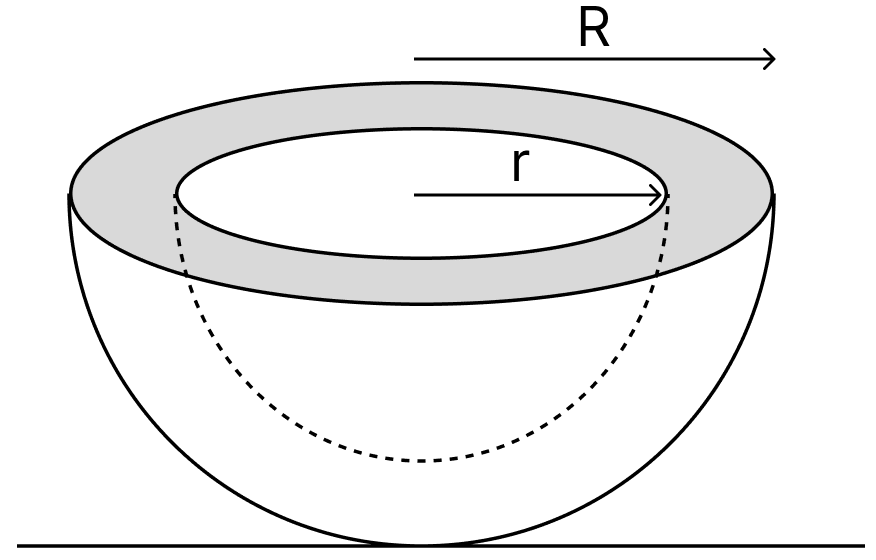
A hemi-spherical bowl (as shown) has external radius R and internal radius r, the outer surface area of the bowl is :
2πR2 + πr2
3πR2 - πr2
2πR2 + 2πr2
2πR2 - πr2
Answer
Outer surface area of the hemi-spherical bowl = Surface area of outer hemisphere + Area of outer cross-section - Area of inner cross-section
= 2πR2 + πR2 - πr2
= 3πR2 - πr2 .
Hence, Option 2 is the correct option.
The ratio between the volumes of two spherical solids is 27 : 8. The ratio between their curved surface areas is :
27 : 8
8 : 27
3 : 2
9 : 4
Answer
Let radius of two spherical solids be R and r.
Given,
The ratio between the volumes of two spherical solids is 27 : 8.
⇒ Vol. of 1st spherical solid Vol. of 2nd spherical solid = 27 8 ⇒ 4 3 π R 3 4 3 π r 3 = 27 8 ⇒ R 3 r 3 = 27 8 ⇒ ( R r ) 3 = ( 3 2 ) 3 ⇒ R r = 3 2 .........(1) \Rightarrow \dfrac{\text{Vol. of 1st spherical solid}}{\text{Vol. of 2nd spherical solid}} = \dfrac{27}{8} \\[1em] \Rightarrow \dfrac{\dfrac{4}{3}πR^3}{\dfrac{4}{3}πr^3} = \dfrac{27}{8} \\[1em] \Rightarrow \dfrac{R^3}{r^3} = \dfrac{27}{8} \\[1em] \Rightarrow \Big(\dfrac{R}{r}\Big)^3 = \Big(\dfrac{3}{2}\Big)^3 \\[1em] \Rightarrow \dfrac{R}{r} = \dfrac{3}{2} \text{ .........(1)} ⇒ Vol. of 2nd spherical solid Vol. of 1st spherical solid = 8 27 ⇒ 3 4 π r 3 3 4 π R 3 = 8 27 ⇒ r 3 R 3 = 8 27 ⇒ ( r R ) 3 = ( 2 3 ) 3 ⇒ r R = 2 3 .........(1)
The ratio between the curved surface area of two spherical solids :
⇒ CSA of 1st spherical solid CSA of 2nd spherical solid = 4 π R 2 4 π r 2 = R 2 r 2 = ( R r ) 2 = ( 3 2 ) 2 = 9 4 = 9 : 4. \Rightarrow \dfrac{\text{CSA of 1st spherical solid}}{\text{CSA of 2nd spherical solid}} = \dfrac{4πR^2}{4πr^2} \\[1em] = \dfrac{R^2}{r^2} \\[1em] = \Big(\dfrac{R}{r}\Big)^2 \\[1em] = \Big(\dfrac{3}{2}\Big)^2 \\[1em] = \dfrac{9}{4} \\[1em] = 9 : 4. ⇒ CSA of 2nd spherical solid CSA of 1st spherical solid = 4 π r 2 4 π R 2 = r 2 R 2 = ( r R ) 2 = ( 2 3 ) 2 = 4 9 = 9 : 4.
Hence, Option 4 is the correct option.
A solid metallic sphere of radius 8 cm is melted and recast into 64 identical solid spheres. The diameter of each smaller sphere formed is :
4 cm
2 cm
8 cm
1 cm
Answer
Given,
Radius of larger metallic sphere (R) = 8 cm
Let radius of each smaller sphere be r cm.
Given,
A solid metallic sphere of radius 8 cm is melted and recast into 64 identical solid spheres.
∴ Volume of larger metallic sphere = 64 × Volume of smaller metallic sphere
⇒ 4 3 π R 3 = 64 × 4 3 π r 3 ⇒ 64 = 4 3 π R 3 4 3 π r 3 ⇒ 64 = R 3 r 3 ⇒ 64 = 8 3 r 3 ⇒ r 3 = 8 3 64 ⇒ r 3 = 512 64 ⇒ r 3 = 8 ⇒ r = 8 3 = 2 cm . \Rightarrow \dfrac{4}{3}πR^3 = 64 \times \dfrac{4}{3}πr^3 \\[1em] \Rightarrow 64 = \dfrac{\dfrac{4}{3}πR^3}{\dfrac{4}{3}πr^3} \\[1em] \Rightarrow 64 = \dfrac{R^3}{r^3} \\[1em] \Rightarrow 64 = \dfrac{8^3}{r^3} \\[1em] \Rightarrow r^3 = \dfrac{8^3}{64} \\[1em] \Rightarrow r^3 = \dfrac{512}{64} \\[1em] \Rightarrow r^3 = 8 \\[1em] \Rightarrow r = \sqrt[3]{8} = 2 \text{ cm}. ⇒ 3 4 π R 3 = 64 × 3 4 π r 3 ⇒ 64 = 3 4 π r 3 3 4 π R 3 ⇒ 64 = r 3 R 3 ⇒ 64 = r 3 8 3 ⇒ r 3 = 64 8 3 ⇒ r 3 = 64 512 ⇒ r 3 = 8 ⇒ r = 3 8 = 2 cm .
Diameter of smaller sphere = 2 × 2 = 4 cm.
Hence, Option 1 is the correct option.
r1 , r2 and r3 are the radii of three metallic spheres. If these spheres are melted to form a single solid sphere, the radius of sphere formed is :
r 1 3 + r 2 3 + r 3 3 \sqrt{r_1^3 + r_2^3 + r_3^3} r 1 3 + r 2 3 + r 3 3
r1 + r2 + r3
r 1 3 + r 2 3 + r 3 3 r_1^3 + r_2^3 + r_3^3 r 1 3 + r 2 3 + r 3 3
r 1 3 + r 2 3 + r 3 3 3 \sqrt[3]{r_1^3 + r_2^3 + r_3^3} 3 r 1 3 + r 2 3 + r 3 3
Answer
Given,
r1 , r2 and r3 are the radii of three metallic spheres. These spheres are melted to form a single solid sphere.
Let the radius of sphere formed be R.
∴ Volume of sphere formed = Sum of volume of three smaller spheres
⇒ 4 3 π R 3 = 4 3 π r 1 3 + 4 3 π r 2 3 + 4 3 π r 3 3 ⇒ 4 3 π R 3 = 4 3 π ( r 1 3 + r 2 3 + r 3 3 ) ⇒ R 3 = r 1 3 + r 2 3 + r 3 3 ⇒ R = r 1 3 + r 2 3 + r 3 3 3 . \Rightarrow \dfrac{4}{3}πR^3 = \dfrac{4}{3}πr_1^3 + \dfrac{4}{3}πr_2^3 + \dfrac{4}{3}πr_3^3 \\[1em] \Rightarrow \dfrac{4}{3}πR^3 = \dfrac{4}{3}π(r_1^3 + r_2^3 + r_3^3) \\[1em] \Rightarrow R^3 = r_1^3 + r_2^3 + r_3^3 \\[1em] \Rightarrow R = \sqrt[3]{r_1^3 + r_2^3 + r_3^3}. ⇒ 3 4 π R 3 = 3 4 π r 1 3 + 3 4 π r 2 3 + 3 4 π r 3 3 ⇒ 3 4 π R 3 = 3 4 π ( r 1 3 + r 2 3 + r 3 3 ) ⇒ R 3 = r 1 3 + r 2 3 + r 3 3 ⇒ R = 3 r 1 3 + r 2 3 + r 3 3 .
Hence, Option 4 is the correct option.
The volume of a sphere is 38808 cm3 ; find its diameter and the surface area.
Answer
Given,
Volume of the sphere = 38808 cm3
Let the radius of the sphere = r
By formula,
Volume of sphere = 4 3 π r 3 \dfrac{4}{3}πr^3 3 4 π r 3
⇒ 4 3 π r 3 = 38808 ⇒ 4 3 × 22 7 × r 3 = 38808 ⇒ r 3 = ( 38808 × 7 × 3 ) ( 4 × 22 ) ⇒ r 3 = 814968 88 ⇒ r 3 = 9261 ⇒ r = 9261 3 ⇒ r = 21 cm . \Rightarrow \dfrac{4}{3} πr^3 = 38808 \\[1em] \Rightarrow \dfrac{4}{3} \times \dfrac{22}{7} \times r^3 = 38808 \\[1em] \Rightarrow r^3 = \dfrac{(38808 \times 7 \times 3)}{(4 \times 22)} \\[1em] \Rightarrow r^3 = \dfrac{814968}{88} \\[1em] \Rightarrow r^3 = 9261 \\[1em] \Rightarrow r = \sqrt[3]{9261} \\[1em] \Rightarrow r = 21 \text{ cm}. ⇒ 3 4 π r 3 = 38808 ⇒ 3 4 × 7 22 × r 3 = 38808 ⇒ r 3 = ( 4 × 22 ) ( 38808 × 7 × 3 ) ⇒ r 3 = 88 814968 ⇒ r 3 = 9261 ⇒ r = 3 9261 ⇒ r = 21 cm .
∴ Diameter = 2r = 21 x 2 = 42 cm.
Surface area = 4πr2 = 4 × 22 7 × 21 × 21 4 \times \dfrac{22}{7} \times 21 \times 21 4 × 7 22 × 21 × 21
= 5544 cm2 .
Hence, diameter of ball = 42 cm and surface area = 5544 cm2 .
A spherical ball of lead has been melted and made into identical smaller balls with radius equal to half the radius of the original one. How many such balls can be made?
Answer
Let the radius of the spherical ball be r cm.
So, the volume = 4 3 π r 3 \dfrac{4}{3} πr^3 3 4 π r 3
Radius of smaller ball = r 2 \dfrac{r}{2} 2 r
According to question,
The volume of large spherical balls = Volume of all small balls
Let no. of small spherical balls that can be made be n.
∴ 4 3 π r 3 = n × 4 3 π ( r 2 ) 3 ⇒ n = 4 3 π r 3 4 3 π ( r 2 ) 3 ⇒ n = 4 3 π r 3 × 2 3 4 3 π r 3 ⇒ n = 2 3 = 8. \therefore \dfrac{4}{3}πr^3 = n \times \dfrac{4}{3}π\Big(\dfrac{r}{2}\Big)^3 \\[1em] \Rightarrow n = \dfrac{\dfrac{4}{3}πr^3}{\dfrac{4}{3}π\Big(\dfrac{r}{2}\Big)^3} \\[1em] \Rightarrow n = \dfrac{\dfrac{4}{3}πr^3 \times 2^3}{\dfrac{4}{3}πr^3} \\[1em] \Rightarrow n = 2^3 = 8. ∴ 3 4 π r 3 = n × 3 4 π ( 2 r ) 3 ⇒ n = 3 4 π ( 2 r ) 3 3 4 π r 3 ⇒ n = 3 4 π r 3 3 4 π r 3 × 2 3 ⇒ n = 2 3 = 8.
Hence, 8 balls can be made.
How many balls each of radius 1 cm can be made by melting a bigger ball whose diameter is 8 cm ?.
Answer
Given,
Diameter of bigger ball = 8 cm
So, radius of bigger ball (R) = 8 2 \dfrac{8}{2} 2 8
Volume of bigger ball = 4 3 π R 3 \dfrac{4}{3}πR^3 3 4 π R 3
= 4 3 × π ( 4 ) 3 \dfrac{4}{3} \times π (4)^3 3 4 × π ( 4 ) 3
= 4 3 × π × 64 = 256 π 3 cm 3 \dfrac{4}{3} \times π \times 64 = \dfrac{256π}{3} \text{ cm}^3 3 4 × π × 64 = 3 256 π cm 3
Radius of small ball (r) = 1 cm
Volume of each smaller ball = 4 3 π r 3 \dfrac{4}{3}πr^3 3 4 π r 3
= 4 3 × π × ( 1 ) 3 = 4 3 π cm 3 . \dfrac{4}{3} \times π \times (1)^3 = \dfrac{4}{3}π \text{ cm}^3. 3 4 × π × ( 1 ) 3 = 3 4 π cm 3 .
Let n smaller balls can be made by, melting bigger ball.
Volume of bigger ball = n × Volume of each smaller ball
⇒ 256 π 3 = n × 4 3 π ⇒ n = 256 π 3 4 3 π ⇒ n = 256 × π × 3 4 × 3 × π ⇒ n = 64. \Rightarrow \dfrac{256π}{3} = n \times \dfrac{4}{3}π \\[1em] \Rightarrow n = \dfrac{\dfrac{256π}{3}}{\dfrac{4}{3}π} \\[1em] \Rightarrow n = \dfrac{256 \times π \times 3}{4 \times 3 \times π} \\[1em] \Rightarrow n = 64. ⇒ 3 256 π = n × 3 4 π ⇒ n = 3 4 π 3 256 π ⇒ n = 4 × 3 × π 256 × π × 3 ⇒ n = 64.
Hence, 64 balls can be made.
The volume of one sphere is 27 times that of another sphere. Calculate the ratio of their:
(i) radii
(ii) surface areas
Answer
Given,
Volume of first sphere = 27 x volume of second sphere
Let the radius of the first sphere = r1 and, radius of second sphere = r2
(i) According to the question, we have :
⇒ 4 3 π r 1 3 = 27 × 4 3 π r 2 3 ⇒ r 1 3 = 27 × r 2 3 ⇒ r 1 3 r 2 3 = 27 1 ⇒ ( r 1 r 2 ) 3 = ( 3 1 ) 3 ⇒ r 1 r 2 = 3 1 . \Rightarrow \dfrac{4}{3} πr_1^3 = 27 \times \dfrac{4}{3} πr_2^3 \\[1em] \Rightarrow r_1^3 = 27 \times r_2^3 \\[1em] \Rightarrow \dfrac{r_1^3}{r_2^3} = \dfrac{27}{1} \\[1em] \Rightarrow \Big(\dfrac{r_1}{r_2}\Big)^3 = \Big(\dfrac{3}{1}\Big)^3 \\[1em] \Rightarrow \dfrac{r_1}{r_2} = \dfrac{3}{1}. ⇒ 3 4 π r 1 3 = 27 × 3 4 π r 2 3 ⇒ r 1 3 = 27 × r 2 3 ⇒ r 2 3 r 1 3 = 1 27 ⇒ ( r 2 r 1 ) 3 = ( 1 3 ) 3 ⇒ r 2 r 1 = 1 3 .
Hence, r1 : r2 = 3 : 1.
(ii) Surface area of the first sphere = 4π(r1 )2
Surface area of second sphere = 4π(r2 )2
Ratio of surface areas = 4 π r 1 2 4 π r 2 2 = r 1 2 r 2 2 = ( 3 1 ) 2 = 9 1 . \text{Ratio of surface areas} = \dfrac{4πr_1^2}{4πr_2^2} \\[1em] = \dfrac{r_1^2}{r_2^2} = \Big(\dfrac{3}{1}\Big)^2 \\[1em] = \dfrac{9}{1}. Ratio of surface areas = 4 π r 2 2 4 π r 1 2 = r 2 2 r 1 2 = ( 1 3 ) 2 = 1 9 .
Hence, the ratio of surface areas = 9 : 1.
If the number of square centimeters on the surface of a sphere is equal to the number of cubic centimeters in its volume, what is the diameter of the sphere ?
Answer
Let r be the radius of the sphere.
According to question,
Surface area of sphere = Volume of sphere
⇒ 4 π r 2 = 4 3 π r 3 ⇒ r 2 = r 3 3 ⇒ r 3 r 2 = 3 ⇒ r = 3 cm . \Rightarrow 4πr^2 = \dfrac{4}{3}πr^3 \\[1em] \Rightarrow r^2 = \dfrac{r^3}{3} \\[1em] \Rightarrow \dfrac{r^3}{r^2} = 3 \\[1em] \Rightarrow r = 3\text{ cm}. ⇒ 4 π r 2 = 3 4 π r 3 ⇒ r 2 = 3 r 3 ⇒ r 2 r 3 = 3 ⇒ r = 3 cm .
Diameter of sphere = 2r = 2 × 3 = 6 cm.
Hence, diameter of sphere = 6 cm.
A solid metal sphere is cut through its center into 2 equal parts. If the diameter of the sphere is 3 1 2 3\dfrac{1}{2} 3 2 1
Answer
Diameter of sphere = 3 1 2 = 7 2 3\dfrac{1}{2} = \dfrac{7}{2} 3 2 1 = 2 7
Radius of sphere (r) = 7 2 2 = 7 4 \dfrac{\dfrac{7}{2}}{2} = \dfrac{7}{4} 2 2 7 = 4 7
Total surface area of each hemisphere = 1 2 \dfrac{1}{2} 2 1
= 1 2 × 4 π r 2 + π r 2 \dfrac{1}{2} \times 4πr^2 + πr^2 2 1 × 4 π r 2 + π r 2
= 2πr2 + πr2
= 3πr2
= 3 × 22 7 × 7 4 × 7 4 = 3 × 22 × 7 16 = 3 × 77 8 = 28.88 cm 2 . = 3 \times \dfrac{22}{7} \times \dfrac{7}{4} \times \dfrac{7}{4} \\[1em] = 3 \times \dfrac{22 \times 7}{16} \\[1em] = 3 \times \dfrac{77}{8} \\[1em] = 28.88 \text{ cm}^2. = 3 × 7 22 × 4 7 × 4 7 = 3 × 16 22 × 7 = 3 × 8 77 = 28.88 cm 2 .
Hence, total surface area of each hemisphere 28.88 cm2 .
The internal and external diameters of a hollow hemispherical vessel are 21 cm and 28 cm respectively. Find :
(i) internal curved surface area,
(ii) external curved surface area,
(iii) total surface area,
(iv) volume of material of the vessel.
Answer
(i) Given,
Internal diameter = 21 cm
Internal radius (r) = 21 2 \dfrac{21}{2} 2 21
By formula,
Internal curved surface area = 2πr2 .
= 2 × 22 7 × 21 2 × 21 2 = 19404 28 = 693 cm 2 . = 2 \times \dfrac{22}{7} \times \dfrac{21}{2} \times \dfrac{21}{2} \\[1em] = \dfrac{19404}{28} \\[1em] = 693 \text{ cm}^2. = 2 × 7 22 × 2 21 × 2 21 = 28 19404 = 693 cm 2 .
Hence, internal curved surface area = 693 cm2 .
(ii) Given,
Internal diameter = 28 cm
Internal radius (R) = 28 2 \dfrac{28}{2} 2 28
By formula,
External curved surface area = 2πR2 .
= 2 × 22 7 × 14 × 14 = 1232 cm 2 . = 2 \times \dfrac{22}{7} \times 14 \times 14 \\[1em] = 1232 \text{ cm}^2. = 2 × 7 22 × 14 × 14 = 1232 cm 2 .
Hence, external curved surface area = 1232 cm2 .
(iii) By formula,
Total surface area of hemisphere = 2πr2 + 2πR2 + π(R2 - r2 )
= 693 + 1232 + 22 7 × [ ( 14 ) 2 − ( 21 2 ) 2 ] = 1925 + 22 7 × [ 196 − 441 4 ] = 1925 + 22 7 × 784 − 441 4 = 1925 + 22 7 × 343 4 = 1925 + 11 × 49 2 = 1925 + 539 2 = 1925 + 269.5 = 2194.5 cm 2 . = 693 + 1232 + \dfrac{22}{7} \times \Big[(14)^2 - \Big(\dfrac{21}{2}\Big)^2\Big] \\[1em] = 1925 + \dfrac{22}{7} \times \Big[196 - \dfrac{441}{4}\Big] \\[1em] = 1925 + \dfrac{22}{7} \times \dfrac{784 - 441}{4} \\[1em] = 1925 + \dfrac{22}{7} \times \dfrac{343}{4} \\[1em] = 1925 + \dfrac{11 \times 49}{2} \\[1em] = 1925 + \dfrac{539}{2} \\[1em] = 1925 + 269.5 \\[1em] = 2194.5 \text{ cm}^2. = 693 + 1232 + 7 22 × [ ( 14 ) 2 − ( 2 21 ) 2 ] = 1925 + 7 22 × [ 196 − 4 441 ] = 1925 + 7 22 × 4 784 − 441 = 1925 + 7 22 × 4 343 = 1925 + 2 11 × 49 = 1925 + 2 539 = 1925 + 269.5 = 2194.5 cm 2 .
Hence, total surface area of hemisphere = 2194.5 cm2 .
(iv) By formula,
Volume of hemispherical vessel = 2 3 π ( R 3 − r 3 ) \dfrac{2}{3}π(R^3 - r^3) 3 2 π ( R 3 − r 3 )
= 2 3 × 22 7 × [ ( 14 ) 3 − ( 21 2 ) 3 ] = 2 3 × 22 7 × [ 2744 − 1157.625 ] = 2 3 × 22 7 × 1586.375 = 44 21 × 1586.375 = 3323.83 cm 3 . = \dfrac{2}{3} \times \dfrac{22}{7} \times [(14)^3 - \Big(\dfrac{21}{2}\Big)^3] \\[1em] = \dfrac{2}{3} \times \dfrac{22}{7} \times [2744 - 1157.625] \\[1em] = \dfrac{2}{3} \times \dfrac{22}{7} \times 1586.375 \\[1em] = \dfrac{44}{21} \times 1586.375 \\[1em] = 3323.83 \text{ cm}^3. = 3 2 × 7 22 × [( 14 ) 3 − ( 2 21 ) 3 ] = 3 2 × 7 22 × [ 2744 − 1157.625 ] = 3 2 × 7 22 × 1586.375 = 21 44 × 1586.375 = 3323.83 cm 3 .
Hence, volume of vessel = 3323.83 cm3 .
A solid sphere and a solid hemi-sphere have the same total surface area. Find the ratio between their volumes.
Answer
Let radius of sphere be R cm and hemi-sphere be r cm.
Given,
Solid sphere and a solid hemi-sphere have the same total surface area.
∴ 4 π R 2 = 3 π r 2 ⇒ R 2 r 2 = 3 π 4 π ⇒ R 2 r 2 = 3 4 ⇒ R r = 3 4 ⇒ R r = 3 2 . \therefore 4πR^2 = 3πr^2 \\[1em] \Rightarrow \dfrac{R^2}{r^2} = \dfrac{3π}{4π} \\[1em] \Rightarrow \dfrac{R^2}{r^2} = \dfrac{3}{4} \\[1em] \Rightarrow \dfrac{R}{r} = \sqrt{\dfrac{3}{4}} \\[1em] \Rightarrow \dfrac{R}{r} = \dfrac{\sqrt{3}}{2}. ∴ 4 π R 2 = 3 π r 2 ⇒ r 2 R 2 = 4 π 3 π ⇒ r 2 R 2 = 4 3 ⇒ r R = 4 3 ⇒ r R = 2 3 .
Calculating ratio between volumes,
Vol. of sphere Vol. of hemi-sphere = 4 3 π R 3 2 3 π r 3 = 4 π R 3 × 3 2 π r 3 × 3 = 2 × R 3 r 3 = 2 × ( 3 2 ) 3 = 2 × 3 3 8 = 3 3 4 . \dfrac{\text{Vol. of sphere}}{\text{Vol. of hemi-sphere}} = \dfrac{\dfrac{4}{3}πR^3}{\dfrac{2}{3}πr^3} \\[1em] = \dfrac{4πR^3 \times 3}{2πr^3 \times 3} \\[1em] = 2 \times \dfrac{R^3}{r^3} \\[1em] = 2 \times \Big(\dfrac{\sqrt{3}}{2}\Big)^3 \\[1em] = 2 \times \dfrac{3\sqrt{3}}{8} \\[1em] = \dfrac{3\sqrt{3}}{4}. Vol. of hemi-sphere Vol. of sphere = 3 2 π r 3 3 4 π R 3 = 2 π r 3 × 3 4 π R 3 × 3 = 2 × r 3 R 3 = 2 × ( 2 3 ) 3 = 2 × 8 3 3 = 4 3 3 .
Hence, ratio between volumes = 3 3 : 4 3\sqrt{3} : 4 3 3 : 4
Metallic spheres of radii 6 cm, 8 cm and 10 cm respectively are melted and recasted into a single solid sphere. Taking π = 3.1, find the surface area of the solid sphere formed.
Answer
Let radius of spheres be r1 , r2 and r3 cm respectively.
Let r be the radius of new sphere formed.
Volume of new sphere formed = Total volume of the three spheres melted
⇒ 4 3 π r 3 = 4 3 π ( r 1 ) 3 + 4 3 π ( r 2 ) 3 + 4 3 π ( r 3 ) 3 ⇒ 4 3 π r 3 = 4 3 π ( r 1 3 + r 2 3 + r 3 3 ) ⇒ r 3 = r 1 3 + r 2 3 + r 3 3 ⇒ r 3 = ( 6 ) 3 + ( 8 ) 3 + ( 10 ) 3 ⇒ r 3 = 216 + 512 + 1000 ⇒ r 3 = 1728 ⇒ r 3 = ( 12 ) 3 ⇒ r = 12 cm. \Rightarrow \dfrac{4}{3}πr^3 = \dfrac{4}{3}π(r_1)^3 + \dfrac{4}{3}π(r_2)^3 + \dfrac{4}{3}π(r_3)^3 \\[1em] \Rightarrow \dfrac{4}{3}πr^3 = \dfrac{4}{3}π(r_1^3 + r_2^3 + r_3^3) \\[1em] \Rightarrow r^3 = r_1^3 + r_2^3 + r_3^3 \\[1em] \Rightarrow r^3 = (6)^3 + (8)^3 + (10)^3 \\[1em] \Rightarrow r^3 = 216 + 512 + 1000 \\[1em] \Rightarrow r^3 = 1728 \\[1em] \Rightarrow r^3 = (12)^3 \\[1em] \Rightarrow r = 12 \text{ cm.} ⇒ 3 4 π r 3 = 3 4 π ( r 1 ) 3 + 3 4 π ( r 2 ) 3 + 3 4 π ( r 3 ) 3 ⇒ 3 4 π r 3 = 3 4 π ( r 1 3 + r 2 3 + r 3 3 ) ⇒ r 3 = r 1 3 + r 2 3 + r 3 3 ⇒ r 3 = ( 6 ) 3 + ( 8 ) 3 + ( 10 ) 3 ⇒ r 3 = 216 + 512 + 1000 ⇒ r 3 = 1728 ⇒ r 3 = ( 12 ) 3 ⇒ r = 12 cm.
By formula,
Surface area of sphere = 4πr2
= 4 × 3.1 × 122
= 1785.6 cm2 .