
The maximum value of x for the inequation 4x ≤ 12 + x is :
5
4
3
2.4
Answer
Given,
⇒ 4x ≤ 12 + x
⇒ 4x - x ≤ 12
⇒ 3x ≤ 12
⇒ x ≤
⇒ x ≤ 4
∴ Maximum value of x will be 4.
Hence, Option 2 is the correct option.
The minimum value of x for the inequation 5x - 4 ≥ 18 - 6x is :
2
22
-22
-2
Answer
Given,
⇒ 5x - 4 ≥ 18 - 6x
⇒ 5x + 6x ≥ 18 + 4
⇒ 11x ≥ 22
⇒ x ≥
⇒ x ≥ 2
∴ Minimum value of x will be 2.
Hence, Option 1 is the correct option.
If 1 ≤ -x < 5, x is an integer then the sum of smallest and greatest values of x is :
-5
-4
-3
0
Answer
Given,
⇒ 1 ≤ -x < 5
⇒ -5 < x ≤ -1
Since, x is an integer
The possible integer values are: {-4, -3, -2, -1}
The sum of smallest and greatest values = -4 + (-1) = -5
Hence, Option 1 is the correct option.
The value of x for the inequation 3x + 15 < 5x + 13, x ∈ Z is :
> 1
< 1
= 1
≥ 1
Answer
Given,
⇒ 3x + 15 < 5x + 13
⇒ 5x + 13 > 3x + 15
⇒ 5x - 3x > 15 - 13
⇒ 2x > 2
⇒ x > 1
Hence, Option 1 is the correct option.
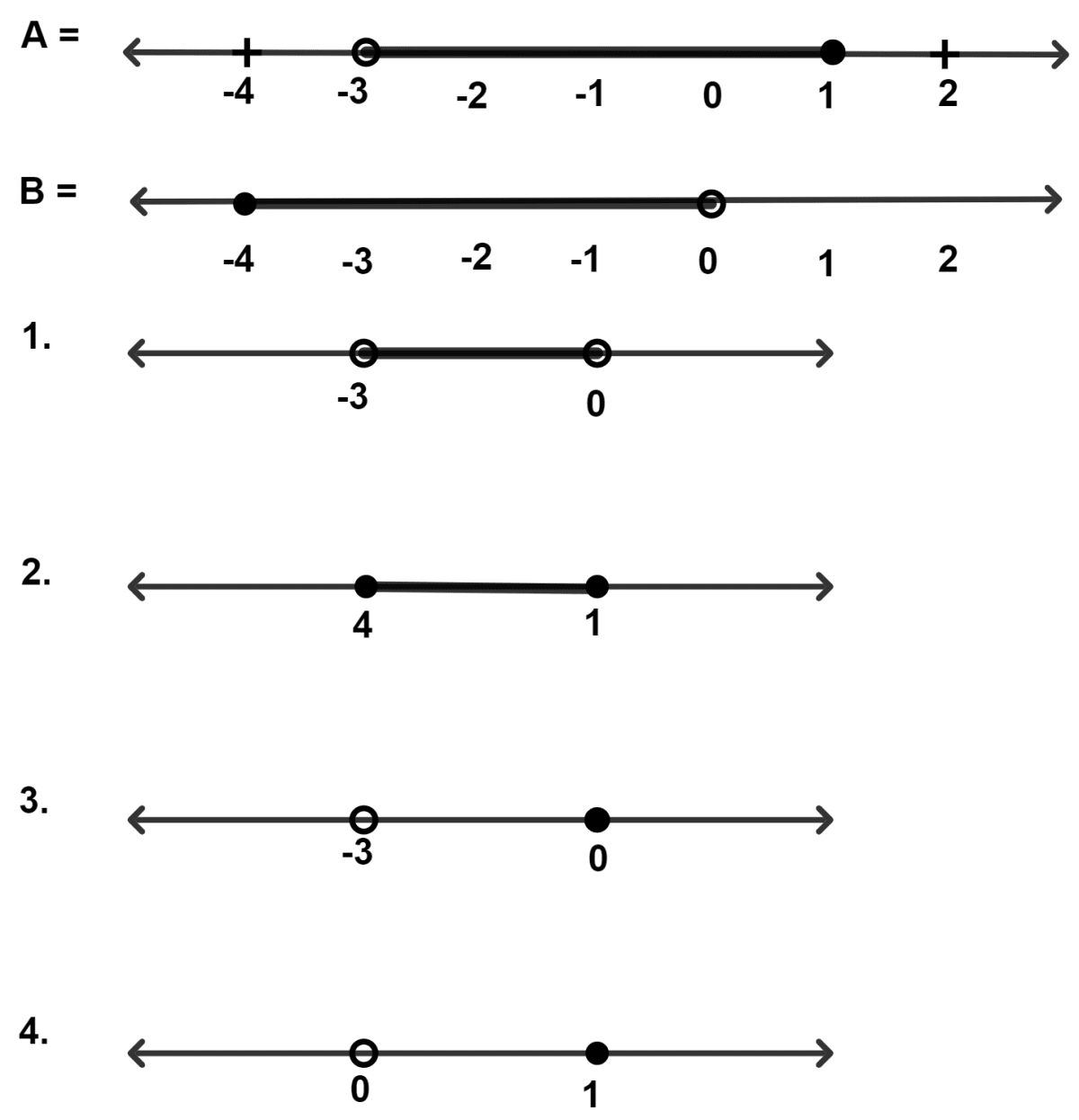
The real number lines for two inequations A and B are as given below, A ∩ B is :
Answer
A = {x : x ∈ R and -3 < x ≤ 1}
B = {x : x ∈ R and -4 ≤ x < 0}
A ∩ B = {x : x ∈ R and -3 < x < 0}
Hence, Option 1 is the correct option.
For the inequations A and B [as given above in part (d)], A ∪ B is :
![For the inequations A and B [as given above in part (d)], A ∪ B is : Linear Inequations, Concise Mathematics Solutions ICSE Class 10.](https://cdn1.knowledgeboat.com/img/cm10/q1-e-test-linear-inequations-maths-concise-icse-class-10-solutions-1126x1099.png)
Answer
A = {x : x ∈ R and -3 < x ≤ 1}
B = {x : x ∈ R and -4 ≤ x < 0}
A ∪ B = {x : x ∈ R and -4 ≤ x ≤ 1}
Hence, Option 1 is the correct option.
where x ∈ R.
Assertion (A): The largest value of x is .
Reason (R): When the signs of both the sides of an inequalities are changed, the sign of inequality reverses.
A is true, R is false.
A is false, R is true.
Both A and R are true and R is the correct reason for A.
Both A and R are true and R is the incorrect reason for A.
Answer
Both A and R are true and R is the correct reason for A.
Reason
According to the assertion:
So, Assertion (A) is true.
According to the reason:
When you multiply or divide both sides of an inequality by a negative number, the direction of the inequality sign must be reversed to maintain the validity of the inequality
So, Reason (R) is true.
Hence, option 3 is correct.
Inequation 5 - 2x ≥ x - 10, where x ∈ N (Natural numbers)
Assertion (A): 5 - 2x ≥ x - 10 ⇒ -3x ≥ -15 ⇒ x ≥ 5
∴ Solution set = {5, 6, 7, 8, ..........}
Reason (R): 5 - 2x ≥ x - 10 ⇒ 5 + 10 ≥ 3x ⇒ x ≤ 5
∴ Solution set = {1, 2, 3, 4, 5}
A is true, R is false.
A is false, R is true.
Both A and R are true and R is correct reason for A.
Both A and R are true and R is incorrect reason for A.
Answer
A is false, R is true.
Reason
According to Assertion: 5 - 2x ≥ x - 10
⇒ 5 - 2x + 10 ≥ x
⇒ -2x + 15 ≥ x
⇒ 15 ≥ x + 2x
⇒ 15 ≥ 3x
⇒ x ≤
⇒ x ≤ 5
∴ Solution set = {1, 2, 3, 4, 5}
So, Assertion (A) is false.
According to Reason:
Solution set = {1, 2, 3, 4, 5}
So, Reason (R) is true.
Hence, A is false, R is true.
x ∈ W, x ≥ -3 and x < 5.
Statement (1) : There will be no solution for the given inequalities.
Statement (2) : The real number line for the given inequations is :

Both the statements are true.
Both the statements are false.
Statement 1 is true, and statement 2 is false.
Statement 1 is false, and statement 2 is true.
Answer
Statement 1 is false, and statement 2 is true.
Reason
x ≥ -3
Solution set of x = {-3, -2, -1, 0, 1, 2, ..........} .......... (1)
And, x < 5
Solution set of x = {.........., 1, 2, 3, 4} .......... (2)
From (1) and (2), we get
Solution set = {-3, -2, -1, 0, 1, 2, 3, 4}
So, statement 1 is false.
The real number line for the given inequations is :
So, statement 2 is true.
Hence, option 4 is correct.
5 + x ≤ 2x < x - 2, x ∈ R.
Statement (1) : There is no value of x ∈ R that satisfies the given inequation.
Statement (2) : 5 + x - x ≤ 2x - x < x - 2 - x ⇒ 5 ≤ x < -2
Both the statements are true.
Both the statements are false.
Statement 1 is true, and statement 2 is false.
Statement 1 is false, and statement 2 is true.
Answer
Both the statements are true.
Reason
Given,
Equation : 5 + x ≤ 2x < x - 2
⇒ 5 + x ≤ 2x
⇒ 5 ≤ 2x - x
⇒ 5 ≤ x .......... (1)
And, 2x < x - 2
⇒ 2x - x < -2
⇒ x < -2 .......... (2)
There can be no real number which is greater than or equal to 5 and less than -2 at the same time.
∴ Both the statements are true.
Hence, option 1 is correct.
Solve the inequation :
and x ∈ R.
Answer
Given,
∴ Solution set = {x : x ∈ R and x ≥ 6}.
Given x ∈ {whole numbers}, find the solution set of :
-1 ≤ 3 + 4x < 23
Answer
Given,
-1 ≤ 3 + 4x < 23
Solving L.H.S. of the equation,
⇒ -1 ≤ 3 + 4x
⇒ 4x ≥ -1 - 3
⇒ 4x ≥ -4
⇒ x ≥ -1 ........(i)
Solving R.H.S. of the equation,
⇒ 3 + 4x < 23
⇒ 4x < 23 - 3
⇒ 4x < 20
⇒ x < 5 .........(ii)
From (i) and (ii) we get,
-1 ≤ x < 5
Since, x ∈ {whole numbers},
∴ Solution set = {0, 1, 2, 3, 4}.
Find the set of values of x, satisfying :
7x + 3 ≥ 3x - 5 and , where x ∈ N.
Answer
Solving,
⇒ 7x + 3 ≥ 3x - 5
⇒ 7x - 3x ≥ -5 - 3
⇒ 4x ≥ -8
⇒ x ≥ -2 .......(i)
Solving,
From (i) and (ii) we get,
-2 ≤ x ≤ 5
Since, x ∈ N
∴ Solution set = {1, 2, 3, 4, 5}.
Solve :
(i) , where x is a positive odd integer
(ii) , where x is a positive even integer
Answer
(i) Solving,
Since, x is a positive odd integer
∴ Solution set = {1, 3, 5}.
(ii) Solving,
Since, x is a positive even integer
∴ Solution set = {2, 4, 6, 8, 10, 12, 14}.
Solve the inequation :
, x ∈ W.
Graph the solution set on the number line.
Answer
Given,
Solving L.H.S. of the equation,
Solving R.H.S. of the equation,
From (i) and (ii) we get,
Since, x ∈ W
∴ Solution set = {0, 1, 2}.
Solution on the number line is :

Find three consecutive largest positive integers such that the sum of one-third of first, one-fourth of second and one-fifth of third is at most 20.
Answer
Let three consecutive positive integers be x, x + 1 and x + 2.
Given, sum of one-third of first, one-fourth of second and one-fifth of third is at most 20
∴ x = 24, x + 1 = 25, x + 2 = 26.
Hence, three consecutive numbers are 24, 25 and 26.
Solve the following inequation and represent the solution set on the number line :
4x - 19 < , x ∈ R
Answer
Given,
4x - 19 <
Solving L.H.S. of the equation,
Solving R.H.S. of the equation,
From (i) and (ii) we get,
-4 ≤ x < 5
∴ Solution set = {x : -4 ≤ x < 5, x ∈ R}.
Solution on the number line is :

Find the greatest value of x ∈ Z, so that :
-1 ≤ 3 + 4x < 23
Answer
Given,
-1 ≤ 3 + 4x < 23
Solving L.H.S. of the inequation,
⇒ -1 ≤ 3 + 4x
⇒ -1 - 3 ≤ 4x
⇒ -4 ≤ 4x
⇒ ≤ x
⇒ -1 ≤ x
⇒ x ≥ -1 ....(1)
Solving R.H.S. of the inequation,
⇒ 3 + 4x < 23
⇒ 4x < 23 - 3
⇒ 4x < 20
⇒ x <
⇒ x < 5 ....(2)
From (1) and (2) we get,
-1 ≤ x < 5
Since x ∈ Z,
x = {-1, 0, 1, 2, 3, 4}
Hence, greatest value of x is 4.
If 7 ≥ -2x + 1 > -7 ; find the sum of greatest and smallest values of x ∈ I.
Answer
Given,
7 ≥ -2x + 1 > -7
Solving L.H.S. of the inequation,
⇒ 7 ≥ -2x + 1
⇒ 7 - 1 ≥ -2x
⇒ 6 ≥ -2x
⇒ 2x ≥ -6
⇒ x ≥
⇒ x ≥ -3 ....(1)
Solving R.H.S. of the inequation,
⇒ -2x + 1 > -7
⇒ -2x > -7 - 1
⇒ -2x > -8
⇒ 2x < 8
⇒ x <
⇒ x < 4 ....(2)
From (1) and (2) we get,
-3 ≤ x < 4
Since x ∈ I,
x = {-3, -2, -1, 0, 1, 2, 3}
Greatest value of x is 3 and smallest value of x is -3
The sum of greatest and smallest values of x = -3 + 3 = 0
Hence, sum of greatest and smallest values of x = 0.