
The sum of a number and its reciprocal is 4.25; the number is :
2 or
4 or
or 5
or 3
Answer
Let the number be x.
Given,
Sum of a number and its reciprocal is 4.25
Hence, Option 2 is the correct option.
The sum of two whole numbers is 18 and their product is 45, the numbers are :
15 and 3
-15 and -3
-15 and 3
15 and -3
Answer
Let numbers be x and y.
Given,
Sum of whole numbers = 18
⇒ x + y = 18
⇒ x = 18 - y ......(1)
Product = 45
⇒ xy = 45 ........(2)
Substituting value of x from equation (1) in equation (2), we get :
⇒ (18 - y)y = 45
⇒ 18y - y2 = 45
⇒ y2 - 18y + 45 = 0
⇒ y2 - 15y - 3y + 45 = 0
⇒ y(y - 15) - 3(y - 15) = 0
⇒ (y - 3)(y - 15) = 0
⇒ y - 3 = 0 or y - 15 = 0
⇒ y = 3 or y = 15.
If y = 3,
x = 18 - y = 18 - 3 = 15.
If y = 15,
x = 18 - y = 18 - 15 = 3.
Hence, Option 1 is the correct option.
The lengths of a rectangle is 3 m more than its width. If its area is 180 m2; the length of the rectangle is :
12 m
9 m
15 m
10 m
Answer
Let width be x meters and length be (x + 3) meters.
Given,
Area = 180 m2
⇒ x(x + 3) = 180
⇒ x2 + 3x = 180
⇒ x2 + 3x - 180 = 0
⇒ x2 + 15x - 12x - 180 = 0
⇒ x(x + 15) - 12(x + 15) = 0
⇒ (x - 12)(x + 15) = 0
⇒ x - 12 = 0 or x + 15 = 0
⇒ x = 12 or x = -15.
Since, width cannot be negative.
∴ x = 12 meters.
Length = x + 3 = 12 + 3 = 15 meters.
Hence, Option 3 is the correct option.
The speed of a boat in still water is 15 km/hr and speed of stream is 5 km/hr. The boat goes x km downstream and then returns back to the point of start in :
hrs
hrs
hrs
hrs
Answer
Speed of boat (downstream) = Speed of boat in still water + Speed of stream = 15 + 5 = 20 km/hr.
Speed of boat (upstream) = Speed of boat in still water - Speed of stream = 15 - 5 = 10 km/hr.
By formula,
Time =
Time taken by boat to go x km downstream =
Time taken by boat to go x km upstream =
Total time taken = hrs.
Hence, Option 3 is the correct option.
One pipe can fill an empty cistern in 3 hrs less than the another pipe. When both the pipes are opened together, the empty cistern is filled in 2 hrs. The second pipe will fill the empty cistern in :
3 hrs
6 hrs
1 hr
5 hrs
Answer
Let time taken by 2nd pipe be x min.
So, in 1 min it will fill of cistern.
So, 1st pipe will take 3 hrs i.e. 180 min less = (x - 180) min
So, in 1 min it will fill of cistern.
Both pipes will fill the cistern together in 2 hrs i.e. 120 mins.
So, in 1 min they will fill = of cistern.
x cannot be equal to 60 as then x - 180 will be negative, which is not possible as time cannot be negative.
∴ x = 360 mins = 6 hours.
Hence, Option 2 is the correct option.
The sum of the ages of Rohan and his father is 35 years, whereas the product of their ages is 150.
Assertion (A) : Rohan's age is 5 years.
Reason (R) : If Rohan's age is x years then x(35 - x) = 150
option
A is true, R is false.
A is false, R is true.
Both A and R are true and R is correct reason for R.
Both A and R are true and R is incorrect reason for R.
Answer
Both A and R are true and R is correct reason for R.
Reason
Let the age of Rohan be x years.
It is given that the sum of the ages of Rohan and his father is 35 years.
⇒ Father's age = 35 - x
And, the product of their ages is 150.
⇒ x(35 - x) = 150
⇒ 35x - x2 = 150
⇒ 35x - x2 - 150 = 0
⇒ x2 - 35x + 150 = 0
⇒ x2 - 30x - 5x + 150 = 0
⇒ x(x - 30) - 5(x - 30) = 0
⇒ (x - 30)(x - 5) = 0
⇒ (x - 30) = 0 or (x - 5) = 0
⇒ x = 30 or x = 5
When son's age is 5 years, father's age = (35 - x) = (35 - 5) = 30 years.
When son's age is 30 years, father's age = (35 - x) = (35 - 30) = 5 years (father's age is less than son's age which is not possible).
So, Assertion (A) and Reason (R) both are true and R is correct reason for A.
Hence, option 3 is the correct option.
The speed of a boat downstream is 20 km/hr and upstream is 16 km/hr.
Assertion (A) : The speed of the boat in still water = km/hr.
Reason (R) : If the speed of boat in still water is x km/hr and the speed of stream is y km/hr, the speed downstream equals to (x + y) km/hr and speed upstream equals to (x - y) km/hr.
A is true, R is false.
A is false, R is true.
Both A and R are true and R is the correct reason for R.
Both A and R are true and R is the incorrect reason for R.
Answer
A is false, R is true.
Reason
Given,
Speed of boat downstream = 20 km/hr
Speed of boat upstream = 16 km/hr
Let the speed of boat in still water is x km/hr and the speed of stream is y km/hr.
Speed of boat downstream = x + y
⇒ x + y = 20 .......... (1)
Speed of boat upstream = x - y
⇒ x - y = 16 .......... (2)
Adding equation (1) and (2), we get
⇒ x = = 18 km/hr
Subtracting equation (2) from (1), we get
⇒ y = = 2 km/hr
According to Assertion, the speed of the boat in still water = km/hr = km/hr = 1 km/hr.
So, Assertion (A) is false but Reason (R) is true.
Hence, option 2 is the correct option.
Two consecutive natural numbers each of which is multiple of 3 and with their product = 108.
Statement 1: The required natural numbers are 9 and 12.
Statement 2: If two natural numbers are 3x and 3x + 3; 3x(3x + 3) = 108.
Both the statement are true.
Both the statement are false.
Statement 1 is true, and statement 2 is false.
Statement 1 is false, and statement 2 is true.
Answer
Both the statement are true.
Reason
Let the two consecutive natural numbers each of which is multiple of 3 be 3x and 3(x + 1).
Product = 108
⇒ 3x 3(x + 1) = 108
⇒ 3x (3x + 3) = 108
⇒ 9x2 + 9x = 108
⇒ 9x2 + 9x - 108 = 0
⇒ 9(x2 + x - 12) = 0
⇒ x2 + x - 12 = 0
⇒ x2 + 4x - 3x - 12 = 0
⇒ x(x + 4) - 3(x + 4) = 0
⇒ (x + 4)(x - 3) = 0
⇒ (x + 4) = 0 or (x - 3) = 0
⇒ x = -4 or x = 3
Since, number are two natural numbers. So, x = 3.
And, when x = 3, two consecutive numbers = 3 x 3 = 9 and 3 x (3 + 1) = 3 x 4 = 12
So, both statements are true.
Hence, option 1 is the correct option.
The selling price of an article is ₹24. If cost price is ₹x and loss is x%.
Statement 1: x - x% of ₹24
Statement 2: x - x% of x = ₹24
Both the statement are true.
Both the statement are false.
Statement 1 is true, and statement 2 is false.
Statement 1 is false, and statement 2 is true.
Answer
Statement 1 is false, and statement 2 is true.
Reason
Given,
C.P. = ₹x
S.P. = ₹24
Loss% = x%
Using the formula, Loss = C.P. - S.P.
⇒ S.P. = C.P. - Loss
⇒ S.P. = C.P. - Loss% of C.P.
Substituting the values, we get
⇒ 24 = x - x% of x
So, statement 2 is true.
Hence, option 4 is the correct option.
The distance by road between two towns A and B is 216 km, and by rail it is 208 km. A car travels at a speed of x km/hr and the train travels at a speed which is 16 km/hr faster than the car. Calculate :
(i) the time taken by the car to reach town B from A, in terms of x;
(ii) the time taken by the train, to reach town B from A, in terms of x.
(iii) If the train takes 2 hours less than the car, to reach town B, obtain an equation in x and solve it.
(iv) Hence, find the speed of the train.
Answer
(i) Time taken by car = hours.
Hence, time taken by car = hours.
(ii) Time taken by train = hours.
Hence, time taken by train = hours.
(iii) According to question,
Since speed cannot be negative,
∴ x = 36
Hence, required equation = and x = 36.
(iv) Speed of train = x + 16 = 36 + 16 = 52.
Hence, speed of train = 52 km/hr.
A trader buys x articles for a total cost of ₹ 600.
(i) Write down the cost of one article in terms of x.
If the cost per article were ₹ 5 more, the number of articles that can be bought for ₹ 600 would be four less.
(ii) Write down the equation in x for the above situation and solve it for x.
Answer
(i) Total cost = ₹ 600
No. of articles = x
Cost of each article = ₹
Hence, cost of each article = ₹ .
(ii) According to question,
Since no. of articles cannot be negative,
∴ x ≠ -20.
From (i) we get quadratic equation,
Hence, required quadratic equation and x = 24.
A hotel bill for a number of people for overnight stay is ₹ 4800. If there were 4 people more, the bill each person had to pay, would have reduced by ₹ 200. Find the number of people staying overnight.
Answer
Let no. of people be x.
Each person's bill = ₹
According to question,
No. of people cannot be negative,
∴ x = 8.
Hence, no. of people staying overnight = 8.
An aeroplane travelled a distance of 400 km at an average speed of x km/hr. On the return journey, the speed was increased by 40 km/hr. Write down an expression for the time taken for :
(i) onward journey
(ii) the return journey
If the return journey took 30 minutes less than the onward journey, write down an equation in x and find its value.
Answer
(i) Time =
Time taken for onward journey = hours.
(ii) Time =
Time taken for return journey = hours.
According to question,
Since speed cannot be negative,
∴ x = 160
Hence, required equation = and speed = 160 km/hr.
A plane left 30 minutes later than the scheduled time and in order to reach its destination 1500 km away in time, it has to increase its speed by 250 km/hr from its usual speed. Find its usual speed.
Answer
Let usual speed be x km/hr
Time taken = hours
If speed is increased by 250 km/hr then time taken = hours
Given, on increasing speed it takes 30 minutes less,
Since, speed cannot be negative
∴ x ≠ -1000.
Hence, usual speed = 750 km/hr.
In an auditorium, seats were arranged in rows and columns. The number of rows was equal to number of seats in each row. When the number of rows was doubled and the number of seats in each row was reduced by 10, the total number of seats increased by 300. Find :
(i) the number of rows in the original arrangement.
(ii) the number of seats in the auditorium after re-arrangement.
Answer
(i) Let no. of rows be x and no. of seats in each row = x.
Total no. of seats = x2
If row is doubled then rows = 2x
No. of seats in each row are reduced by 10 = (x - 10)
Total no. of seats = 2x(x - 10)
According to question,
⇒ 2x(x - 10) - x2 = 300
⇒ 2x2 - 20x - x2 = 300
⇒ x2 - 20x - 300 = 0
⇒ x2 - 30x + 10x - 300 = 0
⇒ x(x - 30) + 10(x - 30) = 0
⇒ (x - 30)(x + 10) = 0
⇒ x - 30 = 0 or x + 10 = 0
⇒ x = 30 or x = -10.
Since, no. of rows cannot be negative,
∴ x = 30
Hence, no. of rows in original arrangement = 30.
(ii) No. of seats after rearrangement = 2x(x - 10) = 2(30)(30 - 10) = 2 × 30 × 20 = 1200.
Hence, no. of seats after rearrangement = 1200.
In a certain positive fraction, the denominator is greater than the numerator by 3. If 1 is subtracted from the numerator and the denominator both, the fraction reduces by . Find the fraction.
Answer
Let numerator be x and denominator = x + 3.
Fraction =
New fraction's numerator = x - 1 and denominator = x + 3 - 1 = x + 2
New Fraction =
According to question,
Since fraction is positive,
∴ x ≠ -9.
Fraction = .
Hence, fraction = .
In a two digit number, the ten's digit is bigger. The product of the digits is 27 and the difference between the two digits is 6. Find the number.
Answer
Let ten's digit be x and one's digit be y.
According to question,
⇒ xy = 27 ........(i)
⇒ x - y = 6
⇒ x = 6 + y .......(ii)
Substituting value of x from (ii) in (i) we get,
⇒ (6 + y)y = 27
⇒ y2 + 6y = 27
⇒ y2 + 6y - 27 = 0
⇒ y2 + 9y - 3y - 27 = 0
⇒ y(y + 9) - 3(y + 9) = 0
⇒ (y - 3)(y + 9) = 0
⇒ y - 3 = 0 or y + 9 = 0
⇒ y = 3 or y = - 9.
Since digits cannot be negative,
∴ y ≠ -9
x = 6 + y = 6 + 3 = 9
Number = 10(x) + y = 10(9) + 3 = 93.
Hence, number = 93.
₹ 480 is divided equally among 'x' children. If the number of children were 20 more then each would have got ₹ 12 less. Find 'x'.
Answer
No. of children = x and money = ₹ 480
Each children received = ₹
No. of new children = x + 20
Each children received = ₹
According to question,
Since no. of children cannot be negative,
∴ x ≠ -40.
Hence, x = 20.
A rectangular plot has an area of 24 m2. If its perimeter is 20 m, find its length.
Answer
Let the length and the breadth of rectangular plot be l m and b m.
Area of rectangle: l × b = 24 .....(1)
Perimeter of rectangle = 20 m
⇒ 2(l + b) = 20
⇒ (l + b) =
⇒ (l + b) = 10
⇒ b = 10 - l
Substituting value of 'b' in equation (1), we get:
⇒ l × (10 - l) = 24
⇒ 10l - l2 = 24
⇒ l2 - 10l + 24 = 0
⇒ l2 - 6l - 4l + 24 = 0
⇒ l(l - 6) - 4(l - 6) = 0
⇒ (l - 4)(l - 6) = 0
⇒ (l - 4) = 0 or (l - 6) = 0
⇒ l = 4 or 6.
Length of rectangle = 6 m or 4 m
Hence, the length of the rectangular plot is 6 m or 4 m.
A rectangular garden 10 m by 16 m is surrounded by a concrete walk of uniform width. The area of concrete walk is 120 square metre.
Assuming the width of the walk to be x m, form an equation in x and solve it to find the value of x.
Answer
Let ABCD be a rectangular garden.
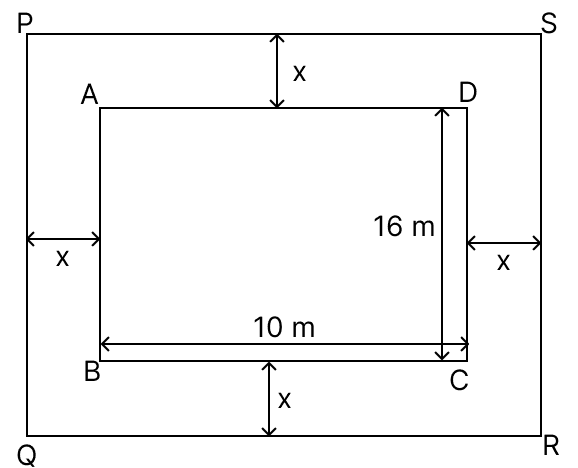
Let the width of the walk be x m
ABCD is the rectangular garden,
Length of rectangular garden = 16 m
Breadth of rectangular garden = 10 m
From figure,
Length of PQRS = 16 + x + x = (16 + 2x) m
Breadth of PQRS = 10 + x + x = (10 + 2x) m
Area of PQRS = (16 + 2x)(10 + 2x)
Area of rectangular garden ABCD = 16 × 10 = 160 m2
Area of concrete walk = 120
Now,
From figure,
⇒ Area of walk = Area of rectangle PQRS - Area of rectangle ABCD
⇒ (16 + 2x)(10 + 2x) - 160 = 120
⇒ (16 + 2x)(10 + 2x) = 120 + 160
⇒ (16 + 2x)(10 + 2x) = 280
⇒ 160 + 32x + 20x + 4x2 = 280
⇒ 4x2 + 52x + 160 = 280
⇒ 4x2 + 52x + 160 - 280 = 0
⇒ 4x2 + 52x - 120 = 0
⇒ 4(x2 + 13x - 30) = 0
⇒ x2 + 13x - 30 = 0
⇒ x2 + 15x - 2x - 30 = 0
⇒ x(x + 15) - 2(x + 15) = 0
⇒ (x - 2)(x + 15) = 0
⇒ (x - 2) = 0 or (x + 15) = 0
⇒ x = 2 or x = -15
Since width cannot be negative,
x = 2 m.
Hence, the width of the concrete walk is 2 m.
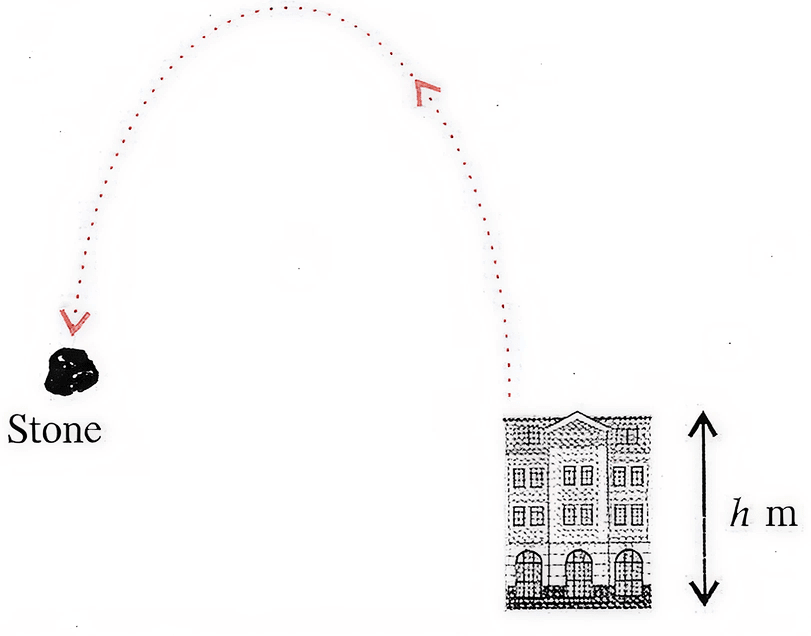
A stone is thrown into air from the top of a building of height h m. The height of the stone (in metres) above the ground after t seconds is given by h(t) = 5t2 + 30t + 2; where t is the time from when the stone is thrown.
(i) How high will the stone be from the ground after 2 seconds?
(ii) From what height, above the ground, the stone is thrown?
(iii) At what time will the stone be 37 m above the ground?
Answer
(i) Given,
The height of the stone above the ground after t seconds: h (t) = 5t2 + 30t + 2
t = 2
Substituting value of t = 2 in h(t):
⇒ h(2) = 5(2)2 + 30(2) + 2
= 5(4) + 60 + 2
= 20 + 60 + 2
= 82 m.
Hence, the height after 2 seconds is 82 m.
(ii) The initial height of stone,
Substituting value of t = 0 in h(t):
⇒ h(0) = 5(0)2 + 30(0) + 2
= 2 m.
Hence, stone is thrown from a height of 2 m.
(iii) Given,
h(t) = 37
⇒ 5t2 + 30t + 2 = 37
⇒ 5t2 + 30t + 2 - 37 = 0
⇒ 5t2 + 30t - 35 = 0
⇒ 5(t2 + 6t - 7) = 0
⇒ t2 + 6t - 7 = 0
⇒ t2 + 7t - t - 7 = 0
⇒ t(t + 7) - 1(t + 7) = 0
⇒ (t - 1)(t + 7) = 0
⇒ (t - 1) = 0 or (t + 7) = 0
⇒ t = 1 or t = -7
Since time cannot be negative,
t = 1 second.
Hence, stone will be 37 m above the ground after 1 second.