
Two years ago the ages of Radha and Meena were in the ratio 5 : 2. If the sum of their present ages is 39 years, their ages, 2 years ago, were :
27 years and 12 years
17 years and 22 years
25 years and 10 years
11 years and 28 years
Answer
Let present ages of Radha and Meena be x and y years respectively.
Given,
Sum of present ages = 39
⇒ x + y = 39
⇒ x = 39 - y ........(1)
Given,
Two years ago the ages of Radha and Meena were in the ratio 5 : 2.
x = 39 - y = 39 - 12 = 27.
∴ Radha's ages = 27 years and Meena's age = 12 years.
Two years ago their age will be :
x - 2 = 27 - 2 = 25 years and y - 2 = 12 - 2 = 10 years.
Hence, Option 3 is the correct option.
The perimeter of a rectangular field is 28 m and its area is 40 sq. m. Its sides are :
8 m and 6 m
4 m and 10 m
10 m and 6 m
3 m and 11 m
Answer
Let length and breadth of rectangular field be l and b meters respectively.
By formula,
⇒ Perimeter = 2(l + b)
⇒ 28 = 2(l + b)
⇒ l + b = 14
⇒ l = 14 - b ......(1)
By formula,
⇒ Area = lb
⇒ 40 = lb
Substituting value of l from equation (1), we get :
⇒ 40 = b(14 - b)
⇒ 40 = 14b - b2
⇒ b2 - 14b + 40 = 0
⇒ b2 - 10b - 4b + 40 = 0
⇒ b(b - 10) - 4(b - 10) = 0
⇒ (b - 4)(b - 10) = 0
⇒ b - 4 = 0 or b - 10 = 0
⇒ b = 4 or b = 10.
If b = 4,
l = 14 - b = 14 - 4 = 10.
If b = 10,
l = 14 - b = 14 - 10 = 4.
∴ Sides = 4 m and 10 m.
Hence, Option 2 is the correct option.
The perimeter of a square is numerically equal to its area. The perimeter of the square is :
4 units
8 units
12 units
16 units
Answer
Let side of square be x units.
Given,
Area = Perimeter
⇒ (side)2 = 4 × side
⇒ x2 = 4x
⇒ x2 - 4x = 0
⇒ x(x - 4) = 0
⇒ x = 0 or x - 4 = 0
⇒ x = 0 or x = 4.
Since, side cannot be equal to zero.
∴ Side = 4 units
Perimeter = 4 × 4 = 16 units.
Hence, Option 4 is the correct option.
If the width of the uniform shaded portion is x m; its area in terms of x is :
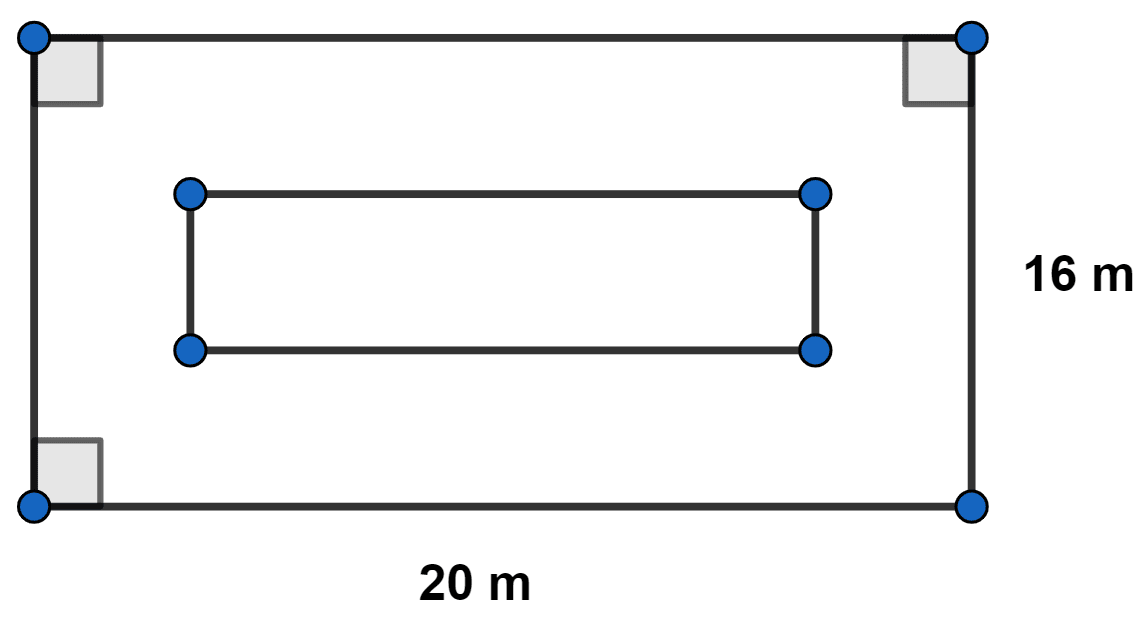
320 m2 - (16 - 2x)(20 - 2x) m2
320 m2 - (16 - x)(20 - x) m2
320 m2 - (16 - 2x)(20 - x) m2
320 m2 - (16 - x)(20 - 2x) m2
Answer
From figure,
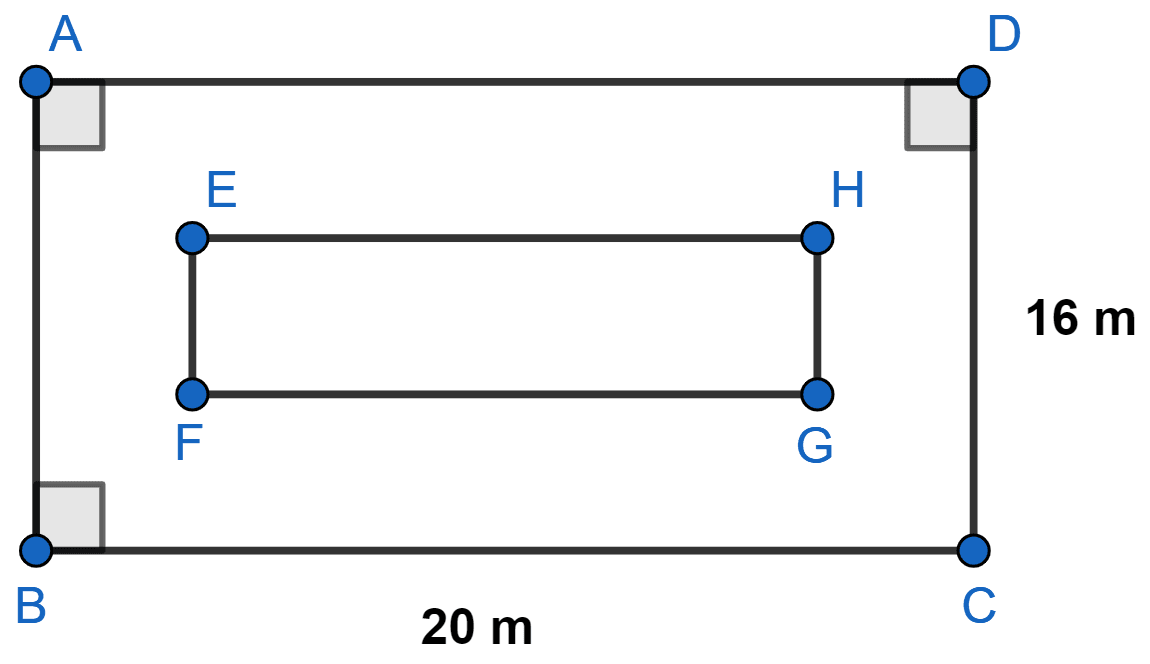
EF = 16 - x - x = (16 - 2x) meters
FG = 20 - x - x = (20 - 2x) meters
Area of shaded portion = Area of rectangle ABCD - Area of rectangle EFGH
= AB × BC - EF × FG
= 16 × 20 - (16 - 2x)(20 - 2x)
= 320 m2 - (16 - 2x)(20 - 2x) m2.
Hence, Option 1 is the correct option.
The speed of a boat is 32 km/h. If the speed of stream is 8 km/h, the speed of the boat upstream is :
36km/h
40 km/h
16 km/h
24 km/h
Answer
Speed of boat upstream = Speed of boat - Speed of stream
= 32 km/h - 8 km/h
= 24 km/h
Hence, Option 4 is the correct option.
The speed of train A is x km/hr and speed of train B is (x - 5) km/h. How much time will each train take to cover 400 km ?
hrs
x × 400 hrs and (x - 5) × 400 hrs
hrs
hrs
Answer
By formula,
Time =
For train A :
Time taken = hrs.
For train B :
Time taken = hrs.
Hence, Option 3 is the correct option.
A boy is twice as old as her sister. Four years hence, the product of their ages (in years) will be 160. Find their present ages.
Answer
Let the age of sister be x years.
It is given in question that the boy is twice as old as her sister.
⇒ Boy's age = 2x
Four years hence, the product of their ages = 160
⇒ (Sister's age + 4) x (Boy's age + 4) = 160
⇒ (x + 4) (2x + 4) = 160
⇒ x (2x + 4) + 4 (2x + 4) = 160
⇒ 2x2 + 4x + 8x + 16 = 160
⇒ 2x2 + 12x + 16 - 160 = 0
⇒ 2x2 + 12x - 144 = 0
⇒ x2 + 6x - 72 = 0
⇒ x2 + 12x - 6x - 72 = 0
⇒ x(x + 12) - 6(x + 12) = 0
⇒ (x + 12)(x - 6) = 0
⇒ (x + 12) = 0 or (x - 6) = 0
⇒ x = -12 or x = 6
Since age cannot be negative,
∴ Present age of sister = 6 years
Boy's age = 2 x 6 = 12 years
Thus, the present age of boy = 12 years and sister = 6 years.
Seven years ago, Rohit's age was five times the square of Geeta's age. 3 years hence, Geeta's age will be two fifths of Rohit's age. Find their ages.
Answer
Let the age of Geeta be x years and that of Rohit be y years.
It is given that 7 years ago, Rohit's age was five times the square of Geeta's age.
⇒ y - 7 = 5(x - 7)2
⇒ y - 7 = 5(x2 + 49 - 14x)
⇒ y - 7 = 5x2 + 245 - 70x
⇒ y = 5x2 + 245 - 70x + 7
⇒ y = 5x2 + 252 - 70x .......... (1)
And, 3 years hence, Geeta's age will be two fifths of Rohit's age.
⇒ (x + 3) = (y + 3)
⇒ 5(x + 3) = 2(y + 3)
⇒ 5x + 15 = 2y + 6
⇒ 5x + 15 - 6 = 2y
⇒ 5x + 9 = 2y .......... (2)
Substituting the value of y in the above equation,
⇒ 5x + 9 = 2(5x2 + 252 - 70x)
⇒ 5x + 9 = 10x2 + 504 - 140x
⇒ 10x2 + 504 - 140x - 5x - 9 = 0
⇒ 10x2 - 145x + 495 = 0
⇒ 2x2 - 29x + 99 = 0
⇒ 2x2 - 18x - 11x + 99 = 0
⇒ 2x(x - 9) - 11(x - 9) = 0
⇒ (x - 9)(2x - 11) = 0
⇒ (x - 9) = 0 or (2x - 11) = 0
⇒ x = 9 or 2x = 11
⇒ x = 9 or x =
Since, age cannot be in fraction. So, the age of Geeta = 9 years.
Substituting the value of x in equation (2),
⇒ 5 9 + 9 = 2y
⇒ 45 + 9 = 2y
⇒ 54 = 2y
⇒ y = = 27
Thus, the age of Rohit = 27 years and that of Geeta = 9 years.
The sum of the reciprocals of Joseph's age 3 years ago and five years from now is . Find his present age.
Answer
Let present age of Joseph be x years.
It is given that the sum of the reciprocals of Joseph's age 3 years ago and five years from now is .
Since, age cannot be negative.
Hence, the present age of Joseph = 7 years.
The diagonal of a rectangular field is 16 m more than the shorter side. If the longer side is 14 m more than the shorter side, find the length and the breadth of the rectangular field.
Answer
Let the shorter side of the rectangular field be x m.
It is given that the diagonal of a rectangular field is 16 m more than the shorter side.
⇒ d = x + 16
And, the longer side is 14 m more than the shorter side.
⇒ l = x + 14
As we know that angles of rectangle are 90°. Using Pythagoras theorem,
⇒ diagonal2 = length2 + breadth2
⇒ (x + 16)2 = (x + 14)2 + x2
⇒ x2 + 162 + 32x = x2 + 142 + 28x + x2
⇒ x2 + 256 + 32x = 2x2 + 196 + 28x
⇒ 2x2 + 196 + 28x - x2 - 256 - 32x = 0
⇒ x2 - 4x - 60 = 0
⇒ x2 - 10x + 6x - 60 = 0
⇒ x(x - 10) + 6(x - 10) = 0
⇒ (x - 10)(x + 6) = 0
⇒ (x - 10) = 0 or (x + 6) = 0
⇒ x = 10 or x = -6
As length of shorter side cannot be negative,
Length = 10 + 14 = 24 m
Hence, length and breath of the rectangle = 24 m and 10 m.
Sum of the areas of two squares is 260 m2. If the difference of their perimeters is 24 m, find the sides of the two squares.
Answer
Let the sides of two squares be 'a' m and 'b' m.
As we know that area of square = (side)2 and perimeter of square = 4 x side
It is given that sum of the areas of two squares is 260 m2.
⇒ a2 + b2 = 260 .......... (1)
And, the difference of their perimeters is 24 m.
⇒ 4a - 4b = 24
⇒ 4(a - b) = 24
⇒ a - b =
⇒ a - b = 6
⇒ a = 6 + b .......... (2)
Substituting the value of a in equation (1), we get
⇒ (6 + b)2 + b2 = 260
⇒ 36 + b2 + 12b + b2 = 260
⇒ 36 + 2b2 + 12b - 260 = 0
⇒ 2b2 + 12b - 224 = 0
⇒ 2(b2 + 6b - 112) = 0
⇒ b2 + 6b - 112 = 0
⇒ b2 + 14b - 8b - 112 = 0
⇒ b(b + 14) - 8(b + 14) = 0
⇒ (b + 14)(b - 8) = 0
⇒ (b + 14) = 0 or (b - 8) = 0
⇒ b = -14 or b = 8
Since, side of square cannot be negative.
Side of one square = 8 m
Side of other square = 6 + 8 = 14 m
Thus, side of squares = 8 m and 14 m.
A man walks 1 km/hr faster than his usual speed and covers a distance of 3 km in 15 minutes less time. Find his usual speed.
Answer
Let the usual speed of man be x km/hr.
Given that when he walks 1 km/h faster than usual, his speed is (x + 1) km/h, and he covers a distance of 3 km in 15 minutes less time than usual.
Using the formula; Time =
The time it takes for him to cover 3 km at his usual speed x km/h is given by:
Usual time = hr
The time it takes for him to cover 3 km at the faster speed x + 1 km/h is given by:
Faster time = hr
The faster time is 15 minutes ( hours) less than the usual time. Therefore, we can write:
Since, speed cannot be negative,
∴ Usual speed of man = 3 km/hr
Hence, usual speed of man = 3 km/hr.
A bus travels at a certain speed for a distance of 75 km and then travels a distance of 90 km at a speed of 10 km/hr more than the first speed. If it takes 3 hours to complete the journey, find the original speed.
Answer
Let's assume the bus's original speed is x km/hr.
Using the formula; Time =
The time taken to travel 75 km at the original speed x km/hr =
The time taken to travel 90 km at a speed of (x + 10) km/hr (since the second speed is 10 km/h more than the original speed) =
The total time taken for the journey is 3 hours. Therefore, we can write the equation:
Since, speed of bus cannot be negative.
Hence, speed of bus = 50 km/hr.
The speed of an ordinary train is x km per hour and that of an express train is (x + 25) km per hr.
(i) Find the time taken by each train to cover 300 km.
(ii) If the ordinary train takes 2 hrs more than the express train; calculate the speed of the express train.
Answer
(i) We know that,
Time =
Time taken by ordinary train =
Time taken by express train =
Hence, time taken by ordinary train = hours and hours.
(ii) According to question,
Since, speed cannot be negative
∴ x = 50 and x + 25 = 75.
Hence, speed of express train = 75 km/hr.
A goods train leaves a station at 6 p.m., followed by an express train which leaves at 8 p.m. and travels 20 km/hour faster than the goods train. The express train arrives at a station, 1040 km away, 36 minutes before the goods train. Assuming that speed of both the trains remain constant between the two stations; calculate their speeds.
Answer
Let speed of goods train be x km/hr
Speed of express train will be (x + 20) km/hr
Time taken to cover 1040 km by,
Goods train = hours
Express train = hours
Since express train leaves 2 hours after the goods train and arrives 36 minutes before the goods train,
∴ It takes 2 hours 36 minutes less i.e., (2 x 60) + 36 = 156 minutes
Since speed cannot be negative,
∴ x = 80, (x + 20) = 100.
Hence, speed of goods train = 80 km/hr and express train = 100 km/hr.