
Case study:
Cable cars, at hill stations, are major tourist attractions. On a hill station, the length of a cable car ride from the base to the topmost point on the hill is 5000 m. Poles are installed at equal intervals on the way to provide support to the cable on which the car moves.
The distance of the first pole from the base point is 200 m and subsequent poles are installed at equal intervals of 150 m. Further, the distance of the last pole from the top is 300 m.
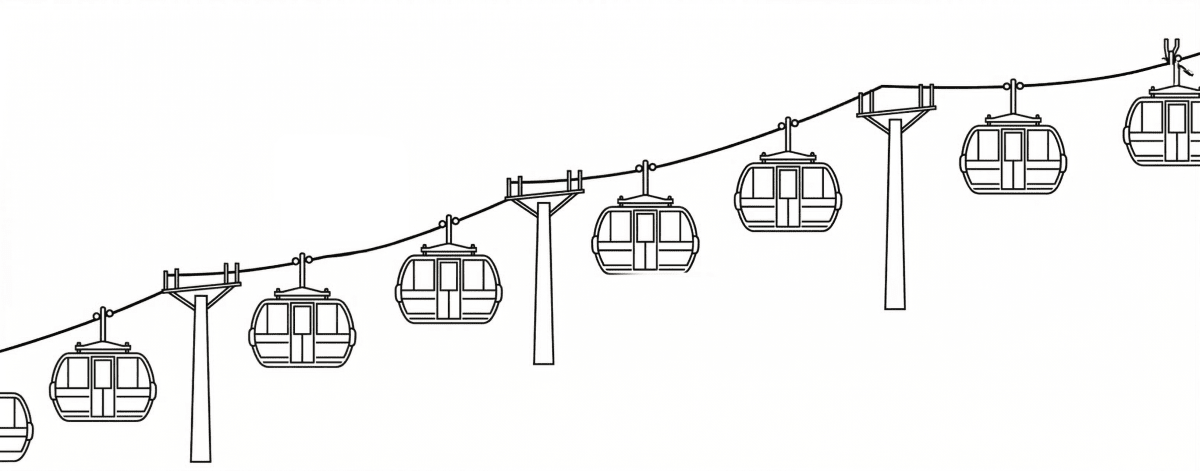
Based on above information, answer the following questions using Arithmetic Progression:
(i) Find the distance of the 10th pole from the base.
(ii) Find the distance between the 15th pole and 25th pole.
(iii) Find the time taken by the cable car to reach the 15th pole from the top if it is moving at a speed of 5 m/s and coming from the top.
Answer
(i) Given,
Total cable length = 5000 m
Distance of first pole from base (a) = 200 m
Distance between poles (d) = 150 m
So poles form an A.P. : 200, 350, 500, 650,…
Distance of 10th pole from base,
We know that,
an = a + (n - 1)d
⇒ a10 = 200 + (9) × 150
= 200 + 1350
= 1550 m.
Hence, distance of 10th pole from base = 1550 m.
(ii) Distance between 15th and 25th poles,
We know that,
an = a + (n - 1)d
⇒ a15 = 200 + (14)150
= 200 + 2100
= 2300 m.
⇒ a25 = 200 + (24)150
= 200 + 3600
= 3800 m.
Distance between 15th and 25th poles = 3800 - 2300 = 1500 m.
Hence, distance between 15th and 25th poles is 1500 m.
(iii) Let the total number of poles be n.
The last pole is 300 m from the top (5000 m point), so its distance from the base is : 5000 - 300 = 4700 m.
∴ an = 4700
⇒ a + (n - 1)d = 4700
⇒ 200 + (n - 1)150 = 4700
⇒ 150(n - 1) = 4700 - 200
⇒ 150(n - 1) = 4500
⇒ n - 1 =
⇒ n - 1 = 30
⇒ n = 30 + 1 = 31.
Thus, there are 31 poles in total.
Thus, the 15th pole from the top = (31 - 15 + 1) = 17th pole from the base.
Distance between 31st and 17th pole = (31 - 17)d = 14d = 14 × 150 = 2100 m.
Total distance from top to the 15th pole from the top = 2100 + 300 = 2400 m
Speed = 5 m/s
Time taken = = 480 s or 8 mins.
Hence, time to reach 15th pole from top = 8 minutes.
Case study:
A school auditorium is to be constructed to accommodate at least 1500 people. The chairs are to be placed in a concentric circular arrangement in such a way that each succeeding circular row has 10 seats more than the previous one.
(i) If the first circular row has 30 seats, how many seats will the 10th row have?
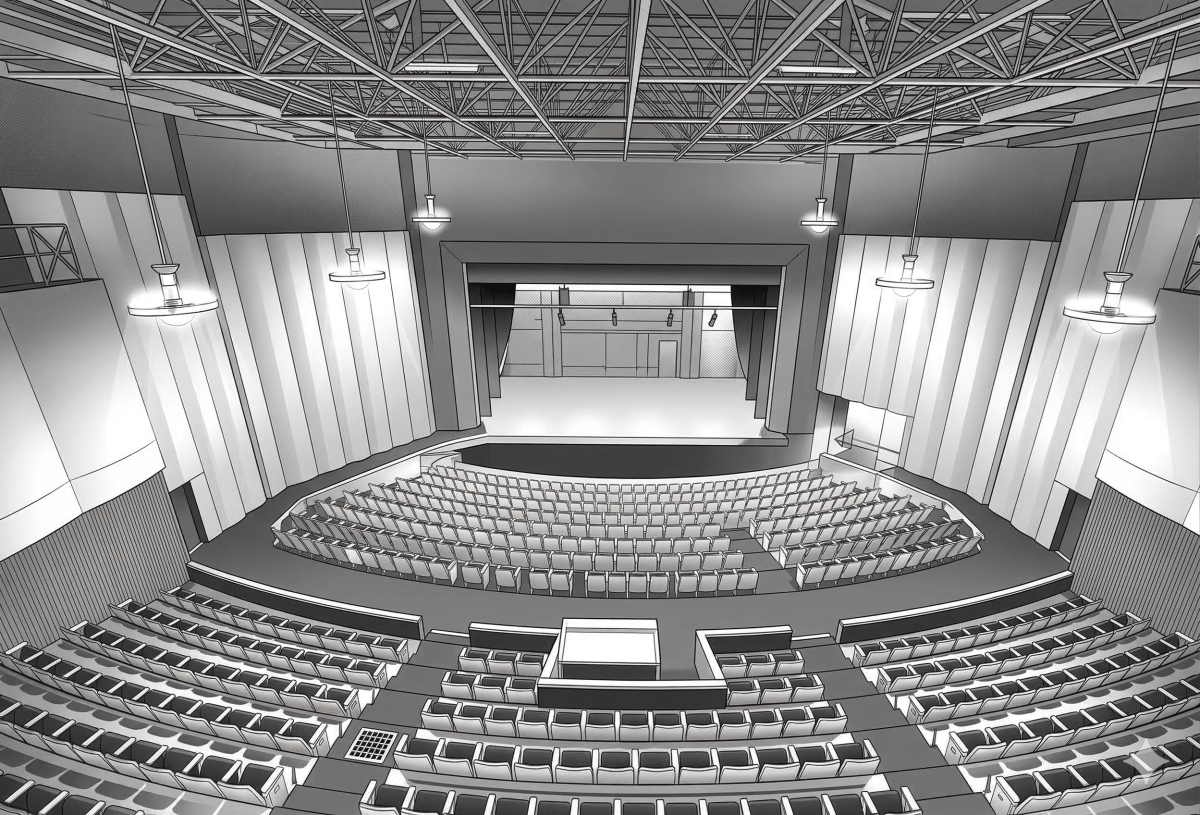
(ii) For 1500 seats in the auditorium, how many circular rows need to be there?
(iii) If there were 17 rows in the auditorium, how many seats will there be in the middle row?
Answer
(i) Given,
The first circular row has 30 seats.
a = 30
Each next row has 10 more seats (d) = 10
So the rows form an A.P.: 30, 40, 50, 60,…
Seats in 10th row :
We know that,
an = a + (n - 1)d
⇒ a10 = 30 + (9) × 10
= 30 + 90
= 120.
Hence, there are 120 seats in the 10th row.
(ii) Let n rows be required for 1500 seats.
By formula,
Substituting values, we get :
Number rows cannot be negative, thus : n = 15
Hence, rows required for 1500 seats = 15.
(iii) If there are 17 rows, seats in the middle row :
Since 17 is odd,
Middle row number = .
9th term :
We know that,
an = a + (n - 1)d
⇒ a9 = 30 + (8)10
= 30 + 80
= 110.
Hence, 110 seats will be there in the middle row.
Case study:
The figure shows a big triangle in which multiple other triangles can be seen. Observe the pattern of dark shaded and light unshaded triangles starting with one triangle in row 1, three triangles in row 2, five triangles in row 3 and so on.
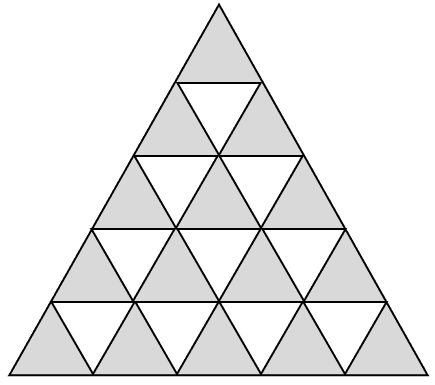
Based on the above information, answer the following questions:
(i) How many triangles will be there in the 15th row?
(ii) In which row will the number of triangles be 47?
(iii) The number of dark shaded triangles in each row are in A.P. Find the total number of dark shaded triangles in the first 15 rows.
Answer
(i) Number of triangles in rows are in A.P.:
1, 3, 5, 7, 9,....
We know that,
an = a + (n - 1)d
⇒ a15 = 1 + (15 - 1).2
= 1 + 14.2
= 1 + 28
= 29.
Hence, 29 triangles will be there in the 15th row.
(ii) We know that,
an = a + (n - 1)d
Let 47 triangles be there in n rows.
⇒ 47 = 1 + (n - 1).2
⇒ 47 - 1 = 2(n - 1)
⇒ = (n - 1)
⇒ 23 = (n - 1)
⇒ n = 23 + 1
⇒ n = 24.
Hence, 47 triangles occur in 24th row.
(iii) In first row, there is 1 dark shaded triangle, in 2nd row there are 2, in 3rd row there are 3.
Thus, the dark shaded triangle are in A.P. with first term (a) = 1 and common difference (d) = 1.
By formula,
Substituting values, we get :
Hence, total number of dark shaded triangles in the first 15 rows = 120.