
Triangles ABC and A'B'C' are similar to each other, the corresponding vertices of the two triangles are :
A and B'
C and A'
B and B'
C' and A
Answer
Given,
Triangles ABC and A'B'C' are similar to each other.
So, the corresponding vertices are A and A', B and B', C and C'.
Hence, Option 3 is the correct option.
Triangles ABC and RSP are similar to each other, the corresponding sides of the two triangles are :
AB and RS
BC and RP
AC and SP
AB and RP
Answer
Given,
Triangles ABC and RSP are similar to each other.
We know that,
Corresponding sides of similar triangle are proportional.
Hence, Option 1 is the correct option.
A : Two similar triangles are congruent.
B : Two congruent triangles are similar, then :
A is true, B is false
A is false, B is true
A is false, B is false
A is true, B is true
Answer
We know that,
Congruent triangles have both the same shape and the same size but it is not necessary that similar triangle are equal in size.
Hence, Option 2 is the correct option.
Triangles ABC and PQR are similar to each other, then :
Answer
We know that,
The areas of two similar triangles are proportional to the squares on their corresponding sides.
.......(1)
.........(2)
From equation (1) and (2), we get :
Hence, Option 2 is the correct option.
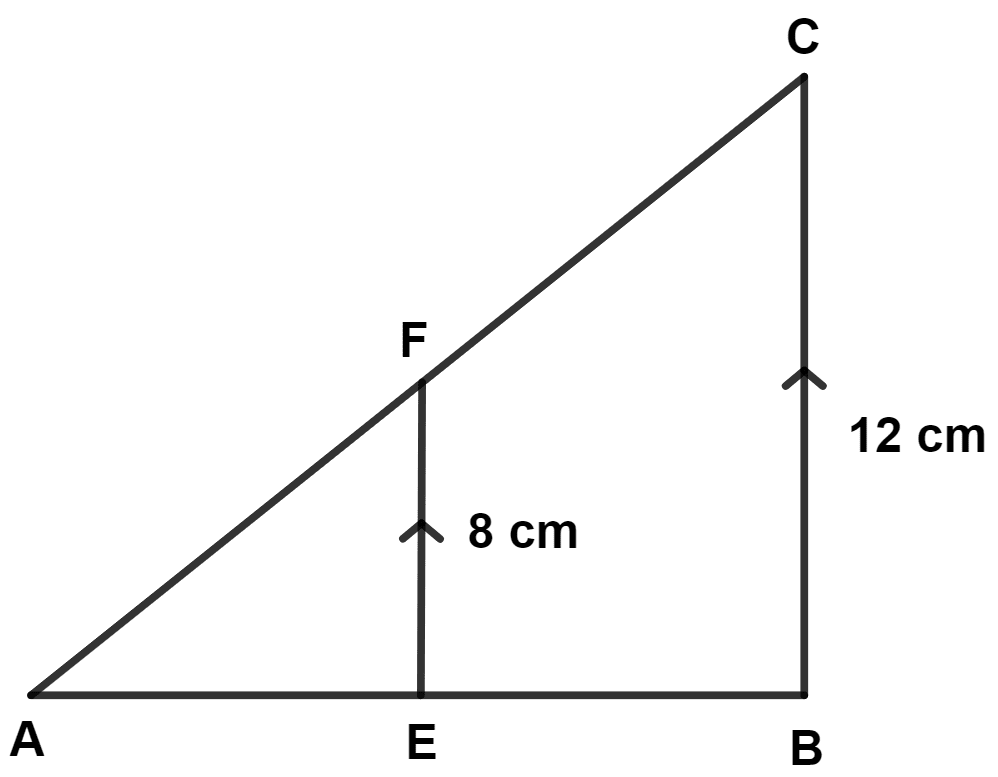
In the given figure, EF is parallel to BC. If area of triangle ABC is 576 cm2, the area of triangle AEF is :
128 cm2
288 cm2
256 cm2
768 cm2
Answer
From figure,
In △ AEF and △ ABC,
⇒ ∠EAF = ∠BAC (Common angle)
⇒ ∠AEF = ∠ABC (Corresponding angle)
∴ △ AEF ~ △ ABC (By A.A. axiom)
We know that,
The areas of two similar triangles are proportional to the squares of their corresponding sides.
Hence, Option 3 is the correct option.
In △ABD, C is a point on side BD such that ∠ACD = ∠BAD. Is △BAD similar to triangle ACD? If yes, then which axiom is satisfied :
Yes, ASA
Yes, SAS
Yes, AA
No

Answer
From figure,
In △ BAD and △ ACD,
⇒ ∠BAD = ∠ACD (Given)
⇒ ∠ADB = ∠ADC (Common angle)
∴ △ BAD ~ △ ACD (By A.A. axiom)
Hence, Option 3 is the correct option.
The model of a ship is made to a scale of 3 : 500. If the length of the model is 1.5 m, the length of ship is :
750 m
1000 m
450 m
250 m
Answer
Given,
Scale factor (k) = 3 : 500
By formula,
⇒ Length of model = Scale factor × Length of ship
Substituting values we get :
Hence, Option 4 is the correct option.
The perpendicular BD drawn from the vertex of a right triangle ABC.
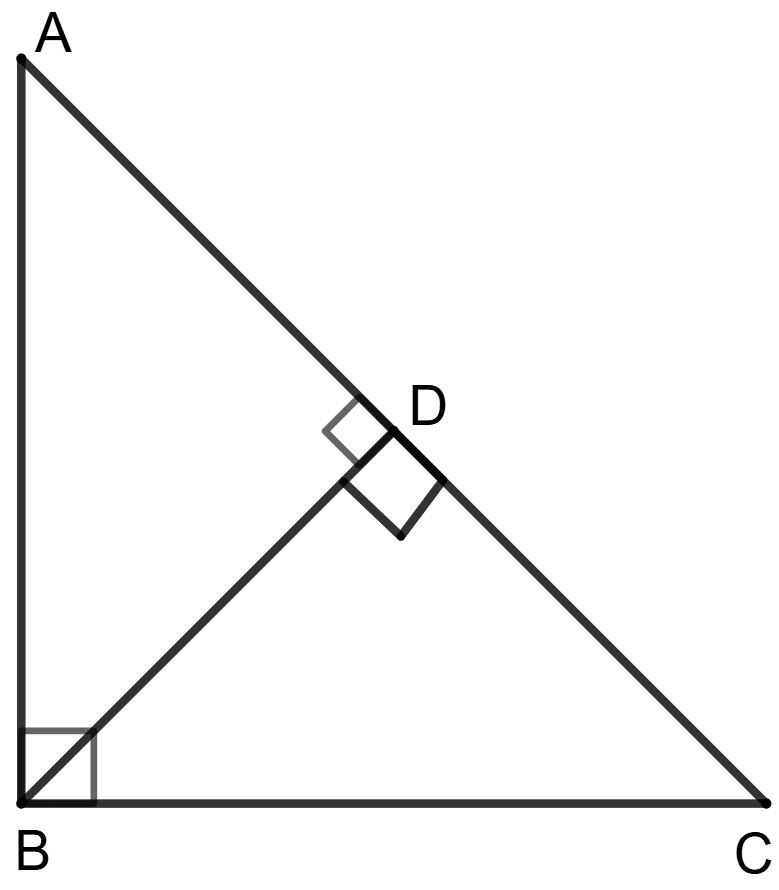
Assertion (A) : Triangles ABD and BCD are similar to each other.
Reason (R) : Triangles, which are similar to the same triangle, are similar to each other.
A is true, R is false.
A is false, R is true.
Both A and R are true and R is correct reason for A.
Both A and R are true and R is incorrect reason for A.
Answer
In Δ ABC and Δ ABD,
⇒ ∠ABC = ∠ADB (Both are 90°)
⇒ ∠BAC = ∠BAD (Common angle)
∴ Δ ABC ∼ Δ ADB (By AA postulate) .......... (1)
Similarly, in Δ ABC and Δ BDC,
⇒ ∠ABC = ∠BDC (Both are 90°)
⇒ ∠BCA = ∠BCD (Common angles)
∴ Δ ABC ∼ Δ BDC (By AA postulate) .......... (2)
As,
Triangles, which are similar to the same triangle, are similar to each other.
From equation (1) and (2), we get :
Δ ADB ∼ Δ BDC
∴ Both A and R are true and R is correct reason for A.
Hence, option 3 is the correct option.
Δ ABC and Δ PQR are congruent to each other.
Assertion (A) : Triangles ABC and PQR are similar to each other.
Reason (R) : Two similar triangles are congruent to each other.
A is true, R is false.
A is false, R is true.
Both A and R are true and R is correct reason for A.
Both A and R are true and R is incorrect reason for A.
Answer
Given, Δ ABC and Δ PQR are two congruent triangles.
Corresponding angles and sides are equal.
⇒ ∠A = ∠P, ∠B = ∠Q and ∠C = ∠R
∴ Δ ABC ∼ Δ PQR (By AAA postulate)
So, assertion (A) is true.
Similar triangles have the same shape but not necessarily the same size.
Congruent triangles have the same shape and size.
Size can be different in similar triangles but it has to be same in congruent triangles.
So, reason (R) is false.
Hence, option 1 is the correct option.
Δ ABC is reflected in origin to get Δ A'B'C'.
Statement (1) : Δ ABC is congruent to Δ A'B'C'.
Statement (2) : The two triangles are similar to each other.
Both the statement are true.
Both the statement are false.
Statement 1 is true, and statement 2 is false.
Statement 1 is false, and statement 2 is true.
Answer
Reflection in the origin means each point (x, y) becomes (-x, -y). Shape, size, angles and size length remains same in reflection.
So, Δ ABC is reflected in origin to get Δ A'B'C'.
Hence, Δ ABC is congruent to Δ A'B'C'.
So, statement 1 is true.
As we know that all congruent triangles are similar.
Hence, Δ ABC is similar to Δ A'B'C'.
So, statement 2 is true.
Hence, option 1 is the correct option.
Two similar triangles ABC and DEF such that area of Δ ABC = 64 sq. unit and area of Δ DEF = 121 sq. unit.
Statement (1) : .
Statement (2) : The ratio of perimeters of two similar triangles is equal to the ratio of their areas.
Both the statement are true.
Both the statement are false.
Statement 1 is true, and statement 2 is false.
Statement 1 is false, and statement 2 is true.
Answer
Given, △ ABC ∼ △ DEF.
We know that,
The ratio of the areas of two similar triangles is equal to the square of the ratio of their corresponding sides.
Since, corresponding sides of similar triangle are proportional.
We know that,
For any two or more equal ratios, each ratio is equal to the ratio between sum of their antecedents and sum of their consequents.
So, statement 1 is false.
The ratio of perimeters of two similar triangles is equal to the ratio of their corresponding sides.
So, statement 2 is false.
Hence, option 2 is the correct option.
In triangle ABC, AD : DB = 2 : 3, DE is parallel to BC.
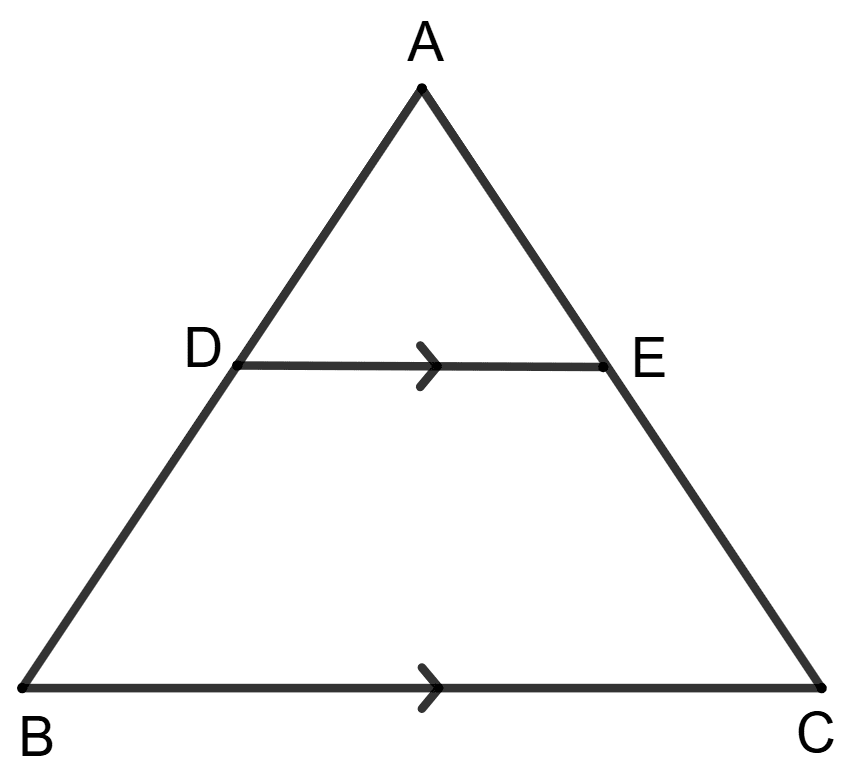
Assertion (A) : .
Reason (R) : .
A is true, R is false.
A is false, R is true.
Both A and R are true and R is correct reason for A.
Both A and R are true and R is incorrect reason for A.
Answer
Given,
AD : DB = 2 : 3
Let AD = 2x and DB = 3x.
From figure,
AB = AD + DB = 2x + 3x = 5x.
In Δ ADE and Δ ABC
⇒ ∠DAE = ∠BAC (Common angle)
⇒ ∠ADE = ∠ABC (Corresponding angles are equal)
⇒ ∠AED = ∠ACB (Corresponding angles are equal)
∴ ΔADE ∼ ΔABC (By AAA postulate)
We know that,
In similar triangles, corresponding sides are proportional (or in the same ratio).
∴ Assertion (A) is false, reason (R) is true.
Hence, option 2 is the correct option.
In triangle ODQ, ∠Q = ∠BPO = 90° AB = 2 x OA, BC = 3 x OA and CD = 4 x OA.
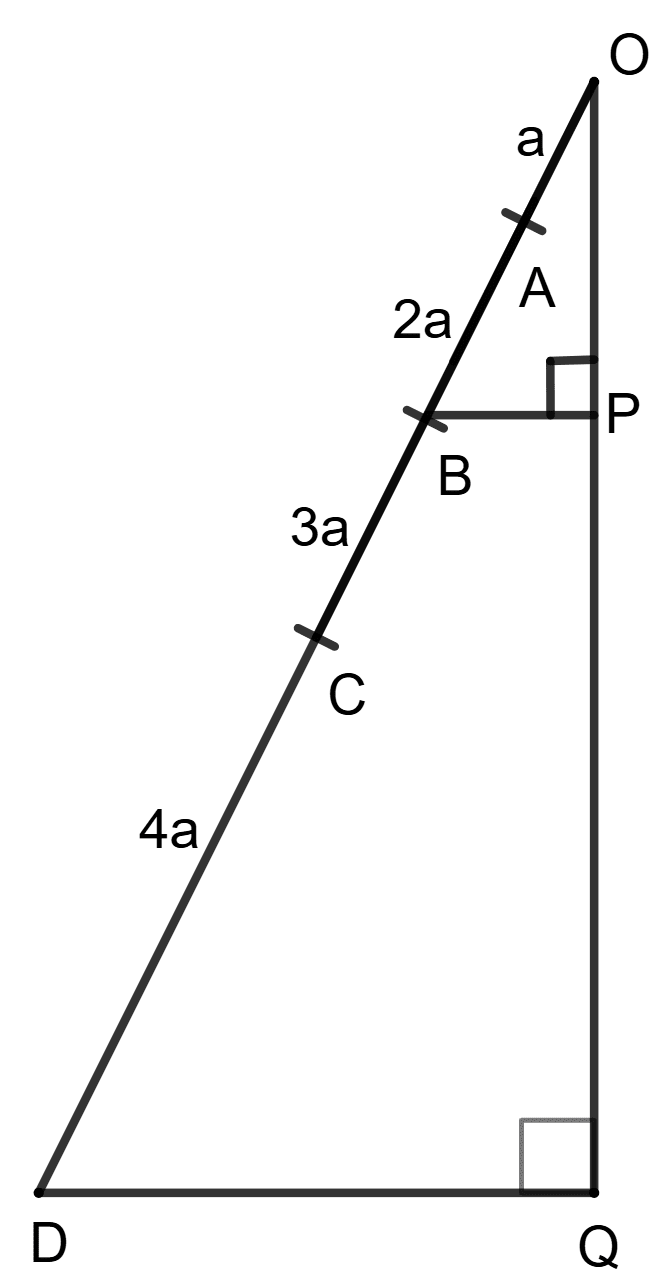
Assertion (A) : .
Reason (R) : Δ OBP - ODQ and .
A is true, R is false.
A is false, R is true.
Both A and R are true and R is correct reason for A.
Both A and R are true and R is incorrect reason for A.
Answer
In Δ ODQ and Δ OBP
⇒ ∠DOQ = ∠BOP (Common angle)
⇒ ∠OQD = ∠OPB (Both equal to 90°)
∴ Δ ODQ ∼ Δ OBP (By A.A. postulate)
From figure,
OB = a + 2a = 3a
OD = a + 2a + 3a + 4a = 10a
We know that,
The ratio of the areas of two similar triangles is equal to the square of the ratio of their corresponding sides.
Let the area of Δ OBP be 9m and that of area of Δ ODQ be 100m.
From figure,
Area of trapezium BPQD = Area of Δ ODQ - Area of Δ OBP = 100m - 9m
Now,
∴ Both A and R are true and R is correct reason for A.
Hence, option 3 is the correct option.
In triangle ABC, ∠B = 90° and in triangle ADE, ∠D = 90°.
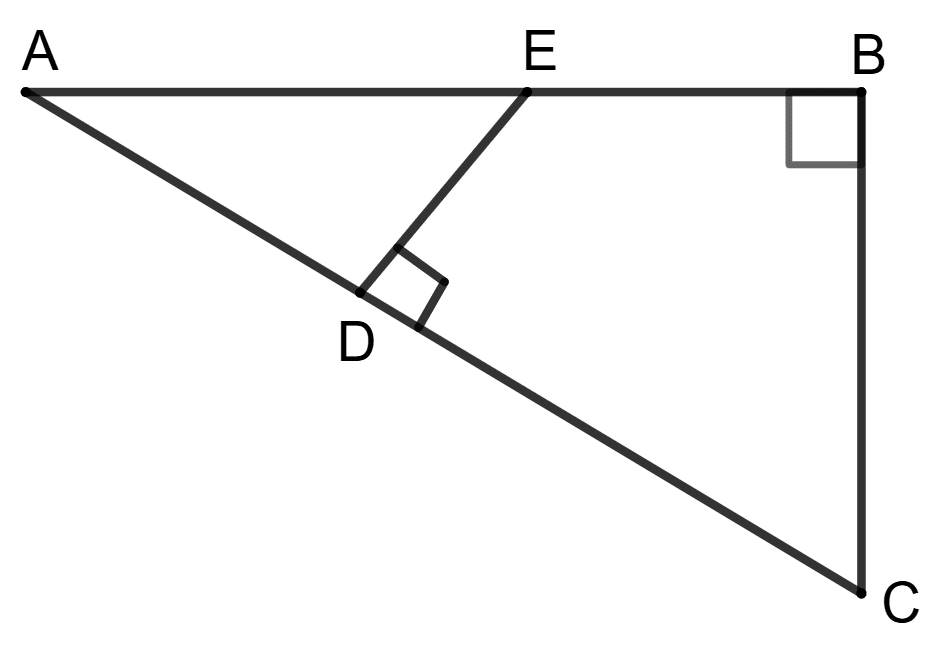
Statement (1) : .
Statement (2) : Triangle AED and ACB are similar.
Both the statement are true.
Both the statement are false.
Statement 1 is true, and statement 2 is false.
Statement 1 is false, and statement 2 is true.
Answer
In Δ ADE and Δ ABC,
⇒ ∠DAE = ∠BAC (Common angle)
⇒ ∠ADE = ∠ABC (Both are 90°)
∴ Δ ADE ∼ Δ ABC (By AA postulate)
We know that,
Corresponding sides of similar triangles are proportional.
So, both the statements are true.
Hence, option 1 is the correct option.
Area of triangle ADE = 9 cm2 and area of trapezium DBCE = 16 cm2.
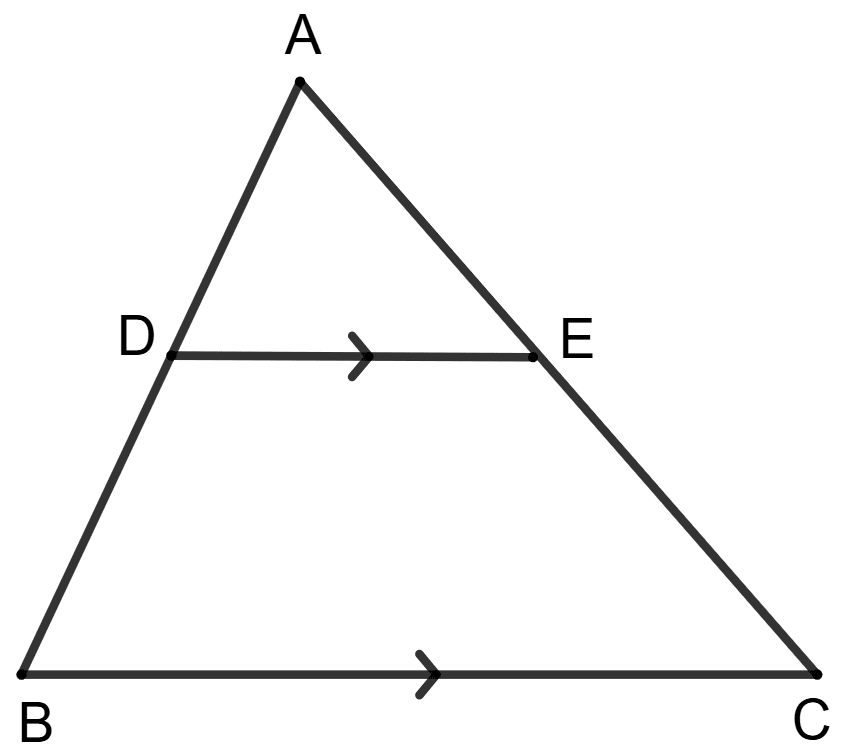
Statement (1) : .
Statement (2) : .
Both the statement are true.
Both the statement are false.
Statement 1 is true, and statement 2 is false.
Statement 1 is false, and statement 2 is true.
Answer
Given,
Area of triangle ADE = 9 cm2 and area of trapezium DBCE = 16 cm2.
In Δ ABC and Δ ADE,
⇒ ∠BAC = ∠DAE (Common angle)
⇒ ∠ABC = ∠ADE (Corresponding angles are equal)
⇒ ∠ACB = ∠AED (Corresponding angles are equal)
∴ Δ ABC ∼ Δ ADE (By A.A.A. postulate)
From figure,
⇒ Area of triangle ABC = Area of triangle ADE + Area of trapezium DBCE = 9 + 16 = 25 cm2
We know that,
The ratio of the areas of two similar triangles is equal to the square of the ratio of their corresponding sides.
So, statement 1 is false but statement 2 is true.
Hence, option 4 is the correct option.
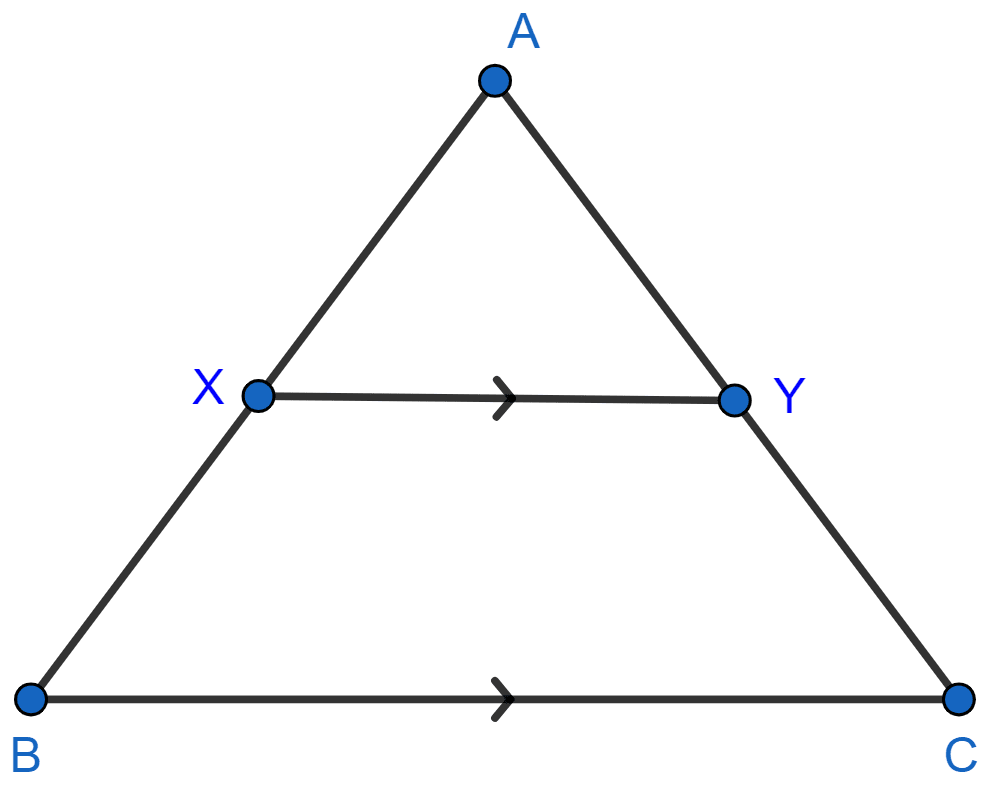
In the following figure, XY is parallel to BC, AX = 9 cm, XB = 4.5 cm and BC = 18 cm.
Find:
(i)
(ii)
(iii) XY
Answer
(i) By basic proportionality theorem,
A line drawn parallel to a side of triangle divides the other two sides proportionally.
Hence,
(ii) Given,
Let AY = 2x and YC = x.
From figure,
AC = AY + YC = 2x + x = 3x.
.
Hence, .
(iii) In △AXY and △ABC,
∠AXY = ∠ABC [Corresponding angles are equal]
∠A = ∠A [Common]
∴ △AXY ~ △ABC.
Since, corresponding sides of similar triangle are proportional to each other.
Hence, XY = 12 cm.
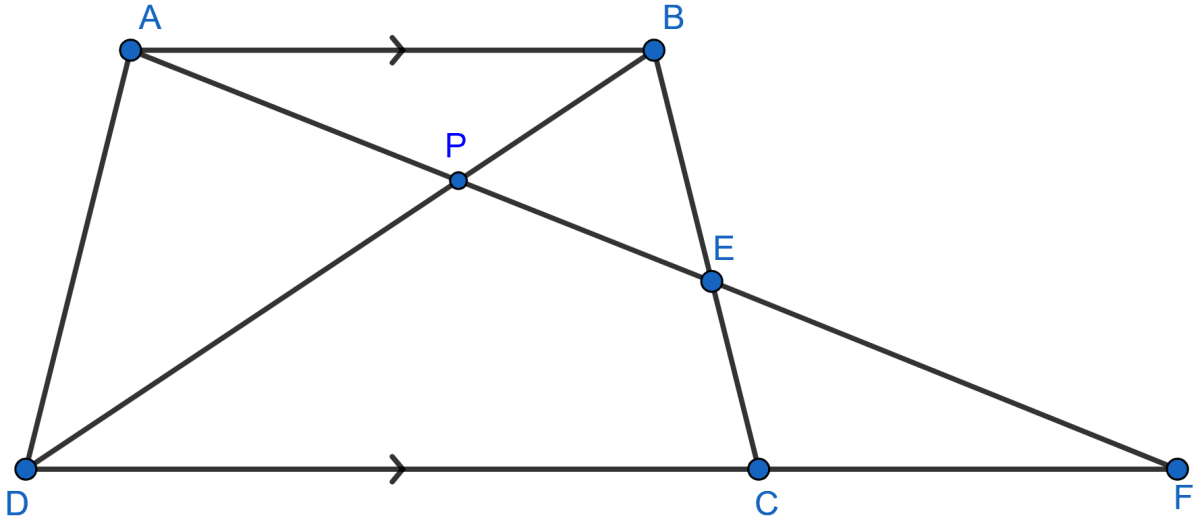
In the following figure, ABCD is a trapezium with AB || DC. If AB = 9 cm, DC = 18 cm, CF = 13.5 cm, AP = 6 cm and BE = 15 cm,
Calculate :
(i) EC (ii) AF (iii) PE
Answer
(i) In ΔAEB and ΔFEC,
∠AEB = ∠FEC [Vertically opposite angles are equal]
∠BAE = ∠CFE [Alternate angles are equal]
∴ ∆AEB ~ ∆FEC [By AA]
Since, corresponding sides of similar triangles are proportional.
Hence, EC = 22.5 cm.
(ii) In ΔAPB and ΔFPD,
∠APB = ∠FPD [Vertically opposite angles are equal]
∠BAP = ∠DFP [Alternate angles are equal]
∴ ∆APB ~ ∆FPD [By AA]
Since, corresponding sides of similar triangles are proportional.
From figure,
AF = AP + FP = 6 + 21 = 27 cm.
Hence, AF = 27 cm.
(iii) We already have, ∆AEB ~ ∆FEC
So,
From figure,
PE = PF – EF = 21 – 16.2 = 4.8 cm
Hence, PE = 4.8 cm
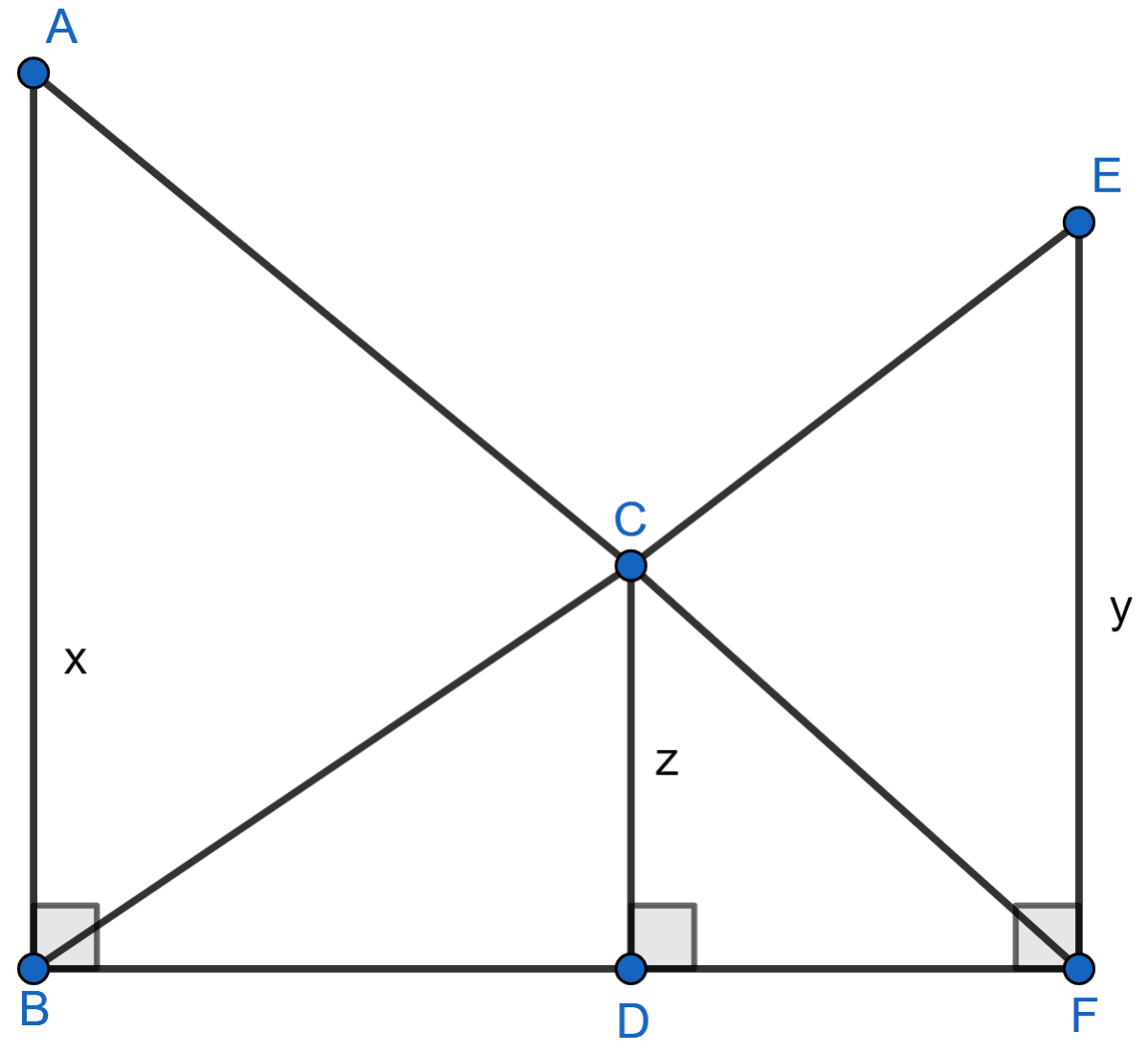
In the following figure, AB, CD and EF are perpendicular to the straight line BDF.
If AB = x and, CD = z unit and EF = y unit, prove that:
Answer
Let BD = a and DF = b.
In ΔFDC and ΔFBA,
∠FDC = ∠FBA [Both = 90°]
∠DFC = ∠BFA [Common angle]
∴ ∆FDC ~ ∆FBA [By AA]
Since, corresponding sides of similar triangle are proportional to each other.
In ΔBDC and ΔBFE,
∠BDC = ∠BFE [Both = 90°]
∠DBC = ∠FBE [Common angle]
∴ ∆BDC ~ ∆BFE [By AA]
Since, corresponding sides of similar triangle are proportional to each other.
Adding (1) and (2) we get :
Hence, proved that .
Triangle ABC is similar to triangle PQR. If AD and PM are corresponding medians of the two triangles, prove that: .
Answer
Given, ∆ABC ~ ∆PQR
AD and PM are the medians, so BD = DC and QM = MR
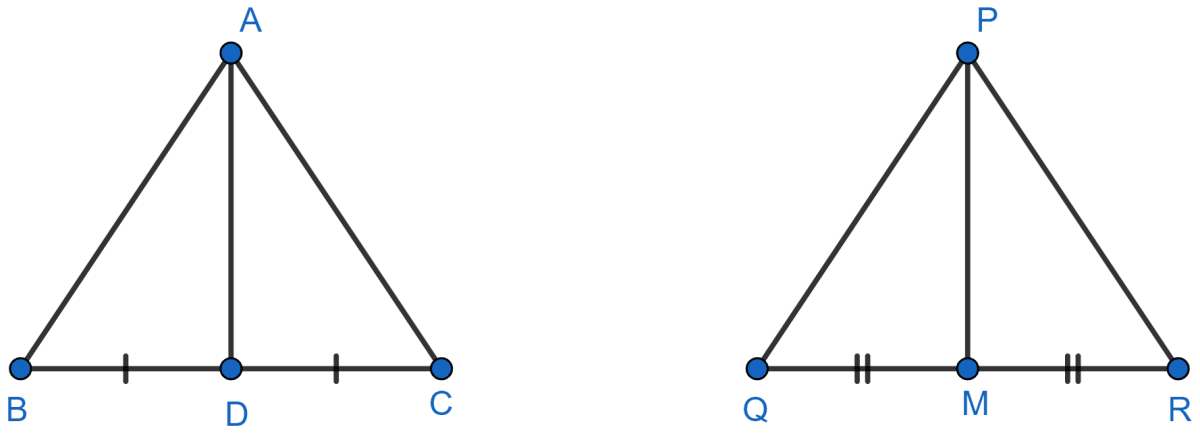
Since, corresponding sides of similar triangles are proportional.
We can write,
And, ∠ABC = ∠PQR i.e., ∠ABD = ∠PQM
∴ ∆ABD ~ ∆PQM [By SAS]
Since, corresponding sides of similar triangles are proportional.
.
Hence, proved that .
Triangle ABC is similar to triangle PQR. If AD and PM are altitudes of the two triangles, prove that: .
Answer
Given, ∆ABC ~ ∆PQR
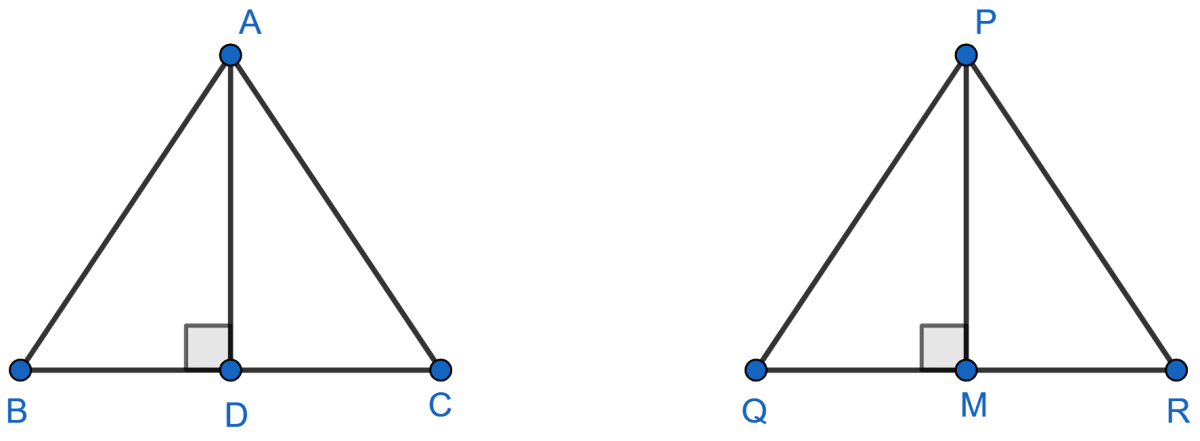
So,
∠ABC = ∠PQR i.e., ∠ABD = ∠PQM
Also, ∠ADB = ∠PMQ [Both are right angles]
∴ ∆ABD ~ ∆PQM [By AA]
Since, corresponding sides of similar triangles are proportional.
.
Hence, proved that .
Triangle ABC is similar to triangle PQR. If bisector of angle BAC meets BC at point D and bisector of angle QPR meets QR at point M, prove that: .
Answer
Given, ∆ABC ~ ∆PQR and AD and PM are the angle bisectors.
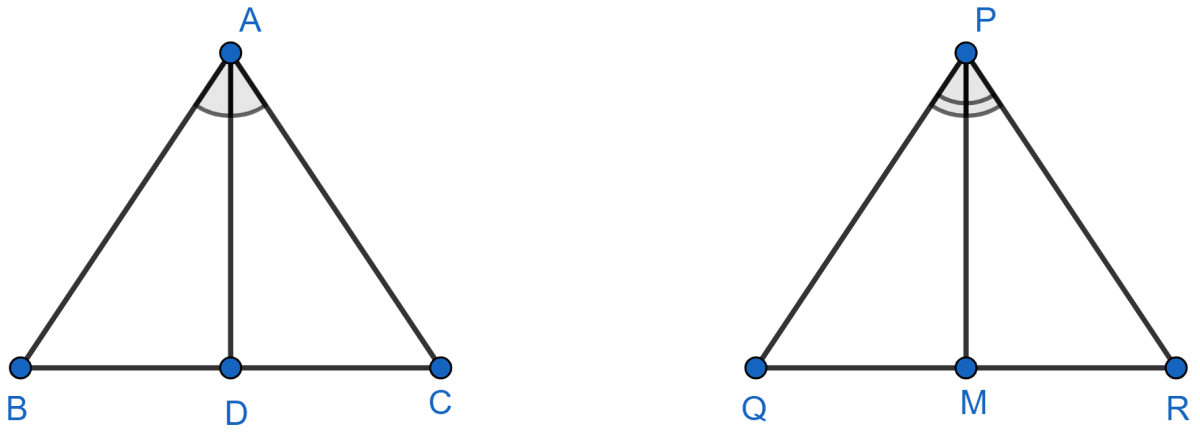
So,
⇒ ∠A = ∠P
⇒
⇒ ∠BAD = ∠QPM
Also, ∠ABC = ∠PQR i.e., ∠ABD = ∠PQM.
∴ ∆ABD ~ ∆PQM [By AA]
Since, corresponding sides of similar triangles are proportional.
.
Hence, proved that .
In the following figure, ∠AXY = ∠AYX.
If , show that triangle ABC is isosceles.
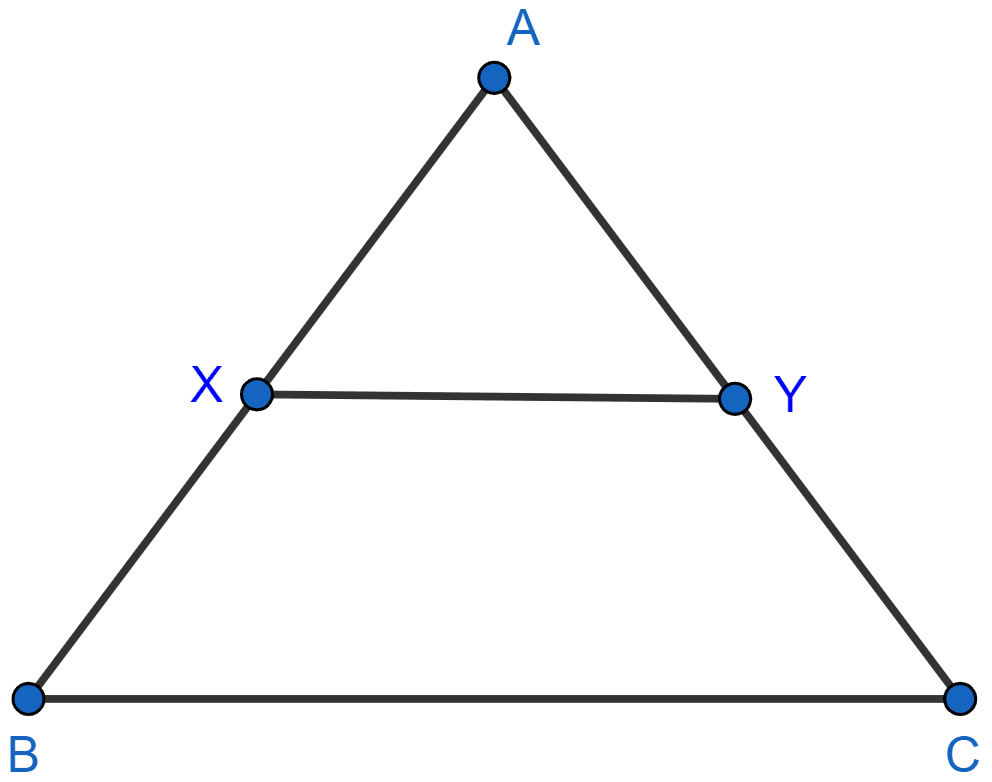
Answer
Given,
∠AXY = ∠AYX
So, AX = AY = a (let) [Sides opposite to equal angles are equal.]
Given,
From figure,
AB = AX + XB = a + b.
AC = AY + CY = a + b.
So, AB = AC.
Hence, proved that ∆ABC is an isosceles triangle.
In the following figure, DE || AC and DC || AP. Prove that : .

Answer
Given, DE || AC
In △BAC,
By basic proportionality theorem,
.....(1)
Given, DC || AP
In △BPA,
By basic proportionality theorem,
.....(2)
.
Hence, proved that .
In the figure given below, AB ‖ EF ‖ CD. If AB = 22.5 cm, EP = 7.5 cm, PC = 15 cm and DC = 27 cm.
Calculate: (i) EF (ii) AC

Answer
(i) In ∆PCD and ∆PEF,
∠CPD = ∠EPF [Vertically opposite angles are equal]
∠DCP = ∠FEP [Alternate angles are equal]
∴ ∆PCD ~ ∆PEF [By AA]
Since corresponding sides of similar triangle are proportional to each other.
Hence, EF = 13.5 cm.
(ii) In ∆CEF and ∆CAB
∠FCE = ∠BCA [Common angles]
∠CFE = ∠CBA [As FE || BA, corresponding angles are equal]
∴ ∆CEF ~ ∆CAB [By AA]
Since corresponding sides of similar triangle are proportional to each other.
Hence, AC = 37.5 cm.
In ΔABC, ∠ABC = ∠DAC, AB = 8 cm, AC = 4 cm and AD = 5 cm.
(i) Prove that ΔACD is similar to ΔBCA.
(ii) Find BC and CD.
(iii) Find the area of ΔACD : area of ΔABC.
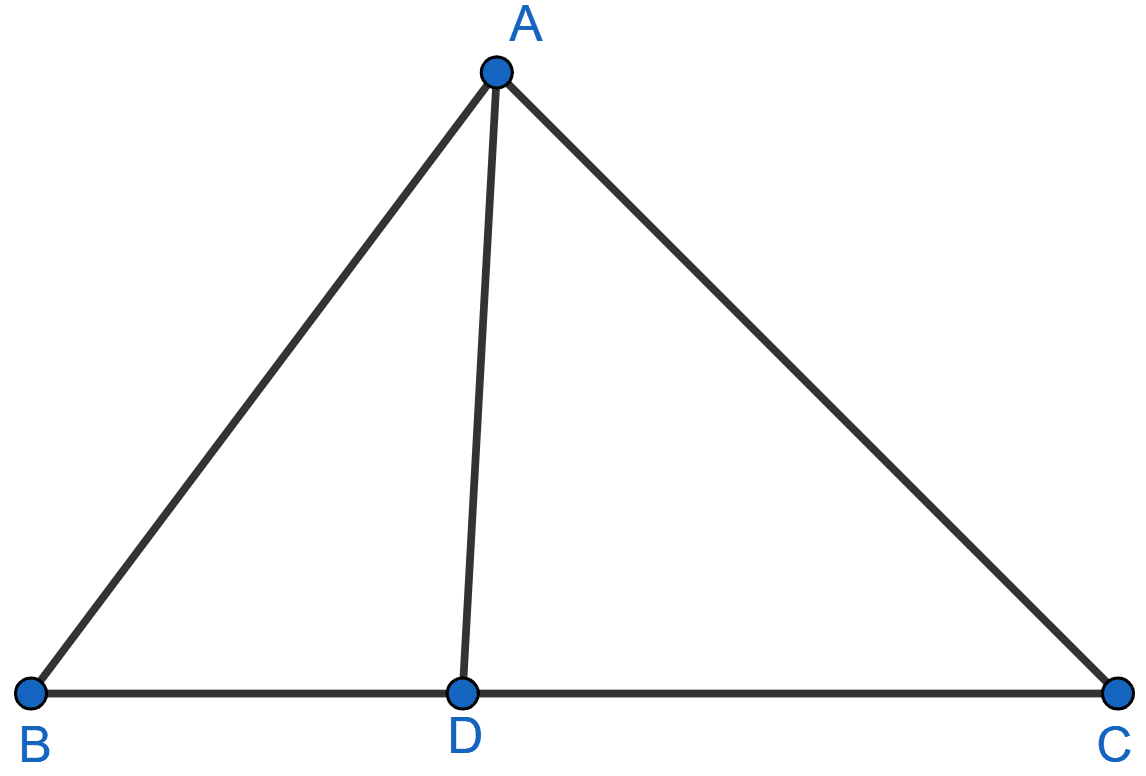
Answer
(i) In ∆ACD and ∆BCA,
∠DAC = ∠ABC [Given]
∠ACD = ∠BCA [Common angles]
∴ ∆ACD ~ ∆BCA [By AA]
Hence, proved that ∆ACD ~ ∆BCA.
(ii) Since, ∆ACD ~ ∆BCA
We know that,
Corresponding sides of similar triangle are proportional.
Also,
Hence, BC = 6.4 cm and CD = 2.5 cm.
(iii) As, ∆ACD ~ ∆BCA
We know that,
The areas of two similar triangles are proportional to the squares of their corresponding sides.
Hence, area of ∆ACD : area of ∆ABC = 25 : 64.
In the following figure, AD and CE are medians of ∆ABC. DF is drawn parallel to CE. Prove that:
(i) EF = FB,
(ii) AG : GD = 2 : 1
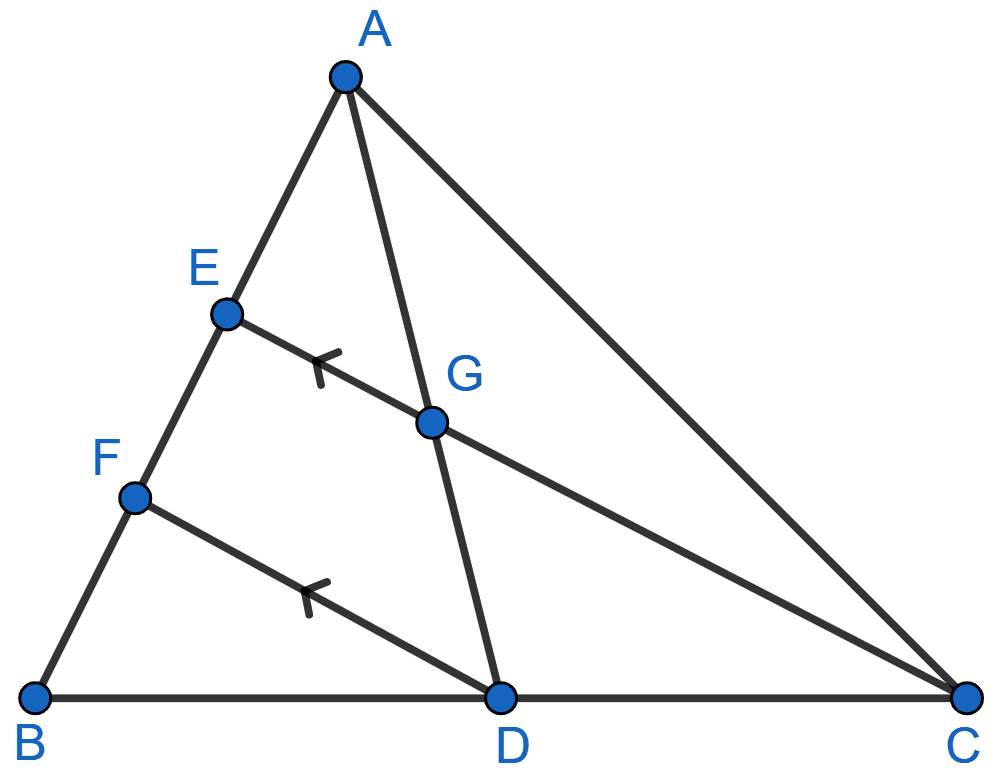
Answer
(i) In ∆BFD and ∆BEC,
∠BFD = ∠BEC [Corresponding angles are equal]
∠FBD = ∠EBC [Common]
∴ ∆BFD ~ ∆BEC [By AA].
Since, corresponding sides of similar triangles are proportional.
[∵ AD is median so D is the mid-point of BC]
From figure,
⇒ BE = BF + FE
⇒ 2BF = BF + FE
⇒ BF = FE.
Hence, proved that EF = FB.
(ii) In ∆AFD, EG || FD.
By basic proportionality theorem we have,
.....(1)
Now, AE = EB [∵ CE is median so E is the mid-point of AB]
As, AE = EB = 2EF [As, EF = FB].
Substituting value of AE in (1) we get,
.
Hence, AG : GD = 2 : 1.
The two similar triangles are equal in area. Prove that the triangles are congruent.
Answer
Let's consider two similar triangles as ∆ABC ~ ∆PQR
We know that,
The areas of two similar triangles are proportional to the squares of their corresponding sides.
So,
Since,
Area of ∆ABC = Area of ∆PQR [Given]
Hence,
AB = PQ
BC = QR
AC = PR
So, as the respective sides of two similar triangles are all of same length.
We can conclude that,
∆ABC ≅ ∆PQR [By SSS rule]
Hence proved that both triangles are congruent.
The ratio between the altitudes of two similar triangles is 3 : 5; write the ratio between their:
(i) corresponding medians.
(ii) perimeters.
(iii) areas.
Answer
Let △ABC and △PQR be two similar triangles with AD and PS as perpendiculars.
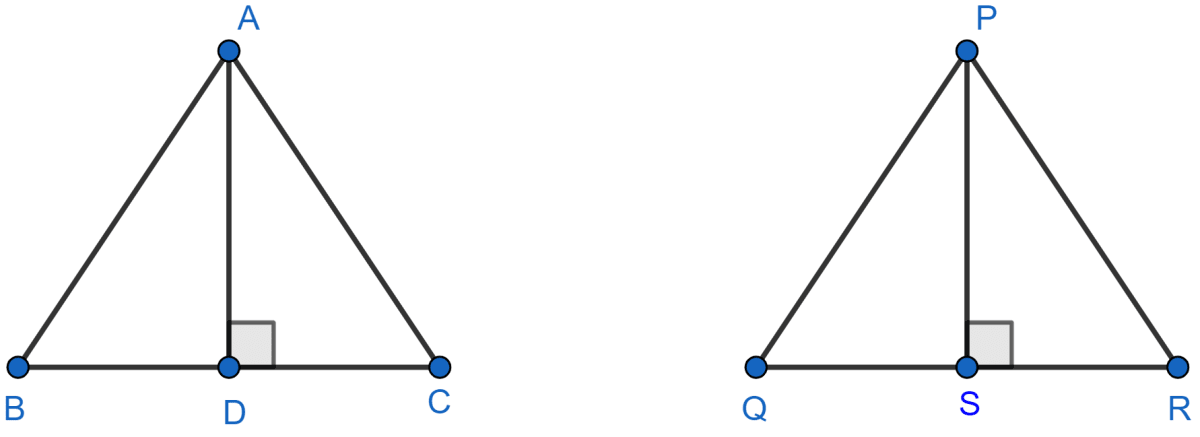
So,
∠ABD = ∠PQS [As ∠ABC = ∠PQR]
∠ADB = ∠PSQ [Both = 90°]
So, △ABD ~ △PQS.
.
(i) The ratio between the medians of two similar triangles is same as the ratio between their sides.
Hence, the required ratio = 3 : 5.
(ii) The ratio between the perimeters of two similar triangles is same as the ratio between their sides.
Hence, the required ratio = 3 : 5.
(iii) The ratio between the areas of two similar triangles is same as the square of the ratio between their corresponding sides.
Ratio = (3)2 : (5)2 = 9 : 25.
Hence, the required ratio = 9 : 25.
The ratio between the areas of two similar triangles is 16 : 25. State the ratio between their :
(i) perimeters
(ii) corresponding altitudes
(iii) corresponding medians.
Answer
We know that,
The ratio between the areas of two similar triangles is same as the square of the ratio between their corresponding sides.
Given,
Ratio between areas = 16 : 25.
So, ratio between sides = = 4 : 5.
(i) The ratio between the perimeters of two similar triangles is same as the ratio between their sides.
Hence, the required ratio = 4 : 5.
(ii) The ratio between the altitudes of two similar triangles is same as the ratio between their sides.
Hence, the required ratio = 4 : 5.
(iii) The ratio between the medians of two similar triangles is same as the ratio between their sides.
Hence, the required ratio = 4 : 5.
On a map, drawn to a scale of 1 : 20000, a rectangular plot of land ABCD has AB = 24 cm and BC = 32 cm. Calculate :
(i) the diagonal distance of the plot in kilometre.
(ii) the area of the plot in sq. km.
Answer
The rectangular plot of land ABCD on the map is shown below:
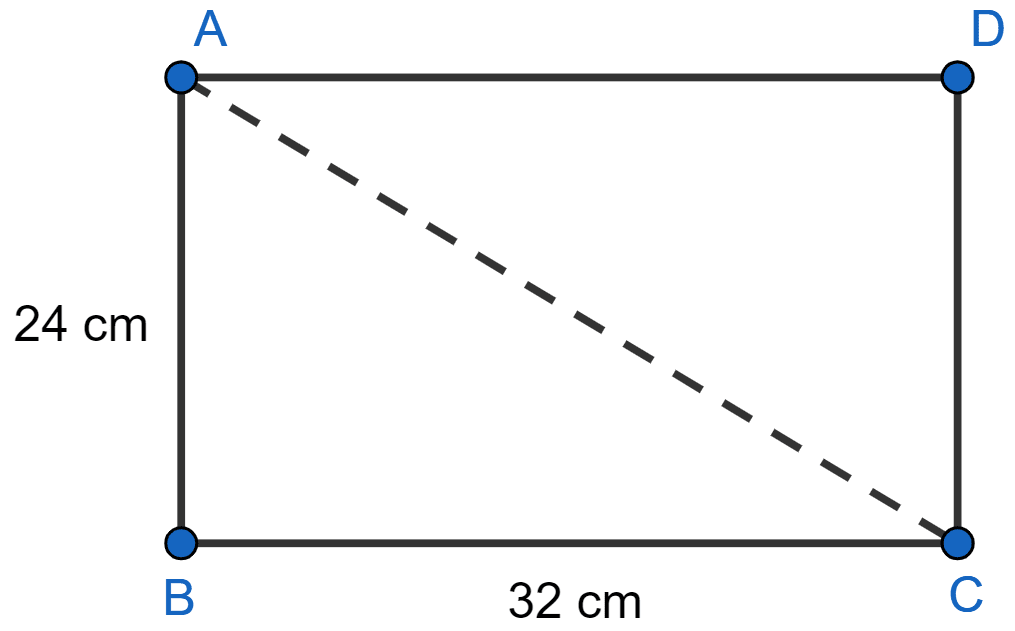
(i) By pythagoras theorem,
⇒ AC2 = AB2 + BC2
⇒ AC2 = 242 + 322
⇒ AC2 = 576 + 1024
⇒ AC2 = 1600
⇒ AC = = 40 cm.
Given,
Scale (k) =
Length of diagonal distance in map = k × Length of diagonal of plot
40 = × Length of diagonal of plot
Length of diagonal of plot = 40 × 20000 = 800000 cm = km = 8 km.
Hence, diagonal distance of plot = 8 km.
(ii) Area of plot on map = AB × BC = 24 × 32 = 768 cm2.
Area of plot on map = k2 × Area of actual plot
768 = × Area of actual plot
Area of actual plot = 768 × 20000 × 20000 cm2
= km2
= 30.72 km2.
Hence, area of plot = 30.72 km2.
The dimensions of the model of a multistoreyed building are 1 m by 60 cm by 1.20 m. If the scale factor is 1 : 50, find the actual dimensions of the building.
Also, find :
(i) the floor area of a room of the building, if the floor area of the corresponding room in the model is 50 sq. cm.
(ii) the space (volume) inside a room of the model, if the space inside the corresponding room of the building is 90 m3.
Answer
Given,
Scale factor (k) = 1 : 50.
Dimensions of model = l × b × h = 1 m × 0.6 m × 1.2 m.
By formula,
Dimensions of building = 50 m × 30 m × 60 m.
(i) By formula,
Floor area of model room = k2 × Floor area of building room
50 = × Floor area of building room
Floor area of building room = 50 × 50 × 50 = 125000 cm2 = m2 = 12.5 m2.
Hence, floor area of a room of the building = 12.5 m2.
(ii) By formula,
Volume of a room of model = k3 × Volume of a room of building
Volume of a room of model = = 0.00072 m3 = 0.00072 x 100 x 100 x 100 cm3 = 720 cm3.
Hence, the space inside a room of the model = 720 cm3.
In a triangle PQR, L and M are two points on the base QR, such that ∠LPQ = ∠QRP and ∠RPM = ∠RQP. Prove that :
(i) △PQL ~ △RPM
(ii) QL × RM = PL × PM
(iii) PQ2 = QR × QL
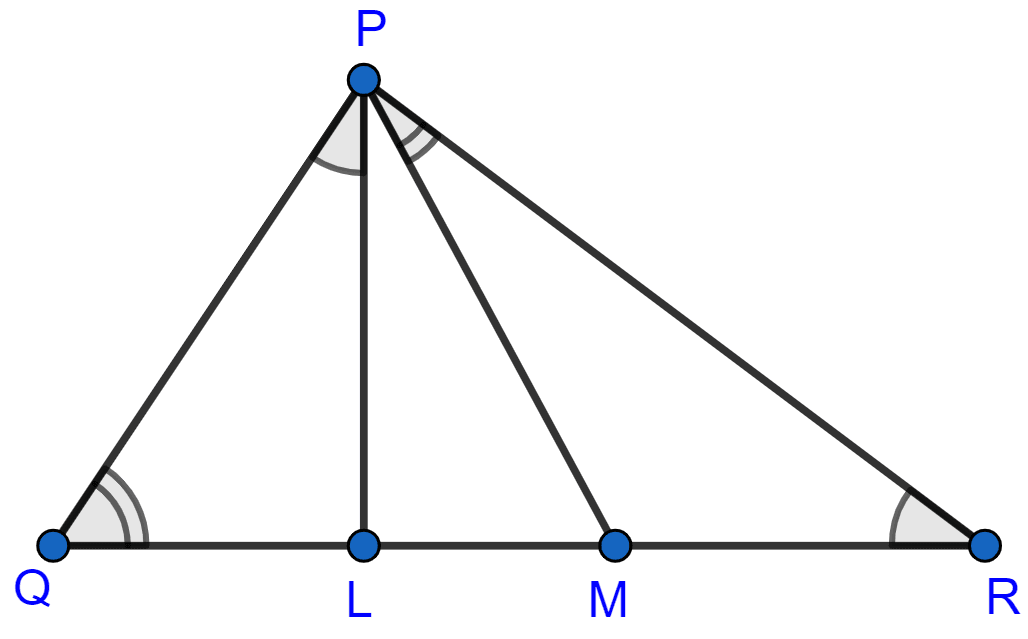
Answer
(i) In △PQL and △RPM
∠LPQ = ∠MRP (Given ∠LPQ = ∠QRP)
∠LQP = ∠RPM (Given ∠RPM = ∠RQP)
∴ △PQL ~ △RPM [By AA]
Hence, proved that △PQL ~ △RPM.
(ii) Since, △PQL ~ △RPM and corresponding sides of similar triangle are proportional to each other.
Hence, proved that QL × RM = PL × PM.
(iii) In △PQL and △RQP
∠LPQ = ∠QRP (Given)
∠Q = ∠Q [Common]
∴ △PQL ~ △RQP [By AA]
Since, corresponding sides of similar triangle are proportional to each other.
Hence, proved that PQ2 = QR x QL.
A triangle ABC with AB = 3 cm, BC = 6 cm and AC = 4 cm is enlarged to △DEF such that the longest side of △DEF = 9 cm. Find the scale factor and hence, the lengths of the other sides of △DEF.
Answer
Longest side in △ABC = BC = 6 cm
Corresponding longest side in △DEF = EF = 9 cm.
Scale factor (k) = = 1.5
Triangle ABC is enlarged to DEF. So, the two triangles will be similar.
.
So,
Hence, DE = 4.5 cm and DF = 6 cm.
Two isosceles triangles have equal vertical angles. Show that the triangles are similar.
If the ratio between the areas of these two triangles is 16 : 25, find the ratio between their corresponding altitudes.
Answer
Let △ABC and △PQR be two isosceles triangles with AB = AC and PQ = PR.
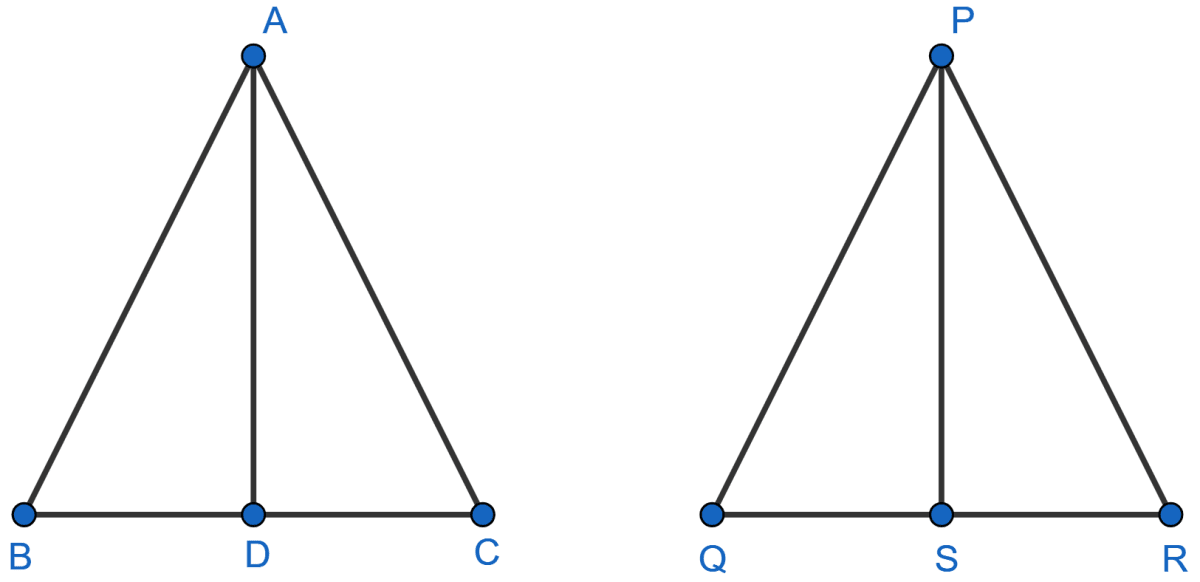
Then,
.
or,
Also,
∠A = ∠P (Given)
∴ △ABC ~ △PQR (By SAS)
We know that,
Ratio of areas of two similar triangles is same as the square of the ratio between their corresponding sides.
We know that,
The ratio between sides of similar triangle is equal to ratio of their altitudes.
Hence, ratio between altitudes = 4 : 5.
In triangle ABC, AP : PB = 2 : 3. PO is parallel to BC and is extended to Q so that CQ is parallel to BA. Find :
(i) area △APO : area △ABC.
(ii) area △APO : area △CQO.
Answer
(i) In △APO and △ABC,
∠APO = ∠ABC [Corresponding angles are equal]
∠PAO = ∠BAC [Common angle]
∴ △APO ~ △ABC [By AA].
Given,
Let AP = 2x and PB = 3x.
From figure,
AB = AP + PB = 2x + 3x = 5x.
We know that,
Ratio of areas of two similar triangles is same as the square of the ratio between their corresponding sides.
Hence, area △APO : area △ABC = 4 : 25.
(ii) Since, PO || BC.
In △ABC,
By basic proportionality theorem,
.
In △APO and △COQ,
∠AOP = ∠COQ [Vertical opposite angles are equal]
∠APO = ∠CQO [Alternate angles are equal]
∴ △APO ~ △COQ [By AA].
We know that,
Ratio of areas of two similar triangles is same as the square of the ratio between their corresponding sides.
Hence, area △APO : area △COQ = 4 : 9.
In the given figure, ABC is a triangle with ∠EDB = ∠ACB. Prove that △ABC ~ △EBD. If BE = 6 cm, EC = 4 cm, BD = 5 cm and area of △BED = 9 cm2. Calculate the :
(i) length of AB
(ii) area of △ABC

Answer
(i) In △ABC and △EBD,
⇒ ∠EDB = ∠ACB [Given]
⇒ ∠DBE = ∠ABC [Common]
∴ △ABC ~ △EBD
From figure,
⇒ BC = BE + EC = 6 + 4 = 10 cm.
Since, corresponding sides of similar triangles are proportional to each other.
Hence, length of AB = 12 cm.
(ii) We know that,
Ratio of areas of two similar triangles is same as the square of the ratio between their corresponding sides.
Hence, area of ∆ABC = 36 cm2.
In the given figure, ABC is a right angled triangle with ∠BAC = 90°.
(i) Prove that : △ADB ~ △CDA.
(ii) If BD = 18 cm and CD = 8 cm, find AD.
(iii) Find the ratio of the area of △ADB is to area of △CDA.
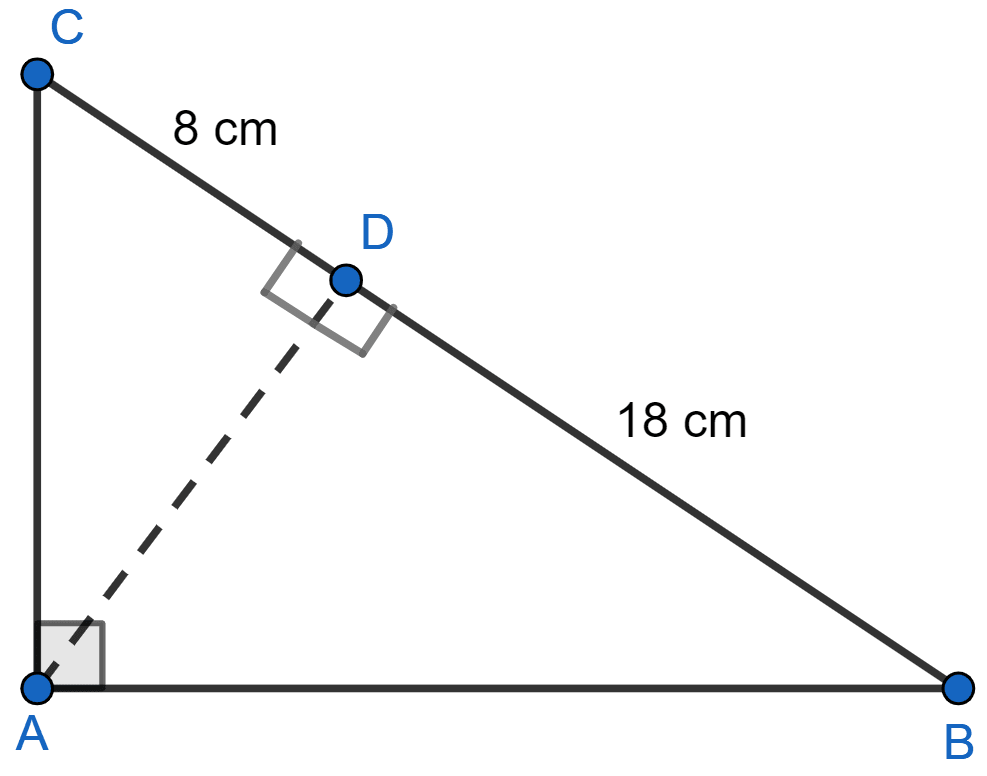
Answer
(i) Let ∠CAD = x.
So, ∠DAB = 90° - x.
In △ABD,
⇒ ∠DAB + ∠ADB + ∠ABD = 180° [By angle sum property]
⇒ 90° - x + 90° + ∠ABD = 180°
⇒ 180° - x + ∠ABD = 180°
⇒ ∠ABD = x + 180° - 180°
⇒ ∠ABD = x.
In △ADB and △CDA,
⇒ ∠CAD = ∠ABD (Both = x)
⇒ ∠CDA = ∠ADB (Both = 90°)
∴ △ADB ~ △CDA [By AA]
Hence, proved that △ADB ~ △CDA.
(ii) Since, △ADB ~ △CDA and corresponding sides of similar triangles are proportional to each other.
⇒ AD2 = BD × CD
⇒ AD2 = 18 × 8
⇒ AD2 = 144
⇒ AD = = 12 cm.
Hence, AD = 12 cm.
(iii) We know that,
Ratio of areas of two similar triangles is same as the square of the ratio between their corresponding sides.
Hence, ratio of the area of △ADB to area of △CDA = 9 : 4.
ABC is a right angled triangle with ∠ABC = 90°. D is any point on AB and DE is perpendicular to AC. Prove that :
(i) △ADE ~ △ACB
(ii) If AC = 13 cm, BC = 5 cm and AE = 4 cm. Find DE and AD.
(iii) Find, area of △ADE : area of quadrilateral BCED.
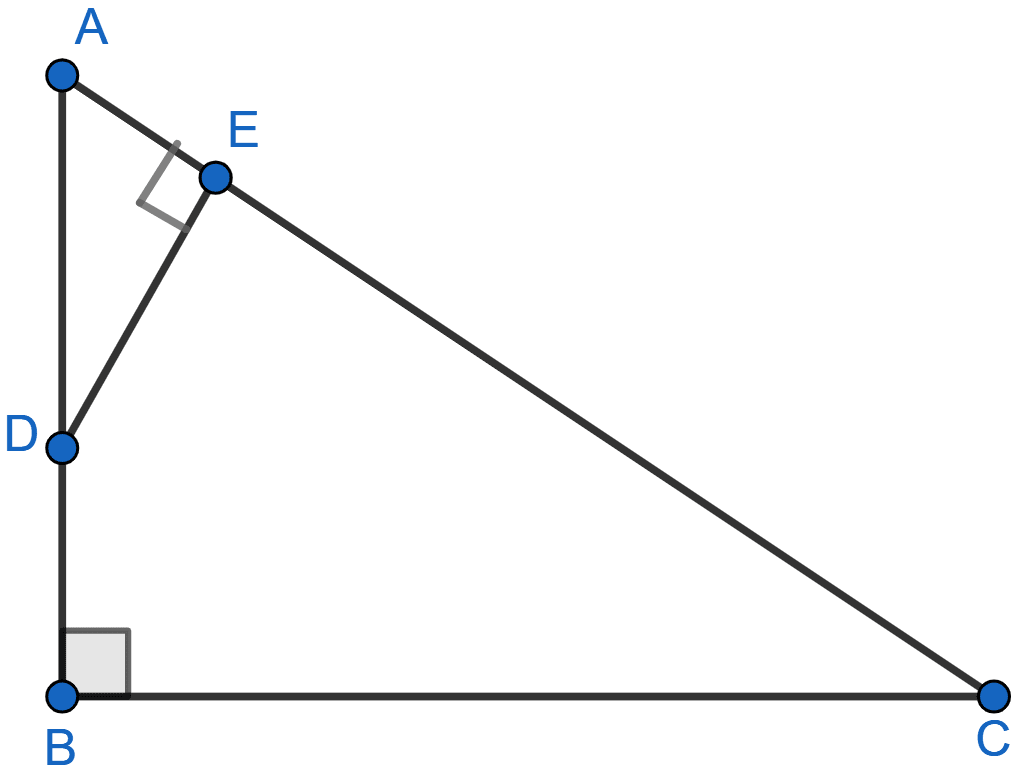
Answer
(i) In △ADE and △ACB,
⇒ ∠AED = ∠ABC [Both = 90°]
⇒ ∠EAD = ∠CAB [Common angle]
∴ △ADE ~ △ACB [By AA].
Hence, proved that △ADE ~ △ACB.
(ii) In right angle triangle ABC,
⇒ AC2 = AB2 + BC2
⇒ 132 = AB2 + 52
⇒ 169 = AB2 + 25
⇒ AB2 = 144
⇒ AB = = 12 cm.
Since, △ADE ~ △ACB and corresponding sides of similar triangles are proportional to each other.
Hence, DE = cm.
(iii) From figure,
Area of △ADE =
Area of quadrilateral BCED = Area of △ABC - Area of △ADE
Hence, area of △ADE : area of quadrilateral BCED = 1 : 8.
Given : AB || DE and BC || EF. Prove that :
(i)
(ii) △DFG ~ △ACG.

Answer
(i) In △ABG, DE || AB.
So, by basic proportionality theorem we get,
.....(1)
In △BCG, EF || BC.
So, by basic proportionality theorem we get,
.....(2)
From (1) and (2) we get,
Hence, proved that
(ii) In △DFG and △ACG,
⇒ [Proved above]
⇒ ∠DGF = ∠AGC [Common angle]
∴ △DFG ~ △ACG [By SAS]
Hence, proved that △DFG ~ △ACG.
PQR is a triangle. S is a point on the side QR of △PQR such that ∠PSR = ∠QPR. Given QP = 8 cm, PR = 6 cm and SR = 3 cm.
(i) Prove △PQR ~ △SPR.
(ii) Find the lengths of QR and PS.
(iii)

Answer
(i) In △PQR and △SPR,
⇒ ∠PSR = ∠QPR [Given]
⇒ ∠PRQ = ∠PRS [Common angle]
∴ △PQR ~ △SPR [By AA]
Hence, proved that △PQR ~ △SPR.
(ii) Since, △PQR ~ △SPR and corresponding sides of similar triangle are proportional to each other.
Hence, QR = 12 cm and PS = 4 cm.
(iii) We know that,
Ratio of areas of two similar triangles is same as the square of the ratio between their corresponding sides.
Hence, = 4 : 1.