
Name the stages of mitosis where the following take place:
(i) Spindle fibres appear.
(ii) Chromosomes are lined up in one plane at equator.
(iii) Centrioles start moving apart.
(iv) Nuclear membrane is formed.
(v) Cytokinesis begins.
Answer
(i) Prophase
(ii) Metaphase
(iii) Prophase
(iv) Telophase
(v) Telophase
Fill in the blanks:
(i) In humans, meiosis takes place in ............... and ............... .
(ii) In flowering plants, meiosis takes place in ............... and ............... .
(iii) In meiosis, chromosome duplication is followed by ............... .
(iv) Meiosis requires ............... time than mitosis.
(v) Crossing over leads to ............... .
Answer
(i) In humans, meiosis takes place in testis and ovary.
(ii) In flowering plants, meiosis takes place in anther and ovary.
(iii) In meiosis, chromosome duplication is followed by two nuclear divisions.
(iv) Meiosis requires more time than mitosis.
(v) Crossing over leads to genetic variation.
Correct sequence of stages in the cell cycle is
- G1, S, G2, M
- G1, G2, S, M
- M, S, G1, G2
- G2, G1, S, M
Answer
G1, S, G2, M
Reason — The cell cycle proceeds through interphase (G1, S and G2 phases) followed by the mitotic (M) phase. Hence, the correct sequence is G1, S, G2, M.
Synthesis phase in the cell cycle is called so, because of the synthesis of more
- RNA
- Proteins
- DNA
- Glucose
Answer
DNA
Reason — During the synthesis (S) phase, replication of DNA occurs and the chromosomes are duplicated. Therefore, it is named the synthesis phase.
In which phase of cell cycle, chromosomes arrange at equatorial plate
- prophase
- metaphase
- anaphase
- telophase
Answer
metaphase
Reason — In metaphase, each chromosome gets attached to the spindle by its centromere and the chromosomes arrange themselves at the equatorial plane.
Which phase of cell cycle is the reverse of prophase is
- metaphase
- interphase
- telophase
- anaphase
Answer
telophase
Reason — Telophase is essentially the reverse of prophase, as the chromosomes unwind into chromatin and the nuclear membrane and nucleolus reappear.
After mitotic cell division how many chromosomes are present in a female human cell
- 44
- 46
- 48
- 42
Answer
46
Reason — In mitosis, the daughter cells have the same number of chromosomes as the parent cell. A human cell contains 46 chromosomes.
Chromosomes align at the centre of the cell during
- Metaphase
- Anaphase
- Prophase
- Telophase
Answer
Metaphase
Reason — In metaphase, the chromosomes arrange themselves along the equatorial plane, i.e., at the centre of the cell.
New cells are to be produced for all except
- Movement
- Growth
- Reproduction
- Germination
Answer
Movement
Reason — New cells need to be produced for growth, replacement, repair and reproduction. Movement does not require the production of new cells.
The chromosomes are duplicated in
- G1 phase
- S phase
- G2 phase
- M phase
Answer
S phase
Reason — In the S phase (synthesis phase), replication of DNA occurs and the chromosomes are duplicated.
The correct sequence in the mitosis are
- Prophase, metaphase, anaphase and telophase
- Prophase, anaphase, metaphase and telophase
- Metaphase, anaphase, prophase and telophase
- Telophase, anaphase, prophase, metaphase
Answer
Prophase, metaphase, anaphase and telophase
Reason — Karyokinesis in mitosis proceeds through four phases in the order — prophase, metaphase, anaphase and telophase.
Which of the following are called equational division?
- Mitosis and Meiosis I
- Mitosis and Meiosis II
- Mitosis and Meiosis
- Meiosis I only
Answer
Mitosis and Meiosis II
Reason — In mitosis and in meiosis II, the chromosome number of the daughter cells remains the same as that of the parent cell. Hence both are called equational (homotypic) divisions, whereas meiosis I is reductional division.
A group of researchers is studying a cell population and notices that a significant number of cells are in the G0 phase. What does this indicate about these cells?
- They have recently undergone mitosis.
- They are actively dividing.
- They are in a resting state or have exited the cell cycle.
- They are in the process of DNA replication.
Answer
They are in a resting state or have exited the cell cycle.
Reason — G0 is a resting phase. Some cells that no longer divide leave the cell cycle and enter this resting phase.
Name the phase which comes after mitotic phase.
- G1 phase
- S phase
- G2 phase
- M phase
Answer
G1 phase
Reason — After the mitotic (M) phase, the daughter cell re-enters interphase, which begins with the G1 phase.
A phase of cell division where the spindle fibres disappear is:
- Telophase
- Prophase
- Metaphase
- Anaphase
Answer
Telophase
Reason — In telophase, the spindle fibres and astral rays disappear as the nuclear membrane and nucleolus reappear.
A cell has 12 chromosomes. After mitotic division the daughter cell will have
- 24 chromosomes
- 6 chromosomes
- 18 chromosomes
- 12 chromosomes
Answer
12 chromosomes
Reason — Mitosis maintains the chromosome number, so each daughter cell has the same number of chromosomes as the parent cell, i.e., 12.
The points where two non-sister chromatids crossover are called
- Chromatid
- Centromere
- Chiasmata
- Kinetochore
Answer
Chiasmata
Reason — The points where the non-sister chromatids of a tetrad cross over each other are called chiasmata. At each chiasma, the chromatids break and rejoin, exchanging segments.
The number of chromosomes in the somatic cells of a human body before mitosis and after mitosis is:
- 23, 23
- 26, 46
- 23, 46
- 46, 46
Answer
46, 46
Reason — Mitosis keeps the chromosome number constant. A human somatic cell has 46 chromosomes both before and after mitosis.
Assertion (A): Cytokinesis is associated with the division of cytoplasm.
Reason (R): Cytokinesis does not occur in plant cells.
- Both (A) and (R) are true
- Both (A) and (R) are false
- Both (A) and (R) are true and (R) is the correct explanation of (A)
- Both (A) and (R) are true but (R) is not the correct explanation of (A)
Answer
(A) is True and (R) is False
Explanation
Assertion (A) is true because cytokinesis is the division of the cytoplasm. Reason (R) is false because cytokinesis also occurs in plant cells, where a cell plate forms at the centre and grows towards the cell wall.
Note: None of the given options represents the correct combination, i.e., “(A) is true and (R) is false.” The options need correction.
Which of the following process occurs only in meiosis and NOT in mitosis?
- Chromosome duplication
- Crossing over
- Cytokinesis
- Chromosome alignment
Answer
Crossing over
Reason — Crossing over is the exchange of segments between non-sister chromatids of homologous chromosomes. It takes place during prophase I of meiosis only and does not occur in mitosis.
Which of the following is reduction division?
- Meiosis I
- Meiosis II
- Mitosis
- Amitosis
Answer
Meiosis I
Reason — Meiosis I is called reductional (heterotypic) division because the chromosome number is reduced to half in the resulting daughter cells.
Neeta was examining a slide of a dividing cell under the microscope. What finding would she draw following a thorough examination of the slide?
A. The chromosomes are without centromere and chromatids.
B. The cytoplasm is dividing in centrifugal manner.
C. Spindle fibres are originating from the poles.
- A and B
- Only B
- B and C
- Only C
Answer
B and C
Reason — Statement A is false because chromosomes possess a centromere and, after duplication, consist of chromatids. Statement B is true for plant cells because cytokinesis is centrifugal, with the cell plate growing from the centre towards the periphery. Statement C is also true because spindle fibres originate from the poles of the dividing cell. Hence, the correct choice is B and C.
After Meiosis, a female human egg cell will have :
- 44 chromosomes
- 46 chromosomes
- 22 chromosomes
- 23 chromosomes
Answer
23 chromosomes
Reason — Meiosis halves the chromosome number. Therefore, the human egg cell (female gamete) receives 23 chromosomes (22 + X).
At the end of ............... , cytokinesis is completed.
- Metaphase
- Prophase
- Interphase
- Telophase
Answer
Telophase
Reason — Cytokinesis begins during early telophase and is completed by the end of telophase, dividing the cell into two daughter cells.
Replication of DNA in the cell cycle occurs during the :
- G1 – phase
- Anaphase
- S – phase
- G2 – phase
Answer
S – phase
Reason — Replication of DNA and synthesis of histone proteins occur during the synthesis (S) phase of interphase.
Karyokinesis :
- It is the division of nucleus during cell division
- It is the division of cytoplasm during cell division
- It is the division of centrosome
- It is the division of nucleolus
Answer
It is the division of nucleus during cell division
Reason — Karyokinesis refers to the division of the nucleus, whereas the division of the cytoplasm is called cytokinesis.
Aster :
- Around the centrioles in plant cells
- Around the centrioles in animal cells
- Around the chromatids in animal cells
- Around the chromatids in plant cells
Answer
Around the centrioles in animal cells
Reason — In animal cells, each centriole is surrounded by radiating rays called aster rays, forming an aster. Asters are not formed in plant cells.
Assertion (A): Telophase is the reverse of prophase.
Reason (R): Nuclear membrane reappear during telophase.
- Both (A) and (R) are true
- Both (A) and (R) are false
- Both (A) and (R) are true and (R) is the correct explanation of (A)
- Both (A) and (R) are true but (R) is not the correct explanation of (A)
Answer
Both (A) and (R) are true and (R) is the correct explanation of (A)
Explanation
In prophase, the nuclear membrane and nucleolus disappear and the chromatin condenses into chromosomes. In telophase, exactly the opposite takes place — the chromosomes unwind into chromatin and the nuclear membrane and nucleolus reappear. Thus, the reappearance of the nuclear membrane during telophase correctly explains why telophase is the reverse of prophase.
A biology teacher asked her students to explain the significance of cell division.
Raj said: Cell division is essential for the growth of organisms.
Sonu said: Cell division can damage tissues in the body.
Lata said: Cell division allows for the replacement of worn-out cells.
Abhay said: Cell division occurs only in reproductive organs.
Who were correct?
- Raj and Abhay
- Raj and Lata
- Sonu and Lata
- Lata and Abhay
Answer
Raj and Lata
Reason — Cell division is essential for the growth of organisms (Raj is correct) and for the replacement of worn-out cells (Lata is correct). Cell division repairs tissues rather than damaging them, so Sonu is wrong; and it occurs in somatic cells too, not only in reproductive organs, so Abhay is wrong.
Meena tried to match the stages of cell division with their respective processes. She tabulated the pairs as follows:
| Stage of Cell Division | Process |
|---|---|
| P | Chromosomes align at the equatorial plane |
| Q | Nuclear membrane reforms around daughter chromosomes |
Identify the correct pair of stages.
- P - Anaphase, Q - Prophase
- P - Metaphase, Q - Telophase
- P - Telophase, Q - Metaphase
- P - Prophase, Q - Anaphase
Answer
P - Metaphase, Q - Telophase
Reason — Chromosomes align at the equatorial plane during metaphase (P), while the nuclear membrane reforms around the daughter chromosomes during telophase (Q).
Mohan was observing an onion root tip under the microscope during his biology practical. He noticed that in some cells, the chromosomes were lined up in the centre of the cell, while in others, the chromosomes were being pulled apart towards opposite poles. Which stages of cell division was Mohan observing?
- Prophase and Telophase
- Metaphase and Anaphase
- Anaphase and Prophase
- Metaphase and Telophase
Answer
Metaphase and Anaphase
Reason — Chromosomes lined up at the centre (equator) of the cell indicates metaphase, while chromosomes being pulled apart towards opposite poles indicates anaphase.
The given figures A and B shows two stages of cell division.
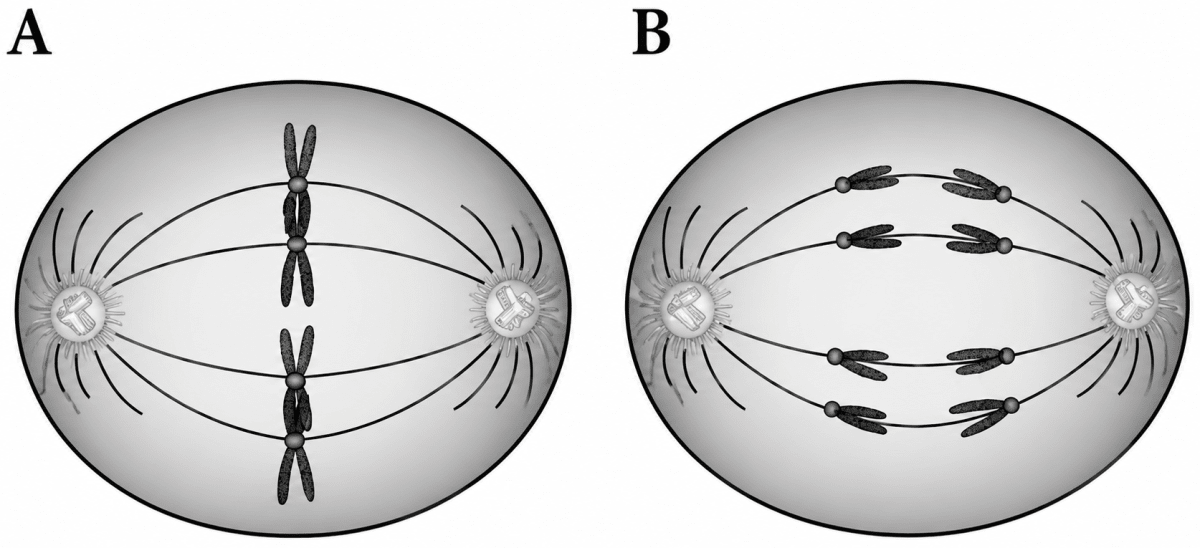
Choose the correct option.
- A- prophase, B- metaphase
- A- telophase, B-anaphase
- A- metaphase, B-anaphase
- A- anaphase, B-telophase
Answer
A- metaphase, B-anaphase
Reason — In figure A the chromosomes are arranged along the equatorial plane, which is the characteristic of metaphase, while in figure B the sister chromatids are separating and moving towards opposite poles (shown by the arrows), which is the characteristic of anaphase.
Name the following:
(i) The stage when sister chromosomes separate from their paired condition.
(ii) A membrane that disappears during late prophase.
(iii) The organelle that forms the aster during cell division.
(iv) The type of cell division which occurs in the cells of the reproductive organs.
Answer
(i) Anaphase
(ii) Nuclear membrane
(iii) Centriole (Centrosome)
(iv) Meiosis
Fill in the blanks:
(i) Meiosis takes place in the ............... , while mitosis takes place in the ............... cells of the body.
(ii) If a cell with two nuclei is spotted under a microscope, the cell is in ............... stage of cell division.
(iii) The spindle fibres are made up of ............... .
(iv) In plant cells, the cytokinesis is ............... .
(v) Duplication of DNA occurs in the ............... stage of cell cycle.
Answer
(i) Meiosis takes place in the reproductive (germ) cells, while mitosis takes place in the somatic (body) cells.
(ii) If a cell with two nuclei is spotted under a microscope, the cell is in telophase stage of cell division.
(iii) The spindle fibres are made up of protein (tubulin).
(iv) In plant cells, the cytokinesis is centrifugal.
(v) Duplication of DNA occurs in the synthesis (S) stage of cell cycle.
Mention if the following statements are true or false. If false, rewrite the sentences by changing the bold words:
(i) Karyokinesis refers to the division of the nucleus.
(ii) Crossing over occurs in mitosis.
(iii) Duplicated chromosomes are held at a point termed centrosome.
(iv) The resting stage in mitosis is called interphase.
(v) Mitosis is the type of cell division occurring in the cells of injured parts of the body.
Answer
(i) True.
(ii) False.
Corrected Statement — Crossing over occurs in meiosis.
(iii) False.
Corrected Statement — Duplicated chromosomes are held at a point termed centromere.
(iv) True.
(v) True.
Match the columns:
| Column I | Column II |
|---|---|
| (i) Karyokinesis | (a) Resting phase |
| (ii) Mitosis | (b) Reductional division |
| (iii) Interphase | (c) Pairing of homologous chromosomes |
| (iv) Cytokinesis | (d) Division of nucleus |
| (v) Meiosis | (e) Somatic cell division |
| (vi) Synapsis | (f) Division of cytoplasm |
Answer
| Column I | Column II |
|---|---|
| (i) Karyokinesis | (d) Division of nucleus |
| (ii) Mitosis | (e) Somatic cell division |
| (iii) Interphase | (a) Resting phase |
| (iv) Cytokinesis | (f) Division of cytoplasm |
| (v) Meiosis | (b) Reductional division |
| (vi) Synapsis | (c) Pairing of homologous chromosomes |
Given below is a cross section of tissue showing different stages of cell division. Match the structures marked (A) to (D) with their correct features:
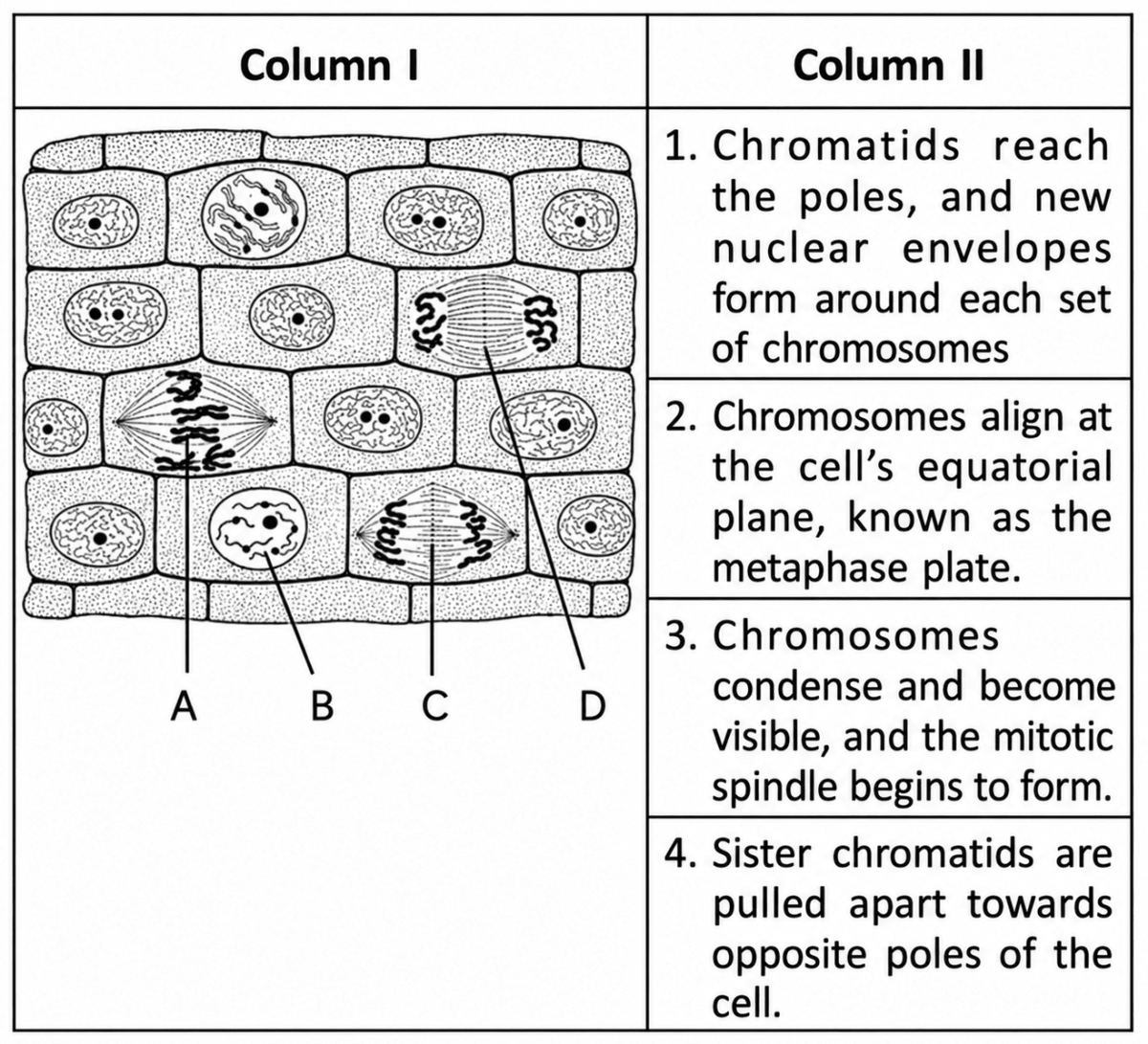
Answer
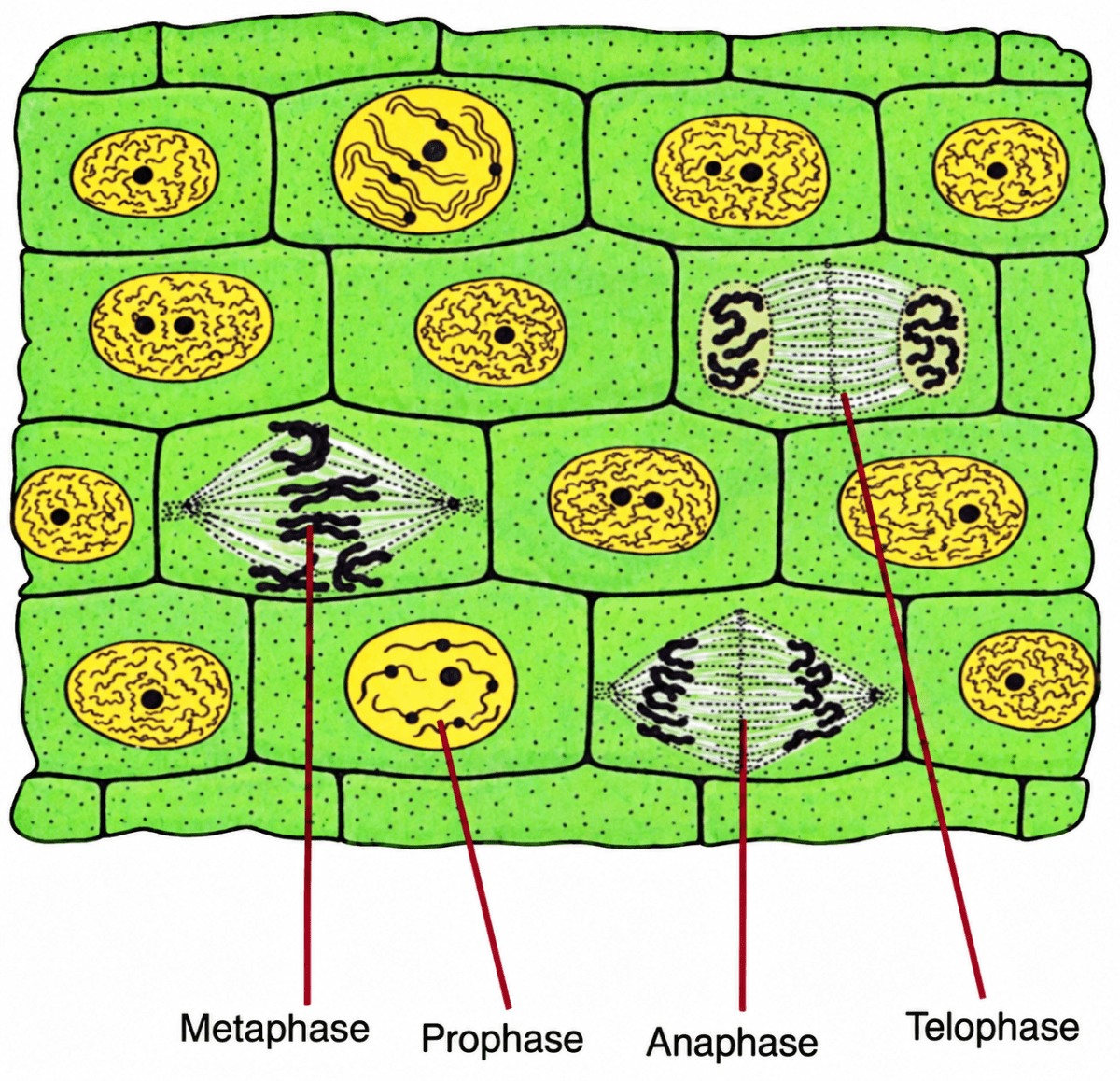
| Column I | Column II | |
|---|---|---|
| A | Metaphase | 2. Chromosomes align at the cell's equatorial plane known as metaphase plate. |
| B | Prophase | 3. Chromosomes condense and become visible, and the mitotic spindle begins to form. |
| C | Anaphase | 4. Sister chromatids are pulled apart towards opposite poles of the cell. |
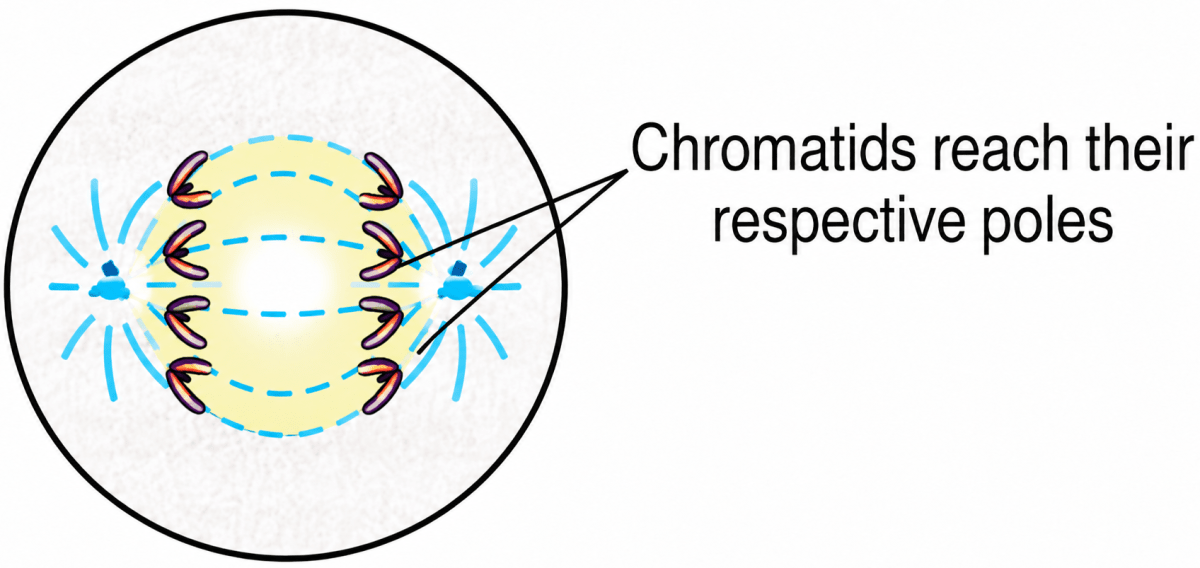
| D | Telophase | 1. Chromatids reach the poles, and new nuclear envelopes form around each set of chromosomes. |
Define Cytokinesis in plant cells.
Answer
In plant cells, cytokinesis is the division of the cytoplasm in which a cell plate is formed at the centre of the cytoplasm and grows outwards towards the cell wall. This type of cytokinesis is centrifugal.
Define Chiasma.
Answer
A chiasma is the point (or area) where two non-sister chromatids of homologous chromosomes cross over each other and exchange their segments during prophase of meiosis I.
Define Heterotypic division.
Answer
Meiosis I is called heterotypic division because it results in the formation of daughter cells having half the number of chromosomes of the parent cell. It is also known as reductional division.
Define Homologous chromosomes.
Answer
Homologous chromosomes are a pair of chromosomes, one received from the mother and one from the father, which have the same genes at the same loci and a similar length and centromere position, and which pair up with each other during meiosis.
Differentiate between G1 phase and G2 phase
Answer
Differences between G1 phase and G2 phase are:
| G1 phase | G2 phase |
|---|---|
| It is the first gap (growth) phase. | It is the second gap (growth) phase. |
| It occurs before the S phase. | It occurs after the S phase. |
| The cell grows in size and synthesises RNA and proteins. | Synthesis of RNA and protein continues, which is required for cell growth. |
| No change occurs in the DNA content. | Two centrosomes are formed by the replication of a single centrosome. |
Differentiate between Karyokinesis and Cytokinesis
Answer
Differences between Karyokinesis and Cytokinesis are:
| Karyokinesis | Cytokinesis |
|---|---|
| It is the division of the nucleus. | It is the division of the cytoplasm. |
| It is the first division to take place. | It occurs after karyokinesis. |
| It results in the formation of two nuclei. | It results in the formation of two daughter cells. |
Differentiate between Mitosis and Meiosis
Answer
Differences between Mitosis and Meiosis are:
| Mitosis | Meiosis |
|---|---|
| It occurs in somatic cells. | It occurs in the reproductive (germ) cells. |
| It produces cells for growth and tissue repair. | It produces gametes. |
| Two daughter cells are formed. | Four daughter cells are formed. |
| Each daughter cell is diploid. | Each daughter cell is haploid. |
| Each daughter cell is genetically identical to the parent cell. | Each daughter cell is genetically different from the parent cell. |
| Crossing over does not occur. | Crossing over occurs during prophase I. |
What is the importance of meiosis in creating variation?
Answer
During meiosis, crossing over takes place between the non-sister chromatids of homologous chromosomes, leading to the exchange and recombination of genes. In addition, the maternal and paternal chromosomes get randomly assorted into the gametes. Together, these events produce gametes with new gene combinations, which is the basis of genetic variation among the offspring.
Mention three significant changes that occur in a cell during interphase.
Answer
(i) During the G1 phase, the cell grows in size and synthesises RNA and proteins.
(ii) During the S phase, replication of DNA occurs and the chromosomes are duplicated.
(iii) During the G2 phase, synthesis of RNA and protein continues and two centrosomes are formed by the replication of a single centrosome.
How many daughter cells are formed at the end of mitosis and meiosis?
Answer
At the end of mitosis, two daughter cells are formed, while at the end of meiosis, four daughter cells are formed.
Name the point of attachment of two chromatids of a chromosome.
Answer
Centromere.
During mitosis, what is the position of chromatids in
(a) Metaphase
(b) Anaphase
Answer
(a) In metaphase, each chromosome (consisting of two chromatids joined at the centromere) gets attached to the spindle by its centromere and lies along the equatorial plane of the cell.
(b) In anaphase, the centromere splits and the two sister chromatids separate and move towards the opposite poles of the cell.
Give the reasons:
(i) Gametes have a haploid number of chromosomes.
(ii) Mitosis is called equational division.
Answer
(i) Gametes are formed by meiosis, in which the chromosome number is reduced to half. As a result, gametes have the haploid (n) number of chromosomes. This ensures that when two gametes fuse during fertilisation, the normal diploid (2n) number of chromosomes is restored.
(ii) Mitosis is called equational division because the two daughter cells formed have the same number and kind of chromosomes as the parent cell. The chromosome number remains unchanged (equal) after division.
(i) Draw a diagram of the nucleus of a cell, having chromosome number 6, as it would appear in the Metaphase stage of mitosis and label the following parts in the diagram; (1) Aster (2) Spindle fibres (3) Chromatid (4) Centromere.
(ii) Mention the difference between mitosis and meiosis with reference to :
(a) Number of daughter cells formed at the end of the division.
(b) The chromosome number of the daughter cells formed.
Answer
(i) The diagram of a cell with 6 chromosomes as it appears in the metaphase stage of mitosis, with the labelled parts, is shown below:
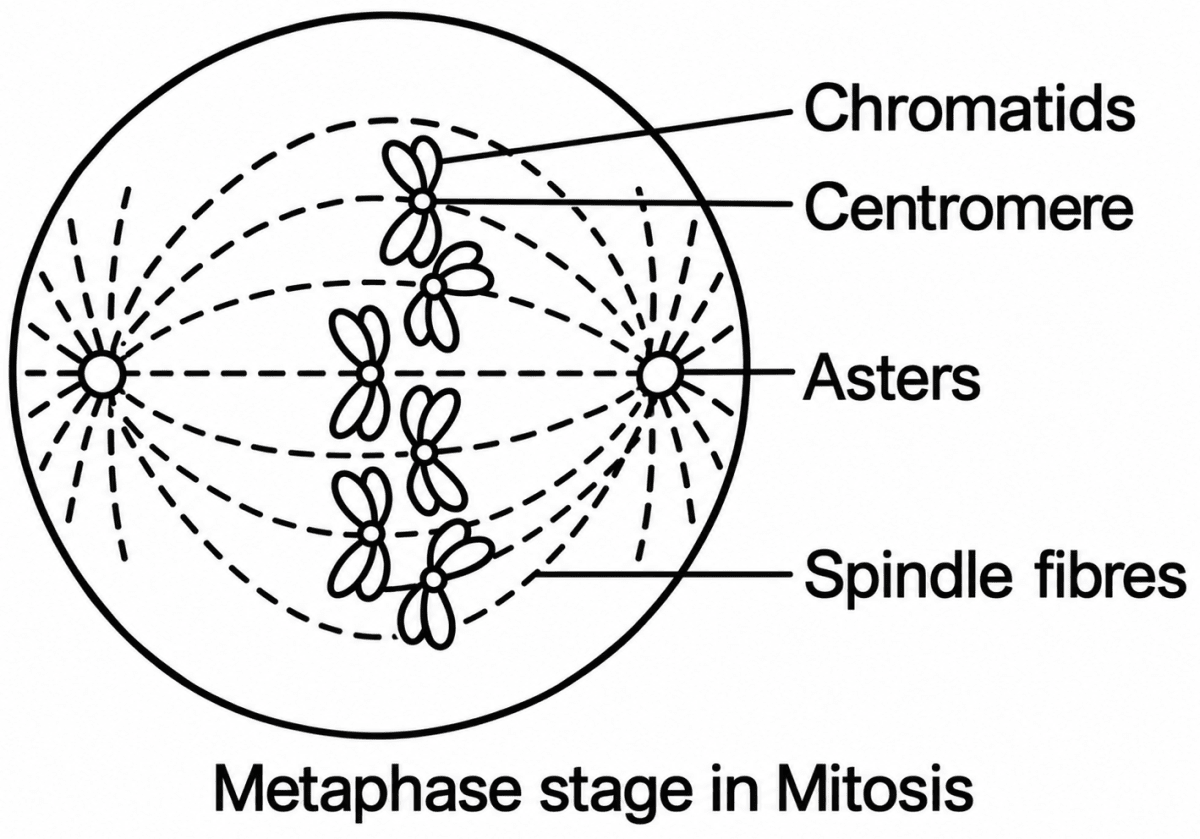
(ii) Difference between mitosis and meiosis:
| Mitosis | Meiosis |
|---|---|
| Two daughter cells are formed at the end of the division. | Four daughter cells are formed at the end of the division. |
| The daughter cells are diploid (2n), having the same chromosome number as the parent cell. | The daughter cells are haploid (n), having half the chromosome number of the parent cell. |
Why is meiosis referred to as reduction division?
Answer
Meiosis is referred to as reduction division because the number of chromosomes is reduced to half in the daughter cells — from the diploid (2n) number of the parent cell to the haploid (n) number. This reduction takes place during meiosis I. It is essential because when the male and female gametes fuse during fertilisation, the normal diploid number of chromosomes is restored.
State how meiosis maintains chromosome number in a species.
Answer
Meiosis halves the chromosome number while forming gametes, so that each gamete is haploid (n). During fertilisation, the haploid male gamete fuses with the haploid female gamete to restore the diploid (2n) number of chromosomes in the zygote. In this way, the chromosome number of a species is kept constant generation after generation.
Draw a neat, labelled diagram of an animal cell showing metaphase with four chromosomes.
Answer
The labelled diagram of an animal cell showing the metaphase stage with four chromosomes is given below:

The diagram given below represents a stage during mitotic cell division in an animal cell :
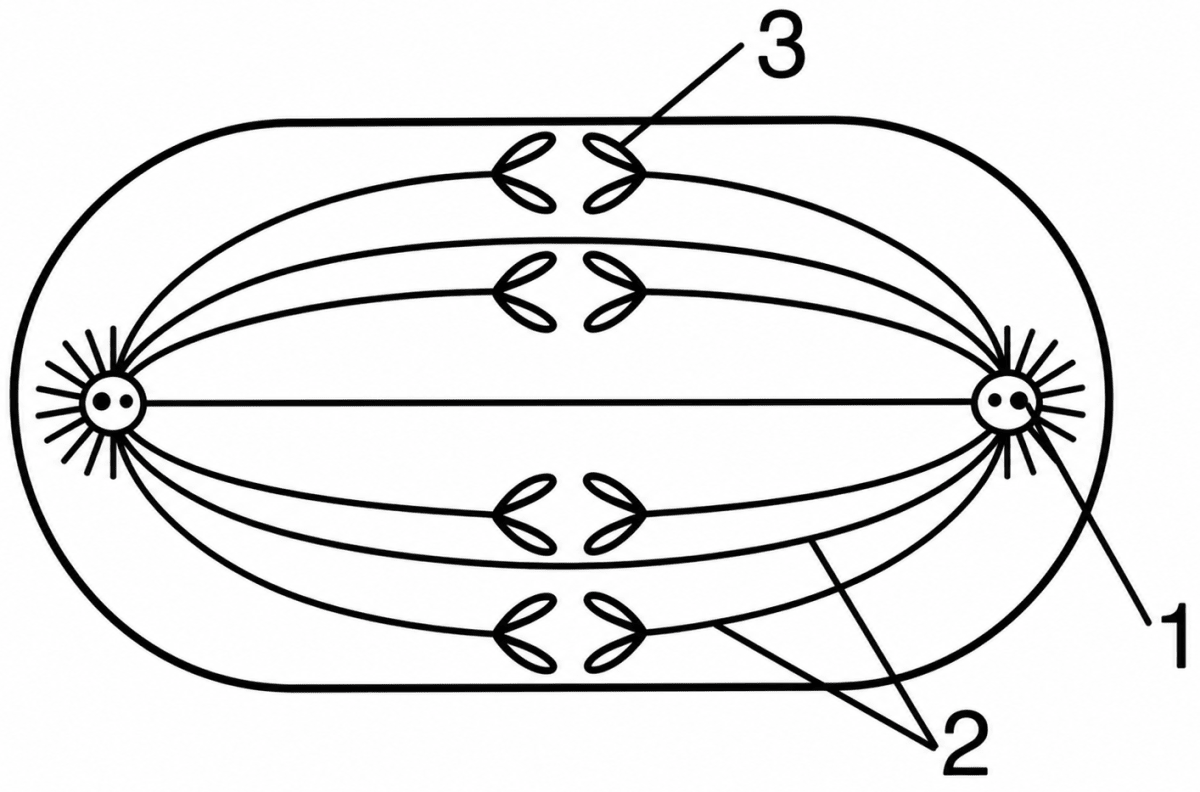
(i) Identify the stage. Give a reason to support your answer.
(ii) Name the parts labelled 1, 2, and 3.
(iii) What is the chromosome number of the cell?
(iv) Draw a neat, labelled diagram of the cell as it would appear in the next stage. Name the stage.
Answer
(i) The stage is metaphase, because the chromosomes are arranged along the equatorial plane of the cell and are attached to the spindle fibres by their centromeres.
(ii) The parts are as follows:
- 1 → Aster
- 2 → Spindle fibres
- 3 → Chromatid
(iii) The chromosome number of the cell is 4.
(iv) The next stage is anaphase. Its labelled diagram is shown below:
The diagram given below represents a stage in cell division. Study the same and answer the questions that follow :
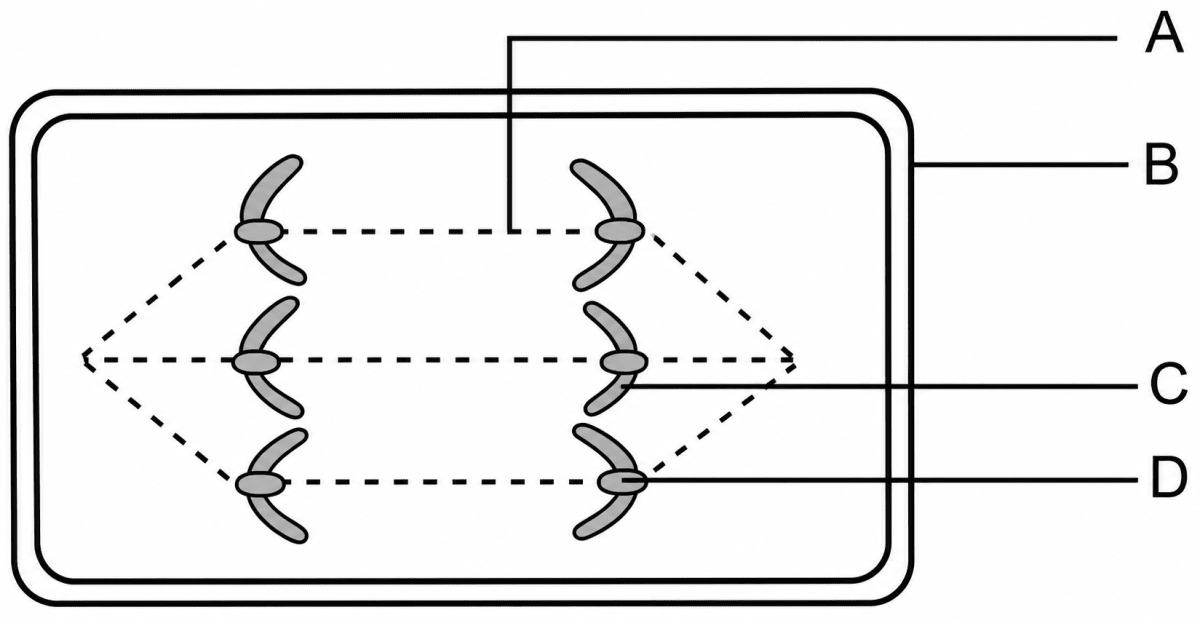
(i) Identify the stage of cell division.
(ii) Name the parts labelled A, B, C and D.
(iii) What is the unique feature observed in this stage?
(iv) Where does this type of cell division usually occur?
(v) How many daughter cells are formed from this type of cell division?
(vi) Is the dividing cell shown a plant cell or an animal cell? Give a reason to support your answer.
Answer
(i) The stage shown is anaphase I of meiosis, in which the homologous chromosomes (each still made up of two chromatids) are separating and moving towards the two opposite poles of the cell along the spindle fibres.
(ii) The parts are as follows:
- A → Spindle fibre
- B → Cell wall
- C → Chromosome
- D → Centromere
(iii) The unique feature observed is that the homologous chromosomes separate from each other and move to opposite poles (and not the sister chromatids), so that each pole receives only half the number of chromosomes. This reductional separation is the special feature of meiosis.
(iv) This type of cell division (meiosis) occurs in the reproductive cells present in the reproductive organs — the anther and ovary in plants, and the testis and ovary in animals.
(v) Four daughter cells are formed.
(vi) The dividing cell is a plant cell, because it has a cell wall and lacks centrioles and asters.
Given below is a diagram representing a stage during mitotic cell division in an animal cell :
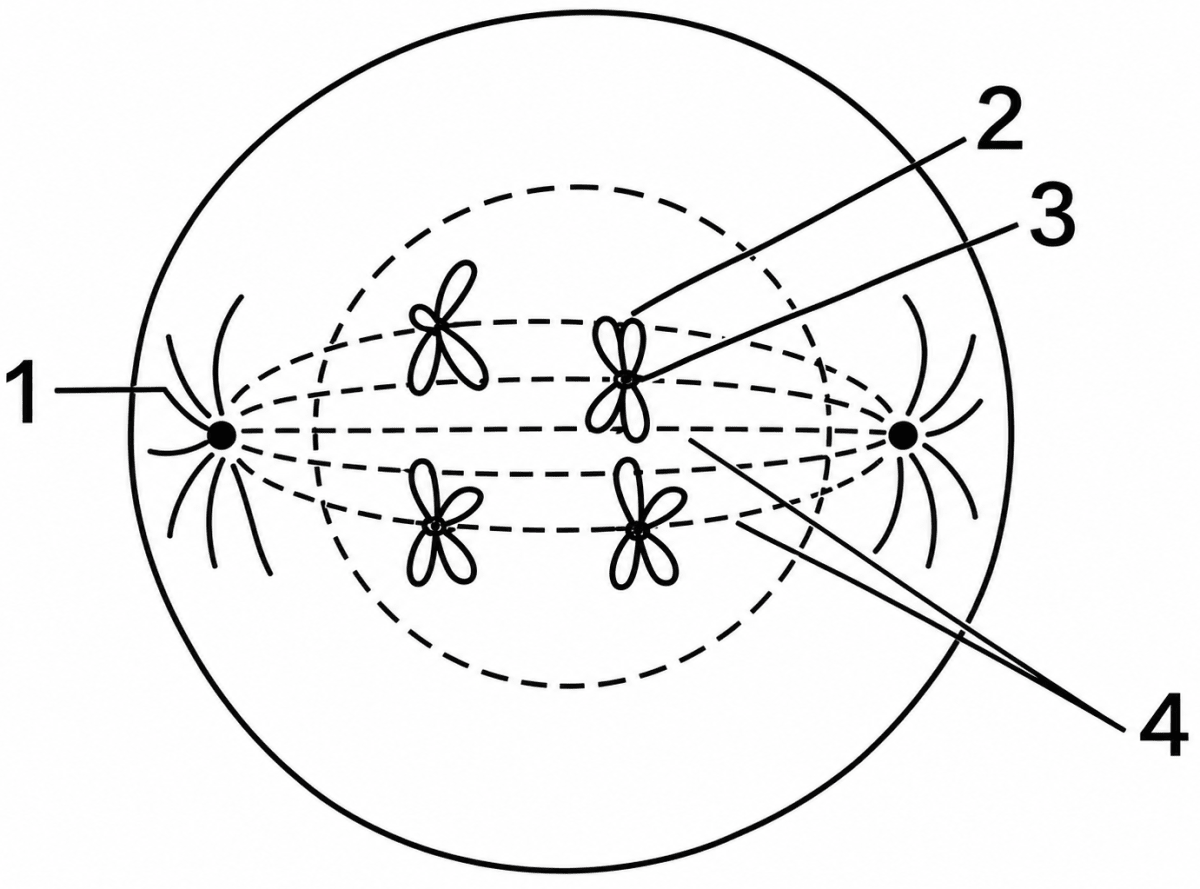
(i) Identify the stage. Give a reason to support your answer.
(ii) Name the parts labelled 1, 2, 3 and 4.
(iii) What is the function of part 3?
(iv) Name the stage that comes just after the stage shown in the diagram. Draw a well-labelled diagram of this stage.
Answer
(i) The stage is metaphase, because the chromosomes are arranged at the equatorial plane and are attached to the spindle fibres by their centromeres.
(ii) The parts are as follows:
- 1 → Aster
- 2 → Chromatid
- 3 → Centromere
- 4 → Spindle fibres
(iii) Part 3, the centromere, joins the two sister chromatids of a duplicated chromosome and provides the region at which spindle fibres attach during cell division.
(iv) The stage that comes just after metaphase is anaphase. Its well-labelled diagram is shown below:
The diagram represents a stage during cell division. Study the same and then answer the questions that follow :
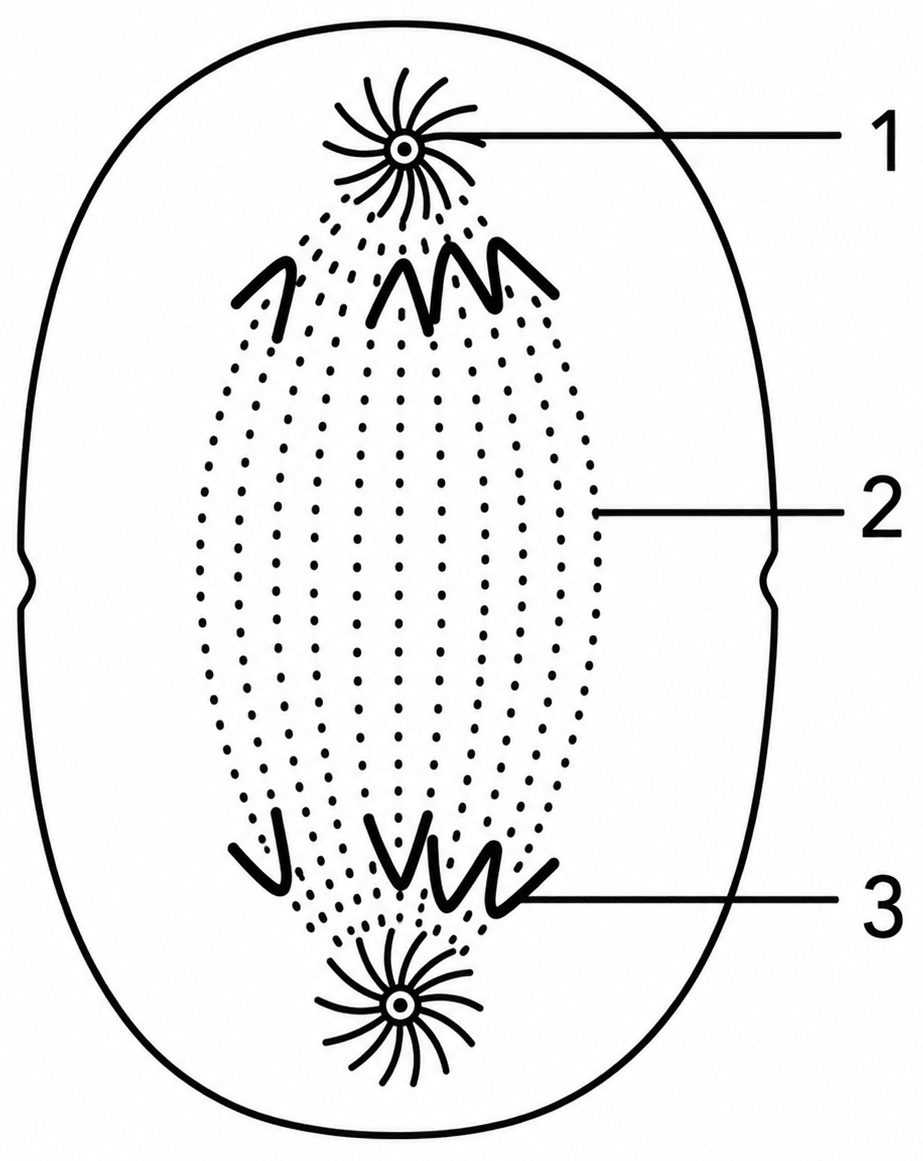
(i) Name the parts labelled 1, 2 and 3.
(ii) Identify the above stage and give a reason to support your answer.
(iii) Mention where in the body this type of cell division occurs.
(iv) Name the stage prior to this stage and draw a diagram to represent the same.
Answer
(i) The parts are as follows:
- 1 → Centriole (centrosome)
- 2 → Spindle fibres
- 3 → Chromatids
(ii) The stage is anaphase, because the sister chromatids have separated and are moving towards the opposite poles of the cell.
(iii) This is a mitotic division, and it occurs in somatic (body) cells.
(iv) The stage prior to anaphase is metaphase. Its diagram is shown below:
Given below is a diagram representing a stage during mitotic cell division. Study it carefully and answer the questions that follow :

(i) Is it a plant cell or an animal cell? Give a reason to support your answer.
(ii) Identify the stage shown.
(iii) Name the stage that follows the one shown here. How is that stage identified?
(iv) How will you differentiate between mitosis and meiosis on the basis of the chromosome number in the daughter cells?
(v) Draw a duplicated chromosome and label its parts.
Answer
(i) It is an animal cell, because the centrioles have formed asters and no cell wall is present around the cell.
(ii) The stage shown is prophase, because the chromosomes have condensed and become visible, while they are not yet arranged at the equatorial plane. The nuclear membrane is also in the process of disappearing.
(iii) The stage that follows prophase is metaphase. It is identified by the arrangement of chromosomes along the equatorial plane of the cell, with spindle fibres attached to their centromeres.
(iv) In mitosis, each daughter cell has the same (diploid, 2n) chromosome number as the parent cell, whereas in meiosis, each daughter cell has half (haploid, n) the chromosome number of the parent cell.
(v) The labelled diagram of a duplicated chromosome is shown below:

The given diagram shows a stage during mitotic division in an animal cell :
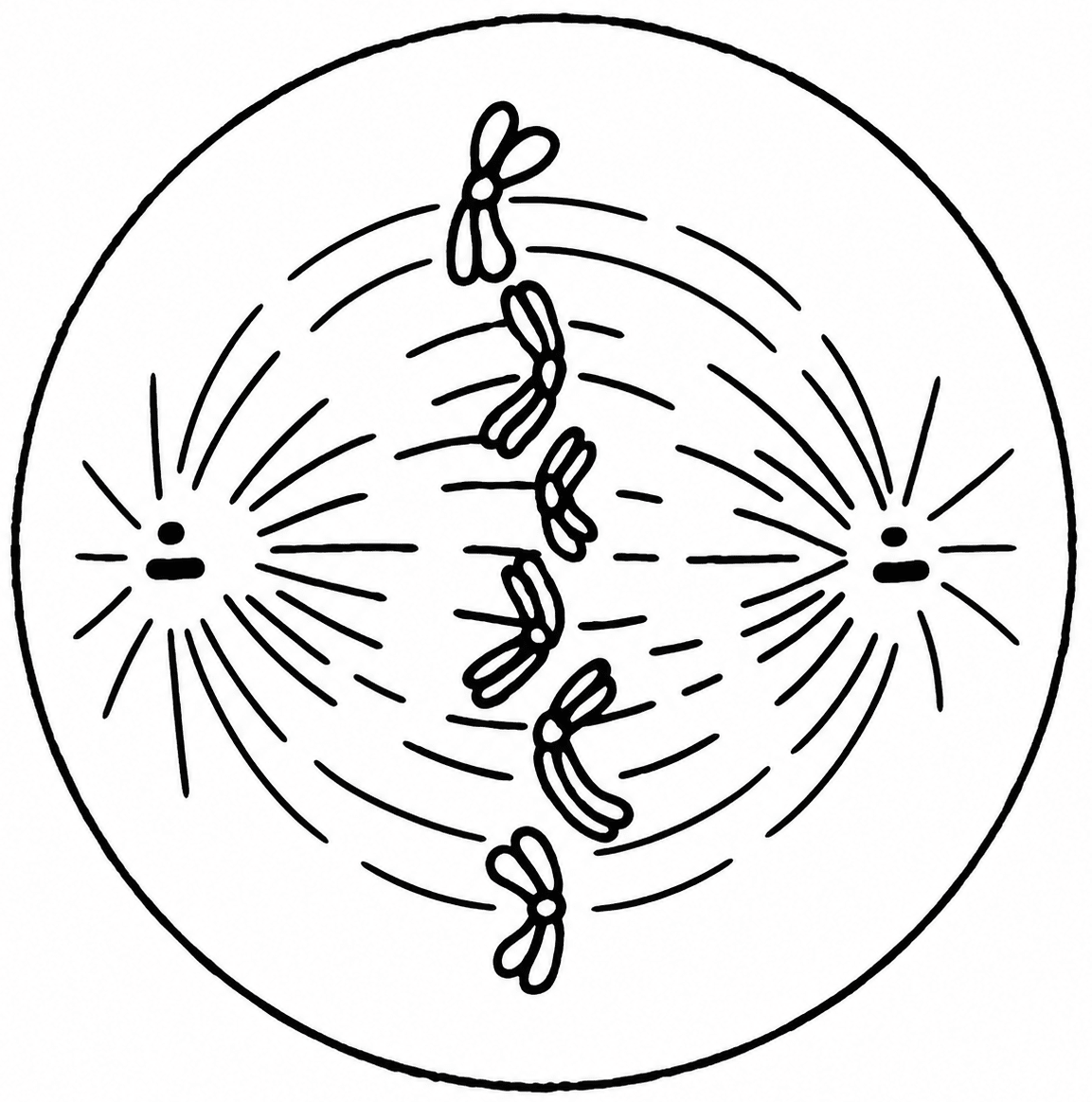
(i) Identify the stage. Give a reason to support your answer.
(ii) Draw a neat labelled diagram of the cell as it would appear in the next stage. Name the stage.
(iii) In what two ways is mitotic division in an animal cell different from the mitotic division in a plant cell?
(iv) Name the type of cell division that occurs during. A. Growth of a shoot. B. Formation of pollen grains.
Answer
(i) The stage is metaphase, because the chromosomes are arranged along the equatorial plane and are attached to the spindle fibres by their centromeres.
(ii) The next stage is anaphase. Its neat labelled diagram is shown below:
(iii) Two differences between mitosis in an animal cell and a plant cell:
| Mitosis in animal cell | Mitosis in plant cell |
|---|---|
| Asters are formed. | Asters are not formed. |
| Cytokinesis takes place by the formation of a cleavage furrow (centripetal). | Cytokinesis takes place by the formation of a cell plate (centrifugal). |
(iv) A. Growth of a shoot → Mitosis B. Formation of pollen grains → Meiosis
Study the diagram given below which represents a stage during the mitotic cell division and answer the questions that follow :

(i) Identify the stage giving suitable reasons.
(ii) Name the parts numbered 1 and 2.
(iii) What is the technical term for the division of nucleus?
(iv) Mention the stage that comes before the stage shown in the diagram. Draw a neat labelled diagram of the stage mentioned.
(v) Which is the cell division that results in half the number of chromosomes in daughter cells.
Answer
(i) The stage is telophase, because the cell has started to constrict in the middle by a cleavage furrow to form two daughter cells, and the chromosomes have reached the two opposite poles.
(ii) The parts are as follows:
- 1 → Chromosomes become indistinct
- 2 → Nuclear membrane
(iii) The technical term for the division of the nucleus is karyokinesis.
(iv) The stage that comes before telophase is anaphase. Its neat labelled diagram is shown below:

(v) Meiosis is the cell division that results in half the number of chromosomes in the daughter cells.
Shown below are four stages (EFGH) of a certain kind of cell division. Answer the questions followed:
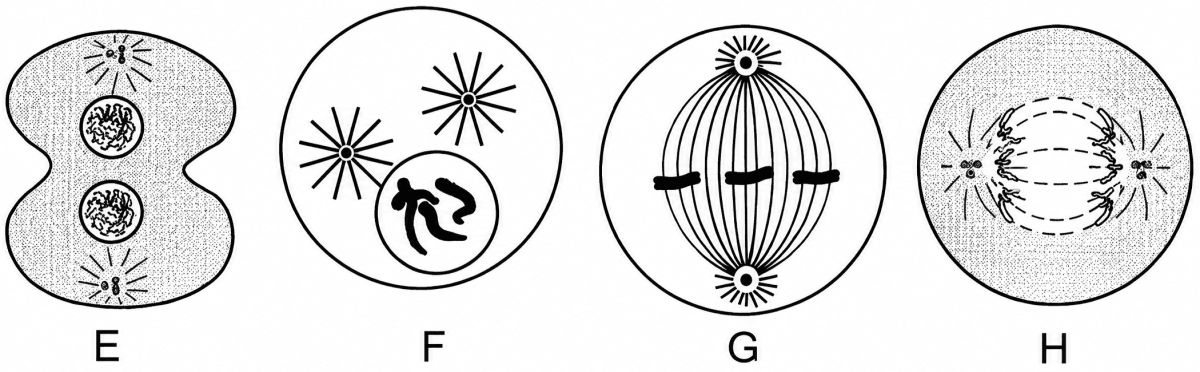
(i) Which type of cell is shown above?
- Plant cell
- Animal cell
- Bacterial cell
- Eukaryotic cell
(ii) The cell division shown is
- Mitosis
- Meiosis
- Multiple fission
- Cloning
(iii) The correct sequence of the four stages is
- F → E → H → G
- E → H → F → G
- G → F → E → H
- F → G → H → E
(iv) Specific feature of stage G is
- disappearing nucleolus
- disappearing nuclear membrane
- chromosomes arranged at the centre
- condensation of chromosomes
Answer
(i) Animal cell
Reason — The diagrams show asters and centrioles at the poles, which are characteristic of animal cells.
Plant cells generally lack centrioles and asters and have a rigid cell wall. Bacteria are prokaryotic and do not undergo mitosis or possess a nucleus or spindle fibres. Although an animal cell is a eukaryotic cell, the specific type shown is an animal cell, as indicated by the presence of asters.
(ii) Mitosis
Reason — The stages shown are prophase, metaphase, anaphase, and telophase, which are stages of mitosis.
Meiosis involves two successive divisions and pairing of homologous chromosomes, which are not shown. Multiple fission produces many daughter cells simultaneously, unlike the two daughter cells shown here. Cloning is a method of producing genetically identical organisms, not a stage of cell division.
(iii) F → G → H → E
Reason — The stages of mitosis occur in the order:
Prophase → Metaphase → Anaphase → Telophase
Telophase (E) occurs after anaphase. Reason: Telophase is the last stage of mitosis, not the first. Metaphase cannot occur before prophase, and anaphase should occur before telophase.
(iv) chromosomes arranged at the centre
Reason — Stage G is metaphase, in which chromosomes are aligned at the equatorial plate (centre) of the cell.
The nucleolus disappears during prophase, not metaphase. The nuclear membrane breaks down during prophase, not metaphase. Chromosome condensation occurs during prophase. By metaphase, the chromosomes are already fully condensed and aligned at the equatorial plate.