
Fill in the blanks:
(i) The opening of the stomata usually depends upon the ............... of the guard cell.
(ii) During photosynthesis, light energy is trapped by ............... .
(iii) Light energy is used in splitting the ............... molecule, into ............... .
(iv) Reduction of NADP takes place in ............... reaction.
Answer
(i) The opening of the stomata usually depends upon the turgidity of the guard cell.
(ii) During photosynthesis, light energy is trapped by chlorophyll.
(iii) Light energy is used in splitting the water molecule, into hydrogen ions and hydroxyl ions.
(iv) Reduction of NADP takes place in light reaction.
Which type of changes take place in dark reaction?
Answer
A series of biochemical changes take place in the dark reaction, during which carbon dioxide is converted into carbohydrate.
What is the first stable product of Calvin cycle?
Answer
The first stable product of the Calvin cycle is phosphoglyceric acid (PGA), a 3-carbon compound.
What does photophosphorylation means?
Answer
Photophosphorylation is the process of formation of the energy-rich compound ATP (adenosine triphosphate) from ADP (adenosine diphosphate) and inorganic phosphate, by utilising light energy.
How do the following affect photosynthesis?
- Chloroplast
- Numerous stomata
- Leaf arrangement
Answer
Chloroplast — Chloroplasts contain the pigment chlorophyll and are the sites of photosynthesis. They trap solar energy required to carry out the process.
Numerous stomata — More numerous stomata allow rapid gaseous exchange, letting in more carbon dioxide and speeding up the process of photosynthesis.
Leaf arrangement — Leaves are arranged so as to receive maximum sunlight without overlapping. This ensures maximum light absorption, favouring photosynthesis.
Fill in the blanks:
The chemical used to remove CO2 from the flask is ............... .
CO2 enters into the stomata from atmosphere by ............... .
Light reaction takes place in ............... of chloroplast.
The end products of photosynthesis are ..............., ............... and ............... .
Answer
The chemical used to remove CO2 from the flask is potassium hydroxide.
CO2 enters into the stomata from atmosphere by diffusion.
Light reaction takes place in grana of chloroplast.
The end products of photosynthesis are glucose, oxygen and water.
A plant is kept in a dark cupboard for about 48 hours before conducting any experiment on photosynthesis to
- Remove starch from the plant.
- Ensure that starch is not translocated from the leaves.
- Remove chlorophyll from the leaf of the plant.
- Remove starch from the experimental leaf.
Answer
Remove starch from the plant.
Reason — Keeping the plant in the dark for 24 to 48 hours destarches it. During this period, photosynthesis stops and the starch already present is removed from the leaves and stored in the storage organs. This ensures that any starch detected later is formed only during the experiment.
The individual flattened stacks of membranous structures inside the chloroplasts are known as
- Grana
- Stroma
- Thylakoids
- Cristae
Answer
Thylakoids
Reason — Thylakoids are the flattened sac-like membranous structures found inside the chloroplast. A stack of thylakoids arranged like a pile of coins forms a granum.
The assimilatory powers for dark reaction are
- ATP and O2
- ATP and NADPH2
- O2 and CO2
- ATP and H2O
Answer
ATP and NADPH2
Reason — ATP and NADPH2 produced during the light reaction act as assimilatory powers. They provide the energy and hydrogen required to reduce CO2 to carbohydrate in the dark reaction.
A destarched plant is one whose
- leaves are free from chlorophyll
- aerial parts are free from starch
- leaves are free from starch
- plant is free from starch
Answer
leaves are free from starch
Reason — A destarched plant is one that has been kept in complete darkness for about 48 hours so that its leaves no longer contain any reserve food (starch).
Electrons released on splitting of water molecules in photosynthesis are used in producing:
- NADP
- NADPH
- ATP
- O2
Answer
NADPH
Reason — The electrons and hydrogen ions released during photolysis of water are picked up by NADP, which is reduced to NADPH2.
In an experiment to study the adaptations of leaves for photosynthesis, the palisade cells are tightly packed to optimise the process of (P) while the spongy mesophyll aids in efficient (Q) exchange.
- P- photosynthesis; Q- gas
- P- respiration; Q- water
- P- transpiration; Q- carbon
- P- diffusion; Q- oxygen
Answer
P- photosynthesis; Q- gas
Reason — Palisade cells are deep and tightly packed and their chloroplasts trap maximum light for photosynthesis. The loosely packed spongy mesophyll cells create air spaces that make gaseous exchange efficient.
Raman was growing a plant in his garden under medium-intensity light and a constant temperature of 35°C. He noticed that the plant's rate of photosynthesis is not increasing, even though the light is adequate. What is the most likely limiting factor in this case?
- Water availability
- Carbon dioxide concentration
- Chlorophyll content
- Temperature
Answer
Carbon dioxide concentration
Reason — The temperature (35°C) is optimum and light is adequate, so these are not limiting. Since the concentration of carbon dioxide in the atmosphere is very low (0.03%), it acts as the limiting factor according to Blackmann's principle of limiting factors.
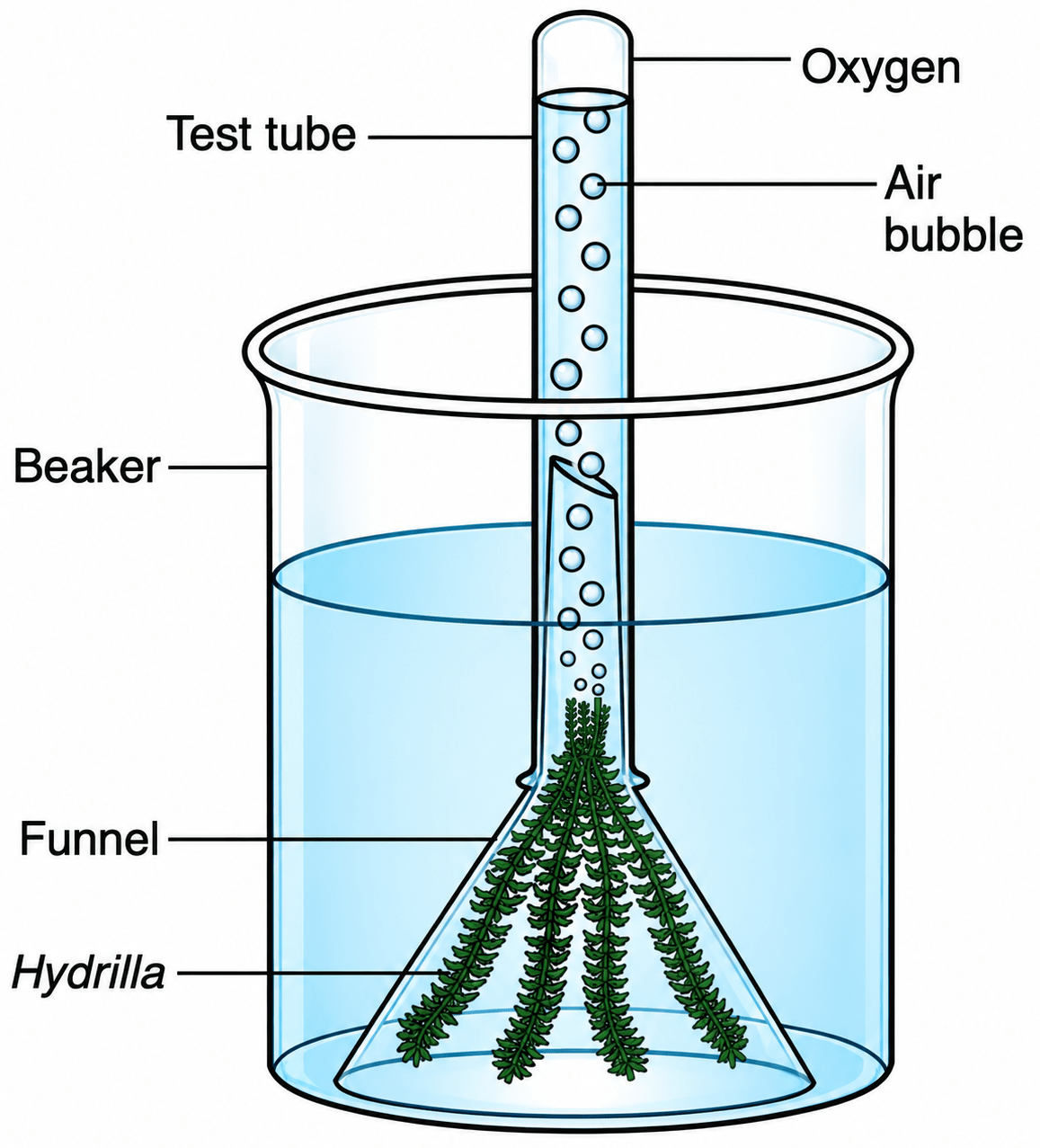
Ria conducted an experiment using a Hydrilla plant to demonstrate the production of oxygen during photosynthesis. She placed the plant under an inverted funnel in a beaker of water and observed gas bubbles forming in the test tube over time. After collecting the gas, she tested it with a glowing splinter, which ignited. What conclusion can Ria draw from her experiment?
- The gas produced is carbon dioxide, indicating that photosynthesis is not occurring.
- The gas produced is oxygen, confirming that photosynthesis releases oxygen.
- The gas produced is nitrogen, showing that plants do not require light for photosynthesis.
- The gas produced is hydrogen, suggesting that photosynthesis only occurs in aquatic plants.
Answer
The gas produced is oxygen, confirming that photosynthesis releases oxygen.
Reason — Oxygen is a supporter of combustion. The gas collected made the glowing splinter burst into flame, which confirms that the gas is oxygen and that oxygen is evolved during photosynthesis.
The ground substance present in chloroplast is
- Stoma
- Stroma
- Grana
- Thylakoids
Answer
Stroma
Reason — Stroma is the colourless ground substance filling the chloroplast. It is the site of the dark reaction of photosynthesis.
During photolysis of water
- the molecules of water is formed
- the molecules of water is broken down
- the molecules of hydrogen is broken down
- CO2 is broken down
Answer
the molecules of water is broken down
Reason — During photolysis, the light energy absorbed by chlorophyll is used to split (break down) the water molecule into hydrogen ions and hydroxyl ions.
In the equation of photosynthesis, the number of molecules of carbon dioxide and water to form 1 molecule of glucose are
- 6 and 8 respectively
- 12 and 6 respectively
- 6 and 12 respectively
- 2 and 6 respectively
Answer
6 and 12 respectively
Reason — In the balanced equation of photosynthesis, 6 molecules of carbon dioxide and 12 molecules of water combine to form 1 molecule of glucose, along with oxygen and water.
The site of light reaction in the cells of a green leaf is:
- Nucleus
- grana of chloroplast
- Cytoplasm
- stroma of chloroplast
Answer
grana of chloroplast
Reason — The site of light reaction in the cells of a green leaf is grana of chloroplast which has chlorophyll.
The colour reflected by chlorophyll is
- red
- green
- blue
- black
Answer
green
Reason — Chlorophyll absorbs blue, violet and red wavelengths strongly but absorbs green light only weakly and therefore reflects it. Hence, chlorophyll appears green.
Assertion (A): Light reaction takes place in the grana of chloroplast.
Reason (R): During light reaction, NADP gets reduced.
- Both (A) and (R) are true
- Both (A) and (R) are false
- Both (A) and (R) are true and (R) is the correct explanation of (A)
- Both (A) and (R) are true but (R) is not the correct explanation of (A)
Answer
Both (A) and (R) are true but (R) is not the correct explanation of (A)
Explanation The light reaction takes place in the grana (thylakoids) of the chloroplast, and during this reaction NADP is reduced to NADPH2. Both statements are correct. However, the reduction of NADP is one of the events of the light reaction; it does not explain why the light reaction occurs in the grana. Hence (R) is not the correct explanation of (A).
The optimum temperature for photosynthesis is:
- 10 – 15°C
- 60 – 65°C
- 40 – 45°C
- 25 – 35°C
Answer
25 – 35°C
Reason — Photosynthesis is most efficient at moderate warm temperatures. Temperatures between 25 – 35°C provide the best conditions for the enzymes involved in photosynthesis to work effectively.
The solvent used for dissolving chlorophyll while testing a leaf for starch is:
- Sodium hydroxide
- Limewater
- Water
- Ethyl alcohol
Answer
Ethyl alcohol
Reason — During the starch test, the leaf is boiled in alcohol (ethyl alcohol / methylated spirit) which dissolves and removes the chlorophyll, making the leaf colourless.
Glucose is the end product of photosynthesis and is stored in the form of
- starch
- sucrose
- cellulose
- all these
Answer
all these
Reason — Glucose produced during photosynthesis is either used immediately or stored in the form of sucrose, starch or cellulose.
During the dark reaction of photosynthesis, carbon dioxide is fixed to form first stable product namely,
A. Phosphoglyceric acid B. Glyceraldehyde phosphate C. Glucose D. Fructose
Choose the correct option.
- A and B
- Only A
- Only B
- B and C
Answer
Only A
Reason — During the dark reaction, carbon dioxide combines with a 5-carbon sugar (RUDP) to form phosphoglyceric acid (PGA), which is the first stable product of carbon dioxide fixation.
The process of conversion of ADP to ATP during Photosynthesis:
- Polymerisation
- Photophosphorylation
- Photorespiration
- Photolysis
Answer
Photophosphorylation
Reason — The formation of the energy-rich compound ATP from ADP and inorganic phosphate using light energy is called photophosphorylation.
Photosynthesis:
- It is the synthesis of glucose from carbon dioxide by non-green plants using light energy.
- It is the synthesis of glucose by green plants from carbon dioxide using light energy.
- It is the synthesis of glucose from carbon dioxide and water by non-green plants using light energy.
- It is the synthesis of glucose from carbon dioxide and water by green plants using light energy.
Answer
It is the synthesis of glucose from carbon dioxide and water by green plants using light energy.
Reason — Photosynthesis is the process by which green plants manufacture glucose from carbon dioxide and water in the presence of light energy.
Grana of chloroplast is not the:
- Site of Light Independent Phase
- Site of Light Dependent Phase
- Site of Photolysis
- Site of Photon absorption
Answer
Site of Light Independent Phase
Reason — The grana is the site of the light dependent phase, which includes photon absorption and photolysis. The light independent phase (dark reaction) takes place in the stroma, not in the grana.
Name the following:
(i) The first form of food produced during photosynthesis.
(ii) The chemical that absorbs carbon dioxide during dark reaction.
(iii) The tissue that transports manufactured food from the leaves to all the parts of the plants.
(iv) That part of chloroplast where the light reaction of photosynthesis takes place.
(v) The ground substance present in a chloroplast.
(vi) The process of conversion of ADP to ATP during the first phase of photosynthesis.
(vii) The process of conversion of several molecules of glucose to one molecule of starch.
(viii) An aquatic plant used in the lab to demonstrate O2 liberation during photosynthesis.
(ix) The compartment which stores energy in the cells.
(x) The organisms that are called natural purifiers of the air.
Answer
(i) Glucose
(ii) Ribulose 1,5-diphosphate (RUDP)
(iii) Phloem
(iv) Grana (thylakoids)
(v) Stroma
(vi) Photophosphorylation
(vii) Polymerisation
(viii) Hydrilla
(ix) ATP (Adenosine triphosphate)
(x) Green plants
Complete the following by filling in the blanks numbered 1 to 10 with the appropriate word/term:
Photosynthesis involves light reaction and dark reaction. During light reaction, the chlorophyll present in the (1) ............... gets activated by absorbing light energy. This energy splits (2) ............... molecules to (3) ............... and oxygen and releases electrons. This process is called (4) ............... . The (5) ............... ions are picked up by NADP to form (6) ............... . The ADP is converted to (7) ............... . This process is called (8) ............... . During the dark phase, the compound produced at the end of light reaction reacts with carbon dioxide to form (9) ............... . This product is converted to starch.
Answer
(1) grana
(2) water
(3) hydrogen
(4) photolysis
(5) hydrogen
(6) NADPH2
(7) ATP
(8) photophosphorylation
(9) glucose
Complete the following paragraph by filling in the blanks (i) to (v) with appropriate words:
To test a leaf for starch, the leaf is boiled in water to (i) ............... . It is then boiled in methylated spirit to (ii) ............... . The leaf is dipped in warm water to soften it. It is placed in a petri dish, and (iii) ............... solution is added. The region of the leaf which contains starch, turns (iv) ............... and the region which does not contain starch, turns (v) ............... .
Answer
To test a leaf for starch, the leaf is boiled in water to (i) kill the cells. It is then boiled in methylated spirit to (ii) remove chlorophyll. The leaf is dipped in warm water to soften it. It is placed in a petri dish, and (iii) iodine solution is added. The region of the leaf which contains starch, turns (iv) blue-black and the region which does not contain starch, turns (v) brown.
Mention if the following statements are true or false. If false, rewrite the sentences by changing only the words printed in bold face:
(i) Photosynthesis occurs in all cells of the plant.
(ii) Potassium hydroxide absorbs oxygen.
(iii) By-product of photosynthesis is CO2.
(iv) The dark reaction of photosynthesis is light independent.
(v) Plants that manufacture their own food are termed as heterotrophs.
(vi) Photosynthesis occurs only in cells containing chloroplasts.
(vii) Xylem transports starch from the leaves to all parts of the plant body.
(viii) All life on Earth is supported by Photosynthesis.
Answer
(i) False Corrected Statement — Respiration occurs in all cells of the plant.
(ii) False Corrected Statement — Pyrogallic acid absorbs oxygen.
(iii) False Corrected Statement — By-product of photosynthesis is oxygen.
(iv) True
(v) False Corrected Statement — Plants that manufacture their own food are termed as autotrophs.
(vi) True
(vii) False Corrected Statement — Phloem transports starch from the leaves to all parts of the plant body.
(viii) True
Given below is a set of five terms. Rewrite the terms in the correct order so as to be in logical sequence as per the directions given in brackets:
(i) Water molecules, oxygen, grana, hydrogen and hydroxyl ions, photons. (photosynthesis)
(ii) Destarched plant, iodine added, washed in water, a leaf boiled in alcohol, placed in sunlight. (testing for presence of starch)
(iii) Palisade cells, cuticle, upper epidermis, spongy cells. (Arrange in logical sequence beginning from term that is underlined)
Answer
(i) Photons, grana, water molecules, hydrogen and hydroxyl ions, oxygen.
(ii) Destarched plant, placed in sunlight, a leaf boiled in alcohol, washed in water, iodine added.
(iii) Cuticle, upper epidermis, palisade cells, spongy cells.
A potted plant having variegated leaves was exposed to sunlight for 3 hours. One of the leaves was plucked and tested for starch. What will be your observation after the starch test?
Answer
Only the green portions of the leaf turn blue-black, indicating the presence of starch, while the non-green (white) portions turn brown, indicating that no starch has been formed. This shows that photosynthesis occurs only in the green parts containing chlorophyll.
The initial food prepared by green plant is A, which is later converted to food B by polymerisation. Name food A and food B.
Answer
Food A is glucose and food B is starch.
Define Photosynthesis.
Answer
Photosynthesis — Photosynthesis is the process by which green plants manufacture carbohydrates from atmospheric carbon dioxide and water, in the presence of sunlight, using chlorophyll, and release oxygen as a by-product.
Define Chloroplast.
Answer
Chloroplast — Chloroplasts are green plastids found in the green parts of plants. They contain the pigment chlorophyll and are the sites of photosynthesis.
Define Compensation point.
Answer
Compensation point — It is the point at which the rate of photosynthesis exactly matches the rate of cellular respiration, so that the carbon dioxide released during respiration is equal to that taken up during photosynthesis.
Define Photolysis.
Answer
Photolysis — Photolysis is the splitting of a water molecule into hydrogen ions and hydroxyl ions using the light energy absorbed by chlorophyll.
Define Destarched plant.
Answer
Destarched plant — A destarched plant is one which has been kept in complete darkness for about 48 hours, so that it no longer contains any reserve food (starch).
Define Photophosphorylation.
Answer
Photophosphorylation — It is the process of formation of the energy-rich compound ATP from ADP and inorganic phosphate, by utilising light energy.
Differentiate between Light reaction and Dark reaction.
Answer
| Light Reaction | Dark Reaction |
|---|---|
| It occurs in the thylakoid membranes of the grana. | It occurs in the stroma. |
| It is a photochemical change requiring light energy. | It involves a series of biochemical changes. |
| Light energy is converted to chemical energy in the form of ATP and NADPH2. | Carbon dioxide is converted to carbohydrate (glucose). |
Differentiate between Photolysis and Photophosphorylation.
Answer
| Photolysis | Photophosphorylation |
|---|---|
| It is the splitting of a water molecule into hydrogen ions and hydroxyl ions using light energy. | It is the formation of ATP from ADP and inorganic phosphate using light energy. |
| Oxygen is released as a result of this process. | ATP is formed as a result of this process. |
Explain — All life would come to an end if there were no green plants.
Answer
Green plants are autotrophs and the only organisms that can trap solar energy and convert it into the chemical energy of food. All animals depend on plants directly or indirectly for food. Green plants also release oxygen needed for respiration. In the absence of green plants there would be no food and no oxygen, and hence all life would come to an end.
Explain — Sleeping under a tree at night is not advisable.
Answer
At night there is no light, so plants do not carry out photosynthesis. They only respire, taking in oxygen and releasing carbon dioxide. As a result, the amount of carbon dioxide around the tree increases and oxygen decreases at night, which makes sleeping under a tree at night not advisable.
Explain — All the food chains begin with green plants.
Answer
Green plants are called producers. They are the only organisms that can convert solar energy into the chemical energy of food. All other organisms depend on them for food. Therefore, all food chains begin with green plants.
Expand the abbreviations:
(i) NADP
(ii) PGA
(iii) ATP
Answer
(i) NADP — Nicotinamide Adenine Dinucleotide Phosphate
(ii) PGA — Phosphoglyceric Acid
(iii) ATP — Adenosine Triphosphate
Draw a neat, labelled diagram to show that oxygen is released during photosynthesis.
Answer
The diagram below shows the experiment to demonstrate that oxygen is released during photosynthesis:
Under which condition does a leaf take carbon dioxide from the atmosphere?
Answer
A leaf takes in carbon dioxide from the atmosphere during the day, in the presence of light, when the stomata are open. This carbon dioxide is used for photosynthesis.
Differentiate in the rate of photosynthesis for the increase in temperature.
(i) 20° to 30°C
(ii) 40°C to 50°C
Answer
(i) Between 20°C and 30°C, the rate of photosynthesis increases (it nearly doubles for every 10°C rise), as this range lies below the optimum temperature.
(ii) Between 40°C and 50°C, the rate of photosynthesis decreases because this range is above the optimum temperature for photosynthesis.
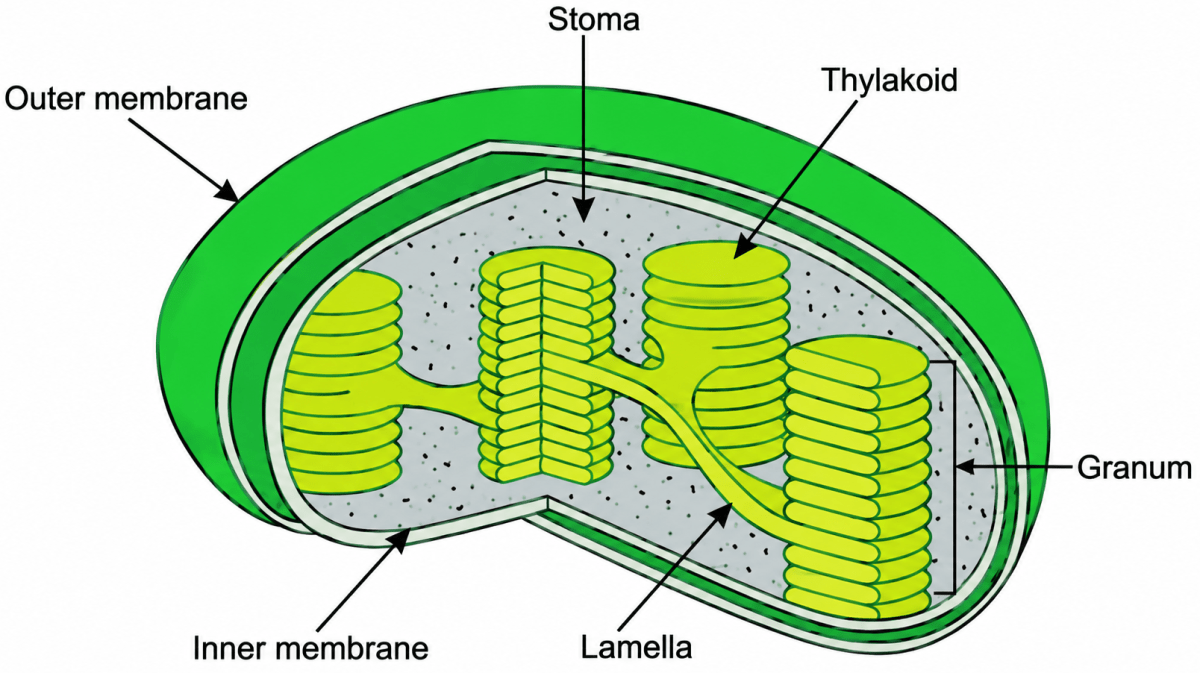
Draw a neat and well labelled diagram of the chloroplast.
Answer
The diagram below shows the structure of a chloroplast with its different parts labelled:
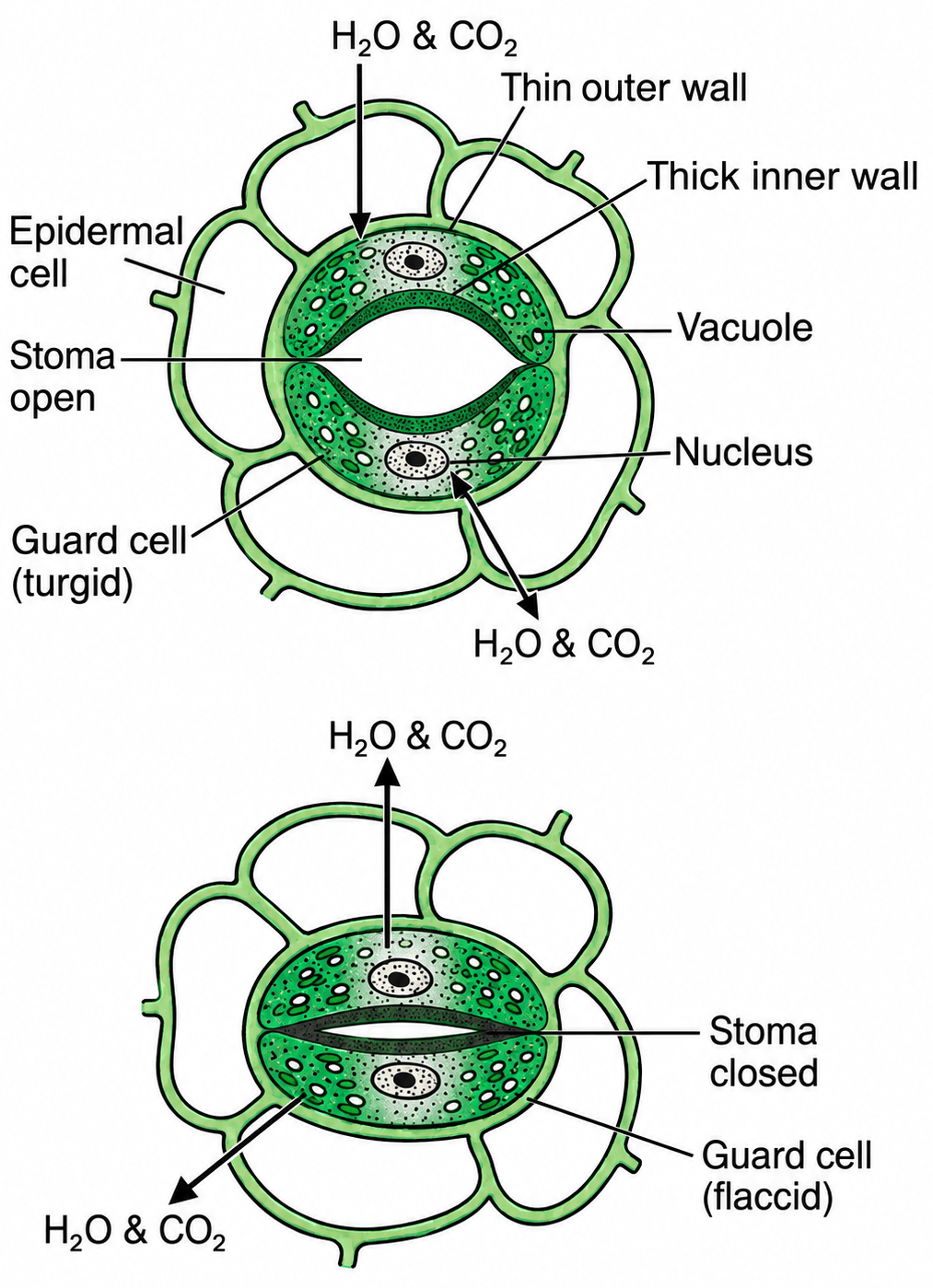
Draw a neat, labelled diagram of a stomatal apparatus.
Answer
The diagram below shows the stomatal apparatus with its different parts labelled:
List the events taking place in the photochemical phase of photosynthesis.
Answer
The events taking place in the photochemical phase (light reaction) of photosynthesis are:
Absorption of light energy by chlorophyll — Chlorophyll absorbs photons of light and gets 'excited' or activated.
Photolysis of water — The absorbed light energy is used to split water molecules into hydrogen ions (H+) and hydroxyl ions (OH-), releasing oxygen and electrons.
Reduction of NADP — The hydrogen ions and electrons released are picked up by NADP, which is reduced to NADPH2.
Photophosphorylation — ATP is formed from ADP and inorganic phosphate using light energy.
Thus, oxygen, ATP and NADPH2 are produced during the photochemical phase.
If you are planning an experiment to show the effect of light on photosynthesis:
(i) Will you select white light or green light? Justify your answer.
(ii) Why would you select a destarched plant?
Answer
(i) I will select white light. The rate of photosynthesis is higher in white light than in light of any particular colour. Green light is weakly absorbed (mostly reflected) by chlorophyll, so photosynthesis would be very poor in green light. Hence white light is chosen.
(ii) I would select a destarched plant so that all pre-existing starch is removed from its leaves. This ensures that any starch found after the experiment is formed only during the experiment, giving a correct result.
Give reason — Green leaves are thin and broad.
Answer
Green leaves are thin so that gases can diffuse in and out quickly over a short distance. They are broad to provide a large surface area for maximum absorption of light. Both these features favour photosynthesis.
Give reason — Photosynthesis is considered as a process supporting all life on earth.
Answer
Photosynthesis provides food to all living organisms, as animals depend on plants directly or indirectly. It also releases oxygen into the atmosphere needed for respiration and helps keep the carbon dioxide and oxygen concentrations balanced. Hence photosynthesis is considered a process supporting all life on earth.
Why do the leaves have upper surface more green and shiny than the lower layer?
Answer
The upper surface of a leaf contains more chlorophyll, as the chloroplasts are concentrated in the upper (palisade) layers to trap maximum sunlight. This makes the upper surface more green. It is also covered by a waxy cuticle that reduces water loss and makes it shiny. Hence the upper surface is more green and shiny than the lower surface.
Describe the chemical changes which occur during photosynthesis in:
(a) Light reaction
(b) Dark reaction
Answer
(a) Light reaction — Chlorophyll absorbs light energy and gets excited. This energy is used to split water molecules (photolysis) into hydrogen ions and hydroxyl ions, releasing oxygen and electrons:
The hydrogen ions and electrons reduce NADP to NADPH2, and ATP is formed from ADP and inorganic phosphate (photophosphorylation). Thus oxygen, ATP and NADPH2 are produced.
(b) Dark reaction — Carbon dioxide combines with a 5-carbon sugar (RUDP) to form phosphoglyceric acid (PGA), the first stable product. Using the ATP and NADPH2 from the light reaction, PGA is converted into glucose, while RUDP is regenerated to keep the cycle going.
Write the overall equation for photosynthesis.
Answer
Draw the diagrams of a food chain. Name the biological process at the starting point. Explain how all the animals are dependent on it?
Answer
The diagram below shows a food chain:
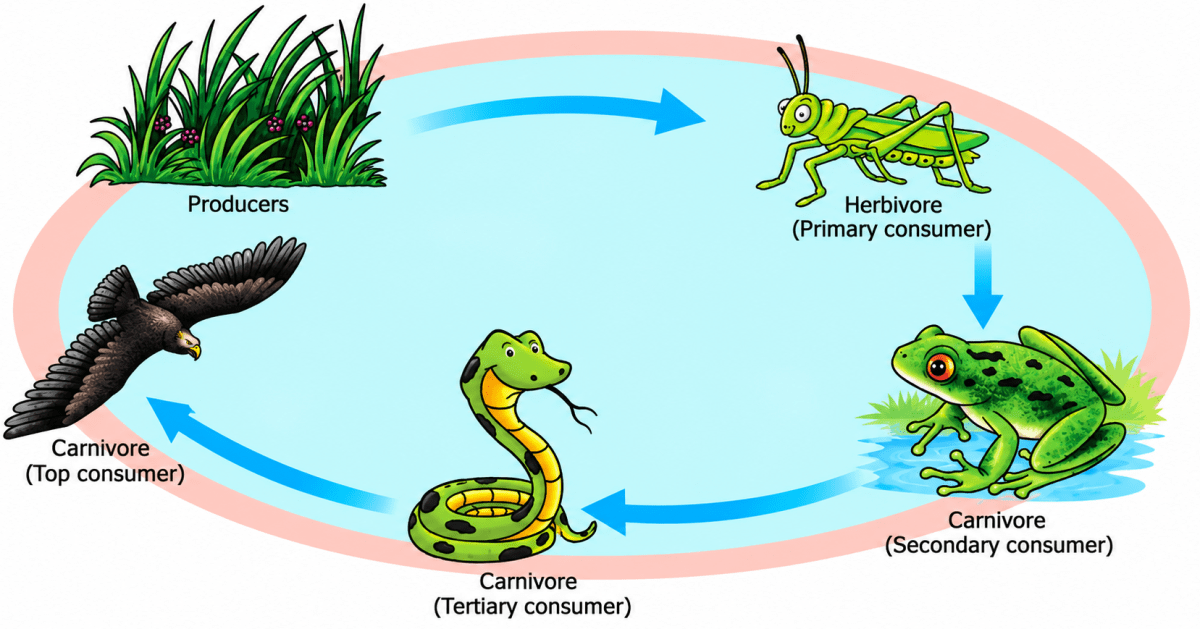
The biological process at the starting point of the food chain is photosynthesis.
Green plants (producers) trap solar energy through photosynthesis and prepare their own food. Herbivores (primary consumers) feed on these green plants, carnivores feed on the herbivores, and so on. Thus all animals depend, directly or indirectly, on green plants and the process of photosynthesis for their food and energy.
Divya performed an experiment on photosynthesis. At the end of the experiment, she tested the experimental leaf for the presence of starch. During the starch test she first boiled the leaf in water and then in methylated spirit.
(i) Why did she boil the leaf in water?
(ii) Mention the reason why she then boiled the leaf in methylated spirit.
Answer
(i) She boiled the leaf in water to kill the cells. This destroys the enzymes and suspends all the chemical changes taking place in the leaf.
(ii) She then boiled the leaf in methylated spirit to remove the chlorophyll. The leaf becomes colourless (and hard and brittle) so that the colour change of the starch test can be clearly seen.
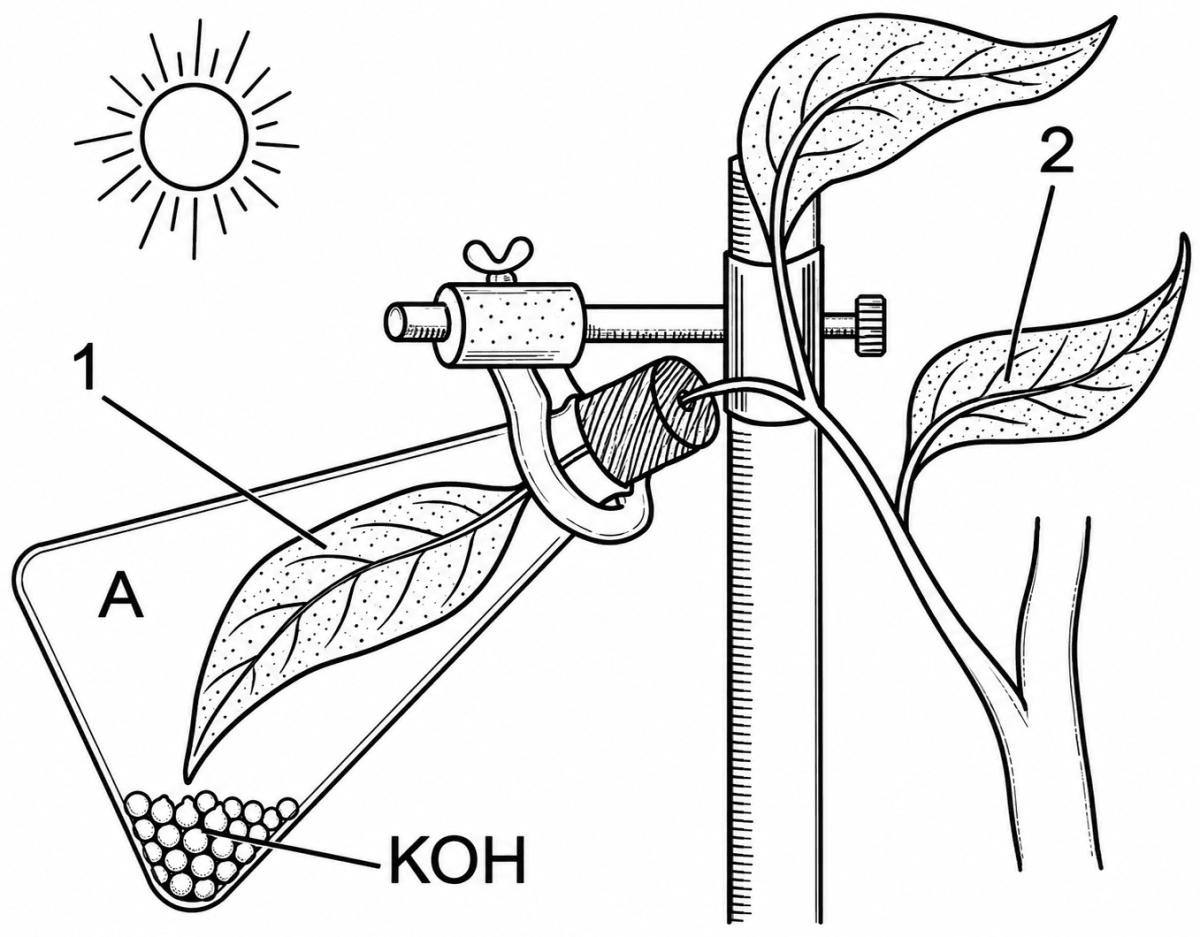
The figure given below represents an experiment to demonstrate a particular aspect of photosynthesis. The alphabet 'A' represents a certain condition inside the flask.

(i) What is the aim of the experiment ?
(ii) Identify the special condition inside the flask.
(iii) Name an alternative chemical that can be used instead of KOH.
(iv) In what manner do the leaves 1 and 2 differ at the end of the starch test?
Answer
(i) The aim of the experiment is to show that carbon dioxide (CO2) is necessary for photosynthesis.
(ii) The special condition inside the flask is the absence of carbon dioxide (CO2), because KOH absorbs the carbon dioxide present in the flask.
(iii) An alternative chemical that can be used instead of KOH is NaOH (Sodium hydroxide).
(iv) Leaf 1 does not turn blue-black after the starch test because it does not receive carbon dioxide and therefore does not form starch. Leaf 2 receives atmospheric carbon dioxide and turns blue-black, showing the presence of starch.
The diagram given below is an experiment conducted to study a factor necessary for photosynthesis. Observe the diagrams given below and then answer the following questions:
(i) What is the aim of the experiment?
(ii) Name the test performed on the leaf and the solution used for test.
(iii) What type of leaf was used for the experiment? Give an example.
(iv) What is the expected result of the above test on the parts labelled A and B?
(v) Give a balanced chemical equation to represent the process of photosynthesis.
Answer
(i) The aim of the experiment is to show that chlorophyll is essential for photosynthesis.
(ii) The test performed is the starch test (iodine test), and the solution used is iodine solution.
(iii) A variegated leaf was used for the experiment. Example — Coleus or Croton.
(iv) The green portion (B) turns blue-black, showing the presence of starch, while the non-green (white) portion (A) turns brown, showing that no starch has been formed.
(v) Balanced chemical equation for photosynthesis:
Given below is a diagrammatic representation of the internal structure of an organelle found in a plant cell. Study the same and then answer the questions that follow:
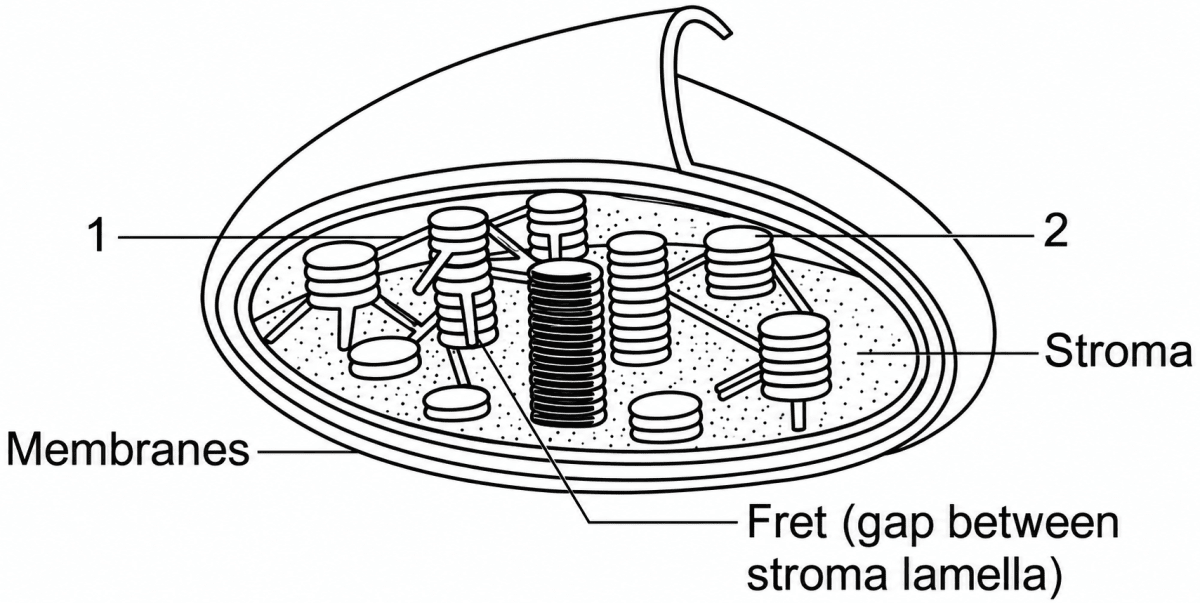
(i) Identify the organelle.
(ii) Name the physiological process occurring in this organelle.
(iii) Mention one way in which this process is beneficial to man.
(iv) Name the phases of the process occurring in the part labelled '1' and '2'.
(v) A chemical substance 'NADP' plays an active part in one of the phases.
Give the expanded form of NADP and state its role in the above process.
(vi) Represent the physiological process mentioned in (ii) above in the form of a chemical equation.
Answer
(i) The organelle is the chloroplast.
(ii) The physiological process occurring in this organelle is photosynthesis.
(iii) It provides food and releases oxygen, which is used by man for respiration. (Any one)
(iv) Part '1' (stroma) — Dark reaction (biosynthetic phase); Part '2' (granum/grana) — Light reaction (photochemical phase).
(v) NADP — Nicotinamide Adenine Dinucleotide Phosphate. Role — During the light reaction, NADP picks up the hydrogen ions and electrons released during photolysis of water and is reduced to NADPH2. This NADPH2 acts as an assimilatory power that provides hydrogen and energy to reduce carbon dioxide to glucose in the dark reaction.
(vi) Chemical equation for photosynthesis:
Study the diagram given below and answer the questions that follow:

(i) Name the gas released when the setup was placed in sunlight.
(ii) Give an example of an aquatic plant that can be used in the above experiment.
(iii) What will happen if a pinch of Sodium bicarbonate is added to the water?
Answer
(i) Oxygen
(ii) Hydrilla
(iii) If a pinch of Sodium bicarbonate is added to the water the amount of carbon dioxide in water will increase. This will increase the rate of photosynthesis and hence the rate of evolution of oxygen will also increase.
A potted plant was taken in order to prove a factor necessary for photosynthesis. The potted plant was kept in the dark for 24 hours. One of the leaves was covered with black paper in the centre. The potted plant was then placed in sunlight for a few hours.
(i) What aspect of photosynthesis was being tested?
(ii) Why was the plant placed in the dark before beginning the experiment?
(iii) During the starch test why was the leaf— (a) boiled in water? (b) boiled in methylated spirit?
(iv) Write a balanced chemical equation to represent the process of photosynthesis.
(v) Draw a neat diagram of a chloroplast and label its parts.
Answer
(i) The experiment is conducted to show that sunlight is necessary for photosynthesis.
(ii) The plant was placed in the dark before beginning the experiment to destarch the leaves.
(iii) (a) The leaf was boiled in water to kill the cells and stop all chemical reactions.
(b) The leaf was boiled in methylated spirit to remove chlorophyll so that the colour change during the iodine test can be seen clearly.
(iv) Balanced chemical equation representing the process of photosynthesis is given below:
(v) Below is the labelled diagram of a chloroplast:

The diagram below shows two test-tubes A and B. Test-tube A contains a green water plant. Test-tube B contains both a green water plant and a snail. Both test-tubes are kept in sunlight. Answer the questions that follow:

(i) Name the physiological process that releases the bubbles of oxygen.
(ii) Explain the physiological process as mentioned above in (i).
(iii) What is the purpose of keeping a snail in test-tube 'B'?
(iv) Why does test-tube 'B' have more bubbles of oxygen?
(v) Give an example of a water plant that can be used in the above experiment.
(vi) Write the overall chemical equation for the above process.
Answer
(i) Photosynthesis
(ii) Photosynthesis is the process by which living plant cells, containing chlorophyll, produce food substances (glucose and starch), from carbon dioxide and water, by using light energy. Plants release oxygen as a by-product during photosynthesis.
(iii) The snail respires and releases Carbon dioxide so more Carbon dioxide is available to the plant for photosynthesis.
(iv) Test tube B have more bubbles of Oxygen because the rate of photosynthesis is more in test tube B as the plant gets more CO2 from the snail.
(v) Hydrilla is a water plant which is used for such experiments.
(vi) Balanced chemical equation representing the process of photosynthesis is given below:
The following diagram demonstrates a physiological process taking place in green plants. The whole set up was placed in bright sunlight for several hours. Study the diagram and answer the questions that follow:

(i) What aspect of the physiological process is being examined?
(ii) Explain the physiological process mentioned in (i) above.
(iii) Label the parts numbered 1 and 2 in the diagram.
(iv) Write a well-balanced chemical equation for the physiological process explained in (ii) above.
(v) What would happen to the rate of bubbling of the gas if a pinch of sodium bicarbonate is added to the water in the beaker? Explain your answer.
Answer
(i) The aspect being examined is the release of Oxygen during Photosynthesis.
(ii) Photosynthesis is the process by which green plant cells containing chlorophyll manufacture carbohydrates from carbon dioxide and water in the presence of light, releasing oxygen as a by-product.
(iii) The parts numbered 1 and 2 are:
- 1 → Oxygen
- 2 → Hydrilla plant
(iv) Balanced chemical equation representing the process of photosynthesis is given below:
(v) Sodium bicarbonate releases carbon dioxide into the water which is made available to the plant. This increases the rate of photosynthesis. So more oxygen is released thus more bubbles are released.
The diagrams given below represent the relationship between a mouse and a physiological process that occurs in green plants. Study the diagrams and answer the questions that follow:
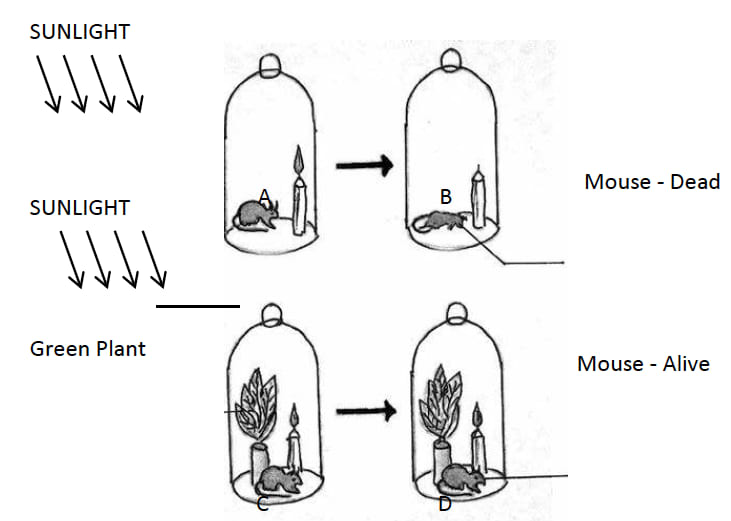
(i) Name the physiological process occurring in the green plant that has kept the mouse alive.
(ii) Explain the physiological process mentioned above.
(iii) Why did the mouse die in bell jar B?
(iv) What is the significance of the process as stated in (i) for life on earth.
(v) Represent the above mentioned physiological process in the form of a chemical equation.
Answer
(i) Photosynthesis occurring in the green plant that has kept the mouse alive.
(ii) Photosynthesis is the process by which green plant cells containing chlorophyll manufacture carbohydrates from carbon dioxide and water in the presence of light, releasing oxygen as a by-product.
(iii) The mouse died in bell jar B because there was no green plant to replenish oxygen by photosynthesis. The burning candle and the respiring mouse consumed the available oxygen, so the oxygen level eventually became insufficient for the mouse.
(iv) The significance of photosynthesis for life on Earth is:
- It provides food directly or indirectly for living organisms.
- It releases oxygen required for respiration.
(v) Balanced chemical equation representing the process of photosynthesis is given below:
Photosynthesis is the single most important mechanism of energy input in the living world. It not only provides food to plants and animals but also gives free oxygen to breathe.
Now answer the following questions:
(i) The first form of food produced by plants is
(a) Sugar
(b) Starch
(c) Glucose
(d) Lactic acid
(ii) The chemical that absorbs CO2 during dark reaction is
(a) Phosphoglyceric Acid
(b) NADPH2
(c) NAD
(d) Ribulose 1, 5-bisphosphate
(iii) The biological process which is the starting point of the food chain is
(a) Transpiration
(b) Photosynthesis
(c) Absorption of water
(d) Cell Division
(iv) The green plants also serve as
(a) CO2 bank
(b) N2 bank
(c) O2 bank
(d) Water bank
Answer
(i) (c) Glucose
Reason — Glucose is the first carbohydrate formed during photosynthesis. It is later converted into starch, sucrose, cellulose, and other organic compounds.
"Sugar" is a general term and does not specifically refer to the first food produced. The first food formed is glucose, a simple sugar. Starch is not produced first. It is formed by converting excess glucose into starch for storage. Lactic acid is produced during anaerobic respiration in animal muscles, not during photosynthesis.
(ii) (d) Ribulose 1, 5-bisphosphate
Reason — RuBP is the carbon dioxide acceptor in the Calvin cycle. It combines with CO2 to begin carbon fixation.
PGA is the first stable product formed after CO2 fixation. It does not absorb CO2. NADPH2 provides hydrogen and reducing power during the dark reaction but does not absorb CO2. NAD is mainly involved in cellular respiration, not in carbon dioxide fixation during photosynthesis.
(iii) (b) Photosynthesis
Reason — Photosynthesis converts solar energy into chemical energy, producing food that supports all other organisms in the food chain.
Transpiration is the loss of water vapour from plants and does not produce food. Water absorption is necessary for plant survival but does not produce food. Cell division is responsible for growth and reproduction, not for producing food.
(iv) (c) O2 bank
Reason — Green plants release oxygen during photosynthesis, helping maintain the oxygen level in the atmosphere.
Green plants use carbon dioxide during photosynthesis rather than storing it as a "CO2 bank." Green plants do not store atmospheric nitrogen. Most plants cannot directly use atmospheric nitrogen. Although plants contain water, they are not reservoirs that maintain atmospheric water in the way they maintain oxygen levels.
A potted plant with variegated leaves was kept in dark for 24 hours and then placed in bright sunlight. Answer the following questions.
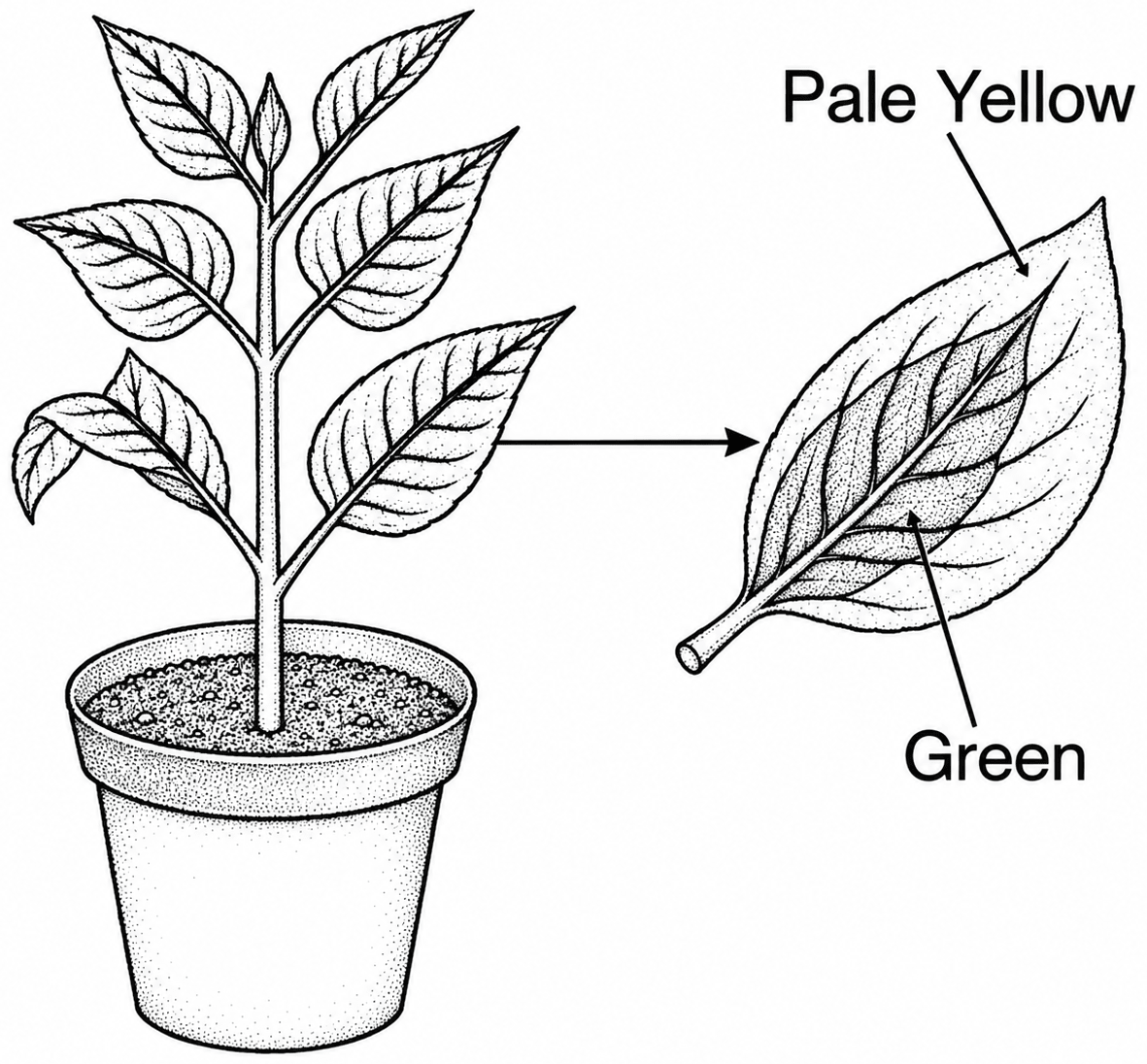
(i) Which aspect of photosynthesis is being tested in the above diagram?
(ii) Why was the plant kept in dark for 24 hours?
(iii) After the starch test what will be the colour of the yellow and green parts of the leaf? Give reasons to support your answer.
Answer
(i) The experiment tests that chlorophyll is essential (necessary) for photosynthesis.
(ii) The plant was kept in the dark for 24 hours to destarch the leaves, i.e. to remove any starch already present, so that the result of the experiment is not affected.
(iii) After the starch test, the green parts of the leaf turn blue-black, showing the presence of starch, while the yellow (non-green) parts turn brown, showing that no starch is formed. This is because photosynthesis, and hence starch formation, occurs only in the green parts that contain chlorophyll; the yellow parts lack chlorophyll and cannot carry out photosynthesis.
The diagram given below represents an experiment to prove the importance of a factor in photosynthesis. Answer the questions that follow :

(i) Name the factor studied in this experiment.
(ii) What will you observe in the experimental leaf after the starch test?
(iii) Explain the process of Photosynthesis.
(iv) Give a balanced chemical equation to represent the process of photosynthesis.
(v) Draw a neat, labelled diagram of an experimental setup to show that oxygen is released during photosynthesis.
Answer
(i) The factor studied in this experiment is Sunlight.
(ii) After the starch test, the exposed parts of the leaf turn blue-black because starch is present, whereas the parts covered with black paper remain brown because they did not receive light and therefore did not form starch.
(iii) Photosynthesis is the process by which green plant cells containing chlorophyll manufacture carbohydrates from carbon dioxide and water in the presence of light, releasing oxygen as a by-product.
(iv) Balanced chemical equation representing the process of photosynthesis is given below:
(v) The below labelled diagram shows an experimental setup demonstrating that oxygen is released during photosynthesis:

Sam observed a slide containing the lower epidermis of a leaf under a microscope. A number of tiny openings between the epidermal cells were present as shown below in the diagram:

(i) What are these tiny openings called?
(ii) Name the cells that regulate the opening and closing of the structures.
(iii) Which ion is responsible for the opening and closing of the openings?
Answer
(i) Stomata
(ii) Guard cells
(iii) Potassium ions
The Amazon rain forest is referred to as the ‘Lungs of the Earth’. It plays an important role in climate regulation through photosynthesis. However, this delicate ecosystem is facing threats from deforestation, climate change and human encroachment which can lead to irreversible environmental consequences.

(i) How does photosynthesis contribute to the Amazon rain forests’ reputation as the ‘Lungs of the Earth’?
(ii) In what way is the environment affected by deforestation?
(iii) Name the pigment that captures the light energy during photosynthesis.
Answer
(i) Photosynthesis performed by the trees in the Amazon rain forest absorbs carbon dioxide and releases oxygen, which helps maintain atmospheric oxygen levels. This process supports life on Earth, earning it the name ‘Lungs of the Earth’.
(ii) Deforestation reduces the number of trees, leading to less carbon dioxide being absorbed and more oxygen being depleted. It causes soil erosion, loss of biodiversity, and contributes to global warming and climate change.
(iii) Chlorophyll.