
Write True (T) or False (F):
(i) The liver converts ammonia into urea.
(ii) Kidneys are round, pale yellow organs.
(iii) Bowman's capsule is a cup shaped body present in the cortex part of the kidney.
(iv) Loop of Henle is a U-shaped part of the nephron.
(v) Collecting ducts collect urine from the urinary bladder.
Answer
(i) True
(ii) False
Corrected Statement — Kidneys are bean-shaped, reddish brown, slightly flattened organs.
(iii) True
(iv) True
(v) False
Corrected Statement — Collecting ducts collect urine from the nephrons.
Fill in the blanks:
(i) The dark-coloured outer zone of the kidney is called ............... and the pale-coloured inner zone is called ............... .
(ii) Each kidney receives oxygenated blood through a ............... artery.
(iii) The process of control of water balance and ionic concentration within organisms is called ............... .
(iv) The main function of kidney is ............... of ............... compounds.
(v) Reabsorption of useful products takes place in ............... .
Answer
(i) The dark-coloured outer zone of the kidney is called cortex and the pale-coloured inner zone is called medulla.
(ii) Each kidney receives oxygenated blood through a renal artery.
(iii) The process of control of water balance and ionic concentration within organisms is called osmoregulation.
(iv) The main function of kidney is excretion of nitrogenous compounds.
(v) Reabsorption of useful products takes place in renal tubule (proximal convoluted tubule).
Write down the functional activity of the given organs:
(i) Ureter ...............
(ii) Glomerulus ...............
(iii) Henle's loop ...............
(iv) Renal artery ...............
Answer
(i) Ureter — It carries urine from the kidney to the urinary bladder.
(ii) Glomerulus — It filters the blood by ultrafiltration. Water and small solutes pass from the glomerular blood into Bowman's capsule to form the glomerular filtrate.
(iii) Henle's loop — It absorbs some water and sodium ions and helps in making the urine concentrated.
(iv) Renal artery — It brings oxygenated blood carrying nitrogenous wastes like urea to the kidney for filtration.
The pale yellow colour of normal human urine is due to the pigment
- Melanin
- Anthocyanin
- Urochrome
- Haemoglobin
Answer
Urochrome
Reason — The normal pale yellow colour of urine is due to the presence of the pigment urochrome.
In humans, osmoregulation is associated with
- Urinary bladder
- Liver
- Kidney
- Blood
Answer
Kidney
Reason — Osmoregulation, the control of water and ionic balance of the body, is brought about by the kidneys.
The Loops of Henle lie in
- Renal Cortex
- Renal Medulla
- Renal Pelvis
- Renal Artery
Answer
Renal Medulla
Reason — The loop of Henle is the middle part of the nephron that runs into the medulla and turns back to the cortex.
Assertion (A): The cortex region of kidney is granular in appearance due to the presence of nephrons.
Reason (R): Nephrons are the structural unit of kidneys.
- Both (A) and (R) are true
- Both (A) and (R) are false
- Both (A) and (R) are true and (R) is the correct explanation of (A)
- Both (A) and (R) are true but (R) is not the correct explanation of (A)
Answer
Both (A) and (R) are true but (R) is not the correct explanation of (A)
Explanation
The cortex is granular because the Bowman's capsules and convoluted tubules of the nephrons lie in it. The fact that nephrons are the structural unit of the kidney is true, but it does not by itself explain the granular appearance of the cortex.
The inorganic constituent of urine is:
- Ammonia
- Urea
- Creatinine
- Uric acid
Answer
Ammonia
Reason — Ammonia is an inorganic nitrogenous waste, whereas urea, creatinine and uric acid are organic nitrogenous wastes.
The nephrons discharge their urine at the
- Urinary bladder
- Urethra
- Renal pelvis
- Renal pyramid
Answer
Renal pelvis
Reason — The collecting ducts receive urine from the nephrons and pour it into the renal pelvis.
Choose the correct path of urine in our body.
- Kidney → Ureter → Urethra → Urinary bladder
- Kidney → Urinary bladder → Urethra → Ureter
- Kidney → Ureter → Urinary bladder → Urethra
- Urinary bladder → Kidney → Ureter → Urethra
Answer
Kidney → Ureter → Urinary bladder → Urethra
Reason — Urine formed in the kidney passes through the ureter, collects in the urinary bladder, and is finally expelled through the urethra.
During the process of urine formation, different molecules are absorbed from the filtrate. From the list of options given below, identify the molecules which are reabsorbed from filtrate during tubular reabsorption.
A. Water
B. Amino acid
C. Salts
Choose the correct option.
- A and B
- B and C
- A, B and C
- Only A
Answer
A, B and C
Reason — During selective reabsorption, water, amino acids and salts are all reabsorbed from the filtrate back into the bloodstream.
Which of the following substances is/are completely reabsorbed from the filtrate in the renal tubule under normal conditions?
- Uric acid
- Glucose
- Salt and water
- Urea
Answer
Glucose
Reason — In a normal individual, all of the glucose (along with amino acids) is completely reabsorbed from the filtrate into the blood.
In the glomerulus of a kidney
- the afferent glomerular capillaries are wider than the efferent glomerular capillaries
- the afferent glomerular capillaries are narrower than the efferent glomerular capillaries
- the afferent glomerular arteriole is narrower than the efferent glomerular arteriole
- the afferent glomerular arteriole is wider than the efferent glomerular arteriole
Answer
the afferent glomerular arteriole is wider than the efferent glomerular arteriole
Reason — The efferent arteriole is narrower than the afferent arteriole, which builds up the high pressure needed for ultrafiltration.
Assertion (A): There is frequent urination in summer than in winter.
Reason (R): In summer we lose a lot of water as sweat, so the kidneys reabsorb more water. Hence, urine formed is less in summer than in winter.
- Both (A) and (R) are true
- Both (A) and (R) are false
- (A) is true and (R) is false
- (A) is false and (R) is true
Answer
(A) is false and (R) is true
Explanation
We urinate fewer times in summer than in winter, so (A) is false. In summer a lot of water is lost as sweat, so the kidneys reabsorb more water and less urine is formed, which makes (R) true.
The diagram given below represents a nephron. Ultrafiltration of blood occurs in:
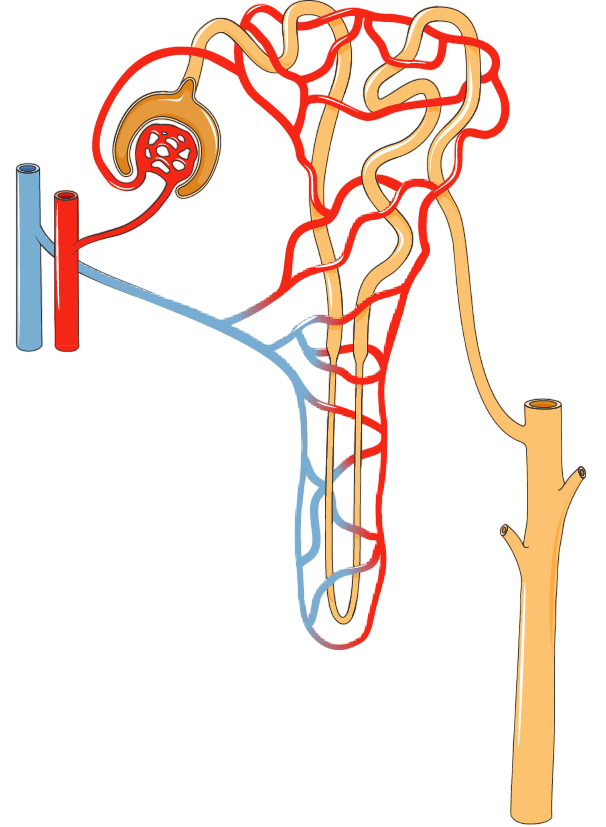
- Bowman’s capsule
- Glomerulus
- Proximal Convoluted Tubule
- Loop of Henle
Answer
Glomerulus
Reason — Ultrafiltration happens in the glomerulus, where blood is filtered to form the filtrate that enters the nephron.
In humans, urea is extracted from blood in
- Kidney
- Spleen
- Ureter
- Urinary bladder
Answer
Kidney
Reason — The kidneys extract urea from the blood and excrete it from the body as part of the urine.
Thomas played cricket on a hot summer afternoon. His urine output was much less, though he drank plenty of water. What could be the possible cause?

P - Kidneys reabsorb a lot of water
Q - Sweat glands are active
R - Kidneys absorb less water
S - Sweat glands are inactive
- R and Q
- P and Q
- P and S
- R and S
Answer
P and Q
Reason — While playing, the player loses most of water through the sweat glands. Therefore, the kidneys reabsorb most of the water back in the blood to maintain the composition and osmotic pressure of blood. This results in less volume of urine.
Based on the given figure, identify the structural as well as the functional unit of kidney:

- A
- B
- C
- D
Answer
C
Reason — The part C in the picture is a nephron. It is the structural and functional unit of kidney.
Bowman's capsule and the glomerulus together are called
- Malpighian tubule
- Malpighian capsule
- Nephron
- Uriniferous tubule
Answer
Malpighian capsule
Reason — The Bowman's capsule together with the glomerulus enclosed in it is called the Malpighian capsule.
Ultrafiltration takes place in
- Loop of Henle
- Bowman's capsule
- Glomerulus
- Nephrons
Answer
Glomerulus
Reason — In the glomerulus, high blood pressure filters out the liquid part of the blood, so ultrafiltration takes place here.
Anup participated in a marathon race and felt dehydrated by the end of the race. The human body has mechanisms to conserve water and prevent dehydration. Which part of the nephron is primarily responsible for the reabsorption of water to prevent dehydration?
(i) Glomerulus
(ii) Proximal Convoluted Tubule
(iii) Loop of Henle
(iv) Distal Convoluted Tubule
- iii
- ii and iii
- i, ii and iii
- ii, iii and iv
Answer
ii, iii and iv
Reason — Water is reabsorbed in the proximal convoluted tubule, the loop of Henle and the distal convoluted tubule, while the glomerulus only filters the blood.
The disease, in which urine contains considerable amount of glucose, is known as
- diabetes
- dialysis
- diarrohea
- tetanus
Answer
diabetes
Reason — In diabetes (diabetes mellitus), the body is unable to store excess glucose, so urine contains a considerable amount of glucose.
The structure that stores urine temporarily is
- Ureter
- Urethra
- Urinary bladder
- Kidneys
Answer
Urinary bladder
Reason — The urinary bladder is a muscular sac in which urine collects and is stored temporarily.
The main nitrogenous waste formed in the human body is
- Uric acid
- Urea
- Ammonia
- Creatinine
Answer
Urea
Reason — Urea is the main nitrogenous waste, formed in the liver from ammonia and excreted by the kidneys.
Priya tried to match the hormones with their effect on the human body. She tabulated the pairs as follows:
| Hormone | Effect on the body |
|---|---|
| P | Stimulates conversion of Glycogen to Glucose |
| Q | Reabsorption of water by the Nephrons. |
Identify the correct pair of hormones.
- P-Insulin, Q- Glucagon.
- P - Adrenaline, Q - Oxytocin.
- P - Glucagon, Q - Vasopressin.
- P - Vasopressin, Q - Adrenaline.
Answer
P - Glucagon, Q - Vasopressin.
Reason — Glucagon stimulates the conversion of glycogen to glucose, while vasopressin (ADH) promotes reabsorption of water by the nephrons.
Assertion (A): We urinate more in summer.
Reason (R): Sweat glands are more active in summer.
- Both (A) and (R) are true
- Both (A) and (R) are false
- (A) is true and (R) is false
- (A) is false and (R) is true
Answer
(A) is false and (R) is true
Explanation
We urinate fewer times in summer, not more, so (A) is false. Sweat glands are indeed more active in summer, which makes (R) true. Because more water is lost as sweat, the kidneys reabsorb more water and less urine is formed.
Assertion (A): Deficiency of Antidiuretic hormone causes an increase in urination.
Reason (R): Antidiuretic hormone acts on the kidney to reabsorb water from the kidney tubules.
- (A) is true and (R) is false.
- (A) is false and (R) is true.
- Both (A) and (R) are true.
- Both (A) and (R) are false.
Answer
Both (A) and (R) are true.
Explanation
Antidiuretic hormone acts on the kidney tubules to reabsorb water. When it is deficient, less water is reabsorbed, so more urine is formed and urination increases. Hence both (A) and (R) are true.
Name the following:
(i) The structural and functional unit of the kidney.
(ii) The duct which carries urine from the urinary bladder to outside the body.
(iii) Knot like mass of blood capillaries inside the Bowman's capsule.
(iv) The organ where urea is produced.
(v) The removal of nitrogenous wastes from the body.
(vi) The vein in which the concentration of urea is maximum.
(vii) Process of maintaining water and salt balance in the blood.
Answer
(i) Nephron
(ii) Urethra
(iii) Glomerulus
(iv) Liver
(v) Excretion
(vi) Hepatic vein
(vii) Osmoregulation
Mark True (T) or False (F) against the following statements and write the false statement:
(i) Bile pigments are formed from the breakdown of haemoglobin of erythrocytes.
(ii) The most poisonous of all waste by-products of metabolism is ammonia.
(iii) The skin plays an excretory role in organisms.
(iv) Liver, the largest gland in the body, is a detoxifying gland.
(v) The left kidney is placed slightly above the right kidney.
(vi) Normal pale yellow colour of the urine is due to the presence of the pigment Melanin.
Answer
(i) True
(ii) True
(iii) True
(iv) True
(v) True
(vi) False
Corrected Statement — Normal pale yellow colour of the urine is due to the presence of the pigment urochrome.
Given below are five groups of terms each. In each group arrange and write the items in the correct order so as to be in logical sequence:
(i) Urethra, ureter, kidney, urinary bladder.
(ii) Lungs, inspired air, expired air, CO2.
(iii) Pelvis, pyramids, ureter, papilla.
(iv) Efferent arteriole, glomerulus, collecting duct, afferent arteriole.
Answer
(i) Kidney → Ureter → Urinary bladder → Urethra
(ii) Inspired air → Lungs → CO2 → Expired air
(iii) Pyramids → Papilla → Pelvis → Ureter
(iv) Afferent arteriole → Glomerulus → Efferent arteriole → Collecting duct
Match the following:
| Column A | Column B |
|---|---|
| (i) The excretory organs | (a) Lungs |
| (ii) Excrete CO2 | (b) Bowman's capsule |
| (iii) Outer dark part of kidney | (c) End part of nephron |
| (iv) A thin walled cup | (d) Kidneys |
| (v) Distal convoluted tubule | (e) Cortex |
Answer
| Column A | Column B |
|---|---|
| (i) The excretory organs | (d) Kidneys |
| (ii) Excrete CO2 | (a) Lungs |
| (iii) Outer dark part of kidney | (e) Cortex |
| (iv) A thin walled cup | (b) Bowman's capsule |
| (v) Distal convoluted tubule | (c) End part of nephron |
Fill in the blanks to make this paragraph meaningful:
Each kidney is made up of ............... main areas—outer ..............., middle medulla and the ............... pelvis. The cortex is granular due to the presence of ............... . Several cone shaped renal ............... extends from the renal cortex to the renal medulla. Each ............... contains around 1 million nephrons.
Answer
Each kidney is made up of three main areas—outer cortex, middle medulla and the renal pelvis. The cortex is granular due to the presence of nephrons. Several cone shaped renal pyramids extends from the renal cortex to the renal medulla. Each kidney contains around 1 million nephrons.
Define ultrafiltration.
Answer
Ultrafiltration is the mechanical filtration occurring in the glomerulus, in which water and small solutes are filtered out of the blood while blood cells and large molecules like proteins and fats are retained.
Define tubular secretion.
Answer
Tubular secretion is the process, reverse of tubular reabsorption, in which the convoluted tubule removes waste materials like uric acid, ammonia, urea, creatinine and drugs from the blood and passes them into the filtrate.
Define selective reabsorption.
Answer
Selective reabsorption is the process in which useful materials such as water, glucose, amino acids and some mineral salts are taken back into the bloodstream from the filtrate as it passes through the tubule.
Define osmoregulation.
Answer
Osmoregulation is the process of control of water content and concentration of ions in the body.
Define renal pelvis.
Answer
Renal pelvis is the internal funnel-shaped cavity of the kidney that collects urine from the collecting ducts and leads it into the ureter.
Define excretion.
Answer
Excretion is the removal of toxic and unwanted waste products from the body of an organism.
Give reason — Urine is slightly thicker in summer than in winter.
Answer
In summer, a good amount of water is lost from the body as sweat (perspiration). To conserve water, the kidneys reabsorb more water from the filtrate. As a result, the urine formed is more concentrated and hence slightly thicker in summer than in winter.
Give reason — Renal cortex has a dotted appearance and Renal medulla has a striped appearance.
Answer
The Bowman's capsules and the convoluted tubules of the nephrons lie in the cortex, giving it a dotted appearance. The loops of Henle and the collecting ducts run through the medulla, giving it a striped appearance.
Give reason — There is frequent urination in winter than in summer.
Answer
In winter, very little water is lost as sweat because sweat glands are less active. Therefore, the kidneys reabsorb less water and more urine is formed, leading to frequent urination in winter than in summer.
Give reason — The kidney is composed of number of nephrons.
Answer
Each kidney is composed of about one million nephrons (not neurons). Nephrons, also called uriniferous tubules, are the structural and functional units of the kidney and carry out the formation of urine.
Differentiate between Cortex and medulla of a kidney.
Answer
Differences between Cortex and medulla of a kidney are:
| Cortex | Medulla |
|---|---|
| It is the outer, dark-coloured, granular region of the kidney. | It is the inner, pale-coloured, striped region of the kidney. |
| It contains the Bowman's capsules and convoluted tubules of the nephrons. | It contains the loops of Henle, collecting ducts and renal pyramids. |
Differentiate between Urea and urine.
Answer
Differences between Urea and urine are:
| Urea | Urine |
|---|---|
| It is a single nitrogenous waste compound formed in the liver from ammonia. | It is a liquid excretory product formed by the kidneys. |
| It is one of the constituents of urine. | It is a mixture of about 95% water and 5% dissolved wastes such as urea, salts and other substances. |
Differentiate between Renal papilla and renal pelvis.
Answer
Differences between Renal papilla and renal pelvis are:
| Renal papilla | Renal pelvis |
|---|---|
| It is the tip of a renal pyramid that projects into the renal pelvis. | It is the funnel-shaped cavity of the kidney. |
| Urine drips from the papilla into the pelvis. | It collects the urine and channels it into the ureter. |
Differentiate between Malpighian capsule and Bowman's capsule.
Answer
Differences between Malpighian capsule and Bowman's capsule are:
| Malpighian capsule | Bowman's capsule |
|---|---|
| It is made up of the Bowman's capsule along with the glomerulus enclosed in it. | It is only the thin-walled, cup-shaped part that encloses the glomerulus. |
| It is the site of ultrafiltration. | It receives and collects the glomerular filtrate. |
Differentiate between Ureter and Urethra.
Answer
Differences between Ureter and Urethra are:
| Ureter | Urethra |
|---|---|
| It carries urine from the kidney to the urinary bladder. | It carries urine from the urinary bladder to outside the body. |
| There are two ureters, one from each kidney. | There is only one urethra. |
Differentiate between Urethra and Uterus.
Answer
Differences between Urethra and Uterus are:
| Urethra | Uterus |
|---|---|
| It is a part of the excretory (urinary) system. | It is a part of the female reproductive system. |
| It carries urine from the urinary bladder to outside the body. | It is the organ in which the foetus develops. |
Differentiate between Nephron and Neuron.
Answer
Differences between Nephron and Neuron are:
| Nephron | Neuron |
|---|---|
| It is the structural and functional unit of the kidney. | It is the structural and functional unit of the nervous system. |
| It is concerned with the formation of urine. | It is concerned with the conduction of nerve impulses. |
Choose the odd one out from the following terms and name the category to which the others belong.
(i) Renal pelvis, Renal artery, Renal cortex, Renal medulla
(ii) Urochrome, Urea, Keratin, Uric acid
Answer
(i) Odd term: Renal artery
Category: Others are parts of the internal structure of the kidney.
(ii) Odd term: Keratin
Category: Others are constituents of urine.
Human kidney is a complex organ. Kidneys receive blood through blood vessels which directly branch from the Aorta. Inside each kidney are tiny functional units which filter the blood.

(a) Name the blood vessels that supply blood to the kidneys.
(b) Which are the functional units that filter the blood?
Answer
(a) Renal arteries.
(b) Nephrons
What is the role of skin, lungs and liver in the process of excretion in human beings?
Answer
The role of skin, lungs and liver in excretion is:
- Skin — It excretes urea, salts and excess water by means of the sweat glands present in it.
- Lungs — They excrete carbon dioxide and water vapour produced during respiration, which are removed from the surface of the lungs by exhalation.
- Liver — It removes urea (by converting ammonia into urea), bile pigments and toxins. It is the largest gland in the body and acts as a detoxifying gland.
Give the principle involved in the functioning of an artificial kidney machine to clean the blood.
Answer
An artificial kidney machine works on the principle of dialysis. Dialysis is a process of separating small molecules from larger ones using a semipermeable membrane.
Blood from an artery in the arm is passed into the machine, where it flows through a cellulosic dialysis tubing (semipermeable) bathed in a dialysing solution similar to blood plasma but lacking the waste substances. Small waste molecules like urea diffuse out of the blood into the solution and are carried away, while useful substances are retained. The cleaned blood is then returned to the patient through a vein in the same arm.
Give a brief of wastes excreted out by human.
Answer
The main wastes excreted out by humans are:
- CO2 and water — Produced by cells during respiration and eliminated mainly through the lungs.
- Nitrogenous wastes — Urea, uric acid and ammonia, produced from proteins mainly in the liver.
- Bile pigments — Formed from the breakdown of haemoglobin of dead RBCs; some are excreted in urine.
- Excess salts and vitamins — Common salt (NaCl) and some excess water-soluble vitamins are given out mainly by the kidney.
What remedial measures are followed if a person is showing symptoms of dehydration?
Answer
If a person shows symptoms of dehydration, the following remedial measures are followed:
- The person should be given plenty of fluids and water to drink.
- Oral Rehydration Solution (ORS), which contains the right balance of salts and sugar, should be given to restore the lost water and ions.
- In severe cases, fluids are given intravenously (through a drip) under medical supervision.
- The person should rest and avoid heat and strenuous activity that causes further loss of water.
Mention the three major steps involved in the production of urine.
Answer
The three major steps involved in the production of urine are:
- Ultrafiltration — A simple mechanical filtration of blood at the glomerulus.
- Selective reabsorption — Reabsorption of useful materials back into the blood, mainly at the proximal convoluted tubule.
- Tubular secretion — Removal of remaining wastes from the blood into the filtrate, mainly at the distal convoluted tubule.
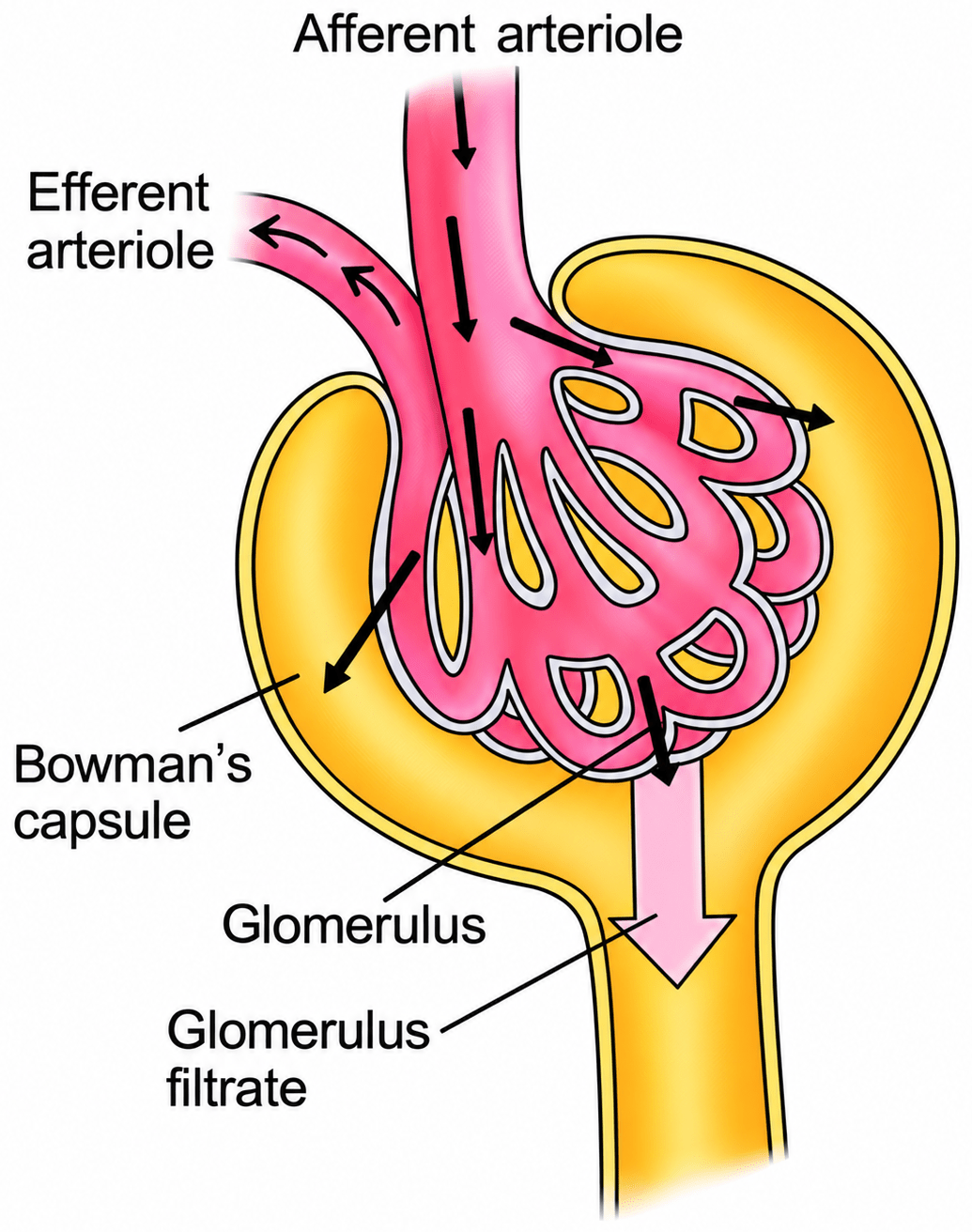
Draw a neat labelled diagram of a Malpighian capsule.
Answer
The labelled diagram of a Malpighian capsule is shown below:
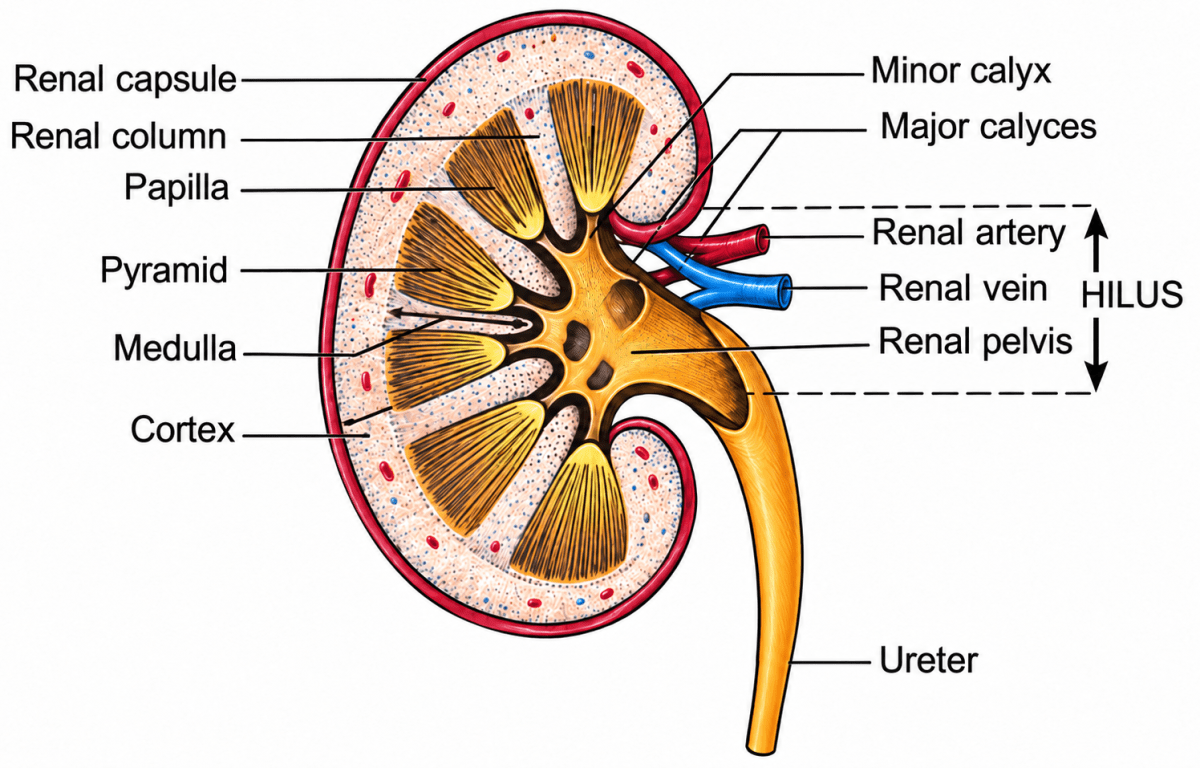
Draw a neat diagram of a longitudinal section of a human kidney and label Renal Cortex and Renal Medulla on the diagram.
Answer
The labelled diagram of the longitudinal section of a human kidney is shown below:
The diagram given below shows a section of a human kidney. Study the diagram carefully and answer the questions that follow:

(i) Label the parts numbered 1 to 4.
(ii) Why does part '2' have a striped appearance?
(iii) What is the fluid that passes down part '4'? Name the main nitrogenous waste present in it.
(iv) Mention the structural and functional units of kidneys.
(v) Name the two major steps in the formation of the fluid mentioned in Q. 5(a) (iii).
Answer
(i) The parts numbered 1 to 4 are:
- 1 → Cortex
- 2 → Medulla
- 3 → Pelvis
- 4 → Ureter
(ii) The medulla contains Henle's loop and collecting ducts that give it a striped appearance.
(iii) Urine passes down the Ureter. The main nitrogenous waste present in it is Urea.
(iv) Nephrons (also called uriniferous tubules, renal tubules, kidney tubules)
(v) The two major steps are —
- Ultrafiltration
- Selective Reabsorption.
The given diagram represents a nephron and its blood supply. Study the diagram and answer the following questions:

(i) Label parts 1, 2, 3 and 4.
(ii) State the reason for the high hydrostatic pressure in the glomerulus.
(iii) Name the blood vessel which contains the least amount of urea in this diagram.
(iv) Name the two main stages of urine formation.
(v) Name the part of the nephron which lies in the renal medulla.
Answer
(i) The parts 1, 2, 3 and 4 are:
- 1 → Collecting duct.
- 2 → Distal convoluted tubule.
- 3 → Loop of Henle.
- 4 → Bowman's capsule.
(ii) The efferent arteriole is narrower than the afferent arteriole. This creates a high hydrostatic pressure in the glomerulus.
(iii) Renal vein (part 6).
(iv) Two main stages of urine formation are:
- Ultrafiltration.
- Selective Reabsorption.
(v) Loop of Henle
Study the diagram given below and then answer the questions that follow:
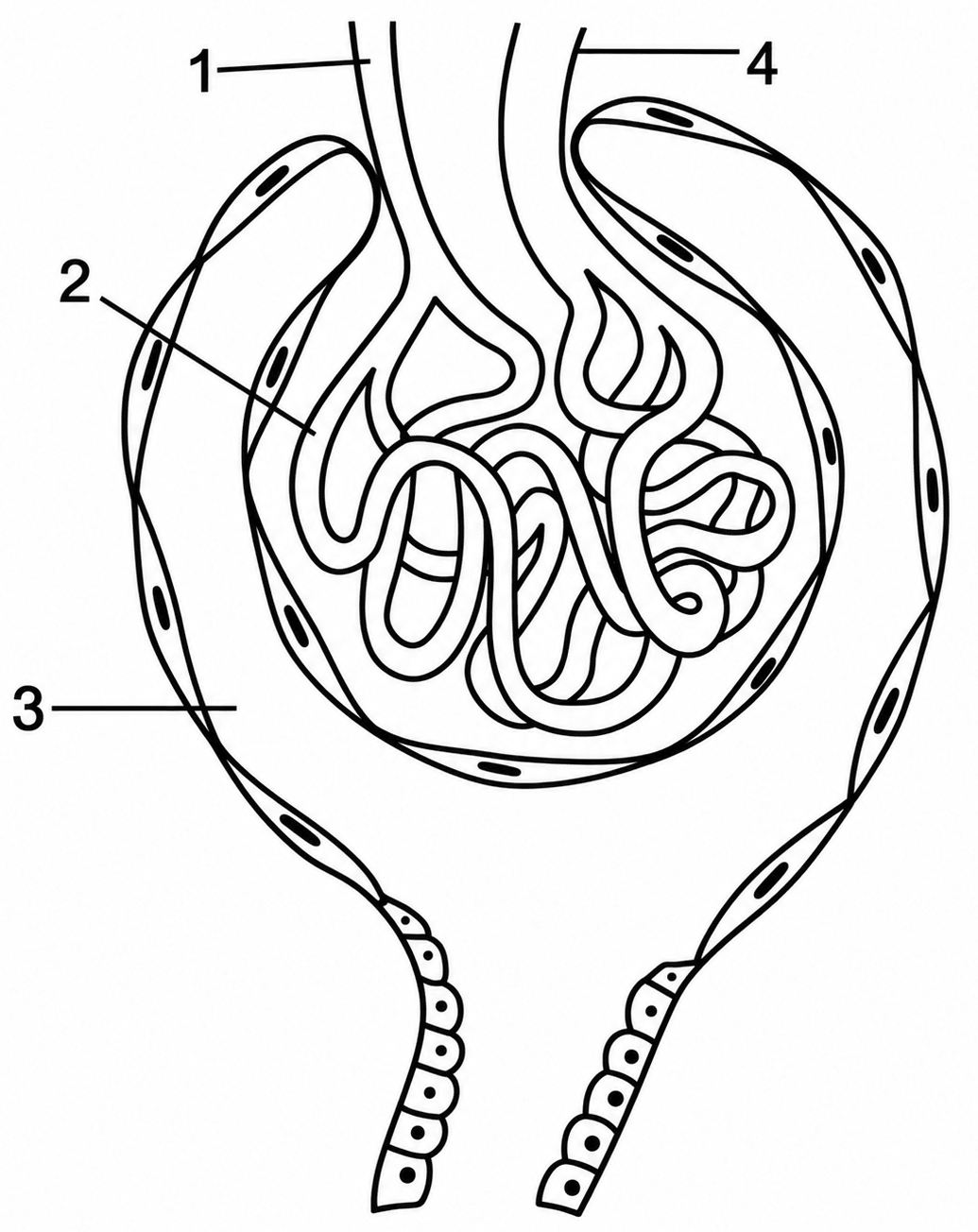
(i) Name the region in the kidney where the above structure is present.
(ii) Name the parts labelled 1, 2, 3 and 4.
(iii) Name the stages involved in the formation of urine.
(iv) What is the technical term given to the process occurring in 2 and 3? Briefly describe the process.
Answer
(i) The structure is a Malpighian capsule, which is present in the cortex of the kidney.
(ii) The parts labelled 1-4 are:
- 1 → Afferent arteriole
- 2 → Glomerulus
- 3 → Bowman's capsule
- 4 → Efferent arteriole
(iii) Urine formation involves three stages:
- Ultrafiltration
- Selective reabsorption
- Tubular secretion
(iv) The process occurring in 2 and 3 is called Ultrafiltration.
The blood flows through the glomerulus under great pressure because the efferent arteriole is narrower than the afferent arteriole. This high pressure causes the liquid part of the blood, along with water, salts, glucose and nitrogenous wastes, to filter out from the glomerulus into the Bowman's capsule, while blood cells and large molecules like proteins are retained. This filtration under great pressure is called ultrafiltration.
The diagram given below shows the excretory system of a human being. Study the same and then answer the questions that follow—
(i) Identify the part 1 to 4 respectively—
- Posterior vena cava, Aorta, Renal artery, Renal vein
- Aorta, Renal vein, Ureter, Urinary bladder.
- Renal artery, Renal vein, Ureter, Posterior vena cava
- Ureter, Urinary bladder, Aorta, Renal vein.
Answer
Posterior vena cava, Aorta, Renal artery, Renal vein
Reason — Posterior vena cava carries deoxygenated blood from the lower parts of the body back to the heart. Aorta is the largest artery that carries oxygenated blood from the heart to different body parts, including the kidneys. Renal artery carries oxygenated blood containing nitrogenous wastes from the aorta to the kidneys for filtration. Renal vein carries filtered blood away from the kidneys and joins the posterior vena cava.
(ii) Which part carry urine from kidney to urinary bladder
- Aorta
- Urethra
- Ureter
- Renal tubule
Answer
Ureter
Reason — The ureter is a muscular tube that transports urine from each kidney to the urinary bladder for temporary storage. Aorta is a blood vessel that carries oxygenated blood from the heart, not urine. Urethra carries urine from the urinary bladder to the outside of the body, not from kidney to bladder. Renal tubules help in filtration, reabsorption, and urine formation inside the kidney but do not transport urine to the bladder.
(iii) The name of part 8 is
- Ureter
- Urethra
- Uterus
- None of these
Answer
Urethra
(iv) Which endocrine gland could be added in the diagram
- Pituitary gland
- Thyroid gland
- Parathyroid gland
- Adrenal gland
Answer
Adrenal gland
Reason — The adrenal glands are located on top of the kidneys and secrete hormones like adrenaline and aldosterone. Since they are associated with the kidneys, they can be added to the excretory system diagram.
The pituitary gland is located at the base of the brain and controls many other endocrine glands; it is not associated with the kidneys. The thyroid gland is located in the neck region and regulates metabolism; it is not attached to the kidneys. The parathyroid glands are present behind the thyroid gland and regulate calcium levels; they are not related to the excretory system.
The diagram given below is that of a structure present in a human kidney. Study the same and answer the questions that follow:

(i) Name the structure represented in the diagram.
(ii) What is the liquid entering part '1' called? Name two substances present in this liquid that are reabsorbed in the tubule.
(iii) What is the fluid that comes to part '2' called? Name the main nitrogenous waste in it.
(iv) Mention the three main steps involved in the formation of the fluid mentioned in (iii) above.
(v) Name the substance which may be present in the fluid in part '2' if a person suffers from Diabetes mellitus.
Answer
(i) The structure represented in the diagram is that of Nephron.
(ii) The liquid entering part 1 is called Glomerular filtrate which is formed by the ultrafiltration of blood through glomerulus. The two substances present in this liquid are — Glucose and Water.
(iii) The fluid that comes to part 2 is called urine. The main nitrogenous waste in urine is Urea.
(iv) The three main steps involved in the formation of urine are:
- Ultrafiltration
- Selective reabsorption
- Tubular secretion.
(v) If a person suffers from diabetes mellitus Glucose will be present in the urine.
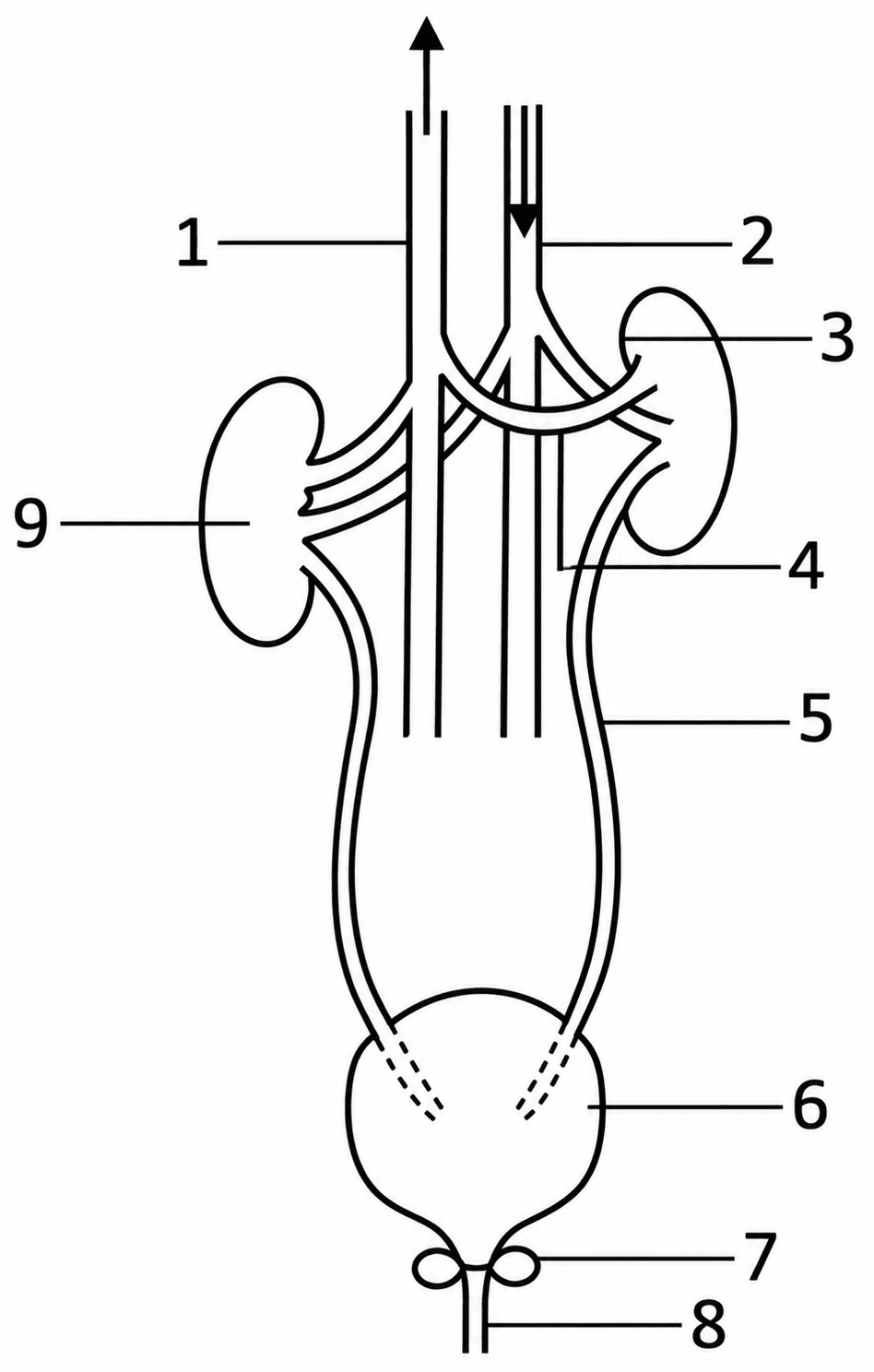
The diagram given below represents an organ system in the human body. Study the same and answer the questions that follow:
(i) Identify the system of human.
(ii) Label the parts marked 3 and 6. Mention the function of part 6.
(iii) Name the structural and functional unit of the part marked 9.
(iv) What is the fluid that accumulates in part 6? Which is the main nitrogenous waste present in it?
(v) Draw a neat, labelled diagram showing the longitudinal section of part 9.
Answer
(i) It is the excretory (urinary) system of humans.
(ii) The parts marked are:
- 3 → Renal artery
- 6 → Urinary bladder
Function of part 6 (Urinary bladder) — It is a muscular sac that stores urine temporarily until it is expelled from the body.
(iii) The part marked 9 is the kidney, and its structural and functional unit is the nephron.
(iv) The fluid that accumulates in part 6 (urinary bladder) is urine, and the main nitrogenous waste present in it is urea.
(v) The labelled diagram of the longitudinal section of part 9 (kidney) is shown below: