
Identify and name the ancestors of humans:
(i) They were about 1 metre in height and 18 kg in weight. ...............
(ii) Their fossils have been discovered from Tanzania. ...............
(iii) They were much stronger than modern human. ...............
(iv) The Java and Peking Man. ...............
Answer
(i) Australopithecus
(ii) Homo habilis
(iii) Neanderthal
(iv) Homo erectus
Fill in the blanks:
(i) The internal factors of life tend to ............... continuously the size of an organism.
(ii) Various organs become greatly ............... through their use.
(iii) When an organism's environment changes, its ............... also change.
(iv) Charles Darwin examined the organisms in his ship named ...............
(v) Only the better species withstand the ............... conditions.
Answer
(i) The internal factors of life tend to increase continuously the size of an organism.
(ii) Various organs become greatly improved through their use.
(iii) When an organism's environment changes, its needs also change.
(iv) Charles Darwin examined the organisms in his ship named HMS Beagle.
(v) Only the better species withstand the adverse conditions.
Which of the following was not taller than 4 feet?
- Homo erectus
- Homo habilis
- Neanderthal
- Australopithecus
Answer
Australopithecus
Reason — Australopithecus were probably not taller than 4 feet, one of the fossils shows their height around 105 cm. Homo erectus, Homo habilis and Neanderthal were all taller than 4 feet.
The characteristic of the face of Cro-Magnon is
- sloping forehead
- longer arms
- a large chin
- very large brain
Answer
a large chin
Reason — Cro-Magnon had a straight forehead, short and wide face with a large chin.
Neanderthal has a large brain but a weak
- memory
- body
- neck
- skeleton
Answer
body
Reason — Neanderthal was much stronger than modern human in the upper body but its lower body was weak.
Lamarck gave an example of an animal to show the use of an organ. This animal was
- Zebra
- Giraffe
- Cat
- Moth
Answer
Giraffe
Reason — Lamarck used the example of the giraffe to explain the use of organs, in which its neck and forelimbs became elongated due to continuous stretching to reach the leaves of trees.
Which of the following is not a vestigial organ?
- Nose
- Vermiform appendix
- Ear pinna
- Nictitating membrane
Answer
Nose
Reason — Nose is a fully functional organ used for breathing and smelling. Vermiform appendix, ear pinna and nictitating membrane are vestigial organs in humans.
The process of changes that led to the emergence of modern human is known as
- Human anatomy
- Human Evolution
- Human physiology
- None of these
Answer
Human Evolution
Reason — Human evolution is the process of changes that led to the emergence of modern human.
Which one is the modern human?
- Homo erectus
- Homo habilis
- Homo sapiens sapiens
- Charles Darwin
Answer
Homo sapiens sapiens
Reason — Homo sapiens sapiens is the modern human with increased brain size, conceptual thought and use of symbolic language.
Which of these is not a part of Darwinism?
- Struggle for existence
- Overpopulation
- Natural selection
- Use and disuse of organs
Answer
Use and disuse of organs
Reason — Use and disuse of organs is a part of Lamarck's theory, not of Darwinism.
Assertion (A): Wisdom teeth is a vestigial structure in humans.
Reason (R): Use and disuse of organs leads to the evolution.
- Both (A) and (R) are true
- Both (A) and (R) are false
- Both (A) and (R) are true and (R) is the correct explanation of (A)
- Both (A) and (R) are true but (R) is not the correct explanation of (A)
Answer
Both (A) and (R) are true and (R) is the correct explanation of (A)
Explanation
Wisdom teeth are considered a vestigial feature in humans. As the diet shifted from hard food towards soft and cooked food, the need for large jaws and teeth was eliminated. Due to this disuse, the wisdom teeth became functionless. Thus, the principle of use and disuse of organs correctly explains why wisdom teeth became a vestigial structure.
Some dinosaurs had feathers although they could not fly but birds have feathers that help them to fly. In the context of evolution this means that —
- Reptiles have evolved from birds.
- There is no evolutionary connection between reptiles and birds.
- Feathers are homologous structure in both the organisms.
- Birds have evolved from reptiles.
Answer
Birds have evolved from reptiles.
Reason — The presence of feathers in both dinosaurs (reptiles) and birds shows a common evolutionary link, indicating that birds have evolved from reptilian ancestors.
Who among the following gave the theory of Natural Selection?
- Lamarck
- Darwin
- Mendel
- Miller
Answer
Darwin
Reason — Charles Darwin proposed the theory of Natural Selection.
According to the evolutionary theory, formation of new species is generally due to
- Sudden creation by nature
- Accumulation of variations over several generations
- Clones formed during sexual reproduction
- Movement of individual from one habitat to another
Answer
Accumulation of variations over several generations
Reason — New species are formed by the gradual accumulation of favourable variations over several generations, and not by sudden change.
A medical student was examining a patient's body during an anatomy class. The student observed a small, worm-like structure attached to the large intestine. The student suspected it might be a vestigial organ. What is the organ most likely to be?
- Pancreas
- Spleen
- Gallbladder
- Appendix
Answer
Appendix
Reason — The vermiform appendix is a small, worm-like outgrowth of the caecum of the large intestine and is a vestigial organ in humans.
While studying the stages in the evolution of man, a well-developed chin is observed in
- Homo habilis
- Homo erectus
- Homo sapiens
- Australopithecus
Answer
Homo sapiens
Reason — Homo sapiens (modern human) has a prominent, well-developed chin. In Homo habilis, Homo erectus and Australopithecus the chin was absent.
A biology teacher asked her students to give two examples of vestigial organs in the human body.
Raj said: Wisdom teeth and Pinna
Sonu said: Body hair and large intestine
Lata said: Vermiform appendix and wisdom teeth
Abhay said: Pinna and Ossicles
Who were correct?
- Abhay and Sonu
- Sonu and Lata
- Raj and Lata
- Abhay and Raj
Answer
Raj and Lata
Reason — Wisdom teeth, pinna and vermiform appendix are vestigial organs in humans, so Raj and Lata gave correct examples. The large intestine and ear ossicles are functional organs, hence Sonu and Abhay were incorrect.
Match the following:
| Column A | Column B |
|---|---|
| (i) Dryopithecus | (a) Hairy but walked like a man |
| (ii) Ramapithecus | (b) Java and Peking Men |
| (iii) Australopithecus | (c) Ape-like |
| (iv) Homo erectus | (d) Practices agriculture |
| (v) Homo sapiens sapiens | (e) Brain with 650-700 cc capacity |
Answer
| Column A | Column B |
|---|---|
| (i) Dryopithecus | (c) Ape-like |
| (ii) Ramapithecus | (a) Hairy but walked like a man |
| (iii) Australopithecus | (e) Brain with 650-700cc capacity |
| (iv) Homo erectus | (b) Java and Peking Men |
| (v) Homo sapiens sapiens | (d) Practices agriculture |
State the given statements True (T) or False (F):
(i) Evolution is a sudden change.
(ii) Homo habilis was taller and stronger than the modern man.
(iii) Darwin proposed the theory of inheritance of acquired characteristics.
(iv) Darwin's research ship was HMS Beagle.
(v) Neanderthal was an intelligent ancestor of modern human.
Answer
(i) False
Corrected Statement — Evolution is a gradual, orderly change from one condition to another.
(ii) False
Corrected Statement — Homo habilis was small in stature, with arms longer than the legs.
(iii) False
Corrected Statement — Lamarck proposed the theory of inheritance of acquired characteristics.
(iv) True
(v) True
What is the scientific name of man?
Answer
Homo sapiens sapiens
Based on the image of the Neanderthal Man given alongside, describe any two characteristic features of this human species.

Answer
Two characteristic features of Neanderthal Man are:
- Cranial Capacity — Neanderthal Man had a large cranial capacity of about 1400 cm3.
- Development of Chin — The chin was very small and the jaw was strongly developed.
Give any two characteristic features of a Cro-Magnon man.
Answer
- Cranial capacity was about 1500–1600 cm3.
- They had a straight forehead, a short and wide face, and a prominent chin.
Define Vestigial organs.
Answer
Vestigial organs are the remnants of structures that served important functions in the organism's ancestors but have become completely functionless in the present-day organism.
Define Vermiform appendix.
Answer
Vermiform appendix is an outgrowth of the caecum in our alimentary canal. It is a vestigial organ in humans, which contains lymphatic tissue but serves no function in normal digestion.
Define Wisdom teeth.
Answer
Wisdom teeth are the last molars which are now considered a vestigial feature of humans. As the diet shifted to soft and cooked food, the need for large jaws and teeth was eliminated, making the wisdom teeth prone to impaction.
Define Ear pinna.
Answer
Ear pinna is the external part of the ear controlled by auricular muscles. In many mammals these muscles help in ear movements, but in humans they are non-functional, so the ear pinnae have become vestigial organs.
Give two features of each one:
(i) Neanderthals
(ii) Homo erectus
(iii) Homo sapiens sapiens
(iv) Australopithecus
Answer
(i) Neanderthals —
- They were tall (about 164–168 cm) and much stronger than modern humans, especially in the upper body.
- They had a large brain with a cranial capacity of about 1400 cm3 and performed ritual burials.
(ii) Homo erectus —
- They were about 1.5 m tall and were the first human ancestors to walk truly upright.
- They had a cranial capacity of about 900 cc, used fire and made distinctive hand axes.
(iii) Homo sapiens sapiens —
- The body is straight upright with very less hair and increased brain size about 1300cc.
- They are capable of conceptual thought and use symbolic language.
(iv) Australopithecus —
- They were not taller than 4 feet (about 105 cm) and walked upright (bipedal).
- Their brain capacity was between 650-750cc and the head was shaped like an ape's head.
Give a brief of 'Theory of Natural Selection'.
Answer
The Theory of Natural Selection was proposed by Charles Darwin. According to it, organisms multiply at an excessive rate, producing more offspring than can survive. This leads to a struggle for existence for food, mates and space. Since variations occur among individuals, only those with favourable variations survive (survival of the fittest) and pass on their traits to the next generation, gradually leading to the formation of new species.
Who proposed the theory of inheritance of acquired characteristics. Give a short note.
Answer
The theory of inheritance of acquired characteristics was proposed by the French naturalist Jean Baptiste de Lamarck. According to this theory, the modifications which an organism acquires during its lifetime in adaptation to its environment are automatically handed down to its descendants. He explained it through use and disuse of organs, in which organs used frequently become greatly improved, while those not used are reduced to vestiges.
What are vestigial organs? Give one example in human mouth.
Answer
Vestigial organs are the remnants of structures that were functional in the organism's ancestors but are now completely functionless. Example in human mouth — Wisdom teeth.
Name the insect which is a classical example of natural selection due to industrial melanism.
Answer
Peppered moth is the classical example of natural selection due to industrial melanism.
Mention any two features of the Cro-Magnon man.
Answer
- They had a solid but heavy body with small hairs and a straight forehead, short and wide face with a large chin.
- They could speak and had a brain equal to or slightly larger than the modern human's.
Identify the given pictures of ancestors of modern men. Write about their specific features.
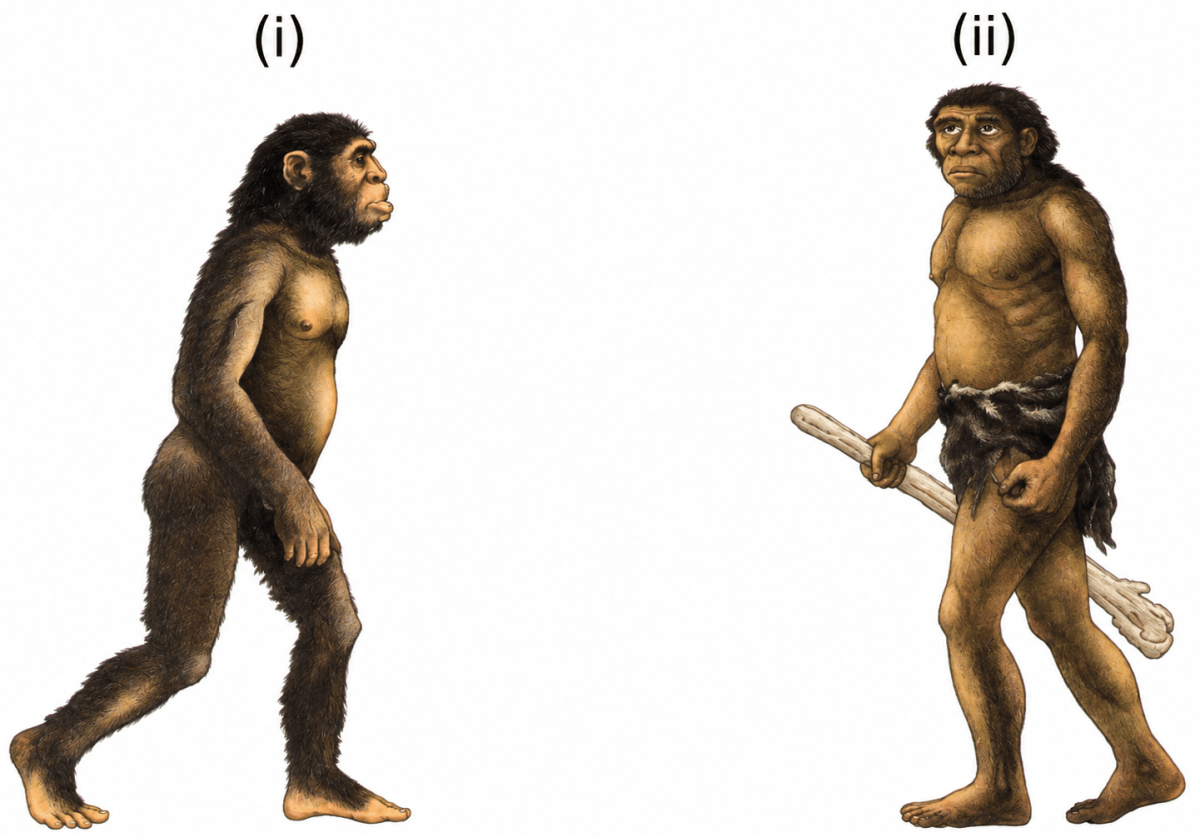
Answer
(i) Australopithecus —
- They were probably not taller than 4 feet (about 105 cm) and walked upright, so they were bipedal.
- Their brain was as big as a chimpanzee's, with a capacity between 650-750cc, and the head was shaped like an ape's head.
- They hunted with stone weapons but essentially ate fruits and vegetables. The early Australopithecus weighed about 18 kg.
(ii) Neanderthal —
- They were about 164–168 cm tall and weighed about 70-78 kg, and were much stronger than modern human, especially in the upper body.
- They were probably intelligent as they had a large brain with a cranial capacity of about 1400cc and used more finely-made tools.
- They performed ritual burials and the presence of the hyoid supported their ability to talk.
Explain the effect of use of organs by giving example of giraffe.
Answer
According to Lamarck, when an animal's environment changes, its needs also change, which places special demands on certain organs. Organs used more frequently enlarge and become more efficient, and such changes are passed on to the offspring.
The deer-like ancestors of the giraffe lived in the grasslands of Africa where there was less or no grass. They were forced to browse upon trees and continuously stretch upwards to reach the leaves. This habit was maintained over long periods by every individual of the race. As a result, the forelimbs became longer than the hind limbs and the neck became so elongated that a modern giraffe can raise its head to a height of about 18 feet without lifting its forelimbs off the ground.
How do the vestigial organs become functionless? Describe about three vestigial organs present in humans.
Answer
Vestigial organs served important functions in the ancestors of an organism. When these organs are continuously useless or disused for longer periods, they gradually degenerate and become completely functionless. Such functionless organs are called vestigial organs.
Three vestigial organs present in humans are:
- Vermiform appendix — It is an outgrowth of the caecum in the alimentary canal. It contains lymphatic tissue but serves no function in normal digestion.
- Wisdom teeth — These are the last molars. As the diet shifted to soft and cooked food, the need for large jaws and teeth was eliminated, so the wisdom teeth became vestigial and prone to impaction.
- Ear pinnae — They are controlled by auricular muscles which help in ear movements in many mammals, but in humans these muscles are non-functional, so the ear pinnae have become vestigial.
Who is named as Homo sapiens sapiens? Give its characteristic features.
Answer
The modern human is named as Homo sapiens sapiens. It first appeared in Africa, and the present species appeared around the time agriculture began, about 10,000 years back.
Its characteristic features are:
- The body is straight upright with very less hair on the skin and a lighter skeleton.
- Increased brain size of about 1300cc.
- They make and use tools effectively and are the only animal capable of conceptual thought.
- They use symbolic language.
- The forehead is flat with heavy brow ridges, and the jaws are less heavily developed with smaller teeth, especially the canines.
- They practise agriculture with agricultural tools.
Who proposed the 'Theory of Natural Selection'? Explain in brief about 'Survival of the Fittest' by giving an example of Peppered-moths.
Answer
The 'Theory of Natural Selection' was proposed by Charles Darwin.
Survival of the Fittest — Among a variety of offspring, some better species are able to withstand the adverse conditions of the environment. The variations exhibited by living things make it easier for them to survive. Such better-adapted organisms survive and leave the most offspring in the successive generations, while the handicapped ones are eliminated. This is called survival of the fittest.
Example of Peppered moths — The peppered moths in England were mostly light in colour, with a very small number being dark-coloured. During the day they rest on light, lichen-covered tree trunks. The light-coloured moths were well camouflaged, while the dark-coloured ones were easily seen and eaten by predators, so the light moths grew in number. After the industrial revolution, the tree trunks became darkened, so the light-coloured moths became easily visible and were eaten by predators, while the dark-coloured moths were now camouflaged and grew in number. This shows a huge shift in the population from light to dark within a few decades, illustrating survival of the fittest.
Given below are two stages in the evolution of man. Study them and answer the questions that follow:

(i) Identify Australopithecus and Neanderthal man from the above pictures.
(ii) Mention two characteristic features each for the two stages.
(iii) Who proposed the theory of 'Natural Selection'?
(iv) Name the organism used as an example to explain 'Industrial Melanism'.
(v) Give two examples of vestigial organs in humans.
Answer
(i) Picture A → Neanderthal man, Picture B → Australopithecus.
(ii) Two characteristic features of each are:
- Neanderthal man — They were about 164–168 cm tall and had a cranial capacity of about 1400 cc.
- Australopithecus — They were about 105 cm tall, walked upright (bipedal), and had a cranial capacity of about 650–750 cc.
(iii) The theory of 'Natural Selection' was proposed by Charles Darwin.
(iv) Peppered moth (Biston bitularia) was the organism used as an example to explain 'Industrial Melanism'.
(v) Two examples of vestigial organs in humans are:
- Vermiform Appendix
- Wisdom tooth