
State the main function of the following:
(i) Seminal vesicle
(ii) Prostate gland
(iii) Cowper's gland
(iv) Leydig cells
Answer
(i) Seminal vesicles produce a secretion which serves as a medium for the transportation of the sperms.
(ii) Prostate gland pours an alkaline secretion into the semen.
(iii) The secretion of Cowper's gland serves as a lubricant.
(iv) Leydig cells secrete the male sex hormone testosterone.
State whether the following sentences are True (T) or False (F):
(i) Semen is a mixture of sperms and fluid containing nutrients.
(ii) Seminiferous tubules secrete testosterone.
(iii) Prostate gland pours an alkaline secretion into the semen.
(iv) The middle piece of a sperm contains Golgi complex.
Answer
(i) True
(ii) False
Corrected Statement — Leydig cells secrete testosterone.
(iii) True
(iv) False
Corrected Statement — The head of a sperm contains Golgi complex.
State whether the following sentences are true (T) or false (F):
(i) Uterus forms placenta for the development of the foetus.
(ii) Ampulla receives eggs from ovary.
(iii) Fallopian tubes open in cervix of uterus.
(iv) Endometrium is rich in tubular glands.
Answer
(i) True
(ii) False
Corrected Statement — Infundibulum receives eggs from ovary.
(iii) False
Corrected Statement — Fallopian tubes open in fundus of uterus.
(iv) True
Name the phase of menstrual cycle where following changes take place:
(i) Follicle matures ...............
(ii) Corpus luteum degenerates ...............
(iii) Egg is released ...............
(iv) Emptied follicle turns into corpus luteum ...............
Answer
(i) Follicular phase (proliferative phase)
(ii) Menstrual phase
(iii) Ovulatory phase
(iv) Luteal phase
Fill in the blanks:
(i) The acrosome releases chemical known as ............... .
(ii) Corpus luteum produces the pregnancy maintaining hormone, ............... .
(iii) Placenta is connected to the foetus by ............... .
(iv) Child birth in viviparous mammals is called ............... .
Answer
(i) The acrosome releases chemical known as sperm lysin.
(ii) Corpus luteum produces the pregnancy maintaining hormone, progesterone.
(iii) Placenta is connected to the foetus by umbilical cord.
(iv) Child birth in viviparous mammals is called parturition.
Name two hormones which are secreted by placenta:
Answer
(i) Oestrogen
(ii) Progesterone
The site of maturation of human sperms is the
- Seminiferous tubule
- Interstitial cells
- Epididymis
- Prostate gland
Answer
Epididymis
Reason — In the epididymis, maturation of spermatids to functional spermatozoa occurs. It also serves as a temporary storage site for the sperms.
Assertion (A): The foetus respires but does not breathe.
Reason (R): The maternal blood supplies oxygen to the foetus through placenta.
- (A) is true and (R) is false
- (A) is false and (R) is true
- Both (A) and (R) are true
- Both (A) and (R) are false
Answer
Both (A) and (R) are true
Explanation
The foetus does not breathe air through its lungs. The exchange of gases takes place through the placenta, where the mother's blood supplies oxygen to the foetal blood and carbon dioxide passes from the foetus to the mother.
The onset of menstruation in the female is called
- Ovulation
- Menarche
- Menopause
- Oogenesis
Answer
Menarche
Reason — Menarche is the onset of menstruation in a young female between the age of 11–15 years.
Assertion (A): The fertilised egg is known as zygote.
Reason (R): Zygote is formed in the uterus of female.
- Both (A) and (R) are true
- Both (A) and (R) are false
- Both (A) and (R) are true and (R) is the correct explanation of (A)
- Both (A) and (R) are true but (R) is not the correct explanation of (A)
Answer
(A) is true and (R) is false
Explanation
The fertilised egg is called a zygote. However, the zygote is formed in the fallopian tube where fertilisation takes place, and not in the uterus.
None of the given options is correct.
A single highly coiled tube where sperms are stored, get concentrated and mature is known as
- Epididymis
- Vas efferentia
- Vas deferens
- Seminiferous tubule
Answer
Epididymis
Reason — In the epididymis, maturation of spermatids into functional spermatozoa occurs and it also serves as a temporary storage site for the sperms.
Fertilisation in human female takes place in
- Vagina
- Oviduct
- Uterus
- Vulva
Answer
Oviduct
Reason — Fertilisation in human female usually takes place in the ampulla of the oviduct (fallopian tube).
Which of the following structures is found in both male and female bodies
- Scrotum
- Uterus
- Urethra
- Testes
Answer
Urethra
Reason — Urethra is present in both males and females. Scrotum and testes are found only in males, while the uterus is found only in females.
The hormone that helps in the maintenance of pregnancy
- Testosterone
- Oestrogens
- Progesterone
- FSH
Answer
Progesterone
Reason — Progesterone prepares the inner lining of the uterus for implantation of the zygote and supports a healthy pregnancy.
Which of these secretes seminal fluid?
- Seminal vesicle
- Prostate gland
- Cowper's gland
- None
Answer
Seminal vesicle
Reason — The seminal vesicles produce a secretion which serves as a medium for the transportation of the sperms.
In human females the fertilised egg gets implanted in the
- Uterus
- Vagina
- Ovary
- Ureter
Answer
Uterus
Reason — The blastocyst formed from the fertilised egg gets fixed in the endometrium (wall) of the uterus during implantation.
In human reproduction, the male gamete known as ............... (P) fuses with the female gamete known as ............... (Q) during fertilization, resulting in the formation of a zygote.
- P- sperm; Q- egg
- P- egg; Q- sperm
- P- ovum; Q- zygote
- P- spermatozoa; Q- ovum
Answer
P- sperm; Q- egg
Reason — In humans, the male gamete (sperm) fuses with the female gamete (egg or ovum) during fertilisation to form the zygote.
The structure related to storage and maturation of sperms in a human male is:
- Epididymis
- Epidermis
- Epithelium
- Endothelium
Answer
Epididymis
Reason — The epididymis serves as the site for maturation of sperms and also acts as a temporary storage site for them.
Gestation period of a human embryo is –
- 28 days
- 280 days
- 35 days
- 363 days
Answer
280 days
Reason — In humans, the gestation period (full term of development of the embryo in the uterus) is about 280 days.
Which of the following is not a part of the female reproductive system in human beings?
- Ovary
- Uterus
- Vas deferens
- Fallopian tube
Answer
Vas deferens
Reason — Vas deferens (sperm duct) is a part of the male reproductive system. Ovary, uterus and fallopian tube are parts of the female reproductive system.
Assertion (A): Seminal vesicles pour an alkaline secretion into the semen as it passes through the ureter.
Reason (R): The female vagina is acidic and needs to be neutralized for sperm survival.
- (A) is true and (R) is false.
- (A) is false and (R) is true.
- Both (A) and (R) are true.
- Both (A) and (R) are false.
Answer
(A) is false and (R) is true.
Explanation
The alkaline secretion of the accessory glands mixes with the semen as it passes through the urethra, not the ureter. Hence the Assertion is false. The female vagina is acidic and the alkaline secretion neutralises it for sperm survival, so the Reason is true.
Read the following statements.
A. Testes are found in the scrotum.
B. Scrotum maintains the ambient temperature for sperm production.
C. Testes are the primary reproductive organs in males.
Choose the option that represents correct statements only.
- A and B
- Only B
- B and C
- A, B, and C
Answer
A, B, and C
Reason — Testes lie in the scrotum, which keeps them at a temperature 2–3°C lower than the body for sperm production, and testes are the primary reproductive organs in males as they produce sperms. Hence all three statements are correct.
The correct sequence of organs in the male reproductive system for transport of sperms is–
- Testis → Vas deferens → Urethra
- Testis → Ureter → Urethra
- Testis → Urethra → Ureter
- Testis → Vas deferens → Ureter
Answer
Testis → Vas deferens → Urethra
Reason — Sperms produced in the testis pass through the vas deferens (sperm duct) and then through the urethra to reach the outside.
The hormone that induces vigorous contractions of the uterus in a pregnant mother is:
- Oestrogen
- Prolactin
- Oxytocin
- Progesterone
Answer
Oxytocin
Reason — Before delivery, the pituitary releases the hormone oxytocin which causes contraction of the uterus.
Haploid number of chromosomes are found in:
- Nephrons
- Neurons
- Skin cells
- Sperms
Answer
Sperms
Reason — Sperms are gametes and contain a haploid number of chromosomes, while nephrons, neurons and skin cells are body cells with a diploid number of chromosomes.
On which day of the menstrual cycle does ovulation take place?
- 5th day
- 28th day
- 14th day
- 1st day
Answer
14th day
Reason — Ovulation (release of the egg) occurs around the middle of the menstrual cycle, i.e. about the 14th day.
Name the following:
(i) The canal through which the testes descend down into the scrotum just before birth.
(ii) The fluid that surround developing embryo.
(iii) Onset of menstruation in a girl around the age of 13 years.
(iv) A cell formed by the fusion of gametes.
(v) The fully developed part of ovary containing a mature ovum.
(vi) Thin walled sac of skin that covers the testes.
(vii) The permanent stoppage of the menstrual cycle in human female around the age of 45 years.
(viii) Fixing of developing zygote on the uterine wall.
(ix) The accessory gland in human male whose secretion activates the sperms.
(x) Cap like structure seen around the head of the human sperm.
(xi) The endocrinal cells which secrete testosterone.
(xii) The structure that connects placenta and human foetus.
Answer
(i) Inguinal canal
(ii) Amniotic fluid
(iii) Menarche
(iv) Zygote
(v) Graafian follicle
(vi) Scrotal sac (scrotum)
(vii) Menopause
(viii) Implantation
(ix) Seminal vesicle
(x) Acrosome
(xi) Leydig cells (interstitial cells)
(xii) Umbilical cord
Mention if the following statements are true or false. If false, rewrite the wrong ones in correct form by changing only the words in bold face:
(i) In human, the ovum is fertilised in uterus.
(ii) Middle piece of sperms contain nucleus.
(iii) Testes are present in the abdominal cavity.
(iv) Narrow part of uterus is called vulva.
(v) Process of fusion of the sperm nucleus and the egg nucleus is termed implantation.
(vi) The protective sac which develops around the developing embryo is called the Pericardium.
(vii) Seminiferous tubules secrete testosterone.
Answer
(i) False
Corrected Statement — In human, the ovum is fertilised in fallopian tube.
(ii) False
Corrected Statement — Head of sperms contain nucleus.
(iii) False
Corrected Statement — Testes are present in the scrotal sac.
(iv) False
Corrected Statement — Narrow part of uterus is called cervix.
(v) False
Corrected Statement — Process of fusion of the sperm nucleus and the egg nucleus is termed fertilisation.
(vi) False
Corrected Statement — The protective sac which develops around the developing embryo is called the amnion.
(vii) False
Corrected Statement — Leydig cells secrete testosterone.
Give the biological/technical term for the following:
(i) Cessation of menstruation in females.
(ii) Non identical twins produced by the fertilization of two eggs.
(iii) The permanent stoppage of menstruation at about the age of 45 years in a female.
(iv) The canal through which the testes descend into the scrotum just before the birth of a male baby.
(v) When an ovum gets fertilised, menstrual cycle stops temporarily in a woman.
(vi) The onset of menstruation in a young girl.
(vii) The fluid which surrounds the foetus.
Answer
(i) Menopause
(ii) Fraternal twins (dizygotic twins)
(iii) Menopause
(iv) Inguinal canal
(v) Pregnancy
(vi) Menarche
(vii) Amniotic fluid
Choose the odd one out from following terms and name the category to which the others belong.
(i) Uterus, Urethra, Urinary bladder, Ureter
(ii) Menstrual phase, Telophase, Follicular phase, Luteal phase
Answer
(i) Odd term: Uterus
Category: Parts of the urinary (excretory) system
(ii) Odd term: Telophase
Category: Phases of the menstrual cycle
State the exact location of the following structures:
(i) Amniotic fluid
(ii) Corpus luteum
Answer
(i) Amniotic fluid is present in the amnion, the sac that surrounds the developing embryo.
(ii) Corpus luteum is present in the ovary, formed from the remaining part of the follicle after ovulation.
Arrange and rewrite the terms in each group in correct order to be in a logical sequence, beginning with the term that is underlined.
(i) Testis, Urethra, Sperm duct, Epididymis
(ii) Embryo, Foetus, Blastocyst, Morula
(iii) Parturition, Implantation, Ovulation, Fertilisation
(iv) Follicular phase, Luteal phase, Menstrual phase, Ovulatory phase
(v) Sperm duct, Seminiferous tubule, Epididymis, Efferent ducts
Answer
(i) Testis → Epididymis → Sperm duct → Urethra
(ii) Morula → Blastocyst → Embryo → Foetus
(iii) Ovulation → Fertilisation → Implantation → Parturition
(iv) Menstrual phase → Follicular phase → Ovulatory phase → Luteal phase
(v) Seminiferous tubule → Efferent ducts → Epididymis → Sperm duct
Define Fertilisation.
Answer
Fertilisation is the fusion of a haploid male gamete (sperm) and a haploid female gamete (ovum) to form a diploid cell, the zygote.
Define Puberty.
Answer
Puberty is the period during which the reproductive system of girls and boys matures and becomes capable of reproducing.
Define Myometrium.
Answer
Myometrium is the middle smooth muscle layer of the wall of the uterus.
Define Parturition.
Answer
Parturition is the childbirth in viviparous mammals, i.e. the expulsion of the fully developed young one from the uterus of the mother.
Define Ovulation.
Answer
Ovulation is the rupture of the follicle releasing the egg from the ovary.
Define Gestation.
Answer
Gestation is the full term of development of the embryo in the uterus from conception till the birth of the young one. In humans it is about 280 days.
Differentiate between Implantation and Gestation (definition).
Answer
Differences between Implantation and Gestation are:
| Implantation | Gestation |
|---|---|
| It is the attachment of the blastocyst to the uterine wall (endometrium). | It is the full term of development of the embryo in the uterus. |
| It takes place about seven days after fertilisation. | It lasts for about 280 days in humans. |
Differentiate between Corpus callosum and Corpus luteum (Function).
Answer
Differences between Corpus callosum and Corpus luteum are:
| Corpus callosum | Corpus luteum |
|---|---|
| It is a band of nerve fibres that connects the two hemispheres of the brain. | It is the yellow mass formed from the remaining follicle in the ovary after ovulation. |
| It helps in communication between the two halves of the brain. | It secretes progesterone and oestrogen to maintain pregnancy. |
Differentiate between Menarche and Menopause.
Answer
Differences between Menarche and Menopause are:
| Menarche | Menopause |
|---|---|
| It is the onset of menstruation in a young female at about the age of 13 years. | It is the permanent stoppage of menstruation in females at about the age of 45 years. |
Differentiate between Hymen and clitoris.
Answer
Differences between Hymen and clitoris are:
| Hymen | Clitoris |
|---|---|
| It is a thin membrane which partially closes the opening of the vagina in young females. | It is a small erectile tissue located in the uppermost angle of the vulva, in front of the urethral opening. |
| It gets ruptured due to strenuous exercise. | It is highly sensitive and is the equivalent of the male penis. |
Differentiate between Testosterone and Progesterone.
Answer
Differences between Testosterone and Progesterone are:
| Testosterone | Progesterone |
|---|---|
| It is a male sex hormone produced by the testes. | It is a female sex hormone produced by the corpus luteum of the ovary and by the placenta. |
| It helps in sperm production and development of secondary sexual characteristics in males. | It prepares the inner lining of the uterus for implantation and supports a healthy pregnancy. |
Mention the functions of:
(i) Placenta
(ii) Amnion
(iii) Testicles
(iv) Sperm duct
(v) Oestrogen
(vi) Hymen
(vii) Epididymis
(viii) Testis
(ix) Amniotic fluid
(x) Seminal Vesicles
Answer
(i) Placenta acts as a nutritive, respiratory, excretory and endocrine organ, connecting the embryo to the wall of the uterus for exchange of substances between the mother and the foetus.
(ii) Amnion is a sac filled with amniotic fluid that develops around the embryo and protects it from jerks and shocks.
(iii) Testicles (testes) produce sperms and secrete the male sex hormone testosterone.
(iv) Sperm duct (vas deferens) transports the sperms from the testes upwards into the abdomen towards the urethra.
(v) Oestrogen promotes the onset of secondary sexual characteristics, controls the menstrual cycle and stimulates the uterus to prepare for pregnancy.
(vi) Hymen is a thin membrane which partially closes the opening of the vagina in young females.
(vii) Epididymis is the site of maturation of sperms and also serves as a temporary storage site for them.
(viii) Testis produces sperms and secretes the male sex hormone testosterone.
(ix) Amniotic fluid acts as a cushion for the embryo, protects it from jerks and prevents sticking of the foetus to the amnion.
(x) Seminal vesicles produce a secretion which serves as a medium for the transportation of the sperms.
Write briefly about the following:
(i) Twins may or may not be identical
(ii) Accessory glands
(iii) Semen
(iv) Artificial insemination
(v) Epididymis
Answer
(i) Twins may or may not be identical. Identical (monozygotic) twins are formed when a single fertilised egg splits into two, so they have the same genes and are always of the same sex. Fraternal (dizygotic) twins are formed when two eggs are released and fertilised by two different sperms, so they are genetically different and may be of the same or different sexes.
(ii) Accessory glands are the male secondary glands which include a pair of seminal vesicles, a prostate gland and a pair of Cowper's glands. Their secretions help in the transport, nourishment and activation of the sperms.
(iii) Semen is a mixture of spermatozoa and the secretions of the glands through which the sperms pass. It is alkaline in reaction and provides a medium for the transport, nourishment and activation of the sperms.
(iv) Artificial insemination is the transfer of sperms into the female body by artificial means, other than the natural process. It is usually adopted to improve cattle breed and is nowadays also practised in human beings.
(v) Epididymis is a coiled tube on the backside of the testicle where maturation of spermatids into functional spermatozoa occurs. It also serves as a temporary storage site for the sperms.
Mrs. Lata Mohan delivered twins – Lalit and Leela in the year 2014. The twins were not of the same gender but were born on the same day and around the same time.
(a) What kind of twins are Lalit and Leela?
(b) Are they monozygotic or dizygotic twins?
(c) Mention the sex chromosomes in each of the body cells of Lalit and Leela.
Answer
(a) Fraternal twins
(b) Dizygotic twins
(c) Lalit (boy): XY, Leela (girl): XX
Shruti’s mother gave birth to two male babies. Both the babies had a strong resemblance to each other. The doctor said that they have been formed from a single ovum.

(a) What kind of twins are they?
(b) Why are they of the same gender?
Answer
(a) They are identical twins.
(b) Identical twins (monozygotic twins), are always of the same gender because they originate from a single fertilized egg (zygote). Their gender is decided at the time of fertilization.
Describe the stages in the development of human embryo.
Answer
The stages in the development of human embryo are as follows:
- After fertilisation in the fallopian tube, a diploid zygote is formed.
- The zygote undergoes rapid mitotic divisions called cleavage and forms 2, 4, 8, 16 cells and so on while moving towards the uterus. The solid ball of cells formed is called the morula.
- Further division produces a blastocyst. By the time it reaches the uterus, the blastocyst consists of numerous cells.
- The blastocyst becomes attached to the endometrium of the uterus. This process is called implantation and occurs about seven days after fertilisation.
- During gastrulation, the cells of the embryo become arranged into germ layers.
- During organogenesis, cells in the germ layers differentiate to form tissues, organs and organ systems. The embryo then develops into a foetus and gradually into a fully formed baby.
What is the significance of the human testes being located in scrotal sacs outside the abdomen?
Answer
The testes are located in the scrotal sacs outside the abdominal cavity so that they remain about 2 to 3°C below normal body temperature. This lower temperature is suitable for spermatogenesis and the production of healthy sperms.
State the location and function of the prostate gland present in the male reproductive system.
Answer
The prostate gland is situated around the urethra close to its origin from the urinary bladder. It pours an alkaline secretion into the semen.
What are the secondary sexual characteristics in the male and female human beings.
Answer
Secondary sexual characteristics in males:
- Deeper voice
- Growth of hair on the face in the form of beard and moustache
- Stronger muscular build
Secondary sexual characteristics in females:
- High pitched voice
- Broadening of hips
- Development of breasts
What are the accessory reproductive organs. Give a brief about them.
Answer
The accessory reproductive organs include all those structures, ducts and glands which help in the storing, transferring and meeting of the sex cells leading to fertilisation and in the growth and development of the egg up to the birth of the baby. They do not directly produce the gametes.
In the male, these include the sperm ducts, accessory glands (seminal vesicles, prostate gland and Cowper's glands) and the penis. In the female, these include the fallopian tubes, uterus, vagina, vulva and accessory glands. For example, the penis in males and the uterus in females are accessory reproductive organs.
Draw a neat, labelled diagram of a human sperm.
Answer
Labelled diagram of a human sperm is shown below:

What is the significance of Testes being placed in Scrotal sacs?
Answer
The testes are placed in the scrotal sacs outside the abdominal cavity so that they remain about 2 to 3°C below normal body temperature. This lower temperature is suitable for spermatogenesis and the production of healthy sperms.
Mention any two functions of the human foetal placenta.
Answer
Two functions of the human foetal placenta are:
- Placenta provides the foetus with oxygen and nutrients.
- Placenta also removes carbon dioxide and waste products of the foetus.
Draw a neat, labelled diagram of a human gamete that has the sex chromosome Y.
Answer
Sperm is the human gamete that can have sex chromosome Y. Its labelled diagram is shown below:

What are the two hormones secreted by Corpus luteum?
Answer
The two hormones secreted by Corpus luteum are progesterone and oestrogen.
Mention any two functions of amniotic fluid.
Answer
- Protects the foetus by cushioning it against jerks or mechanical shocks.
- Keeps an even pressure all around the embryo.
The diagram given below represents two reproductive cells A and B. Study the same and then answer the questions that follow:
(i) Identify the reproductive cells A and B.
(ii) Name the specific part of the reproductive system where the above cells are produced.
(iii) Where in the female reproductive system do these cells unite?
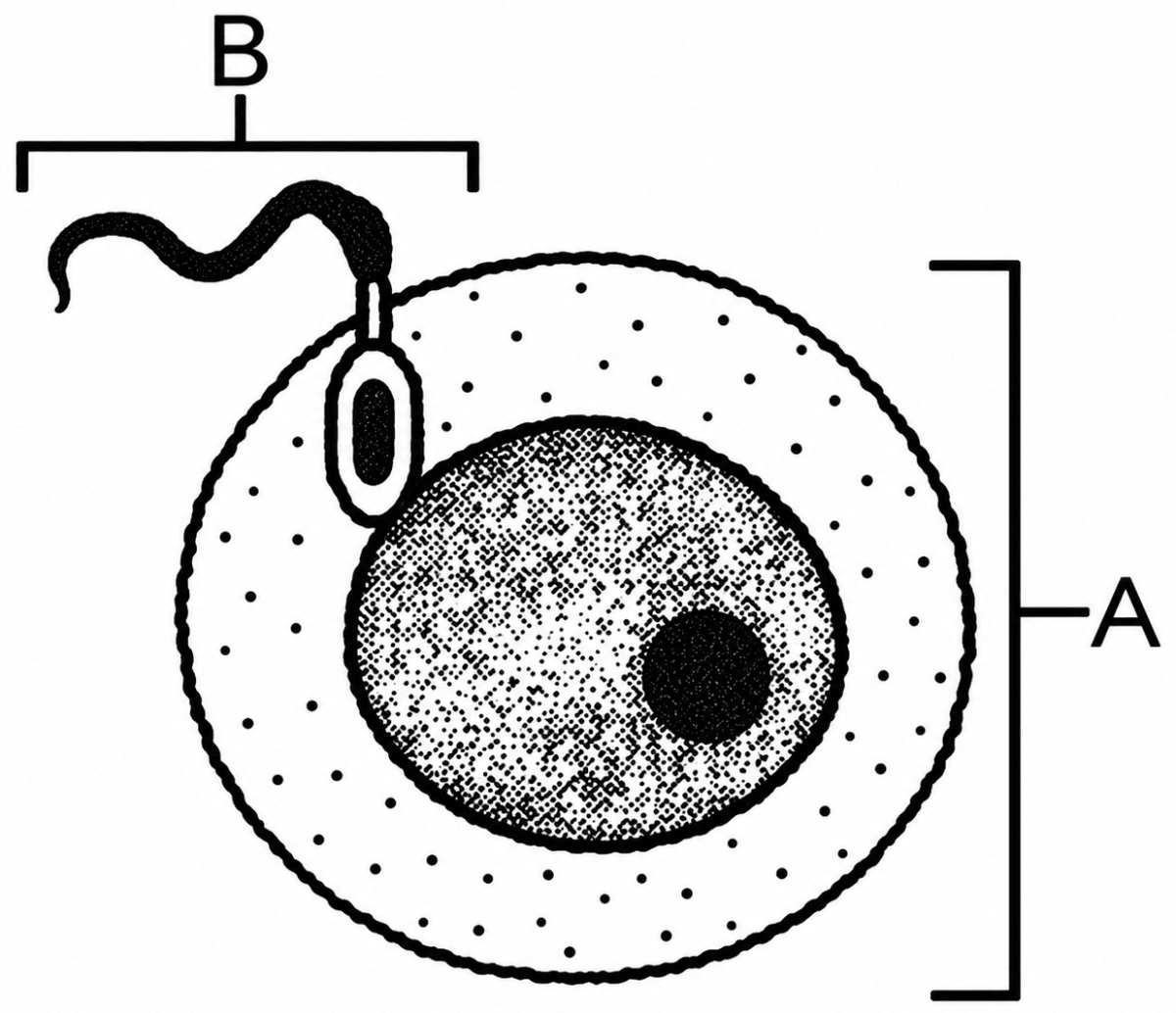
Answer
(i) The reproductive cells A and B are:
- A → Ovum (egg)
- B → Sperm
(ii) Parts of the reproductive system where the above cells are produced are:
- The ovum is produced in the ovary.
- The sperm is produced in the testis.
(iii) The reproductive cells unite in the fallopian tube (oviduct) of the female reproductive system.
Given below is a diagram of the lateral section of a testis of a man. Study the same and answer the questions that follow:

(i) Label the parts numbered 1 to 4 of the diagram.
(ii) State the functions of the parts labelled 1 and 3.
(iii) What is the significance of the testes being located in the scrotal sac outside the abdomen?
(iv) What is the role played by the inguinal canal?
(v) What is semen?
Answer
(i) The parts numbered 1 to 4 of the diagram are:
- 1 → Seminiferous tubules.
- 2 → Testicular lobules
- 3 → Epididymis
- 4 → Sperm duct/Vas deferens.
(ii) The functions of the parts labelled 1 and 3 are:
- Part 1 (Seminiferous tubules): Seminiferous tubules produce sperms by the process called spermatogenesis.
- Part 3 (Epididymis): The epididymis is the site of maturation and temporary storage of sperms and passes them into the vas deferens.
(iii) The testes are located in the scrotal sac outside the abdomen so that their temperature remains about 2 to 3°C below normal body temperature, which is suitable for spermatogenesis. When it is hot, the scrotal skin loosens and the testes move farther from the body; when it is cold, the scrotal skin contracts and draws the testes closer to the body.
(iv) The inguinal canal provides the passage through which the testes descend from the abdominal cavity into the scrotum before birth. The sperm duct, blood vessels and nerves also pass through this region.
(v) Semen is the mixture of sperms and secretions from seminal vesicles, prostrate and cowper's glands. It is a milky fluid.
Given below are diagrams showing different stages in the process of fertilisation of an egg in the female reproductive tract:
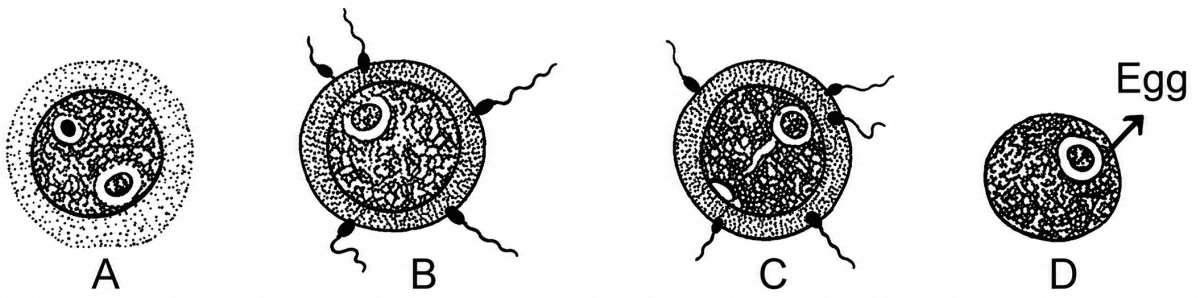
(i) Use the alphabets for each given diagram to show the correct order in the process of fertilisation.
(ii) Where in the female reproductive system does this process normally take place?
(iii) What is the biological term for the product of fusion?
(iv) What is the chromosome number of (1) the egg (2) the fused product?
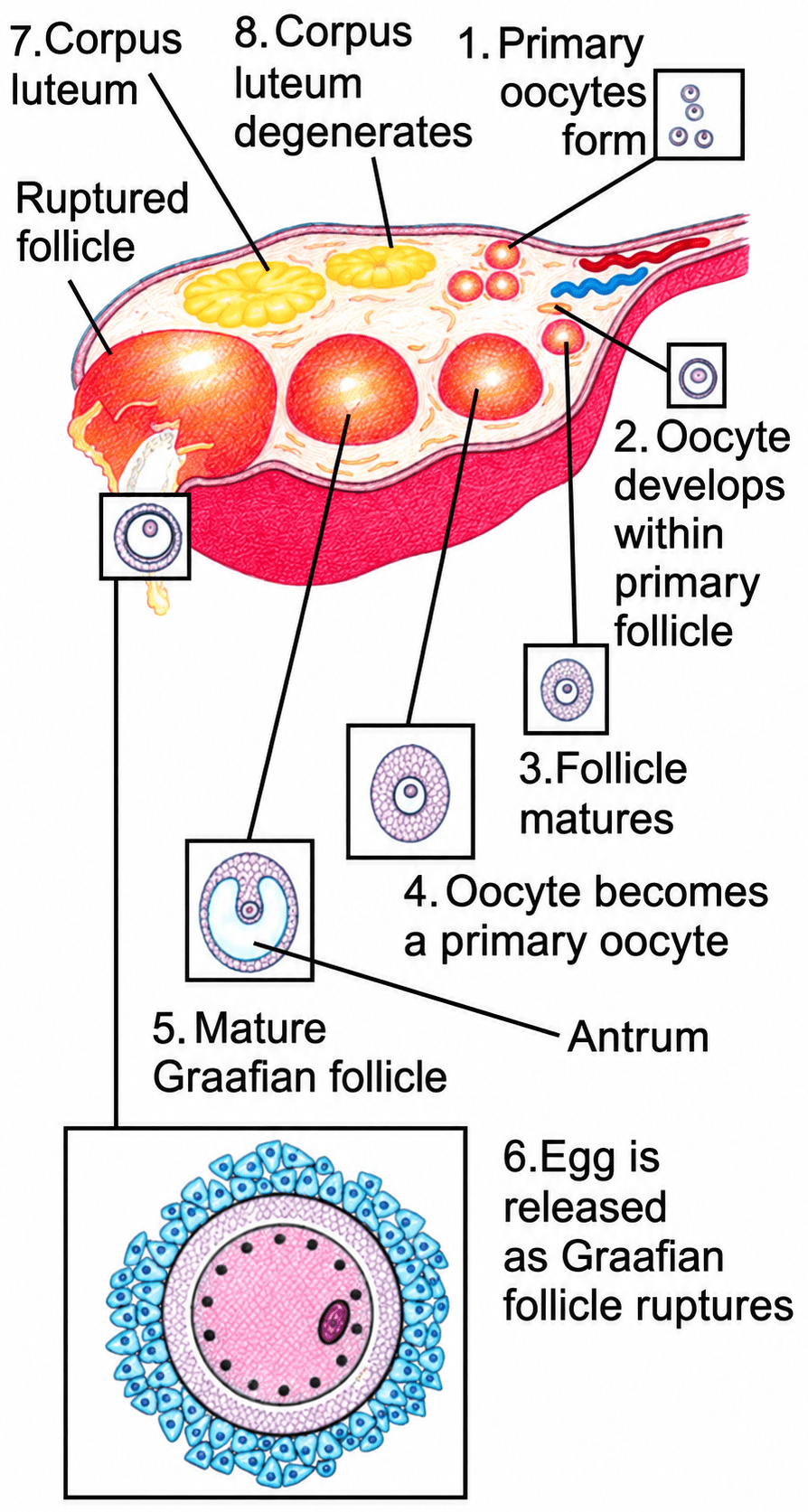
(v) Draw a neat labelled diagram of the follicular development in ovary.
Answer
(i) The correct order in the process of fertilisation is: D → B → C → A
(ii) This process normally takes place in the fallopian tube (oviduct) of the female reproductive system.
(iii) The product of fusion is called the zygote.
(iv) The chromosome number is:
- Egg → 23 (haploid)
- Fused product (zygote) → 46 (diploid)
(v) A neat labelled diagram of the follicular development in the ovary is given below:
The diagram given below is of a developing human foetus in the womb.
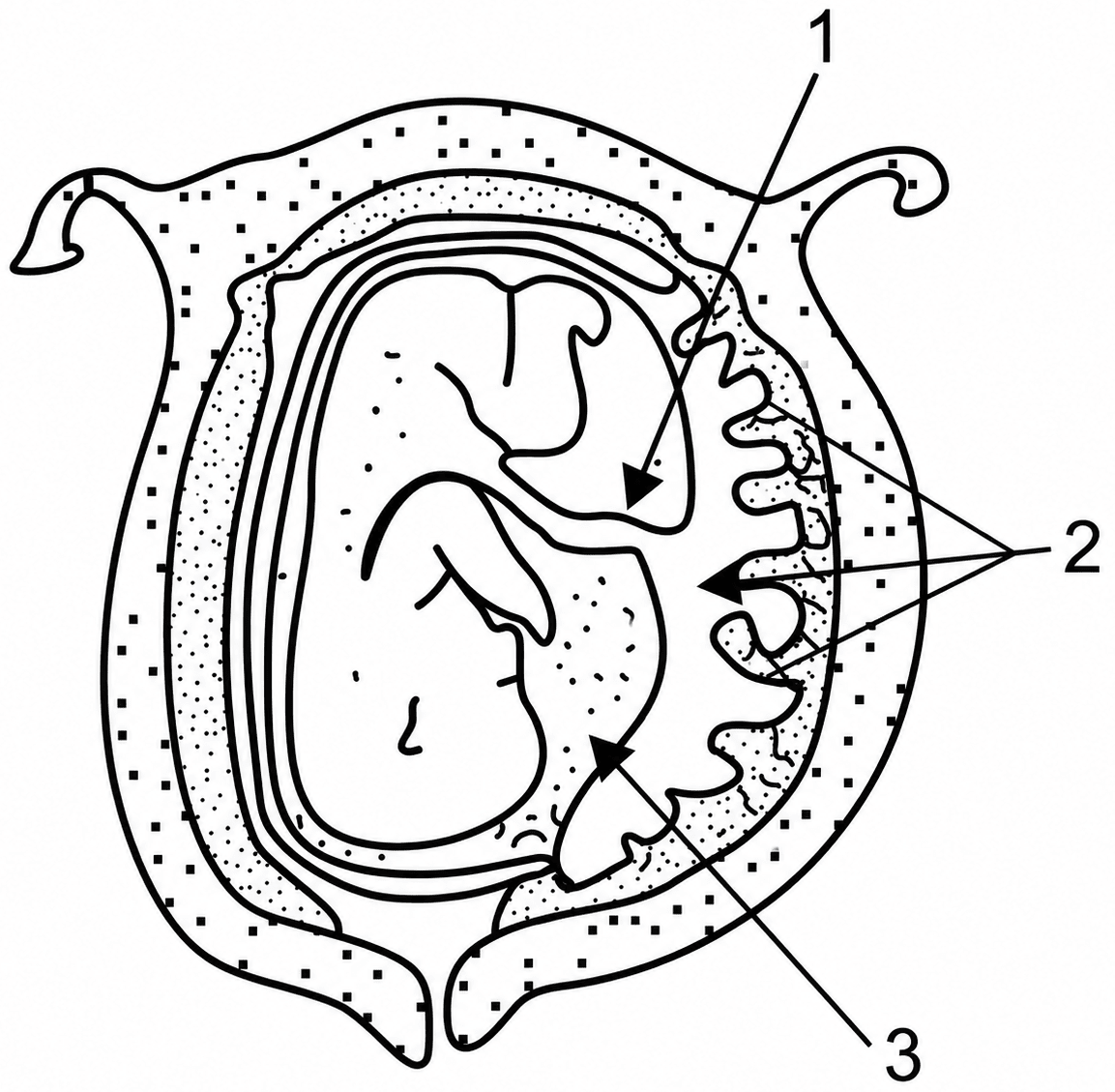
Study the same and then answer the questions that follow:
(i) Name the part labelled 1.
(ii) Mention any two functions of the part labelled 2.
(iii) Explain the role played by the part labelled 3.
(iv) What is the name of gestation period (in days) of the developing foetus?
(v) What is the role of the umbilical cord in the development of the foetus?
(vi) Name the part in the diagram which is endocrine in nature.
Answer
(i) The part labelled 1 is the umbilical cord.
(ii) The part labelled 2 is the placenta. Two functions of the placenta are:
- It supplies oxygen and nutrients from the mother to the foetus.
- It transfers carbon dioxide and nitrogenous wastes from the foetus to the mother.
(iii) The part labelled 3 is the amniotic fluid. It cushions the foetus against jerks and mechanical shocks and prevents the foetus from sticking to the amnion.
(iv) The gestation period of the developing foetus is about 280 days.
(v) The umbilical cord connects the foetus to the placenta. It contains blood vessels through which materials are transported between the foetus and the placenta.
(vi) The placenta is endocrine in nature, as it secretes hormones such as oestrogen and progesterone.
Study the diagram given below and then answer the questions that follow:
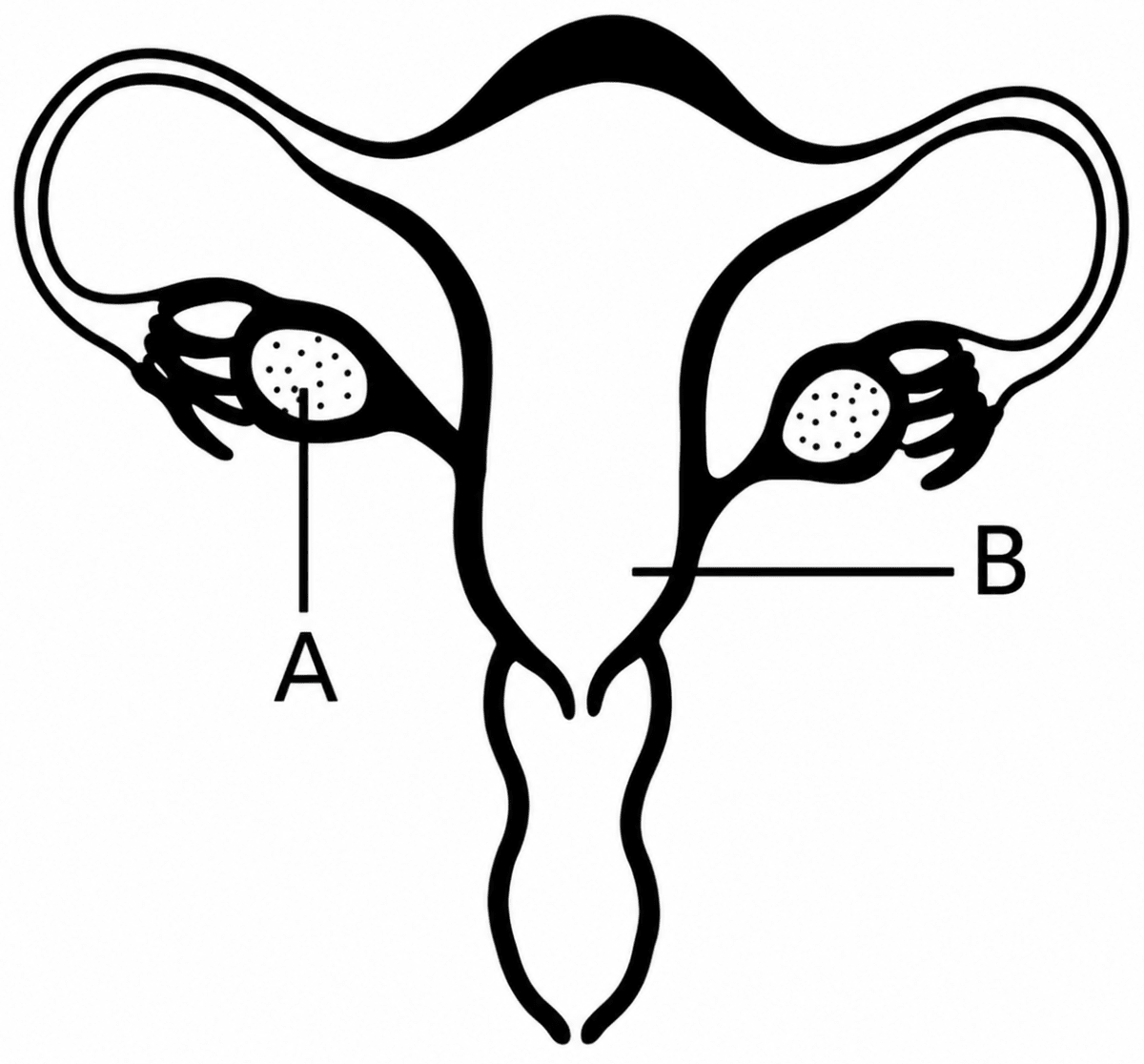
(i) Name the part labelled A. Name any two hormones produced by the part labelled A.
(ii) What happens to the part labelled B (1) If fertilization takes place? (2) If fertilization does not take place?
(iii) Where does fertilization occur?
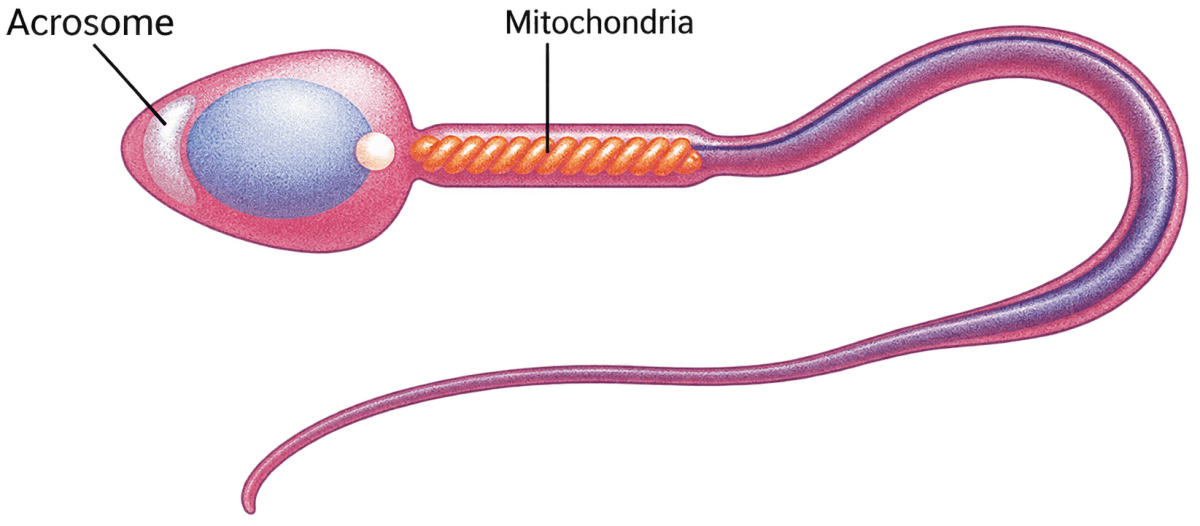
(iv) Draw a neat diagram of the human sperm as seen under high magnification and label the following parts: (1) Acrosome (2) Mitochondria
Answer
(i) The part labelled A is the Ovary.
Two hormones produced by the ovary are oestrogen and progesterone.
(ii)
- If fertilization takes place, the fertilised egg develops into an embryo which gets implanted in the uterus (part B), leading to pregnancy.
- If fertilization does not take place, the thickened lining of the uterus (part B) breaks down and is shed along with blood during menstruation.
(iii) Fertilization occurs in the fallopian tube (oviduct).
(iv) A neat labelled diagram of the human sperm is given below:
Copy and complete the following by filling in the blanks (i) to (v) with appropriate words:
The human female gonads are ovaries. A maturing egg in the ovary is present in a sac of cells called ............... (i). As the egg grows larger, the follicle enlarges and gets filled with a fluid and is now called ............... (ii) follicle. The process of releasing the egg from the ovary is called ............... (iii) The ovum is picked up by the oviducal funnel and fertilization takes place in the ............... (iv) In about a week the blastocyst gets fixed in the endometrium of the uterus and this process is called ............... (v).
Answer
The human female gonads are ovaries. A maturing egg in the ovary is present in a sac of cells called follicle (i). As the egg grows larger, the follicle enlarges and gets filled with a fluid and is now called Graafian (ii) follicle. The process of releasing the egg from the ovary is called ovulation (iii). The ovum is picked up by the oviducal funnel and fertilization takes place in the fallopian tube (iv). In about a week the blastocyst gets fixed in the endometrium of the uterus and this process is called implantation (v).
The diagram given below shows the male urinogenital system of a human being. Study the diagram and answer the questions that follow:

(i) Label the parts numbered 1 to 8.
(ii) Name the corresponding structure of part (4) in female reproductive system.
(iii) What is the role of part 7?
Answer
(i) The parts numbered 1 to 8 are:
- 1 → Urinary bladder
- 2 → Ureter
- 3 → Prostate gland
- 4 → Vas deferens / Sperm duct
- 5 → Urethra
- 6 → Testis
- 7 → Scrotum / Scrotal sac
- 8 → Epididymis
(ii) Fallopian tube / Oviduct
(iii) The scrotum is a thin-walled sac of skin that protects and surrounds the testes. It maintains the testes at about 2 to 3°C below normal body temperature, which is suitable for spermatogenesis.
The diagram given below is that of a developing human foetus. Study the diagram and then answer the questions that follow:

(i) Label the parts numbered 1 to 3 in the diagram.
(ii) Mention any two functions of the part labelled 2 in the diagram.
(iii) Explain the significance of the part numbered 3 in the diagram.
(iv) Define the term 'Gestation'. What is the normal gestational period of the developing human embryo?
(v) Mention the sex chromosomes in a male and female embryo.
Answer
(i) The parts numbered 1 to 3 in the diagram are:
- 1 → Umbilical cord
- 2 → Placenta
- 3 → Amniotic fluid
(ii) Two functions of Placenta are:
- Acts as a barrier and prevents germs from entering foetal blood.
- Secretes Oestrogen and Progesterone.
(iii) Protects the embryo from physical damage by jerks or mechanical shocks, keeps an even pressure all around the embryo and allows the foetus some restricted movement.
(iv) The full term of the development of the embryo in the uterus is called gestation. In humans, it lasts for about 280 days / 40 weeks.
(v) The sex chromosomes in a male and female embryo are:
Male - XY
Female - XX
The diagram shown below is the longitudinal section of a testis of man. Study it carefully and answer the questions that follow:
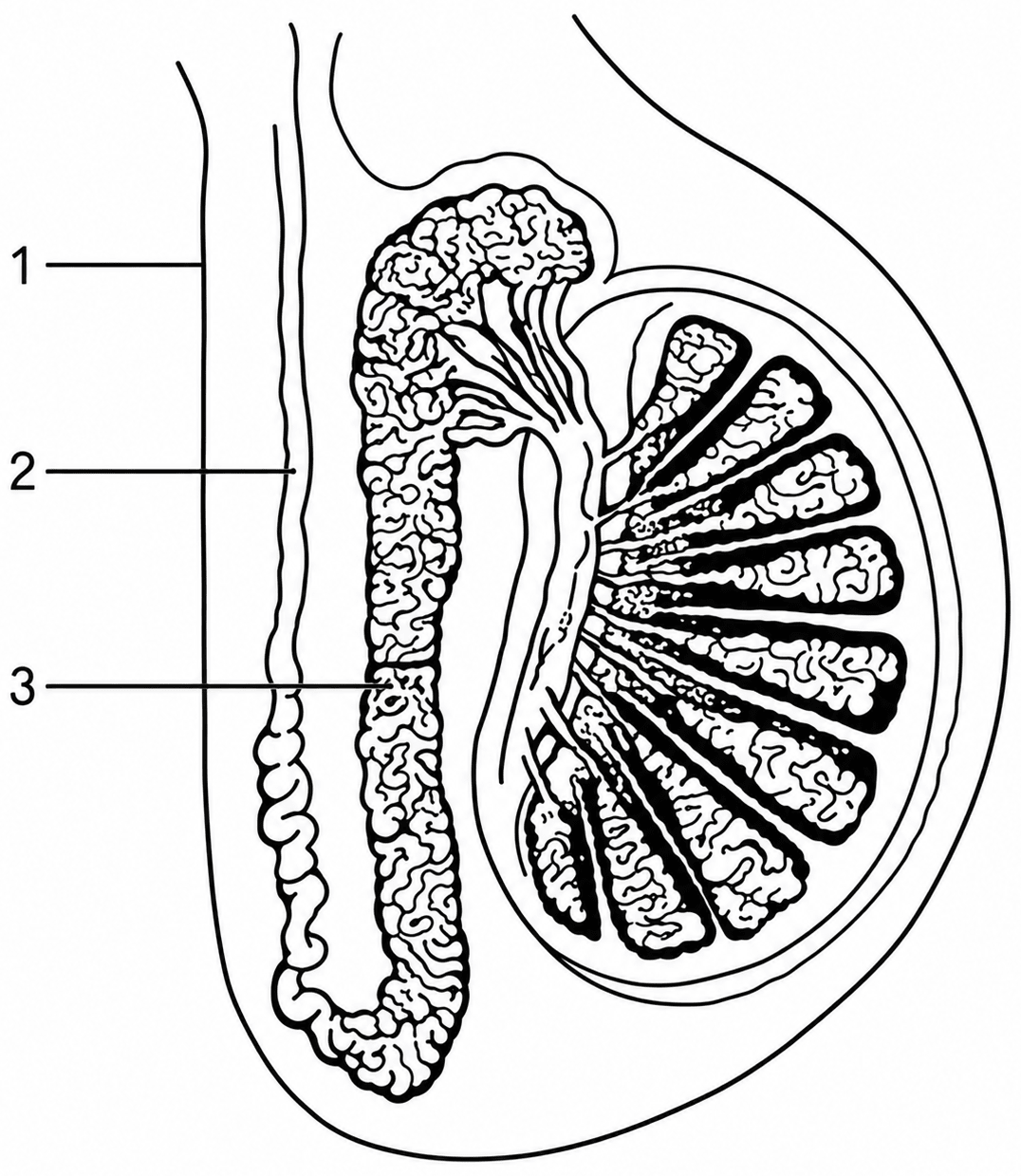
(i) Label the parts numbered 1 to 3 in the diagram.
(ii) In which part of the testis are the sperms produced?
(iii) State the functions of the parts labelled 1 and 3 in the diagram.
(iv) Name the cells that secrete testosterone.
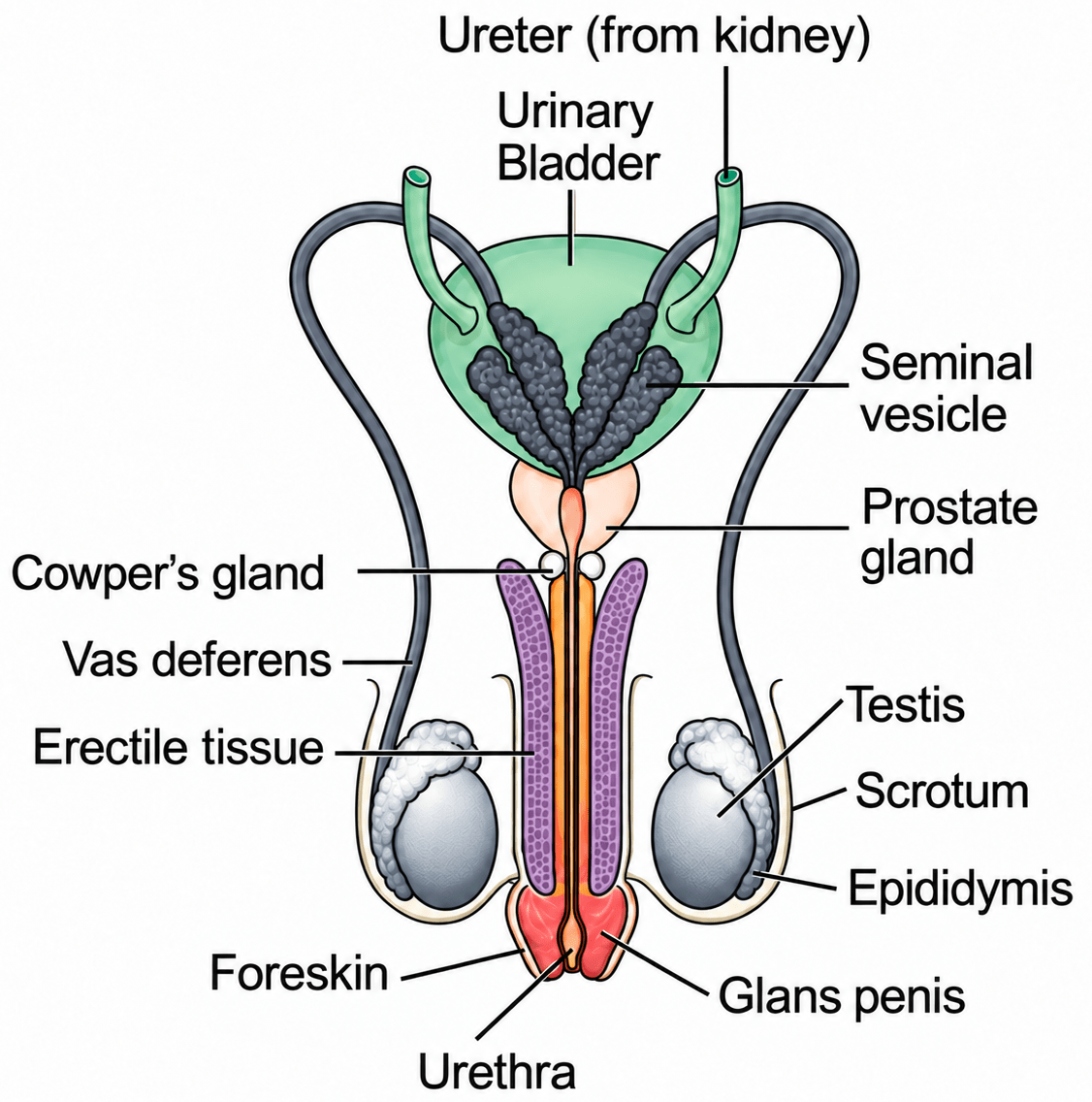
(v) Draw a neat, labelled diagram of a male reproductive system (front view).
Answer
(i) The parts numbered 1 to 3 are:
- 1 → Scrotum / Scrotal sac
- 2 → Sperm duct / Vas deferens
- 3 → Epididymis
(ii) Sperms are produced in the seminiferous tubules of the testes.
(iii) The functions of the parts labelled 1 and 3 are:
- Scrotum (Part 1) — It is a thin-walled sac of skin that protects and surrounds the testes and keeps them about 2 to 3°C below normal body temperature, which is suitable for spermatogenesis.
- Epididymis (Part 3) — The epididymis is the site of maturation and temporary storage of sperms and passes them into the vas deferens.
(iv) Interstitial cells or Leydig cells
(v) A neat labelled diagram of the male reproductive system (front view) is given below:
Observe the figure given below and answer the following questions:
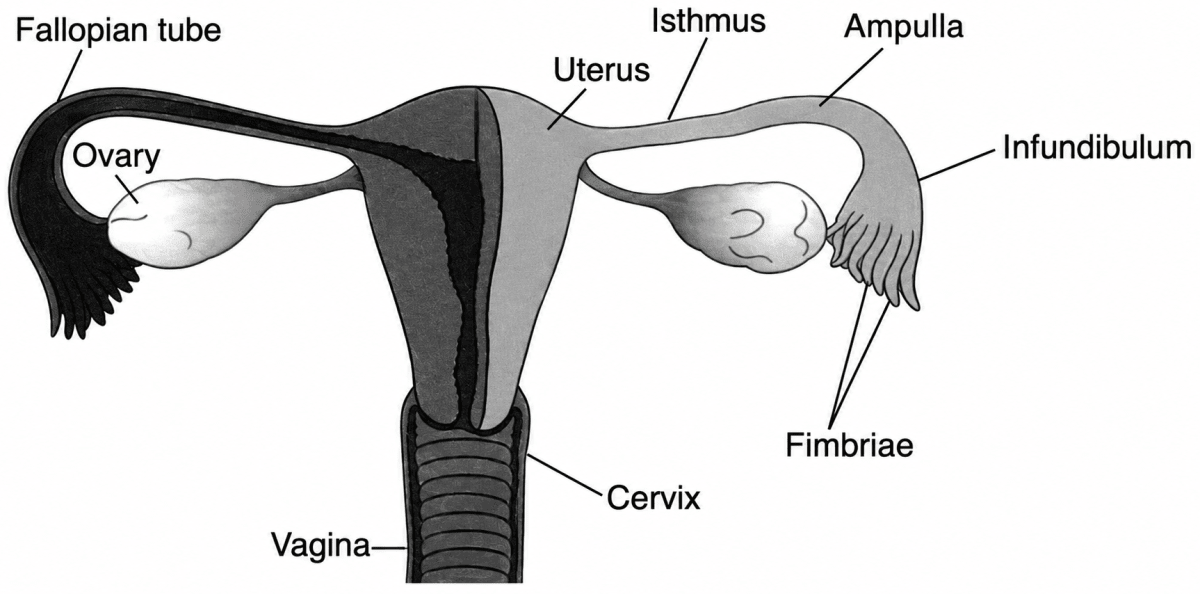
(i) What does above figure indicate?
- Structure of an ovum
- Position of ovary
- L.S. of ovary
- None of these
(ii) Which part of the above figure is associated with fertilization?
- Fallopian tube
- Uterus
- Vagina
- Cervix
(iii) Which part of the given figure is associated with production of an egg?
- Fallopian tube
- Vagina
- Ovary
- Uterus
(iv) The pear-shaped organ situated in the pubic cavity is named as
- Vagina
- Uterus
- Cervix
- Ovary
Answer
(i) Position of ovary
Reason — The figure shows the ovaries along with the fallopian tubes, uterus, cervix and vagina, indicating the position of the ovary within the female reproductive system.
(ii) Fallopian tube
Reason — Fertilisation in human female usually takes place in the ampulla of the fallopian tube (oviduct), where the sperm fuses with the egg.
(iii) Ovary
Reason — The ovary is the primary female reproductive organ which produces the eggs (ova) and also secretes the hormones oestrogen and progesterone.
(iv) Uterus
Reason — The uterus (womb) is a hollow, pear-shaped muscular organ situated in the pubic cavity between the urinary bladder and the rectum.
Given below are diagrams showing the different stages in the process of fertilisation of an egg in the human female reproductive tract. Study the diagrams given below and answer the questions:
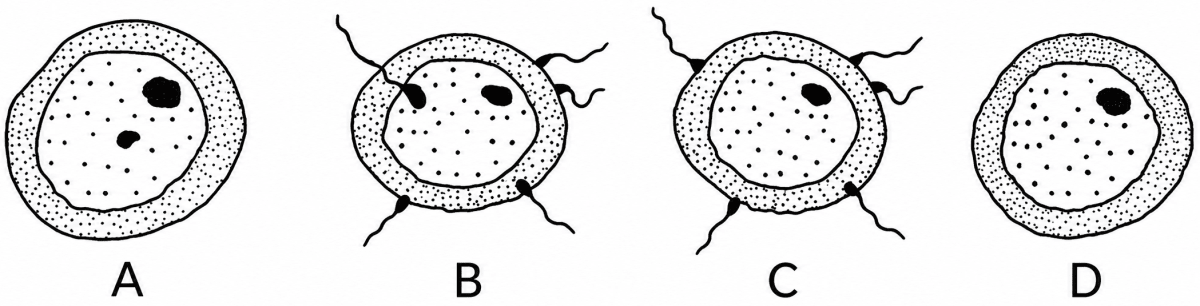
(i) Arrange the letters given below each diagram in a logical sequence to show the correct order in the process of fertilisation.
(ii) Where does fertilisation normally take place? What is 'Implantation' that follows fertilisation?
(iii) Mention the chromosome number of the egg and zygote in humans.
(iv) Explain the term 'Gestation'. How long does Gestation last in humans?
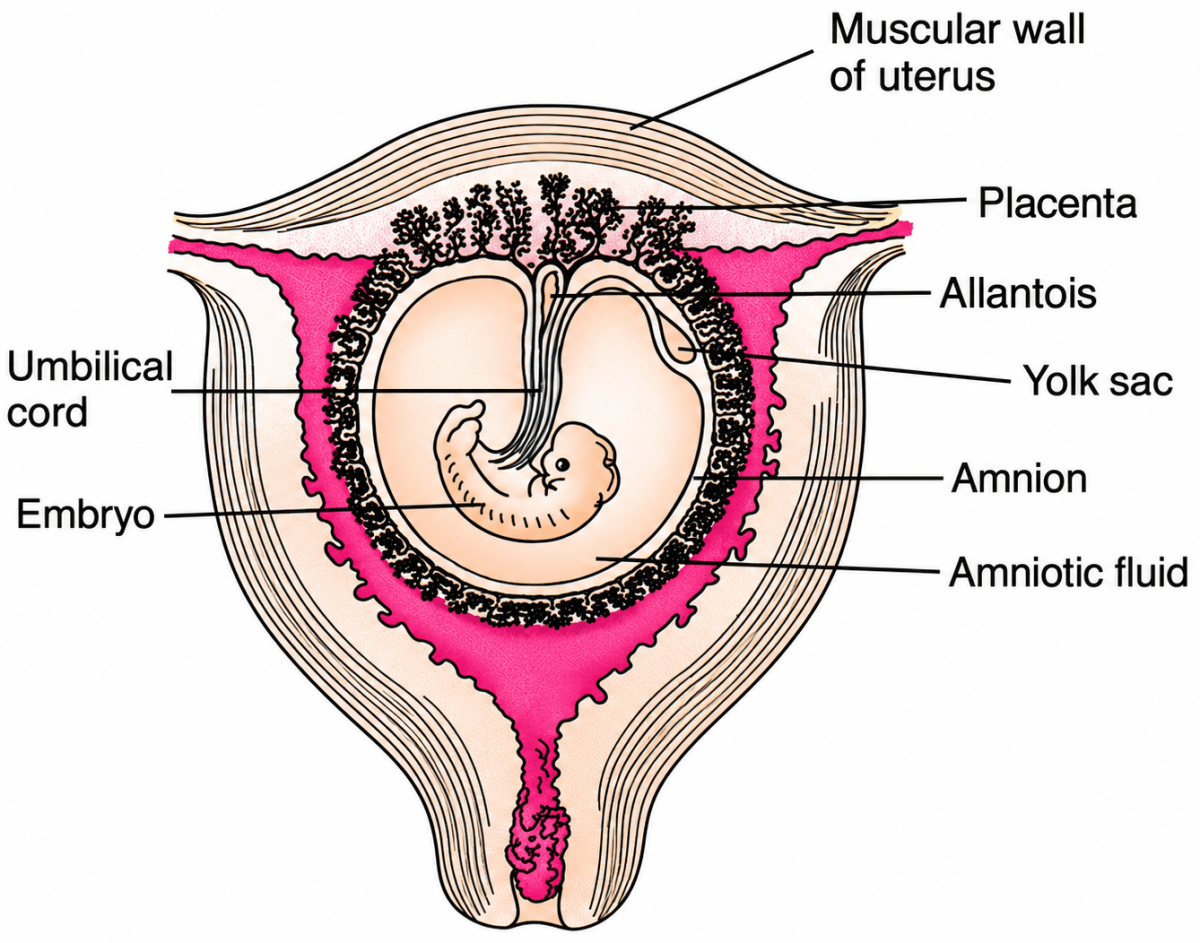
(v) Draw a neat labelled diagram showing human foetal membranes and placenta.
Answer
(i) D → C → B → A
(ii) Fertilisation usually takes place in the fallopian tube (oviduct). Implantation is the attachment or fixing of the blastocyst to the endometrium of the uterus.
(iii) Chromosome number of the egg is 23 and zygote is 46 / 23 pairs.
(iv) Gestation is the period of development from conception till the birth of the young one. In humans, it lasts for about 280 days or 40 weeks.
(v) A neat labelled diagram showing human foetal membranes and placenta is given below:
The diagram given below represents a system in the human body. Study the diagram and answer the following questions:
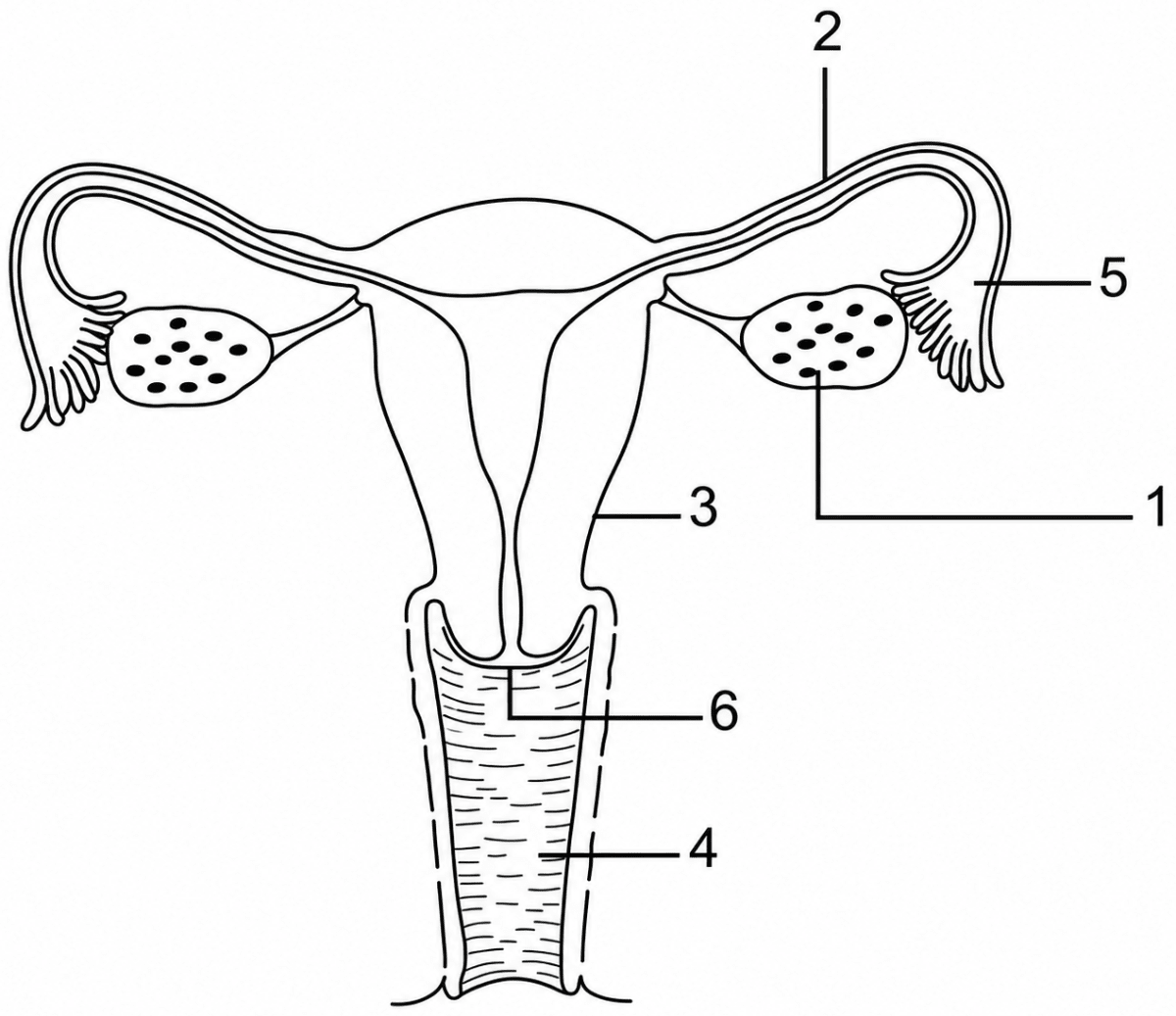
(i) Identify the system.
(ii) Label the parts marked 5 and 6.
(iii) Name the two hormones secreted by 1.
(iv) Mention the number and the name of the part involved in fertilization and implantation from the above diagram.
(v) Name the part of the uterus where (1) Implantation occurs (2) Fertilisation occurs
Answer
(i) The system is the Female Reproductive System.
(ii) The parts marked 5 and 6 are:
- 5 → Oviducal funnel (infundibulum)
- 6 → Cervix
(iii) The two hormones secreted by part 1 (Ovary) are oestrogen and progesterone.
(iv)
- The part involved in fertilization is part 2, the Fallopian tube (oviduct).
- The part involved in implantation is part 3, the Uterus.
(v)
- Implantation occurs in the endometrium (wall) of the uterus.
- Fertilisation occurs in the fallopian tube (oviduct), and not within the uterus.