
Smart schools focus on integrating technology to ............... .
- Enhance transportation systems
- Improve energy efficiency and security
- Facilitate online learning and administrative processes
- Assist individuals with disabilities or limited mobility
Answer
Facilitate online learning and administrative processes
Reason — Smart schools aim to create an environment where technology is integrated into various aspects of education to improve learning and administrative processes for students, teachers, and administrators.
Which one of the following is not a type of a drone?
- Fixed wing
- Multi rotator
- Flexible wing
- Hybrid
Answer
Flexible wing
Reason — Fixed wing, multi-rotator, and hybrid are recognised types of drones, whereas flexible wing is not classified as a type of drone.
What distinguishes a cobot from a traditional robot?
- Cobots are bigger in size as compared to the traditional robots.
- Cobots can only perform simple tasks, while traditional robots are more versatile.
- Cobots emphasise collaboration and interaction with humans.
- Traditional robots are fully autonomous, while cobots require constant human control.
Answer
Cobots emphasise collaboration and interaction with humans, while traditional robots often work autonomously.
Reason — Cobots, or collaborative robots, are made specifically to work safely alongside humans with a focus on cooperation and involvement, whereas traditional robots often work autonomously.
Which of the following is an example of a multi-robot system?
- Robots for smart home
- Robots for smart office
- Robots for fire fighting
- All of the above
Answer
All of these
Reason — A multi-robot system consists of multiple robots connected through a network, and such systems can be used in smart homes, smart offices, and firefighting scenarios.
The purpose of gear is to ............... .
- Give shape to the robot
- Transfer motion and power to the other component of a robot
- Give speed to the robot
- None of these
Answer
Transfer motion and power to the other component of a robot
Reason — Gears are used to transmit motion and power from one component of a robot to another, enabling proper movement and functioning of different robotic parts.
The task of path planning and trajectory control system is to ............... .
- Control the speed of a robot
- Decide the position of a robot
- Decide the path for a robot navigation
- Design the path for user’s navigation
Answer
Decide path for robot navigation
Reason — Path planning and trajectory generation involve algorithms in control systems that design the ideal path and produce trajectories for the robot to follow, while avoiding obstacles and taking the robot’s dynamics into account.
Image is representing ............... .
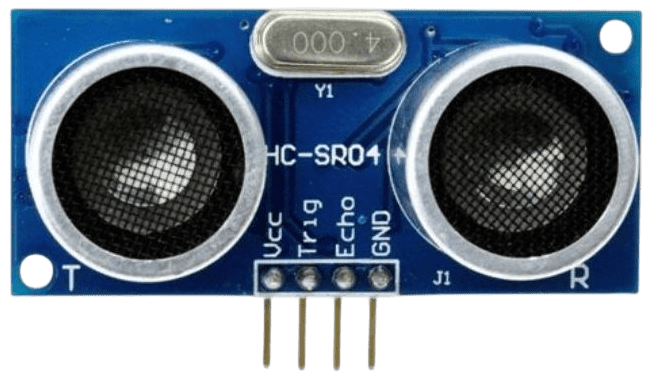
- IR sensor
- Solar sensor
- Ultrasonic sensor
- None of these
Answer
Ultrasonic sensor
Reason — The image represents an Ultrasonic Distance sensor.
Mechanical part of a robot is responsible for ............... .
- Giving shape to the robot
- Allowing interaction with outer environment
- Protecting robot’s electronic part
- All of the above
Answer
All of the above
Reason — The mechanical part of a robot gives it a physical structure, allows it to interact with the outer environment through components like joints and end effectors, and also helps protect the robot’s electronic parts.
Audino Uno is a ............... .
- Sensor
- Actuator
- Microcontroller
- None of these
Answer
Microcontroller
Reason — Arduino Uno is a microcontroller that acts as the controller or brain of the robot.
Motor in robot works as a ............... .
- Sensor
- Actuator
- End effector
- Controller
Answer
Actuator
Reason — A motor converts electrical energy into mechanical movement, which helps a robot move or perform actions, so it functions as an actuator.
Which of the following is true with automated and autonomous systems?
- Autonomous systems are not adaptable
- Automated systems are adaptable
- Autonomous systems are adaptable
- None of these
Answer
Autonomous systems are adaptable
Reason — Autonomous systems can learn from their environment and make decisions based on changing situations, which makes them adaptable, unlike automated systems that work only on predefined rules.
Identifying car in an image is an example of
- Natural language processing
- Object detection
- Text summarization
- None of these
Answer
Object detection
Reason — Identifying a car in an image involves recognising and locating an object within an image, which is known as object detection.
What is an important benefit of collaboration of human intelligence and machine intelligence?
- Reduced cost
- Improved results
- Fast diagnosis without human
- None of these
Answer
Improved results
Reason — Collaboration between human intelligence and machine intelligence combines human reasoning, experience, and judgement with machine speed, accuracy, and data processing ability, leading to more accurate and effective results.
Which is/are the characteristic(s) of machine intelligence?
- Emotion handling
- Context understanding
- Innovative
- All of the above
Answer
Context understanding
Reason — Machine intelligence has a limited ability to understand context based on data and patterns, whereas it does not handle emotions or show innovation, which are characteristics of human intelligence.
What is the meaning of intellectual property infringement?
- Sending a mail that includes a link to a fake site
- Stealing software that may be stored on a pen drive
- Make a copy of someone’s patent design
- None of these
Answer
Make a copy of someone’s patent design
Reason — Intellectual property infringement means copying or using someone’s trademark or patent design without permission.
A module in Python is ............... .
- A function
- Collection of variables
- Collection of Python code in a file
- None of these
Answer
Collection of Python code in a file
Reason — A module is a simple Python file that can contain functions, variables, and other objects.
What would be the output of following code ?
list1 = [2, 3, 4, 5, 6]
print(list1[-2])- 3
- 4
- 5
- Error
Answer
5
Reason — In negative indexing, the index -1 refers to the last element of the list and -2 refers to the second last element, which is 5 in the given list.
Which of the following function is applicable in a tuple?
- insert
- append
- del
- None of these
Answer
del
Reason — A tuple is immutable, so elements cannot be inserted or appended, but the entire tuple can be deleted using the del keyword.
What would be the output of following code?
str1 = "Hello India"
s1 = str1[1:3]
print(s1)- He
- el
- Hlo
- None of these
Answer
el
Reason — String slicing extracts characters from the starting index up to (but not including) the ending index, so str1[1:3] returns the characters at index 1 and 2, which are e and l.
What would be the output of following code?
Q1 = "Hello How are you"
val = Q1.count("H")
print(val)- 1
- 2
- 3
- 4
Answer
2
Reason — The count() function returns the number of occurrences of a character in a string. In the string "Hello How are you", the character "H" appears two times, therefore the output is 2.
What are the warehouse robots and how are they used in the logistics industry?
Answer
Warehouse robots are robots designed to work in warehouses to perform tasks such as picking objects, arranging shelves, sorting items, and packaging products. They help improve the speed and accuracy of warehouse operations in the logistics industry.
What do you understand by cobots? Explain.
Answer
Cobots, also known as collaborative robots, are robotic systems designed to work together with humans or other robots by focusing on cooperation and involvement. They are used in situations where complete control cannot be given to robots, such as medical surgeries or defence operations, and they assist humans while ensuring safe and efficient task performance.
Give an example to illustrate how machines differ from robots.
Answer
A washing machine is an example of a machine because it is designed to perform a specific task and works on predefined instructions. In contrast, a robot can sense its surroundings, take decisions, and perform different tasks using sensors, actuators, and a controller.
Define actuators with the help of an example. What do you understand by revolute and prismatic joint?
Answer
Actuators are components of a robot that help it move and perform actions by converting electrical signals into mechanical motion. For example, motors are actuators that help a robot move its wheels or arms.
A revolute joint is a joint that allows rotational movement between two links, similar to the movement of a door hinge. A prismatic joint is a joint that allows linear (sliding) movement between two links, similar to the movement of a piston.
What distinguishes subjective decision-making from objective decision-making?
Answer
Subjective decision-making is influenced by personal feelings, emotions, experiences, beliefs, and preferences of an individual. In contrast, objective decision-making is based on facts, data, logic, and predefined rules, and is not affected by personal biases or emotions.
Write the differences between autonomous system and automated system?
Answer
| Automated System | Autonomous System |
|---|---|
| Automated systems work on predefined rules and programs. | Autonomous systems can learn from their environment. |
| They do not have decision-making capability. | They have decision-making capability. |
| They cannot adapt to changes in surroundings. | They are adaptable and flexible. |
| Automated systems do not learn from past experiences. | Autonomous systems use machine learning or AI to improve performance over time. |
| Example: Vending machine, traffic lights. | Example: Self-driving car, drones. |
How are machine intelligence and human intelligence inspired by each other?
Answer
Machine intelligence is inspired by human intelligence because machines are designed to mimic human abilities such as learning, reasoning, and decision-making using algorithms and data. At the same time, human intelligence is supported by machine intelligence, as machines help humans by processing large amounts of data quickly and accurately, assisting in tasks like analysis, prediction, and problem-solving, thereby improving overall efficiency and outcomes.
How can we avoid unauthorised access of hardware or software?
Answer
Unauthorised access to hardware or software can be avoided by keeping hardware devices in a safe place, setting up proper authentication mechanisms such as passwords, taking permission before using someone else’s computer or digital device, always logging out from accounts when using public computers, purchasing software only from authorised vendors or official websites, and avoiding the use of pirated software.
Create a list and demonstrate the use of 'insert' function.
Answer
city_list = ["Delhi", "Mumbai", "Chennai"]
city_list.insert(1, "Kolkata")
print(city_list)['Delhi', 'Kolkata', 'Mumbai', 'Chennai']
The insert() function is used to add an element at a specified index position in the list.
Write a Python program to demonstrate the use of repetition operator of a String.
Answer
str1 = "Hello"
print(str1 * 3)HelloHelloHello
What is the motivation behind the progress from robots to cobots? Write a comparison between robots and cobots.
Answer
The progress from robots to cobots is motivated by the need for collaboration between humans and robots in situations where complete control cannot be given to robots. In areas such as medical surgeries and defence operations, human involvement is essential. Cobots (collaborative robots) are therefore designed to work with humans or other robots, focusing on cooperation, involvement, and shared control so that tasks can be performed safely and efficiently.
Differences between Robots and Cobots:
| Basis | Robots | Cobots |
|---|---|---|
| Purpose | Used to automate tasks that are often dangerous, repetitive or tedious. | Designed to work with humans safely in a shared workspace. |
| Design & safety | Usually large, heavy and kept enclosed/caged to avoid accidents. | Usually smaller, lighter and open, made with safety features to prevent harm to humans. |
| Human interaction | Work mostly separately from humans; limited direct collaboration. | Work alongside humans and support them during tasks (collaborative working). |
| Speed | Generally faster in operation. | Generally slower (to ensure safe collaboration). |
| Cost | Usually more expensive. | Generally less expensive than robots. |
What do you understand by gears in robots? Write about various types of gear. Write about various applications of gears in robotics.
Answer
Gears in robots are mechanical components used to transmit motion and power from one component of a robot to another. They help in controlling speed, force, and movement, ensuring smooth and accurate functioning of robotic systems.
Types of gears:
Spur gears: These have straight teeth and are mounted on parallel shafts. They are commonly used for general power transmission.
Helical gears: These gears have curved teeth and provide smoother and quieter operation, suitable for high-speed applications.
Bevel gears: These gears are used to change the direction of motion between two shafts.
Worm gears: These consist of a worm and a worm wheel and are used where slow and precise movement is required.
Planetary gears: These gears are used in robotic arms and engines due to their efficient power transmission.
Applications of gears in robotics:
- Used in robotic joints for smooth and accurate movement
- Used in robot mobility systems such as wheels and tracks
- Used in lifting mechanisms to increase force
- Used for accuracy and control in robotic systems
- Used in gearboxes to adjust speed and torque
What do you mean by mechanical block of a robot? What are the various components of mechanical block of a robot. What are the important applications of mechanical block of a robot?
Answer
The mechanical block of a robot refers to the physical structure of the robot that enables it to work in a real-world environment. It includes all the mechanical components that help the robot move, perform tasks, and interact with its surroundings.
Components of the mechanical block of a robot:
Outer body (chassis): It forms the physical framework of the robot and supports the integration of all mechanical components.
Joints and links: Joints help the robot move, and links connect different parts of the robot to form its structure.
Actuators: Devices such as motors and hydraulic systems that drive the movement of joints.
End effectors: Tools attached to the robot to interact with the environment, such as grippers, cutters, or moppers.
Controller: It controls the mechanical block by receiving input from sensors and sending signals to other components.
Applications of the mechanical block of a robot:
- Logistics: Used in robots for picking, placing, and moving items in warehouses.
- Agriculture: Helps robots perform tasks like planting, weeding, and harvesting.
- Medical robotics: Used in robots designed for medical diagnosis and surgeries requiring precision.
- Manufacturing: Enables robots to handle materials, assemble products, and perform welding and quality checks.
- Household robots: Helps robots perform tasks such as cleaning, picking objects, and moving.
What do you mean by machine learning? Explain the importance of data in machine learning with the help of an example.
Answer
Machine learning is a concept of artificial intelligence in which machines are made capable of learning from data and improving their performance without being explicitly programmed for every task. Machines learn by identifying patterns and relationships in the data and then using them to make decisions or predictions.
Importance of data in machine learning:
Data is the most important requirement in machine learning because it acts as the fuel for AI algorithms. Machine learning models learn and work based on patterns and insights derived from data. The data used must be sufficient, relevant, and accurate so that the model can be trained properly and give reliable results.
Example:
To predict the result of a cricket match between two teams, training data such as pitch conditions and previous match outcomes is used to train the AI model. The model learns the relationship between pitch conditions and match results. Testing data (new pitch conditions) is then used to predict the outcome of future matches.
How does a module helps in code reusability? Explain with the help of an example. Create a Python package and one module under it. Write a Python code to use this package.
Answer
A module helps in code reusability by allowing programmers to write commonly used functions and variables once and reuse them in different programs. Instead of writing the same code repeatedly, it can be stored in a module and imported whenever required. This reduces duplication of code, makes programs simpler, and improves organisation.
Example:
Package structure:
my_new_package/
    my_module.py
main.py
Create the module: my_new_package/my_module.py
# my_module.py

school_name = "KnowledgeBoat"

def greet_student(name):
    return f"Hello {name}! Welcome to {school_name}."
Use this package in a program: main.py
# main.py

from my_new_package.my_module import school_name, greet_student

print("School:", school_name)
print(greet_student("Aarav"))
Output (sample):
School: KnowledgeBoat
Hello Aarav! Welcome to KnowledgeBoat.
What do you understand by escape character? Explain any five escape sequences used in Python with the help of examples.
Answer
An escape character is a special character used in a string to insert characters that cannot be written directly inside the string. In Python, the backslash (\) is used as an escape character. The combination of the backslash and another character is called an escape sequence.
Five escape sequences in Python:
1. \n (New line) — It is used to move the cursor to a new line.
Example:
print("Hello\nWorld")
Output:
Hello
World
2. \t (Tab space) — It is used to provide horizontal tab space in a string.
Example:
print("Python\tProgramming")
Output:
Python Programming
3. \' (Single quote) — It is used to insert a single quote inside a string.
Example:
print('It\'s my pen')
Output:
It's my pen
4. \" (Double quote) — It is used to insert a double quote inside a string.
Example:
print("He said, \"Hello\"")
Output:
He said, "Hello"
5. \\ (Backslash) — It is used to insert a backslash character in a string.
Example:
print("The symbol is \\")
Output:
The symbol is \