
Write the names of at least two robots related to each field (except the robots explained in the chapter).
Answer
| Domain | Robot Name | Main Task |
|---|---|---|
| Medical | Mako SmartRobotics | Assisting doctors in knee and hip replacement surgery |
| CorPath GRX | Robotic assistance in heart and vascular procedures | |
| Agriculture | AgXeed | Autonomous field operations such as ploughing and sowing |
| SwarmFarm Robots | Crop monitoring and precision farming | |
| Education | Thymio | Teaching students basic robotics and programming |
| Dash Robot | Interactive learning and coding education |
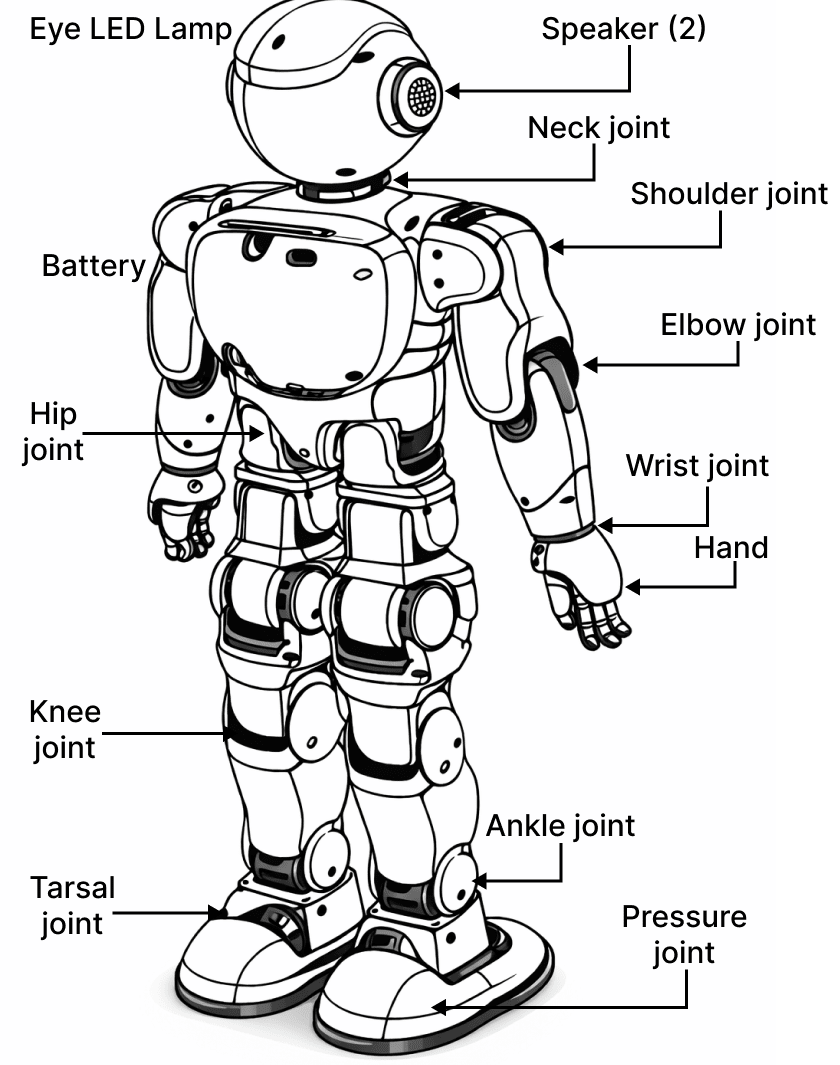
Observe the following humanoid robot and identify its various components. Write the components under appropriate headings in the space provided for answer.
Sensors
- ...............
- ...............
- ...............
Power Sources
- ...............
- ...............
Manipulators
- ...............
- ...............
- ...............
- ...............
- ...............
- ...............
Answer
Sensors:
- Eye LED Lamp
Power Sources:
- Battery
Manipulators:
- Neck joint
- Shoulder joint
- Elbow joint
- Wrist joint
- Hand
- Ankle joint
- Hip joint
- Tarsal joint
- Knee joint
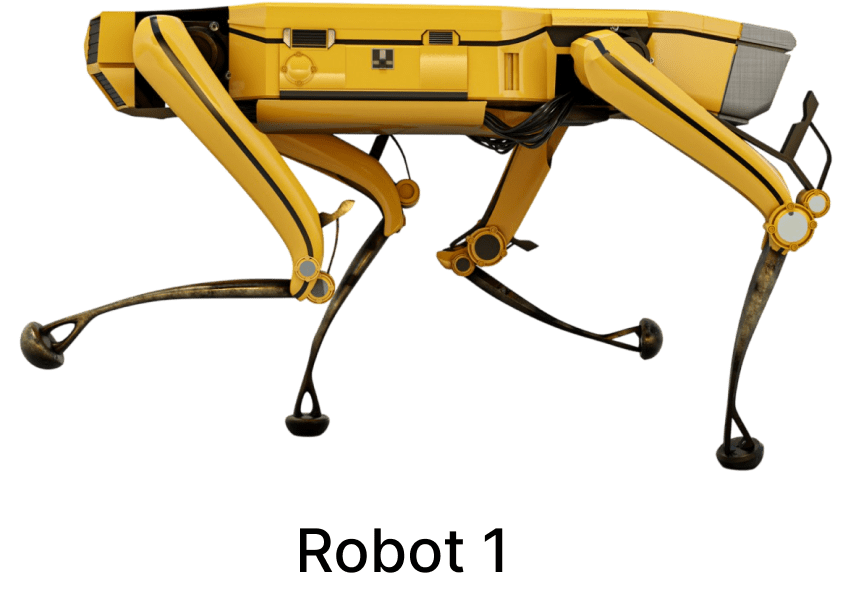
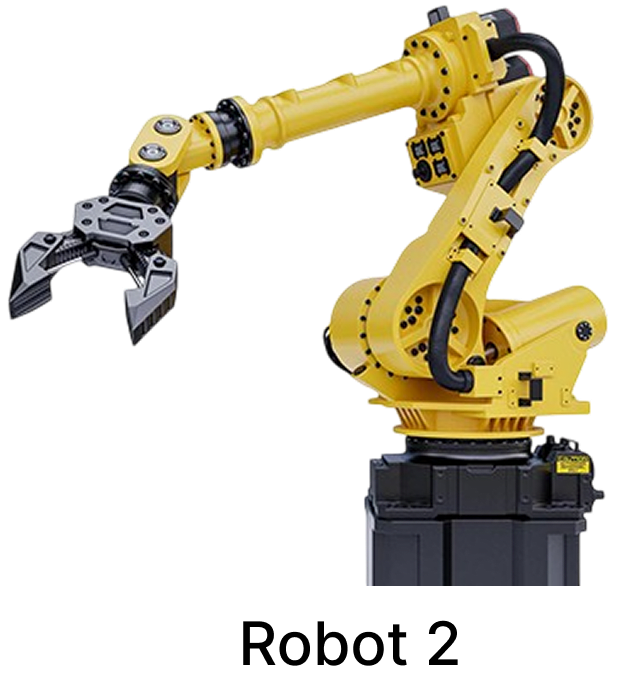
Observe the two robots, identify the types of links and joints they have, and mention the same in the below-given table.
| Component | Robot 1 | Robot 2 |
|---|---|---|
| Links | ||
| Joints |
Answer
Links and joints of the given robots are mentioned in the table below:
| Component | Robot 1 | Robot 2 |
|---|---|---|
| Links | Rigid links | Rigid links |
| Joints | Revolute joints | Spherical joints |
All robots are designed to work autonomously.
Answer
False
Reason — All robots are not designed to work autonomously because some robots are manually operated and depend completely on human control to perform their tasks, while only certain robots are programmed to work independently without human intervention.
Robots can be flexible due to their reprogrammable feature.
Answer
True
Reason — Robots can be flexible because they are reprogrammable, which means the same robot can be programmed again and again to perform different tasks as required. By changing the program, a robot can adapt to new jobs without changing its physical structure, making it flexible in nature.
The term "robot” was first coined in the 20th century.
Answer
True
Reason — The term "robot" was first introduced in the 20th century.
The name of first industrial robot is Unimate.
Answer
True
Reason — The first industrial robot was named Unimate, and it was used in industries to perform repetitive and hazardous tasks such as handling hot metal and heavy materials.
A light sensor detects the presence of an object.
Answer
True
Reason — A light sensor emits light and observe its reflection to detect the obstacle or follow a particular path.
In piezoelectric actuators, pressurised fluid is used to generate motion.
Answer
False
Reason — Piezoelectric actuators move objects using a piezoelectric crystal, while pressurised fluid is used by hydraulic actuators to produce motion.
Sensing is a function of the mechanical block of a robot.
Answer
False
Reason — Sensing is performed by the sensor block, which detects environmental changes and provides input to the robot. The mechanical block of a robot is responsible for creating the robot’s physical structure.
Linear motion represents movement along a straight-line path.
Answer
True
Reason — Linear motion refers to the movement in a straight line along a specific path.
For robots to navigate complicated environments, one-dimensional motion is adequate.
Answer
False
Reason — One-dimensional movement of a robot may not be sufficient for complex applications that require the robot to move in multiple directions.
Angular motion is required for tasks including pivoting and joint rotation.
Answer
True
Reason — The rotating movement of an object or a component of a system around a fixed point or axis is referred to as angular motion. Since pivoting and joint rotation involve rotation about a fixed point or axis, angular motion is required for such tasks.
The three laws of robotics are created by:
- Stephen Hawking
- Victor Scheinman
- Elon Asima
- Isaac Asimov
Answer
Isaac Asimov
Reason — The Three Laws of Robotics are a set of rules created by science fiction writer, Issac Asimov, in his short story "Runaround" and later expanded upon in his novels.
A bio-inspired robot is:
- Powered by biological fuel sources
- Designed to mimic biological structures or processes
- Made entirely of biological material
- Controlled by the human brain
Answer
Designed to mimic biological structures or processes
Reason — A bio-inspired robot is a robot that is designed by taking inspiration from living organisms, and it mimics biological structures or processes such as movement, shape, or behaviour found in nature.
Which of the following is an example of a manual robot?
- Roomba vacuum cleaner
- A self-driving car
- A surgical robot used in medical procedures
- None of these
Answer
A surgical robot used in medical procedures
Reason — A manual robot is a robot that is controlled by a human operator and does not work independently. A surgical robot performs actions only as directed by the doctor and works under human control, which makes it an example of a manual robot.
The Roomba vacuum cleaner and a self-driving car are examples of autonomous robots because they can sense their environment and work automatically without continuous human control, so they are not manual robots.
What is the advantage of using a robot in hazardous environment?
- They are able to operate continuously without any human intervention.
- They are less expensive.
- They provide greater precision and control over tasks.
- They minimise the risk of human exposure to hazardous material.
Answer
They minimise the risk of human exposure to hazardous material.
Reason — One of the main advantages of using robots in hazardous environments is that they can perform dangerous tasks such as handling toxic substances, explosives, or working in unsafe conditions, thereby reducing the risk to human life.
The application(s) of an agriculture robot is/are:
- Fruit picking
- Harvesting
- Weed removal
- All of these
Answer
All of these
Reason — Agricultural robots are used for fruit picking, harvesting, and weed removal to assist farmers in performing farming activities more efficiently. These robots help in reducing manual labour and increasing productivity in agriculture.
Which of the following is/are the robotic component(s)?
- Sensor
- Controller
- Actuator
- All of these
Answer
All of these
Reason — A robot system consists of sensors (to sense environmental changes), a controller (to process information and make decisions), and actuators (to convert signals into physical action). Hence, all the given options are robotic components.
Actuators can be considered as:
- Human legs
- Human muscles
- Human hands
- Human feet
Answer
Human muscles
Reason — Actuators are devices that are used to make the robots perform an action, like move or pick up something. The operation of actuators can be understood by comparing them with our own hands and legs. Therefore, actuators can be considered as the muscles that assist in the movement of the robots.
The ............... are the tools that are attached to the end of a manipulator.
- End-effectors
- Grippers
- Manipulators
- Joints
Answer
End-effectors
Reason — The End-effectors are the tools that are attached to the end of a manipulator.
Which type of joint permits rotation in multiple axes?
- Revolute joint
- Spherical joint
- Prismatic joint
- None of these
Answer
Spherical joint
Reason — Spherical joints, also known as ball and socket joints, provide the most freedom of movement among all joint types. They allow the links to rotate around multiple axes, enabling the robot to move in multiple directions.
Which type of joint permits single axis rotation?
- Prismatic joint
- Spherical joint
- Revolute joint
- None of these
Answer
Revolute joint
Reason — Revolute joints, also known as rotary joints, allow the links to rotate around an axis.
What is a robot?
Answer
A robot is a machine that is designed to carry out specific tasks. The tasks may be as simple as picking a needle or as complex as exploring the space. Robots are designed as both: to work autonomously (without human intervention) or with the support of humans.
Why do robots have longer working span as compared to humans?
Answer
Robots have a longer working span as compared to humans because they can work continuously without rest or breaks, allowing for round-the-clock operation and increased production capacity.
What is the main purpose of Aerial robots?
Answer
Aerial robots are designed to operate in the air and are often used for surveillance, investigation, aerial photography or delivery purposes.
What are the main components of a robot?
Answer
The main components of a robot are: sensors, actuators, controllers, power systems, communication systems, and manipulators.
What is the purpose of actuators in a robot?
Answer
Actuators are the devices that are used to make the robots perform an action, like move or pick up something. In robotics, actuators are used to convert electrical signals into physical movements. These movements can be used to control the motion of the robot, such as its arms, legs, wheels, or grippers.
Explain visual communication in robots.
Answer
In visual communication, communication is done through visualisation of objects. It is done by using a camera.
Explain the difference between linear and angular motion of a robot.
Answer
Linear motion refers to the movement of a robot in a straight line along a specific path. The object in linear motion travels in a straight line and its displacement is proportional to the time elapsed.
Angular motion is the rotating movement of an object or a component of a system around a fixed point or axis. It involves a change in an object's position or orientation in terms of angles and rotational speed.
Discuss the concept of Degrees of Freedom. Why is it significant?
Answer
Degree of Freedom (DoF) in robots is referred to as the number of free movements a robot can perform. A robot’s DoF is determined by its mechanical design and number of joints. Each joint offers a single degree of freedom.
The significance of Degrees of Freedom is that a higher number of links and joints provides the robot more flexibility and enables it to perform complex movements and tasks more efficiently.
Write some examples of activities that involve a robot arm to move in two dimensions.
Answer
Examples of activities where a robot arm moves in two dimensions are:
- Pick-and-place on a conveyor belt – the arm moves sideways (X) and forward/back (Y) to pick objects from one spot and place them in another on the same level.
- Drawing or writing – the arm moves a pen in the X–Y plane to draw shapes, write letters, or make patterns.
- Sorting items on a table – the arm moves left-right and front-back to pick different items and place them into separate bins.
- Placing components on a circuit board (2D assembly) – the arm moves in two directions to position small parts accurately on a flat board.
What are bio-inspired robots?
Answer
Bio-inspired robots are robots that are designed to mimic or be inspired by the behaviour, form, and function of living organisms. These robots can be designed to solve specific problems or to improve upon existing technology by incorporating principles found in nature.
Write various characteristics of robots.
Answer
Following are the characteristics of robots:
- Sensing: Robots are equipped with sensors that allow them to detect and respond to changes in their environment.
- Movement: Robots are designed to move either on wheels, legs, or some other type of locomotion.
- Programmability: Robots can be programmed to perform a wide range of tasks from simple repetitive tasks to complex decision-making processes.
- Autonomy: Robots can operate independently or with minimal human intervention.
- Adaptability: Robots can be designed to adapt to different situations, such as changing environments or new tasks.
- Durability: Robots are often designed to operate in harsh environments, such as space or deep underwater.
- Accuracy: Robots are capable of performing tasks with a high degree of accuracy and precision.
- Learning: Some robots can learn from their experiences and improve their performance over time.
- Safety: Robots can be designed with safety features to prevent self-harm or harm to humans or other objects in their environment.
Write any five examples of ground robots.
Answer
Five examples of ground robots are:
- PackBot
- Pepper
- Aibo
- TurtleBot
- Husky
What is the purpose behind designing bio-inspired robots?
Answer
The purpose of bio-inspired robots is to create machines that can replicate or improve upon the behaviours, forms, and functions found in living organisms. By drawing inspiration from nature, these robots can be designed to solve problems and perform tasks in ways that traditional engineering approaches may not be able to achieve.
Explain any five sensors in brief.
Answer
The following are five sensors used in robots:
- Temperature sensors: Temperature sensors are used to detect changes in temperature.
- Humidity sensors: A humidity sensor, also known as a hygrometer, senses, measures, and reports both moisture and air temperature.
- Infrared (IR) sensors: IR sensors use infrared rays that help in detecting the presence of an object.
- Ultrasonic sensors: These sensors are used to detect an object or obstacle and are based on sound waves.
- Pressure sensors: Pressure sensors are used to detect changes in pressure.
What is the working principle of the mechanical block of a robot?
Answer
The working principle of the mechanical block of a robot is based on the following aspects:
- Rigid body structure: The rigid body structure of the robot provides the framework and support for its components and determines its overall shape and stability.
- Linkages and joints: The mechanical block of a robot consists of a series of interconnected links and joints, which are able to move independently. Joints allow links to rotate and move.
- Actuators: Actuators are used to trigger joints and links. Commonly used actuators are motors, which provide force to links and joints to move or rotate.
- Controller: The block is controlled by a controller. The task of a controller is to receive sensory information and generate control signals for actuators and other components.
- End-effectors: The mechanical block consists of various end-effectors and manipulators, such as grippers, suction cups, tools for cutting, or specialised tools that help a robot to perform a particular task.
What are the important design features of underwater robots?
Answer
The important design features of underwater robots are as follows:
- Pressure resistant mechanism: Underwater robots should have a pressure resistant mechanism to handle extreme water pressure while working in the depths of oceans.
- Buoyancy control: The robot should be able to control its buoyancy by using different buoyancy control mechanisms.
- Propulsion system: Underwater robots should have a propulsion system to help them move in water. It can be achieved by using thrusters, propellers, or other propulsion systems.
- Cameras and sensors: Underwater robots consist of cameras and sensors which help them to navigate in underwater environment. The sensors used may be sonar, depth sensors, or other imaging devices.
- Manipulator arms: Manipulator arms are used to perform various tasks, like collecting objects, manipulating objects, mining, or repairing.
- Communication system: A communication system is required to communicate with the operators. It may be achieved by using wireless or tethered cable communication systems.
- Power source: Waterproof batteries and cells are used as a power source to operate underwater robots.
- Control system: A robust control system is required to control the operations of underwater robots.
- Materials: Underwater robots are made up of materials like titanium, stainless steel, and polymers which can handle environmental factors in the ocean.
Robots are flexible mechanical devices. Explain with the help of examples.
Answer
Robots are flexible mechanical devices because they are designed to move freely and function in different environments. Having mechanical bodies that can acquire different shapes allows robots to meet specific requirements based on their applications.
For example, robots designed for medical applications are made small, precise, and accurate in order to perform delicate procedures. Robots used in space exploration are designed to survive high temperatures and radiation. Similarly, robots created for different environments are built with suitable mechanical structures so that they can perform tasks efficiently under varying conditions.
What are the key characteristics of circular motion? Explain.
Answer
The key characteristics of circular motion are as follows:
- Circular path: The object travels along a curved path that can be a full circle or a portion of a circle.
- Constant distance: Throughout its motion, the object maintains a constant distance (radius) from the centre of the circle.
- Centripetal force: A centripetal force constantly alters the object’s direction and maintains it on a circular path.
What are the various applications of two-dimensional motion robots in industry?
Answer
Two-dimensional motion robots (robots that mainly move on a flat surface, i.e., the X–Y plane) are widely used in industries for tasks such as:
- Material handling and transport: Moving raw materials, tools, and finished goods between stores, machines, and packing areas in factories and warehouses.
- Warehouse operations: Carrying items for order picking, shifting cartons, and supporting sorting and dispatch workflows.
- Assembly-line support: Delivering components to workstations and moving semi-finished products from one stage to the next.
- Quality inspection on shop floors: Patrolling fixed routes to check machine status, detect leaks, read indicators, or capture images for inspection.
- Cleaning and floor maintenance: Automated robots used for industrial floor cleaning in warehouses, plants, and large production halls.
These robots improve speed, accuracy, and safety by reducing manual movement of goods and enabling consistent routine operations on the factory floor.
Explain three actuators in brief.
Answer
The following are three types of actuators used in robots:
- Electric actuators: These actuators are used to create different types of motion in robots. Commonly used electric actuators include DC motors, stepper motors, battery-operated motors, gear motors, and servo motors.
- Hydraulic actuators: Hydraulic actuators use pressurised fluid to produce motion. They are normally used in the manufacturing industry, especially where a high amount of pressure is required.
- Pneumatic actuators: Pneumatic actuators move objects by using compressed air and are commonly used for grasping tiny objects.
List out various facts that ensure that robots are designed to prioritise human safety and ethics.
Answer
The following facts ensure that robots are designed to prioritise human safety and ethical behaviour:
A robot may not injure a human being or, through inaction, allow a human being to come to harm. This law gives the highest priority to human safety.
A robot must obey the orders given to it by human beings, except where such orders would conflict with the First Law. This ensures that ethical behaviour is maintained while following human instructions.
Robots are designed with safety features, such as sensors, which help them detect humans and obstacles and prevent accidents.
Robots are used to work in hazardous environments, such as nuclear plants and disaster areas, to reduce risk to human life.
Robots can perform dangerous tasks involving sharp objects or extreme temperatures, thereby ensuring the safety of humans.
What could be the potential risks and benefits of creating autonomous weapons, and how can we ensure that they are designed and used in an ethical and responsible manner?
Answer
Autonomous weapons are systems that can operate and make decisions without direct human control. Their development can have both benefits and risks, and therefore they must be designed and used in an ethical and responsible manner.
Benefits of autonomous weapons:
- Autonomous weapons can reduce risk to human soldiers by performing dangerous tasks in war zones.
- They can operate in hazardous environments where human presence may be unsafe.
- Such systems can respond quickly and accurately to threats using sensors and programmed instructions.
- They can be used for surveillance and defence operations, improving national security.
Risks of autonomous weapons:
- Autonomous weapons may cause harm to innocent humans if they make incorrect decisions.
- Lack of human judgement may lead to ethical issues, especially in deciding when to use force.
- Technical failures or hacking may result in unintended destruction or misuse.
- Over-dependence on machines may reduce human responsibility and control in critical situations.
Ensuring ethical and responsible use:
- Autonomous weapons should be designed by following the Three Laws of Robotics, giving highest priority to human safety.
- Human supervision and control should always be maintained in critical decision-making.
- Strict rules, regulations, and safety checks should be implemented before deployment.
- Autonomous weapons should be used only for defensive and protective purposes, not for harming innocent people.
How can robots be used to help elderly people? Take a suitable case study and explain.
Answer
Robots can be used to help elderly people by providing assistance, monitoring, and support in their daily lives. These robots help improve the quality of life, ensure safety, and allow elderly people to live more independently.
Role of robots in helping elderly people:
- Robots can monitor the health and daily activities of elderly people.
- They can provide assistance and reminders, such as reminding them to take medicines or attend appointments.
- Robots help elderly people communicate with doctors, caregivers, and family members.
- They can provide support in emergencies by alerting caregivers when help is needed.
Case Study: Giraff – An Elderly Care Robot
Giraff is an elderly care robot. It is designed for remote monitoring and assistance of elderly people.
- Giraff allows caregivers and family members to check on elderly people remotely.
- It helps in video communication between elderly people and doctors or caregivers.
- The robot supports continuous monitoring, ensuring that elderly people receive timely help.
- It reduces the need for constant physical supervision while maintaining safety and care.