
Look at the images given below. Mark the images of a machine with 'M' and the images of a robot with 'R'.
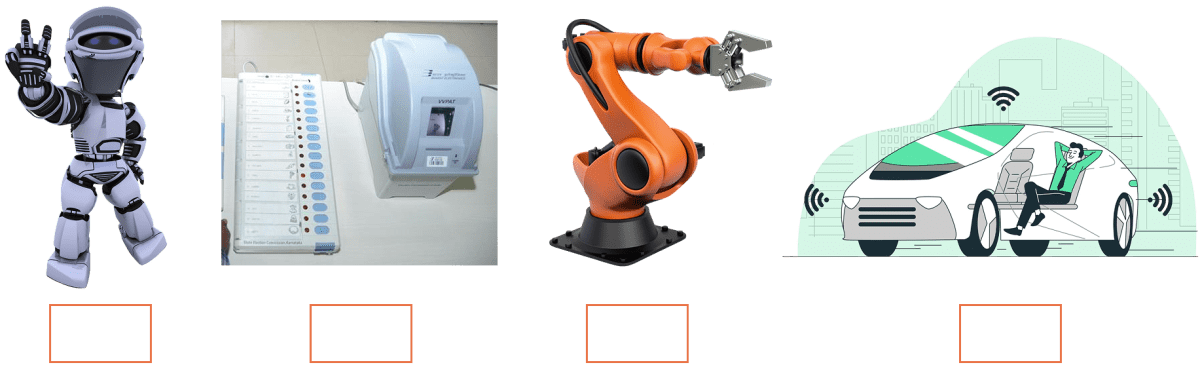
Answer
The images are marked below:
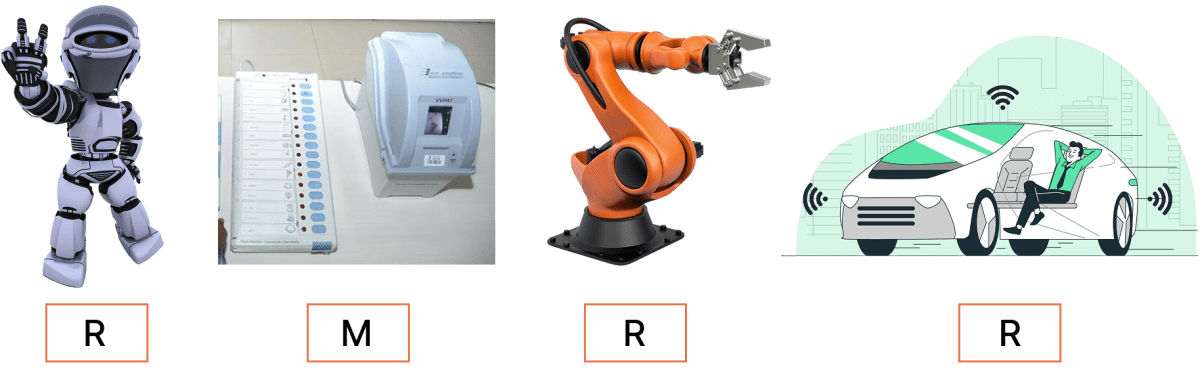
Classify the following tasks as per their suitability on the basis of machines, robots, or cobots.
- Motion recognition
- Printing newspaper
- Medical surgery
- Creative thinking
- Fitting equipment
- Managing disaster
Answer
The given tasks are classified below:
| Machines | Robots | Cobots |
|---|---|---|
| Printing newspaper | Motion recognition | Medical surgery |
| Managing disaster | Fitting equipment | |
| Creative thinking |
Consider the scenario of a multi-robot system used to distribute food and medicine to people in war affected areas. Write down all steps of action.
Answer
The steps of action for distributing food and medicine in war-affected areas are:
- Set the goal & load supplies: Human operator decides what to deliver (food/medicine), quantity, and priority areas.
- Deploy robots/cobots to the field: Robots are sent to the affected region with required supplies and safety settings.
- Connect the system on a network: All robots are connected to each other and to the operator through a network for coordination and communication.
- Sense and understand surroundings: Using sensors, robots detect routes, obstacles, and safe paths to move in the area.
- Assign tasks and routes: The operator (or the system) divides work—Robot A to Zone 1, Robot B to Zone 2, etc., to cover more area efficiently.
- Move to target locations: Robots travel to assigned zones while avoiding obstacles and unsafe areas using sensor feedback.
- Deliver supplies safely: Robots hand over/leave supplies at safe points (relief camps, pickup spots) as instructed.
- Send updates to the operator: Robots share information back (delivered/not delivered, obstacles found, remaining supplies, location status).
- Operator monitors and gives new commands: The operator uses robot feedback to redirect robots, change routes, or send more robots where needed.
- Repeat deliveries until targets are covered: The team continues trips until all priority areas receive supplies.
- Return, recharge, and restock: Robots come back to the base point for battery charging and refilling supplies.
- Final report and improvement: Performance data is reviewed so the system can be improved for the next mission.
Identify two robots and two cobots and list their key distinctions.
Answer
Robots:
- Industrial robotic arm used in manufacturing
- Surveillance robot (robot dog)
Cobots:
- Universal Robots cobot
- Rethink Robotics cobot
| Feature | Robot | Cobot |
|---|---|---|
| Purpose | To automate tasks that are dangerous, repetitive, or tedious | To work with humans in a safe and collaborative way |
| Design | Typically large, heavy, and enclosed | Typically smaller, lighter, and open |
| Speed | Can be very fast | Typically slower than robots |
| Strength | Can be very strong | Generally not as strong as robots |
| Cost | More expensive | Less expensive than robots |
A robot is able to take decision and interact with its environment.
Answer
True
Reason — A robot is a machine that can sense its surroundings, take decisions, and interact with the environment using sensors, actuators, and a controller.
Machines and robots are the same.
Answer
False
Reason — Machines and robots are not the same. Machines are designed to perform specific predefined tasks, whereas robots can sense their surroundings, take decisions, and interact with the environment.
The meaning of the word 'cobot' is collaborative robot.
Answer
True
Reason — The term 'cobot' is derived from collaborative robot, meaning robots that are specifically designed to work safely alongside humans.
Machines are designed to perform specific tasks.
Answer
True
Reason — Machines are designed to perform a specific task, and their operations are predefined based on mechanical, electrical, or software design.
Sensors are an essential component of a robot.
Answer
True
Reason — Sensors are an essential component of a robot because they enable the robot to learn about its environment, which helps it sense surroundings, take decisions, and perform tasks.
Cobots are lighter and more flexible version of robots.
Answer
True
Reason — Cobots are smaller, lighter, and more flexible than robots, which enables them to be utilised in a larger range of applications.
Cobots are standalone robotic systems.
Answer
False
Reason — Cobots are designed to work with humans in a safe and collaborative environment and operate with a human operator, therefore they are not standalone robotic systems.
Cobots are designed to consider human safety.
Answer
True
Reason — Cobots include built-in safety features that prevent them from harming people, and they are designed to work safely alongside humans.
Robots are non-adaptable.
Answer
False
Reason — Robots are more versatile and adaptable than machines because they can sense their surroundings, make decisions, and change their actions.
Cobots require constant human supervision.
Answer
False
Reason — Cobots are designed to work with humans in a safe and collaborative environment and do not require constant human supervision.
Which of the following statements best describes a robot?
- A device that performs a specific task without adaptability
- An advanced machine capable of sensing, decision-making, and interaction
- A mechanical tool used for manual tasks
- A device that requires constant human supervision
Answer
An advanced machine capable of sensing, decision-making, and interaction
Reason — A robot is a system that uses sensors to perceive its environment, controllers to process information and make decisions, and actuators to interact with the environment to perform a specific task. This shows that a robot is an advanced machine capable of sensing, decision-making, and interaction.
What distinguishes a cobot from a traditional robot?
- Cobots are bigger in size as compared to traditional robots.
- Cobots can only perform simple tasks, while traditional robots are more versatile.
- Cobots emphasise collaboration and interaction with humans, while traditional robots often work autonomously.
- Traditional robots are fully autonomous, while cobots require constant human control.
Answer
Cobots emphasise collaboration and interaction with humans, while traditional robots often work autonomously.
Reason — Cobots, or collaborative robots, are made specifically to work safely alongside humans with a focus on cooperation and involvement, whereas traditional robots often work autonomously.
Which of the following is an essential characteristic of a machine?
- Adaptability and interaction with the environment
- Autonomous decision-making capabilities
- Ability to perform complex tasks collaboratively
- Specific functionality for a particular task
Answer
Specific functionality for a particular task
Reason — Machines are designed to perform a specific task, and their operations are predefined based on their mechanical, electrical, or software design.
How do cobots contribute to the progress from robots to more collaborative systems?
- By eliminating the need for human workers
- By increasing the efficiency of traditional robots
- By providing human interaction and safer work environments
- By reducing the overall cost of automation
Answer
By providing human interaction and safer work environments
Reason — Cobots are designed to work with humans in a safe and collaborative environment and include built-in safety features that prevent them from harming people, which supports the progress from robots to more collaborative systems.
Which of the following is a characteristic of a machine?
- Ability to sense and adapt to the environment
- Collaborative interaction with humans
- Performing tasks based on programmed instructions
- Continuous learning and improvement
Answer
Performing tasks based on programmed instructions
Reason — Machines perform operations that are predefined and based on their mechanical, electrical, or software design.
A sewing machine is an example of which of the following options?
- Machine
- Robot
- Cobot
- None of these
Answer
Machine
Reason — A sewing machine is designed to perform a specific task and requires human intervention, and it cannot sense or adjust itself according to the environment. Hence, it is a machine.
Why are cobots important in industrial settings?
- They are expensive.
- They improve productivity by replacing human workers.
- They provide a safer working environment and enable human-robot collaboration.
- None of these
Answer
They provide a safer working environment and enable human-robot collaboration.
Reason — Cobots are designed to work with humans in a safe manner and have built-in safety mechanisms that prevent them from injuring humans, enabling human-robot collaboration in industrial settings.
Which of the following is an example of a multi-robot system?
- Robots for smart home
- Robots for smart office
- Robots for firefighting
- All of these
Answer
All of these
Reason — A multi-robot system consists of multiple robots connected through a network, and such systems can be used in smart homes, smart offices, and firefighting scenarios.
Which is not true for a multi-robot system?
- Multiple robots
- Network connection
- No human interaction
- None of these
Answer
No human interaction
Reason — A multi-robot system consists of multiple robots that are connected through a network, and it involves human interaction where a human operator gives commands and receives information from the robots.
Which is not an example of a machine?
- Washing device
- Printing device
- Automatic floor cleaning device
- None of these
Answer
None of these
Reason — A washing device, a printing device, and an automatic floor cleaning device are all machines designed to perform specific tasks.
Fill in the blanks:
- ................ are designed to perform a specific task.
- A machine cannot work without ................ .
- Robots use ................ to learn about their environment.
- Cobots (collaborative robots) are the robots that are designed to work with ................ .
- A multi-robot system consists of multiple connected ................ .
Answer
- Machines are designed to perform a specific task.
- A machine cannot work without human intervention.
- Robots use sensors to learn about their environment.
- Cobots (collaborative robots) are the robots that are designed to work with humans.
- A multi-robot system consists of multiple connected robots.
Write and explain any two examples of machines.
Answer
Two examples of machines are:
Washing machine — A washing machine is designed to clean clothes and is controlled by a small program written on it. It performs a specific predefined task and requires human intervention.
Sewing machine — A sewing machine is designed to stitch clothes. It cannot sense or adjust itself according to the environment and requires a human to operate it.
Write and explain any two examples of robots.
Answer
Two examples of robots are:
Roomba vacuum cleaner — The Roomba vacuum cleaner uses sensors to detect objects and walls and follows a set of programmed instructions to clean a room automatically. It can move around its surroundings and perform its task without continuous human control.
Robot arm used in manufacturing — A manufacturing robot arm uses sensors to determine the position of objects and follows given instructions to pick up and place items. It can perform tasks with precision and accuracy in industrial environments.
Write and explain any two examples of cobots.
Answer
Two examples of cobots are:
- Universal Robots cobot — Universal Robots cobots are a popular brand of collaborative robotic arms used in industries. These cobots work alongside humans to do tasks like assembling products and other manufacturing/industrial operations. They are designed to be safe, compact, and flexible, so they can share the same workspace with people.
- Rethink Robotics cobot — Rethink Robotics cobots operate in dynamic environments and help humans in tasks such as lifting/assisting in healthcare (e.g., helping a nurse lift a patient) or loading and unloading boxes in warehouses. As they are built for collaboration, they improve efficiency while keeping human safety in mind.
What are the various characteristics of a cobot?
Answer
The various characteristics of a cobot are:
- Cobots often have sensors that enable them to recognise human presence and modify their speed and motions accordingly.
- These are more flexible than traditional robots, which enables them to be utilised in a larger range of applications.
Write some application areas of robots.
Answer
Some application areas of robots are:
- Industry
- Healthcare
- Defence
- Household
- Manufacturing
How do cobots contribute to increase efficiency as compared to conventional robots?
Answer
Cobots increase efficiency (vs conventional robots) because:
- Safe human–robot collaboration: Built-in safety features and sensors let cobots detect human presence and adjust speed/motion, so they can work alongside humans smoothly.
- Easy to deploy: Cobots are generally compact and lightweight, so they can be shifted and used where needed with less setup time.
- More flexible: They are more flexible than traditional robots, so they can be used for a wider range of tasks/applications.
Why is a washing machine not a robot? Explain.
Answer
A washing machine is not a robot because it does not have the ability to sense, take decisions, or interact with its environment. A washing machine is designed to perform a specific task, that is, cleaning clothes. Its operations are predefined and controlled by a small program written on it. It requires human intervention to start, stop, and select modes of operation.
Unlike robots, a washing machine cannot sense its surroundings, cannot adjust itself according to the environment, and cannot perform multiple tasks. It also cannot move on its own or learn from its environment. Therefore, a washing machine is considered a machine and not a robot.
What do you understand by multi-robot systems? Explain with the help of an example.
Answer
A multi-robot system is a system in which there are various robots present in the environment. These robots are connected to each other and the human operator via a network. The operator can give commands to the robots, and the robots can send information back to the operator.
Example:
Let us assume we are a firefighter responding to a sizeable building fire. We have a squad of robots that have various sensors and tools. These robots can assist us in searching for survivors, extinguishing the fire, and rescuing trapped humans.
Robots and we are all connected through a network. This enables us to issue commands to the robots and get data from them in real time. The human operator is vital to the multi-robot system, as the operator is responsible for sending commands, interpreting the information provided by the robots, and deciding how to use the robots to complete the goal.
Explain the different types of robots and cobots.
Answer
Types of Robots:
- Robots used in household applications — A Roomba vacuum cleaner uses sensors to find objects and walls. It follows a set of instructions that specify what to perform in order to clean a room.
- Robots used in transportation — A self-driving car uses sensors to find other cars, people, and barriers. It is programmed to follow a set of rules that keep it safe on the road.
- Robots used in manufacturing — A robot arm used in manufacturing uses sensors to figure out where things are and performs tasks like picking and placing objects based on given directions.
- Multi-robot systems — In a multi-robot system, there are various robots present in the environment. These robots are connected to each other and the human operator via a network. The operator can give commands to the robots, and the robots can send information back to the operator.
Types of Cobots (Collaborative Robots):
- Cobots used in manufacturing — A cobot works with a human to assemble a product in a safe and collaborative environment.
- Cobots used in healthcare — A cobot helps a nurse to lift a patient, ensuring safety and reducing physical strain.
- Cobots used in logistics — A cobot loads and unloads boxes from a warehouse shelf, assisting humans in material handling tasks.
How do machines differ from robots in terms of adaptability? Explain with the help of an example.
Answer
Machines differ from robots in terms of adaptability because machines are designed to perform a specific task, whereas robots can sense their surroundings and adapt their actions accordingly.
Machines have predefined operations based on their mechanical, electrical, or software design and cannot adjust or modify themselves as per the environment. They usually require human intervention or control.
Example: A sewing machine is designed only to stitch clothes. It cannot sense the material or adjust its functioning on its own and needs a human to operate it.
On the other hand, robots are adaptable. A robot is a machine that can move around, sense its surroundings, and do various jobs using sensors, actuators, and a controller. Robots can change their actions based on sensor input.
Example: A Roomba vacuum cleaner uses sensors to find objects and walls and changes its movement to clean a room.
Thus, machines lack adaptability, while robots are adaptable because they can sense and respond to their environment.
What are the challenges associated with designing interfaces for efficient human engagement in multi-robot systems?
Answer
The challenges associated with designing interfaces for efficient human engagement in multi-robot systems are:
- One operator must handle many robots: Creating an interface that lets humans efficiently monitor, control, and coordinate several robots at once is difficult.
- Safety and efficiency in human presence: When humans are around, it becomes hard to ensure the robots' behaviour remains safe as well as efficient at all times.
What are the different components that enable a robot to perform tasks?
Answer
The different components that enable a robot to perform tasks are:
- Sensors: Robots use sensors to learn about their environment. With this knowledge, they can move around their surroundings, avoid obstacles, and interact with objects. Commonly used sensors include cameras, lasers, and ultrasonic sensor.
- Actuators: Robots move and do things with the help of actuators. Commonly used actuators are motors, gears, and connections.
- Controller: Robot’s brain is the controller attached to it. It gives instructions to robot to perform a specific task, which is based on sensor input and a pre-written set of instructions.
Why is the role of the human operator considered vital in operating a multi-robot system?
Answer
The role of the human operator is considered vital in operating a multi-robot system because:
- The operator is in charge of sending commands to the robots, interpreting the information the robots provide back, and deciding how to use the robots to complete the goal.
- Humans can train the robot to perform an ethical goal. This enables the robots to be more versatile and flexible in their behaviour.
- Humans can monitor the robots' development and make resource allocation decisions. This can aid in ensuring that the robots are deployed in the most efficient and effective manner.
- Humans can provide feedback to the robots on their performance. This can assist robots in learning and improving over time.
How do cobots foster human skills development and job enrichment in the workplace?
Answer
Cobots foster human skills development and job enrichment by creating a human–robot collaboration where each does what it is best at:
- Shift from repetitive to higher-value work: Cobots handle repetitive, tiring and physically difficult tasks, so workers can focus on supervision, decision-making, quality checks, and problem-solving making the job more meaningful and skilled.
- Build new technical skills: Since cobots are designed to work with humans, workers learn to operate, guide, and monitor cobots, and gradually develop skills related to basic programming/setup and safe handling.
- Safer and less strain provides better work experience: Cobots are built with human safety in mind and work collaboratively, reducing the risk of physical harm/strain and improving comfort at work.
- More productivity with human control: Cobots improve accuracy and productivity without needing breaks, while humans remain in control of the overall task. This makes workers more capable and effective in their roles.
What are the key challenges in implementing cobots in industries, and how can they be addressed?
Answer
The key challenges in implementing cobots in industries and the ways to address them are explained below:
- Human safety (working close to humans): Cobots must operate safely in the same workspace as humans.
Addressed by: Using sensors and safety features to detect human presence and adjust/stop motion to prevent injury. - Working in close proximity (collision risk): Cobots often need to perform tasks right beside a worker.
Addressed by: Designing cobots specifically for safe collaboration, with controlled speed/force and responsive sensing. - Low cost and lightweight requirement: Industries prefer automation without heavy, expensive setups.
Addressed by: Developing cobots that are smaller, lighter, and less costly than traditional industrial robots. - True collaboration with humans (sharing tasks): Cobots must assist humans (not just replace them), especially in repetitive or difficult tasks.
Addressed by: Building cobots that can adapt to human actions and support humans in shared workflows. - Increasing demand for automation across sectors: Industries need flexible robots for manufacturing, healthcare, and logistics.
Addressed by: Advancements in sensors and actuators that make cobots efficient, flexible, and easy to deploy.
How do cobots enhance the quality and precision of manufacturing processes?
Answer
Cobots enhance quality and precision in manufacturing by:
- Working with humans safely, so human judgement/skill combines with the robot's high precision, giving better overall output quality.
- Using sensors to detect human presence and adjust their actions, reducing errors and improving accuracy during delicate tasks.
- Performing tasks faster and more accurately than humans, with consistent results (less variation in repeated operations).
- Helping in assembly and handling in a controlled manner, which can reduce mistakes and damage in production.