Find the remainder (without division) on dividing f(x) by (x - 2) where
(i) f(x) = 5x2 - 7x + 4
(ii) f(x) = 2x3 - 7x2 + 3
Answer
(i) By remainder theorem, on dividing f(x) by (x - a) , remainder = f(a)
∴ On dividing, f(x) = 5x2 - 7x + 4 by (x - 2)
Remainder = f(2)
=5(2)2−7(2)+4=5(4)−14+4=20−10=10.
Hence, the value of remainder is 10.
(ii) By remainder theorem, on dividing f(x) by (x - a) , remainder = f(a)
∴ On dividing, f(x) = 2x3 - 7x2 + 3 by (x - 2)
Remainder = f(2)
=2(2)3−7(2)2+3=2(8)−28+3=16−28+3=−9.
Hence, the value of remainder is -9.
Using remainder theorem, find the remainder on dividing f(x) by (x + 3) where
(i) f(x) = 2x2 - 5x + 1
(ii) f(x) = 3x3 + 7x2 - 5x + 1
Answer
(i) By remainder theorem, on dividing f(x) by (x - a) , remainder = f(a)
∴ On dividing, f(x) = 2x2 - 5x + 1 by (x + 3) or (x - (-3))
Remainder = f(-3)
=2(−3)2−5(−3)+1=2(9)+15+1=18+16=34.
Hence, the value of remainder is 34.
(ii) By remainder theorem, on dividing f(x) by (x - a) , remainder = f(a)
∴ On dividing, f(x) = 3x3 + 7x2 - 5x + 1 by (x + 3) or (x - (-3))
Remainder = f(-3)
=3(−3)3+7(−3)2−5(−3)+1=−81+63+15+1=−2.
Hence, the value of remainder is -2.
Find the remainder (without division) on dividing f(x) by (2x + 1) where
(i) f(x) = 4x2 + 5x + 3
(ii) f(x) = 3x3 - 7x2 + 4x + 11
Answer
(i) By remainder theorem, on dividing f(x) by (x - a) , remainder = f(a)
∴ On dividing, f(x) = 4x2 + 5x + 3 by (2x + 1) or 2(x - (-21))
Remainder = f(-21)
=4(−21)2+5(−21)+3=4(41)−25+3=1−25+3 (On taking L.C.M.)=22−5+6=23=121.
Hence, the value of remainder is 1 21.
(ii) By remainder theorem, on dividing f(x) by (x - a) , remainder = f(a)
∴ On dividing, f(x) = 3x3 - 7x2 + 4x + 11 by (2x + 1) or 2(x - (-21))
Remainder = f(−21)
=3(−21)3−7(−21)2+4(−21)+11=3(−81)−7(41)−2+11=−83−47+9=8−3−14+72=855=687
Hence, the value of remainder is 687.
Using remainder theorem, find the value of k if on dividing 2x3 + 3x2 - kx + 5 by (x - 2) leaves a remainder 7.
Answer
By remainder theorem, on dividing f(x) by (x - a) , remainder = f(a)
∴ On dividing, f(x) = 2x3 + 3x2 - kx + 5 by (x - 2)
Remainder = f(2)
Given, remainder = 7
∴2(2)3+3(2)2−k(2)+5=7⇒2(8)+3(4)−2k+5=7⇒16+12+5−2k=7⇒33−2k=7⇒2k=33−7⇒2k=26k=13
Hence, the value of k is 13.
Using remainder theorem, find the value of a if the division of x3 + 5x2 - ax + 6 by (x - 1) leaves the remainder 2a.
Answer
By remainder theorem, on dividing f(x) by (x - a) , remainder = f(a)
∴ On dividing, f(x) = x3 + 5x2 - ax + 6 by (x - 1)
Remainder = f(1)
Given, remainder = 2a
∴(1)3+5(1)2−a(1)+6=2a⇒1+5−a+6=2a⇒12−a=2a⇒3a=12a=4
Hence, the value of a is 4.
What number must be subtracted from 2x2 - 5x so that resulting polynomial leaves remainder 2 when divided by 2x + 1 ?
Answer
Let the number to be subtracted be a.
So, polynomial = 2x2 - 5x - a
By remainder theorem, on dividing f(x) by (x - b) , remainder = f(b)
∴ On dividing, f(x) = 2x2 - 5x - a by (2x + 1) or 2(x - (−21))
Remainder = f(−21)
Given, remainder = 2
∴2(−21)2−5(−21)−a=2⇒2(41)+25−a=2⇒21+25−a=2⇒26−a=2⇒3−a=2⇒a=3−2a=1.
Hence, the value of a is 1.
What number must be added to 2x3 - 3x2 - 8x so that resulting polynomial leaves the remainder 10 when divided by 2x + 1?
Answer
Given,
⇒ 2x + 1 = 0
⇒ 2x = -1
⇒ x = −21
Let number added be a.
Polynomial = 2x3 - 3x2 - 8x + a
By remainder theorem,
When a polynomial p(x) is divided by (x - a), then the remainder = f(a).
∴2.(−21)3−3.(−21)2−8.(−21)+a=10⇒2.(−81)−3.(41)+(28)+a=10⇒−82−(43)+4+a=10⇒−41−(43)+4+a=10⇒4−1−3+4+a=10⇒4−4+4+a=10⇒−1+4+a=10⇒3+a=10⇒a=10−3⇒a=7
Hence, the number to be added = 7.
When divided by x - 3 the polynomials x3 - px2 + x + 6 and 2x3 - x2 - (p + 3)x - 6 leave the same remainder . Find the value of 'p'.
Answer
By remainder theorem, on dividing f(x) by (x - b), remainder = f(b)
∴ On dividing, f(x) = x3 - px2 + x + 6 by (x - 3)
Remainder = 33 - p(32) + 3 + 6 = 27 - 9p + 9 = 36 - 9p.
∴ On dividing, f(x) = 2x3 - x2 - (p + 3)x - 6 by (x - 3)
Remainder = 2(3)3 - 32 - (p + 3)(3) - 6 = 2(27) - 9 - 3p - 9 - 6 = 54 - 9 - 3p - 9 - 6 = 30 - 3p
According to question,
⇒36−9p=30−3p⇒36−30=9p−3p⇒6=6p⇒p=1
Hence, the value of p is 1.
Find 'a' if the two polynomials ax3 + 3x2 - 9 and 2x3 + 4x + a, leaves the same remainder when divided by x + 3.
Answer
By remainder theorem, on dividing f(x) by (x - b), remainder = f(b)
∴ On dividing, f(x) = ax3 + 3x2 - 9 by (x + 3) or (x - (-3))
Remainder = f(-3) = a(-3)3 + 3(-3)2 - 9 = -27a + 27 - 9 = 18 - 27a
∴ On dividing, f(x) = f(-3) = 2x3 + 4x + a by (x + 3) or (x - (-3))
Remainder = 2(-3)3 + 4(-3) + a = -54 - 12 + a = a - 66
According to question,
⇒18−27a=a−66⇒a+27a=66+18⇒28a=84⇒a=2884⇒a=3.
Hence, the value of p is 3.
The polynomials ax3 + 3x2 - 3 and 2x3 - 5x + a when divided by x - 4 leave the remainder r1 and r2 respectively. If 2r1 = r2, then find the value of a.
Answer
By remainder theorem, on dividing f(x) by (x - b), remainder = f(b)
∴ On dividing, f(x) = ax3 + 3x2 - 3 by (x - 4)
Remainder = f(4) = a(4)3 + 3(4)2 - 3 = 64a + 45
∴ On dividing, f(x) = 2x3 - 5x + a by (x - 4)
Remainder = f(4) = 2(4)3 - 5(4) + a = 128 - 20 + a = 108 + a
According to question,
r1 = 64a + 45
r2 = 108 + a
2r1 = r2
∴2(64a+45)=108+a⇒128a+90=108+a⇒128a−a=108−90⇒127a=18⇒a=12718.
Using the remainder theorem, find the remainders obtained when x3 + (kx + 8)x + k is divided by x + 1 and x - 2. Hence, find k if the sum of two remainders is 1.
Answer
By remainder theorem, on dividing f(x) by (x - b), remainder = f(b)
∴ On dividing, f(x) = x3 + (kx + 8)x + k by x + 1 or (x - (-1))
Remainder = r1 = f(-1) = -13 + ((-1)k + 8)(-1) + k
= -1 + (8 - k)(-1) + k
= -1 - 8 + k + k
= 2k - 9
∴ On dividing, f(x) = x3 + (kx + 8)x + k by x - 2
Remainder = r2 = (2)3 + (k(2) + 8)2 + k
= 8 + 4k + 16 + k
= 5k + 24
Given, sum of two remainders = 1
∴ r1 + r2 = 1
⇒2k−9+5k+24=1⇒7k+15=1⇒7k=1−15⇒7k=−14⇒k=−714k=−2.
The first remainder is 2k - 9 and the second remainder is 5k + 24 and the value of k is -2.
By factor theorem, show that (x + 3) and (2x - 1) are the factors of 2x2 + 5x - 3.
Answer
By factor theorem, (x - a) is a factor of f(x), if f(a) = 0.
f(x) = 2x2 + 5x - 3
(x + 3) = (x - (-3)) is a factor of f(x), if f(-3) = 0
f(-3) = 2(-3)2 + 5(-3) - 3
= 2(9) - 15 - 3
= 18 - 18 = 0
2x - 1 = 2(x - 21) is a factor of f(x), if f(21) = 0
f(21)=2(21)2+5(21)−3=2(41)+25−3=21+25−3=3−3=0
Since, f(-3) and f(21) = 0 , hence, (x - 3) and (2x - 1) are factors of 2x2 + 5x - 3.
Without actual division, prove that x4 + 2x3 - 2x2 + 2x - 3 is exactly divisible by x2 + 2x - 3.
Answer
Let, f(x) = x4 + 2x3 - 2x2 + 2x - 3
g(x) = x2 + 2x - 3
= x2 + 3x - x - 3
= x(x + 3) - 1(x + 3)
= (x - 1)(x + 3)
⇒ (x - 1) and (x + 3) are factors of g(x).
In order to prove that f(x) is exactly divisible by g(x), it is sufficient to prove that x - 1 and x + 3 are factors of f(x) i.e. it is sufficient to show that f(1) = 0 and f(-3) = 0.
Now,
f(1) = (1)4 + 2(1)3 - 2(1)2 + 2(1) - 3
= 1 + 2 - 2 + 2 - 3 = 0
f(-3) = (-3)4 + 2(-3)3 - 2(-3)2 + 2(-3) - 3
= 81 - 54 - 18 - 6 - 3 = 0
∴ f(x) is divisible by (x - 1) and (x + 3)
Hence, f(x) is exactly divisible by g(x).
Show that (x - 2) is a factor 3x2 - x - 10. Hence, factorize 3x2 - x - 10.
Answer
By factor theorem, (x - a) is a factor of f(x), if f(a) = 0.
f(x) = 3x2 - x - 10
(x - 2) is a factor of f(x), if f(2) = 0
f(2) = 3(2)2 - 2 - 10
= 12 - 12 = 0
Hence, x - 2 is a factor of 3x2 - x - 10.
Now, factorizing 3x2−x−10,
⇒3x2−6x+5x−10⇒3x(x−2)+5(x−2)⇒(3x+5)(x−2)
Hence, 3x2 - x - 10 = (x - 2)(3x + 5).
Using factor theorem, show that (x - 2) is a factor of x3 + x2 - 4x - 4. Hence, factorise the polynomial completely.
Answer
By factor theorem, (x - a) is a factor of f(x), if f(a) = 0.
f(x) = x3 + x2 - 4x - 4
(x - 2) is a factor of f(x), if f(2) = 0
f(2)=(2)3+(2)2−4(2)−4=8+4−8−4=0
Hence, (x - 2) is a factor of x3 + x2 - 4x - 4.
Now, factorizing x3 + x2 - 4x - 4,
⇒x2(x+1)−4(x+1)⇒(x2−4)(x+1)⇒(x−2)(x+2)(x+1)
Hence, x3 + x2 - 4x - 4 = (x - 2)(x + 1)(x + 2).
Show that 2x + 7 is a factor of 2x3 + 5x2 - 11x - 14. Hence, factorise the given expression completely, using the factor theorem.
Answer
By factor theorem, (x - a) is a factor of f(x), if f(a) = 0.
f(x) = 2x3 + 5x2 - 11x - 14
(2x + 7) or 2(x−(−27)) is a factor of f(x), if f(−27) = 0
f(−27)=2(−27)3+5(−27)2−11(−27)−14=2(−8343)+5(449)+(277)−14=(−4343)+(4245)+(277)−14
On taking LCM,
=(4−343+245+154−56)=(4−399+399)=0
Hence, (2x + 7) is the factor of f(x).
On dividing f(x) by (2x + 7),
2x+7)x2−x−22x+7)2x3+5x2−11x−142x+7−2x3−+7x22x+72x3+−2x2−11x2x+72x3++−2x2+−7x2x+72x3++2x2−−4x−142x+72x3++2x2−+−4x+−142x+72x3++2x2−−4x×
we get, x2 - x - 2 as the quotient and remainder = 0.
∴2x3+5x2−11x−14=(2x+7)(x2−x−2)=(2x+7)(x2−2x+x−2)=(2x+7)(x(x−2)+1(x−2))=(2x+7)(x+1)(x−2)
Hence, 2x3 + 5x2 - 11x - 14 = (2x + 7)(x + 1)(x - 2)
Use factor theorem to factorise the following polynomials completely :
(i) x3 + 2x2 - 5x - 6
(ii) x3 - 13x - 12
(iii) 6x3 + 17x2 + 4x - 12
Answer
(i) f(x) = x3 + 2x2 - 5x - 6
Putting, x = -1 in f(x)
f(−1)=(−1)3+2(−1)2−5(−1)−6=−1+2+5−6=7−7=0
Since, f(-1) = 0, hence (x + 1) is factor of f(x) by factor theorem.
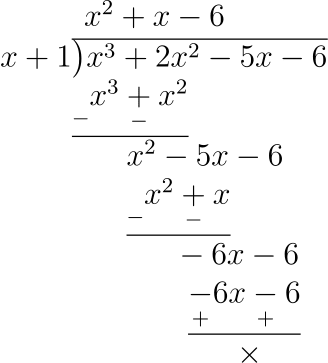
Now, dividing f(x) by (x + 1),
we get x2 + x - 6 as the quotient and remainder = 0.
∴x3+2x2−5x−6=(x+1)(x2+x−6)=(x+1)(x2+3x−2x−6)=(x+1)(x(x+3)−2(x+3))=(x+1)(x−2)(x+3)
Hence, x3 + 2x2 - 5x - 6 = (x + 1)(x - 2)(x + 3).
(ii) Let f(x) = x3 - 13x - 12
Putting, x = 4 in f(x)
f(4)=(4)3−13(4)−12=64−52−12=64−64=0
Since, f(4) = 0, hence (x - 4) is factor of f(x) by factor theorem.
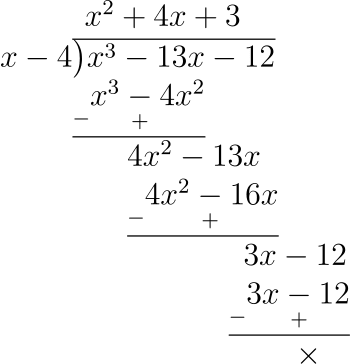
Now, dividing f(x) by (x - 4),
we get x2 + 4x + 3 as quotient and remainder = 0.
∴x3−13x−12=(x−4)(x2+4x+3)=(x−4)(x2+3x+x+3)=(x−4)(x(x+3)+1(x+3))=(x−4)(x+1)(x+3)
Hence, x3 - 13x - 12 = (x - 4)(x + 1)(x + 3).
(iii) Given,
f(x) = 6x3 + 17x2 + 4x - 12
Substituting x = -2 in f(x), we get :
f(-2) = 6(-2)3 + 17(-2)2 + 4(-2) - 12
= 6 × -8 + 17 × 4 - 8 - 12
= -48 + 68 - 8 - 12
= -68 + 68
= 0.
Since, f(-2) = 0, hence (x + 2) is factor of f(x).
Dividing f(x) by (x + 2), we get :
x−3x)6x2+5x−6x+2)6x3+17x2+4x−12x2+4))−+6x3−+12x2x2+3x−5=d)5x2+4x−12x2+3x−54=)−+5x2−+10xx2+3x−54)+2x+3−6x−12 x2+3x−54=zccdvz)+−6x+−12x2+3x−54)+2x+3+dc×
We get 6x2 + 5x - 6 as the quotient and remainder = 0.
∴ 6x3 + 17x2 + 4x - 12 = (x + 2)(6x2 + 5x - 6)
= (x + 2)(6x2 + 9x - 4x - 6)
= (x + 2)[3x(2x + 3) - 2(2x + 3)]
= (x + 2)(2x + 3)(3x - 2)
Hence,6x3 + 17x2 + 4x - 12 = (x + 2)(2x + 3)(3x - 2).
Use Remainder Theorem to factorise the following polynomials completely :
(i) 2x3 + x2 - 13x + 6
(ii) 3x3 + 2x2 - 19x + 6
(iii) 2x3 + 3x2 - 9x - 10
(iv) x3 + 10x2 - 37x + 26
Answer
(i) Let f(x) = 2x3 + x2 - 13x + 6
Putting, x = 2 in f(x)
f(2)=2(2)3+22−13(2)+6=16+4−26+6=0
Since, f(2) = 0 , (x - 2) is factor of f(x) by factor theorem.
Dividing, f(x) by (x - 2),
x−2)2x2+5x−3x−2)2x3+x2−13x+6x−2−2x3+−4x2x−22x3+45x2−13xx−22x3+−5x2+−10xx−22x3++2x2−3x+6x−22x3++2x24+−3x−+6x−22x3++2x2−−4x×
we get, 2x2 + 5x - 3 as quotient and remainder = 0.
∴2x3+x2−13x+6=(x−2)(2x2+5x−3)=(x−2)(2x2+6x−x−3)=(x−2)(2x(x+3)−1(x+3))=(x−2)(2x−1)(x+3)
Hence, 2x3 + x2 - 13x + 6 = (x - 2)(2x - 1)(x + 3).
(ii) Let f(x) = 3x3 + 2x2 - 19x + 6
Putting, x = 2 in f(x)
f(2)=3(2)3+2(2)2−19(2)+6=24+8−38+6=38−38=0
Since, f(2) = 0, (x - 2) is factor of f(x) by factor theorem.
Dividing, f(x) by (x - 2),
x−2)3x2+8x−3x−2)3x3+2x2−19x+6x−2−3x3+−6x2x−22x3+48x2−19xx−22x3+−8x2−+16xx−22x3++2x2−3x+6x−22x3++2x24+−3x−+6x−22x3++2x2−−4x×
we get, 3x2 + 8x - 3 as quotient and remainder = 0.
∴3x3+2x2−19x+6=(x−2)(3x2+8x−3)=(x−2)(3x2+9x−x−3)=(x−2)(3x(x+3)−1(x+3))=(x−2)(3x−1)(x+3)
Hence, 3x3 + 2x2 - 19x + 6 = (x - 2)(3x - 1)(x + 3).
(iii) Let f(x) = 2x3 + 3x2 - 9x - 10
Putting, x = 2 in f(x)
f(2)=2(2)3+3(2)2−9(2)−10=16+12−18−10=28−28=0
Since, f(2) = 0, (x - 2) is factor of f(x) by factor theorem.
Dividing, f(x) by (x - 2),
x−2)2x2+7x+5x−2)2x3+3x2−9x−10x−2−2x3−+4x2x−22x3+47x2−9xx−22x3+−7x2+−14xx−22x3++2x25x−10x−22x3++2x−5x+−10x−22x3++2x2−−4x×
we get, 2x2 + 7x + 5 as quotient and remainder = 0.
∴2x3+3x2−9x−10=(x−2)(2x2+7x+5)=(x−2)(2x2+5x+2x+5)=(x−2)(x(2x+5)+1(2x+5))=(x−2)(x+1)(2x+5)
Hence, 2x3 + 3x2 - 9x - 10 = (x - 2)(x + 1)(2x + 5).
(iv) Let f(x) = x3 + 10x2 - 37x + 26
Putting, x = 1 in f(x)
f(1)=(1)3+10(1)2−37(1)+26=1+10−37+26=37−37=0
Since, f(1) = 0 , (x - 1) is factor of f(x) by factor theorem.
Dividing, f(x) by (x - 1),
x−1)x2+11x−26x−1)x3+10x2−37x+26x−1−x3+−x2x−12x3+411x2−37xx−12x3+−11x2+−11xx−12x3++11x2−26x+26x−12x3++11x2+−26x−+26x−12x3++2x2−−4x×
we get, x2 + 11x - 26 as quotient and remainder = 0.
∴x3+10x2−37x+26=(x−1)(x2+11x−26)=(x−1)(x2+13x−2x−26)=(x−1)(x(x+13)−2(x+13))=(x−1)(x−2)(x+13)
Hence, x3 + 10x2 - 37x + 26 = (x - 1)(x - 2)(x + 13).
If (2x + 1) is a factor of 6x3 + 5x2 + ax - 2, find the value of a.
Answer
f(x) = 6x3 + 5x2 + ax - 2
If, (2x + 1) or 2(x - (-21)) is a factor of f(x) then f(-21) = 0
∴6(−21)3+5(−21)2+a(−21)−2=0⇒−43+45−2a−2=0
On taking L.C.M.,
⇒4−3+5−2a−8=0⇒4−6−2a=0
On Cross Multiplying,
⇒−6−2a=0⇒2a=−6a=−3.
Hence, the value of a is -3.
If (3x - 2) is a factor of 3x3 - kx2 + 21x - 10, find the value of k.
Answer
f(x) = 3x3 - kx2 + 21x - 10
If, (3x - 2) or 3(x−(32)) is a factor of f(x) then f(32) = 0
∴3(32)3−k(32)2+21(32)−10=0⇒3(278)−k(94)+14−10=0⇒98−94k+4=0⇒98−4k+36=0⇒44−4k=0⇒4k=44k=11.
Hence, the value of k is 11.
If (x - 2) is a factor of 2x3 - x2 - px - 2, then
(i) Find the value of p.
(ii) with this value of p, factorise the above expression completely.
Answer
(i) f(x) = 2x3 - x2 - px - 2
If, (x - 2) is a factor of f(x), then f(2) = 0
∴2(2)3−(2)2−2p−2=0⇒16−4−2−2p=0⇒10−2p=0⇒2p=10p=5.
Hence, the value of p is 5.
(ii) Putting value of p = 5 in f(x),
f(x) = 2x3 - x2 - 5x - 2
Since, (x - 2) is a factor of f(x), dividing f(x) by (x - 2),
x−2)2x2+3x+1x−2)2x3−x2−5x−2x−2−2x3+−4x2x−22x3+43x2−5xx−22x3+−3x2+−6xx−22x3++3x2+5x−2x−22x3++3x2+5−x+−2x−22x3++2x2−−4x×
we get, 2x2 + 3x + 1 as quotient and remainder = 0.
∴2x3−x2−5x−2=(x−2)(2x2+3x+1)=(x−2)(2x2+2x+x+1)=(x−2)(2x(x+1)+1(x+1))=(x−2)(2x+1)(x+1)
Hence, 2x3 - x2 - 5x - 2 = (x - 2)(2x + 1)(x + 1).
What number should be subtracted from 2x3 - 5x2 + 5x so that the resulting polynomial has 2x - 3 as a factor?
Answer
Let the number to be subtracted be a.
f(x) = 2x3 - 5x2 + 5x - a
If, (2x - 3) or 2(x - (23)) is a factor of f(x) then f(23) = 0, by factor theorem
∴2(23)3−5(23)2+5(23)−a=0⇒2(827)−5(49)+215−a=0⇒427−445+215−a=0⇒427−45+30−4a=0⇒12−4a=0⇒4a=12a=3.
Hence, the number to be subtracted is 3.
Find the value of the constants a and b, if (x - 2) and (x + 3) are both factors of the expression x3 + ax2 + bx - 12.
Answer
f(x) = x3 + ax2 + bx - 12
If (x - 2) and (x + 3) or (x - (-3)) are factors of f(x) then, f(2) and f(-3) = 0.
∴f(2)=23+a(2)2+2b−12=0⇒8+4a+2b−12=0⇒4a+2b−4=0⇒4a+2b=4
On dividing equation by 2,
⇒2a+b=2b=2−2a (Equation 1)
∴f(−3)=(−3)3+a(−3)2+(−3)b−12=0⇒−27+9a−3b−12=0⇒9a−3b−39=0
Putting value of b = 2 - 2a from equation 1,
⇒9a−3(2−2a)−39=0⇒9a−6+6a−39=0⇒15a−45=0⇒15a=45⇒a=3∴b=2−2a=2−6=−4
Hence, the value of a is 3 and that of b is -4.
If (x + 2) and (x + 3) are factors of x3 + ax + b, find the values of a and b.
Answer
f(x) = x3 + ax + b
If (x + 2) or (x - (-2)) and (x + 3) or (x - (-3)) are factors of f(x) then, f(-2) and f(-3) = 0.
∴f(−2)=(−2)3+(−2)a+b=0⇒−8−2a+b=0⇒b=2a+8 (Equation 1)
∴f(−3)=(−3)3+(−3)a+b=0⇒−27−3a+b=0
Putting value of b = 2a + 8 from equation 1,
⇒−27−3a+2a+8=0⇒−27−a+8=0⇒−a−19=0⇒a=−19∴b=2a+8=−38+8=−30
Hence, the value of a is -19 and that of b is -30.
If (x + 2) and (x - 3) are the factors of x3 + ax + b, find the values of a and b. With these values of a and b, factorise the given expression.
Answer
f(x) = x3 + ax + b
If (x + 2) or (x - (-2)) and (x - 3) are factors of f(x) then, f(-2) and f(3) = 0.
∴f(−2)=(−2)3+(−2)a+b=0⇒−8−2a+b=0⇒b=2a+8 (Equation 1)
∴f(3)=(3)3+(3)a+b=0⇒27+3a+b=0
Putting value of b = 2a + 8 from equation 1,
⇒27+3a+2a+8=0⇒35+5a=0⇒5a=−35⇒a=−7∴b=2a+8=−14+8=−6
Putting the values of a and b in f(x) we get,
f(x) = x3 - 7x - 6
Since, (x + 2) and (x - 3) are factors of f(x) hence, (x + 2)(x - 3) = (x2 - x - 6) is also the factor.
On dividing f(x) by x2 - x - 6,
x2−x−6)x+1x2−x−6)x3−7x−6x2−x−6−x3+−x2+−6xx2−x−62x3+4x2−x−6x2−x−62x3+−x2+−x+−6x2−x−62x3++2x2−×
we get, (x + 1) as quotient and remainder = 0.
∴x3−7x−6=(x2−x−6)(x+1)=(x2−3x+2x−6)(x+1)=(x(x−3)+2(x−3))(x+1)=(x+2)(x−3)(x+1)
Hence, the value of a = -7 and b = -6;
x3 - 7x - 6 = (x + 2)(x - 3)(x + 1).
(x - 2) is a factor of the expression x3 + ax2 + bx + 6. When this expression is divided by (x - 3), it leaves the remainder 3. Find the values of a and b.
Answer
Let f(x) = x3 + ax2 + bx + 6
Given, (x - 2) is factor of f(x), hence, f(2) = 0 by factor's theorem
∴23+a(2)2+b(2)+6=0⇒8+4a+2b+6=0⇒4a+2b+14=0⇒2a+b+7=0b=−7−2a (Equation 1)
Given, on dividing f(x) by (x - 3) remainder left is 3
By remainder theorem, remainder = f(3)
∴33+a(3)2+b(3)+6=3⇒27+9a+3b+6=3⇒33+9a+3b=3
On dividing equation by 3,
⇒11+3a+b=1
Putting value of b from equation 1,
⇒11+3a−7−2a=1⇒a+4=1⇒a=−3 and b=−7−2a=−7−2(−3)=−7+6=−1
Hence, the value of a = -3 and b = -1.
If (x - 2) is a factor of the expression 2x3 + ax2 + bx - 14 and when the expression is divided by (x - 3), it leaves a remainder 52, find the values of a and b.
Answer
Let f(x) = 2x3 + ax2 + bx - 14
Given, (x - 2) is factor of f(x), hence, f(2) = 0 by factor's theorem
∴2(2)3+a(2)2+b(2)−14=0⇒16+4a+2b−14=0⇒2+4a+2b=0
On dividing equation by 2,
⇒2a+b+1=0⇒b=−1−2a (Equation 1)
Given, on dividing f(x) by (x - 3) remainder left is 52
By remainder theorem, remainder = f(3)
∴2(3)3+a(3)2+b(3)−14=52⇒54+9a+3b−14=52⇒9a+3b+40=52⇒9a+3b=12⇒3a+b=4
Putting value of b from equation 1,
⇒3a−1−2a=4⇒a=5 and b=−1−2a=−1−10=−11
Hence, the value of a = 5 and b = -11.
If ax3 + 3x2 + bx - 3 has a factor (2x + 3) and leaves remainder -3 when divided by (x + 2), find the values of a and b. With these values of a and b, factorise the given expression.
Answer
Let f(x) = ax3 + 3x2 + bx - 3
Given, (2x + 3) or 2(x−(−23)) is factor of f(x), hence, f(−23) = 0 by factor's theorem
∴a(−23)3+3(−23)2+b(−23)−3=0⇒−827a+427−23b−3=0⇒(8−27a+54−12b−24)=0
On cross multiplication,
⇒−27a−12b+30=0
On dividing the equation by 3,
⇒−9a−4b+10=0⇒4b+9a=10( Equation 1)
Given, on dividing f(x) by (x + 2) remainder left is -3
By remainder theorem, remainder = f(-2)
∴a(−2)3+3(−2)2+b(−2)−3=−3⇒−8a+12−2b−3=−3⇒−8a−2b+9=−3⇒−8a−2b=−12
On dividing equation by -2,
⇒−4a−b=−6⇒4a+b=6
Multiplying equation by 4,
⇒16a+4b=24
Subtracting above equation from equation 1,
⇒4b+9a−16a−4b=10−24⇒−7a=−14⇒a=2and b=6−4a=6−8=−2.
Putting value of a and b in f(x) we get,
f(x)=2x3+3x2−2x−3=x2(2x+3)−1(2x+3)=(x2−1)(2x+3)=((x)2−(1)2)(2x+3)=(x−1)(x+1)(2x+3)
Hence, the value of a = 2 and b = -2 ; 2x3 + 3x2 - 2x - 3 = (x - 1)(x + 1)(2x + 3).
Given f(x) = ax2 + bx + 2 and g(x) = bx2 + ax + 1. If (x - 2) is a factor of f(x) but leaves the remainder -15 when it divides g(x), find the values of a and b. With these values of a and b, factorise the expression
f(x) + g(x) + 4x2 + 7x
Answer
f(x) = ax2 + bx + 2
Given, (x - 2) is a factor of f(x) hence, by factor theorem f(2) = 0
∴a(2)2+b(2)+2=0⇒4a+2b+2=0
On dividing equation by 2,
⇒2a+b+1=0b=−1−2a( Equation 1)
g(x) = bx2 + ax + 1
Given, on dividing g(x) by (x - 2), remainder = -15 and by remainder theorem, remainder = g(2)
∴g(2)=−15⇒b(2)2+a(2)+1=−15⇒4b+2a=−15−1⇒4b+2a=−16
On dividing equation by 2,
⇒2b+a=−8
Putting value of b = -1 - 2a from equation 1,
⇒2(−1−2a)+a=−8⇒−2−4a+a=−8⇒−3a=−8+2⇒a=−3−6⇒a=2 and b=−1−2a=−1−4=−5.
Putting value of a = 2 and b = -5 in f(x) + g(x) + 4x2 + 7x we get,
(2x2−5x+2)+(−5x2+2x+1)+4x2+7x=2x2−5x2+4x2−5x+2x+7x+2+1=x2+4x+3=x2+3x+x+3=x(x+3)+1(x+3)=(x+1)(x+3)
Hence, the value of a = 2 and b = -5;
f(x) + g(x) + 4x2 + 7x = (x + 1)(x + 3).