Find the coordinates of the mid-points of the line segments joining the following pairs of points :
(i) (2, -3), (-6, 7)
(ii) (5, -11), (4, 3)
(iii) (a + 3, 5b), (2a - 1, 3b + 4).
Answer
(i) We know that,
Coordinates of mid-point of pair of points (x1 , y1 ) and (x2 , y2 ) is given by,
⇒ ( x 1 + x 2 2 , y 1 + y 2 2 ) \Rightarrow \Big(\dfrac{x_1 + x_2}{2}, \dfrac{y_1 + y_2}{2}\Big) ⇒ ( 2 x 1 + x 2 , 2 y 1 + y 2 )
∴ Mid-point of (2, -3), (-6, 7) is,
⇒ ( 2 + ( − 6 ) 2 , ( − 3 ) + ( 7 ) 2 ) = ( − 4 2 , 4 2 ) = ( − 2 , 2 ) . \Rightarrow \Big(\dfrac{2 + (-6)}{2}, \dfrac{(-3) + (7)}{2}\Big) \\[1em] = \Big(-\dfrac{4}{2}, \dfrac{4}{2}\Big) \\[1em] = (-2, 2). ⇒ ( 2 2 + ( − 6 ) , 2 ( − 3 ) + ( 7 ) ) = ( − 2 4 , 2 4 ) = ( − 2 , 2 ) .
Hence, (-2, 2) is the mid-point of (2, -3) and (-6, 7).
(ii) We know that,
Coordinates of mid-point of pair of points (x1 , y1 ) and (x2 , y2 ) is given by,
⇒ ( x 1 + x 2 2 , y 1 + y 2 2 ) \Rightarrow \Big(\dfrac{x_1 + x_2}{2}, \dfrac{y_1 + y_2}{2}\Big) ⇒ ( 2 x 1 + x 2 , 2 y 1 + y 2 )
∴ Mid-point of (5, -11), (4, 3) is,
⇒ ( 5 + 4 2 , ( − 11 ) + 3 2 ) = ( 9 2 , − 8 2 ) = ( 9 2 , − 4 ) . \Rightarrow \Big(\dfrac{5 + 4}{2}, \dfrac{(-11) + 3}{2}\Big) \\[1em] = \Big(\dfrac{9}{2}, -\dfrac{8}{2}\Big) \\[1em] = \Big(\dfrac{9}{2}, -4\Big). ⇒ ( 2 5 + 4 , 2 ( − 11 ) + 3 ) = ( 2 9 , − 2 8 ) = ( 2 9 , − 4 ) .
Hence, ( 9 2 , − 4 ) (\dfrac{9}{2}, -4) ( 2 9 , − 4 )
(iii) We know that,
Coordinates of mid-point of pair of points (x1 , y1 ) and (x2 , y2 ) is given by,
⇒ ( x 1 + x 2 2 , y 1 + y 2 2 ) \Rightarrow \Big(\dfrac{x_1 + x_2}{2}, \dfrac{y_1 + y_2}{2}\Big) ⇒ ( 2 x 1 + x 2 , 2 y 1 + y 2 )
∴ Mid-point of (a + 3, 5b), (2a - 1, 3b + 4) is,
⇒ ( a + 3 + 2 a − 1 2 , 5 b + 3 b + 4 2 ) = ( 3 a + 2 2 , 8 b + 4 2 ) = ( 3 a + 2 2 , 4 b + 2 ) . \Rightarrow \Big(\dfrac{a + 3 + 2a - 1}{2}, \dfrac{5b + 3b + 4}{2}\Big) \\[1em] = \Big(\dfrac{3a + 2}{2}, \dfrac{8b + 4}{2}\Big) \\[1em] = \Big(\dfrac{3a + 2}{2}, 4b + 2\Big). ⇒ ( 2 a + 3 + 2 a − 1 , 2 5 b + 3 b + 4 ) = ( 2 3 a + 2 , 2 8 b + 4 ) = ( 2 3 a + 2 , 4 b + 2 ) .
Hence, ( 3 a + 2 2 , 4 b + 2 ) (\dfrac{3a + 2}{2}, 4b + 2) ( 2 3 a + 2 , 4 b + 2 )
Find a point P which divides internally the line segment joining the points A(-3, 9) and B(1, -3) in the ratio 1 : 3.
Answer
By section-formula,
Point of division = ( m 1 x 2 + m 2 x 1 m 1 + m 2 , m 1 y 2 + m 2 y 1 m 1 + m 2 ) \Big(\dfrac{m_1x_2 + m_2x_1}{m_1+ m_ 2}, \dfrac{m_1y_2 + m_2y_1}{m_1 + m_2}\Big) ( m 1 + m 2 m 1 x 2 + m 2 x 1 , m 1 + m 2 m 1 y 2 + m 2 y 1 )
Given,
m1 : m2 = 1 : 3
(x1 , y1 ) = (-3, 9)
(x2 , y2 ) = (1, -3)
Substituting values we get :
⇒ P = ( 1 × 1 + 3 × − 3 1 + 3 , 1 × − 3 + 3 × 9 1 + 3 ) ⇒ P = ( 1 − 9 4 , − 3 + 27 4 ) ⇒ P = ( − 8 4 , 24 4 ) ⇒ P = ( − 2 , 6 ) . \Rightarrow P = \Big(\dfrac{1 \times 1 + 3 \times -3}{1 + 3}, \dfrac{1 \times -3 + 3 \times 9}{1 + 3}\Big) \\[1em] \Rightarrow P = \Big(\dfrac{1 - 9}{4}, \dfrac{-3 + 27}{4}\Big) \\[1em] \Rightarrow P = \Big(\dfrac{-8}{4}, \dfrac{24}{4}\Big) \\[1em] \Rightarrow P = (-2, 6). ⇒ P = ( 1 + 3 1 × 1 + 3 × − 3 , 1 + 3 1 × − 3 + 3 × 9 ) ⇒ P = ( 4 1 − 9 , 4 − 3 + 27 ) ⇒ P = ( 4 − 8 , 4 24 ) ⇒ P = ( − 2 , 6 ) .
Hence, the co-ordinates of P = (-2, 6).
Find the coordinates of the points of trisection of the line segment joining the points (3, -3) and (6, 9).
Answer
Let P(x1 , y1 ) and Q(x2 , y2 ) be the points of trisection of the points A(3, -3) and B(6, 9).
AP = PQ = QB ⇒ 2AP = PB
⇒ A P P B = 1 2 \dfrac{AP}{PB} = \dfrac{1}{2} PB A P = 2 1
⇒ ( m 1 x 2 + m 2 x 1 m 1 + m 2 , m 1 y 2 + m 2 y 1 m 1 + m 2 ) = ( 1 × 6 + 2 × 3 1 + 2 , 1 × 9 + 2 × ( − 3 ) 1 + 2 ) = ( 6 + 6 3 , 9 − 6 3 ) = ( 12 3 , 3 3 ) = ( 4 , 1 ) . \Rightarrow \Big(\dfrac{m_1x_2 + m_2x_1}{m_1 + m_2}, \dfrac{m_1y_2 + m_2y_1}{m_1 + m_2}\Big) \\[1em] = \Big(\dfrac{1 \times 6 + 2 \times 3}{1 + 2}, \dfrac{1 \times 9 + 2 \times (-3)}{1 + 2}\Big) \\[1em] = \Big(\dfrac{6 + 6}{3}, \dfrac{9 - 6}{3}\Big) \\[1em] = \Big(\dfrac{12}{3}, \dfrac{3}{3}\Big) \\[1em] = (4, 1). ⇒ ( m 1 + m 2 m 1 x 2 + m 2 x 1 , m 1 + m 2 m 1 y 2 + m 2 y 1 ) = ( 1 + 2 1 × 6 + 2 × 3 , 1 + 2 1 × 9 + 2 × ( − 3 ) ) = ( 3 6 + 6 , 3 9 − 6 ) = ( 3 12 , 3 3 ) = ( 4 , 1 ) .
Q divides AB in the ratio 2 : 1, so coordinates of Q are
⇒ ( m 1 x 2 + m 2 x 1 m 1 + m 2 , m 1 y 2 + m 2 y 1 m 1 + m 2 ) = ( 2 × 6 + 1 × 3 2 + 1 , 2 × 9 + 1 × ( − 3 ) 2 + 1 ) = ( 12 + 3 3 , 18 − 3 3 ) = ( 15 3 , 15 3 ) = ( 5 , 5 ) . \Rightarrow \Big(\dfrac{m_1x_2 + m_2x_1}{m_1 + m_2}, \dfrac{m_1y_2 + m_2y_1}{m_1 + m_2}\Big) \\[1em] = \Big(\dfrac{2 \times 6 + 1 \times 3}{2 + 1}, \dfrac{2 \times 9 + 1 \times (-3)}{2 + 1}\Big) \\[1em] = \Big(\dfrac{12 + 3}{3}, \dfrac{18 - 3}{3}\Big) \\[1em] = \Big(\dfrac{15}{3}, \dfrac{15}{3}\Big) \\[1em] = (5, 5). ⇒ ( m 1 + m 2 m 1 x 2 + m 2 x 1 , m 1 + m 2 m 1 y 2 + m 2 y 1 ) = ( 2 + 1 2 × 6 + 1 × 3 , 2 + 1 2 × 9 + 1 × ( − 3 ) ) = ( 3 12 + 3 , 3 18 − 3 ) = ( 3 15 , 3 15 ) = ( 5 , 5 ) .
Hence, (4, 1) and (5, 5) are the coordinates of the points of trisection of the line segment joining the points (3, -3) and (6, 9).
The line segment joining the points (3, -4) and (1, 2) is trisected at the points P and Q. If the coordinates of P and Q are (p, -2) and ( 5 3 , q ) \Big(\dfrac{5}{3}, q\Big) ( 3 5 , q )
Answer
Given P and Q trisect the points (3, -4) and (1, 2).
AP = PQ = QB ⇒ 2AP = PB
⇒ A P P B = 1 2 \dfrac{AP}{PB} = \dfrac{1}{2} PB A P = 2 1
⇒ ( m 1 x 2 + m 2 x 1 m 1 + m 2 , m 1 y 2 + m 2 y 1 m 1 + m 2 ) = ( 1 × 1 + 2 × 3 1 + 2 , 1 × 2 + 2 × ( − 4 ) 1 + 2 ) = ( 1 + 6 3 , 2 − 8 3 ) = ( 7 3 , − 6 3 ) = ( 7 3 , − 2 ) . \Rightarrow \Big(\dfrac{m_1x_2 + m_2x_1}{m_1 + m_2}, \dfrac{m_1y_2 + m_2y_1}{m_1 + m_2}\Big) \\[1em] = \Big(\dfrac{1 \times 1 + 2 \times 3}{1 + 2}, \dfrac{1 \times 2 + 2 \times (-4)}{1 + 2}\Big) \\[1em] = \Big(\dfrac{1 + 6}{3}, \dfrac{2 - 8}{3}\Big) \\[1em] = \Big(\dfrac{7}{3}, -\dfrac{6}{3}\Big) \\[1em] = \Big(\dfrac{7}{3}, -2\Big). ⇒ ( m 1 + m 2 m 1 x 2 + m 2 x 1 , m 1 + m 2 m 1 y 2 + m 2 y 1 ) = ( 1 + 2 1 × 1 + 2 × 3 , 1 + 2 1 × 2 + 2 × ( − 4 ) ) = ( 3 1 + 6 , 3 2 − 8 ) = ( 3 7 , − 3 6 ) = ( 3 7 , − 2 ) .
Q divides AB in the ratio 2 : 1, so coordinates of Q are
⇒ ( m 1 x 2 + m 2 x 1 m 1 + m 2 , m 1 y 2 + m 2 y 1 m 1 + m 2 ) = ( 2 × 1 + 1 × 3 2 + 1 , 2 × 2 + 1 × ( − 4 ) 2 + 1 ) = ( 2 + 3 3 , 4 − 4 3 ) = ( 5 3 , 0 ) = ( 5 3 , 0 ) . \Rightarrow \Big(\dfrac{m_1x_2 + m_2x_1}{m_1 + m_2}, \dfrac{m_1y_2 + m_2y_1}{m_1 + m_2}\Big) \\[1em] = \Big(\dfrac{2 \times 1 + 1 \times 3}{2 + 1}, \dfrac{2 \times 2 + 1 \times (-4)}{2 + 1}\Big) \\[1em] = \Big(\dfrac{2 + 3}{3}, \dfrac{4 - 4}{3}\Big) \\[1em] = \Big(\dfrac{5}{3}, 0\Big) \\[1em] = \Big(\dfrac{5}{3}, 0\Big). ⇒ ( m 1 + m 2 m 1 x 2 + m 2 x 1 , m 1 + m 2 m 1 y 2 + m 2 y 1 ) = ( 2 + 1 2 × 1 + 1 × 3 , 2 + 1 2 × 2 + 1 × ( − 4 ) ) = ( 3 2 + 3 , 3 4 − 4 ) = ( 3 5 , 0 ) = ( 3 5 , 0 ) .
According to question,
Coordinates of P = (p, -2). Comparing it with ( 7 3 , − 2 ) \Big(\dfrac{7}{3}, -2\Big) ( 3 7 , − 2 ) 7 3 . \dfrac{7}{3}. 3 7 .
Coordinates of Q = ( 5 3 , q ) \Big(\dfrac{5}{3}, q\Big) ( 3 5 , q ) ( 5 3 , 0 ) \Big(\dfrac{5}{3}, 0\Big) ( 3 5 , 0 )
Hence, the value of p = 7 3 \dfrac{7}{3} 3 7
The line segment joining the points A(3, 2) and B(5, 1) is divided at the point P in the ratio 1 : 2 and it lies on the line 3x - 18y + k = 0. Find the value of k.
Answer
Let (x, y) be the coordinates of the point P which divides the line segment joining A(3, 2) and B(5, 1) in the ratio 1 : 2.
∴ Coordinates of P are ( m 1 x 2 + m 2 x 1 m 1 + m 2 , m 1 y 2 + m 2 y 1 m 1 + m 2 ) . \Big(\dfrac{m_1x_2 + m_2x_1}{m_1 + m_2}, \dfrac{m_1y_2 + m_2y_1}{m_1 + m_2}\Big). ( m 1 + m 2 m 1 x 2 + m 2 x 1 , m 1 + m 2 m 1 y 2 + m 2 y 1 ) .
Putting the values from question in above formula we get,
⇒ ( 1 × 5 + 2 × 3 1 + 2 , 1 × 1 + 2 × 2 1 + 2 ) = ( 5 + 6 3 , 1 + 4 3 ) = ( 11 3 , 5 3 ) . \Rightarrow \Big(\dfrac{1 \times 5 + 2 \times 3}{1 + 2}, \dfrac{1 \times 1 + 2 \times 2}{1 + 2}\Big) \\[1em] = \Big(\dfrac{5 + 6}{3}, \dfrac{1 + 4}{3}\Big) \\[1em] = \Big(\dfrac{11}{3}, \dfrac{5}{3}\Big). ⇒ ( 1 + 2 1 × 5 + 2 × 3 , 1 + 2 1 × 1 + 2 × 2 ) = ( 3 5 + 6 , 3 1 + 4 ) = ( 3 11 , 3 5 ) .
Since, P lies on the line 3x - 18y + k = 0.
⇒ 3 ( 11 3 ) − 18 ( 5 3 ) + k = 0 ⇒ 11 − 30 + k = 0 ⇒ − 19 + k = 0 ⇒ k = 19. \Rightarrow 3\Big(\dfrac{11}{3}\Big) - 18\Big(\dfrac{5}{3}\Big) + k = 0 \\[1em] \Rightarrow 11 - 30 + k = 0 \\[1em] \Rightarrow -19 + k = 0 \\[1em] \Rightarrow k = 19. ⇒ 3 ( 3 11 ) − 18 ( 3 5 ) + k = 0 ⇒ 11 − 30 + k = 0 ⇒ − 19 + k = 0 ⇒ k = 19.
Hence, the value of k = 19.
Find the coordinates of the point which is three-fourth of the way from A(3, 1) to B(-2, 5).
Answer
Let P(x, y) be the required point. Then according to question,
AP = 3 4 \dfrac{3}{4} 4 3
∴ A P A B = 3 4 ⇒ A P A P + P B = 3 4 ⇒ 4 A P = 3 A P + 3 P B ⇒ 4 A P − 3 A P = 3 P B ⇒ A P = 3 P B ⇒ A P P B = 3 1 ∴ m 1 = 3 , m 2 = 1. \therefore \dfrac{AP}{AB} = \dfrac{3}{4} \\[1em] \Rightarrow \dfrac{AP}{AP + PB} = \dfrac{3}{4} \\[1em] \Rightarrow 4AP = 3AP + 3PB \\[1em] \Rightarrow 4AP - 3AP = 3PB \\[1em] \Rightarrow AP = 3PB \\[1em] \Rightarrow \dfrac{AP}{PB} = \dfrac{3}{1} \\[1em] \therefore m_1 = 3, m_2 = 1. ∴ A B A P = 4 3 ⇒ A P + PB A P = 4 3 ⇒ 4 A P = 3 A P + 3 PB ⇒ 4 A P − 3 A P = 3 PB ⇒ A P = 3 PB ⇒ PB A P = 1 3 ∴ m 1 = 3 , m 2 = 1.
∴ By section formula coordinates of P are
( m 1 x 2 + m 2 x 1 m 1 + m 2 , m 1 y 2 + m 2 y 1 m 1 + m 2 ) \Big(\dfrac{m_1x_2 + m_2x_1}{m_1 + m_2}, \dfrac{m_1y_2 + m_2y_1}{m_1 + m_2}\Big) ( m 1 + m 2 m 1 x 2 + m 2 x 1 , m 1 + m 2 m 1 y 2 + m 2 y 1 )
Putting the values from question in above formula we get,
⇒ ( 3 × ( − 2 ) + 1 × 3 3 + 1 , 3 × 5 + 1 × 1 3 + 1 ) = ( − 6 + 3 4 , 15 + 1 4 ) = ( − 3 4 , 16 4 ) = ( − 3 4 , 4 ) . \Rightarrow \Big(\dfrac{3 \times (-2) + 1 \times 3}{3 + 1}, \dfrac{3 \times 5 + 1 \times 1}{3 + 1}\Big) \\[1em] = \Big(\dfrac{-6 + 3}{4}, \dfrac{15 + 1}{4}\Big) \\[1em] = \Big(-\dfrac{3}{4}, \dfrac{16}{4}\Big) \\[1em] = \Big(-\dfrac{3}{4}, 4\Big). ⇒ ( 3 + 1 3 × ( − 2 ) + 1 × 3 , 3 + 1 3 × 5 + 1 × 1 ) = ( 4 − 6 + 3 , 4 15 + 1 ) = ( − 4 3 , 4 16 ) = ( − 4 3 , 4 ) .
Hence, the coordinates of P are ( − 3 4 , 4 ) . (-\dfrac{3}{4}, 4). ( − 4 3 , 4 ) .
The line segment joining A(-3, 1) and B(5, -4) is a diameter of a circle whose centre is C. Find the coordinates of the point C.
Answer
Given, C is the centre of the circle and AB is the diameter.
C is the midpoint of AB.
Let coordinates of C be (x, y)
∴ x = x 1 + x 2 2 , y = y 1 + y 2 2 ⇒ x = − 3 + 5 2 , y = 1 + ( − 4 ) 2 ⇒ x = 2 2 , y = − 3 2 ⇒ x = 1 , y = − 3 2 . \therefore x = \dfrac{x_1 + x_2}{2}, y = \dfrac{y_1 + y_2}{2} \\[1em] \Rightarrow x = \dfrac{-3 + 5}{2}, y = \dfrac{1 + (-4)}{2} \\[1em] \Rightarrow x = \dfrac{2}{2}, y = -\dfrac{3}{2} \\[1em] \Rightarrow x = 1, y = -\dfrac{3}{2}. ∴ x = 2 x 1 + x 2 , y = 2 y 1 + y 2 ⇒ x = 2 − 3 + 5 , y = 2 1 + ( − 4 ) ⇒ x = 2 2 , y = − 2 3 ⇒ x = 1 , y = − 2 3 .
Hence, coordinates of C are ( 1 , − 3 2 ) (1, -\dfrac{3}{2}) ( 1 , − 2 3 )
The mid-point of the line segment joining the points (3m, 6) and (-4, 3n) is (1, 2m - 1). Find the values of m and n.
Answer
We know by mid-point formula,
x = x 1 + x 2 2 and y = y 1 + y 2 2 x = \dfrac{x_1 + x_2}{2} \text{ and } y = \dfrac{y_1 + y_2}{2} x = 2 x 1 + x 2 and y = 2 y 1 + y 2
Given, the mid-point of (3m, 6) and (-4, 3n) is (1, 2m - 1).
∴ x-coordinate = 1 = 3 m + ( − 4 ) 2 ⇒ 1 = 3 m − 4 2 ⇒ 3 m − 4 = 2 ⇒ 3 m = 2 + 4 ⇒ 3 m = 6 ⇒ m = 2. \therefore \text{x-coordinate } = 1 = \dfrac{3m + (-4)}{2} \\[1em] \Rightarrow 1 = \dfrac{3m - 4}{2} \\[1em] \Rightarrow 3m - 4 = 2 \\[1em] \Rightarrow 3m = 2 + 4 \\[1em] \Rightarrow 3m = 6 \\[1em] \Rightarrow m = 2. ∴ x-coordinate = 1 = 2 3 m + ( − 4 ) ⇒ 1 = 2 3 m − 4 ⇒ 3 m − 4 = 2 ⇒ 3 m = 2 + 4 ⇒ 3 m = 6 ⇒ m = 2.
Similarly by midpoint formula,
y-coordinate = 2 m − 1 = 6 + 3 n 2 \text{y-coordinate } = 2m - 1 = \dfrac{6 + 3n}{2} y-coordinate = 2 m − 1 = 2 6 + 3 n
Putting value of m = 2 in above equation we get,
⇒ 2 × 2 − 1 = 6 + 3 n 2 ⇒ 2 ( 4 − 1 ) = 6 + 3 n ⇒ 6 = 6 + 3 n ⇒ 3 n = 0 ⇒ n = 0. \Rightarrow 2 \times 2 - 1 = \dfrac{6 + 3n}{2} \\[1em] \Rightarrow 2(4 - 1) = 6 + 3n \\[1em] \Rightarrow 6 = 6 + 3n \\[1em] \Rightarrow 3n = 0 \\[1em] \Rightarrow n = 0. ⇒ 2 × 2 − 1 = 2 6 + 3 n ⇒ 2 ( 4 − 1 ) = 6 + 3 n ⇒ 6 = 6 + 3 n ⇒ 3 n = 0 ⇒ n = 0.
Hence, the value of m = 2 and n = 0.
The coordinates of the mid-point of the line segment PQ are (1, -2). The coordinates of P are (-3, 2). Find the coordinates of Q.
Answer
Let the coordinates of Q be (x, y)
Coordinates of P are (-3, 2) and mid-point of PQ are (1, -2) then by mid-point formula, we get
1 = ( − 3 + x ) 2 and ( − 2 ) = ( 2 + y ) 2 1 = \dfrac{(-3 + x)}{2} \text{ and } (-2) = \dfrac{(2 + y)}{2} 1 = 2 ( − 3 + x ) and ( − 2 ) = 2 ( 2 + y )
⇒ -3 + x = 2 and 2 + y = -4
Hence, coordinates of Q are (5, -6).
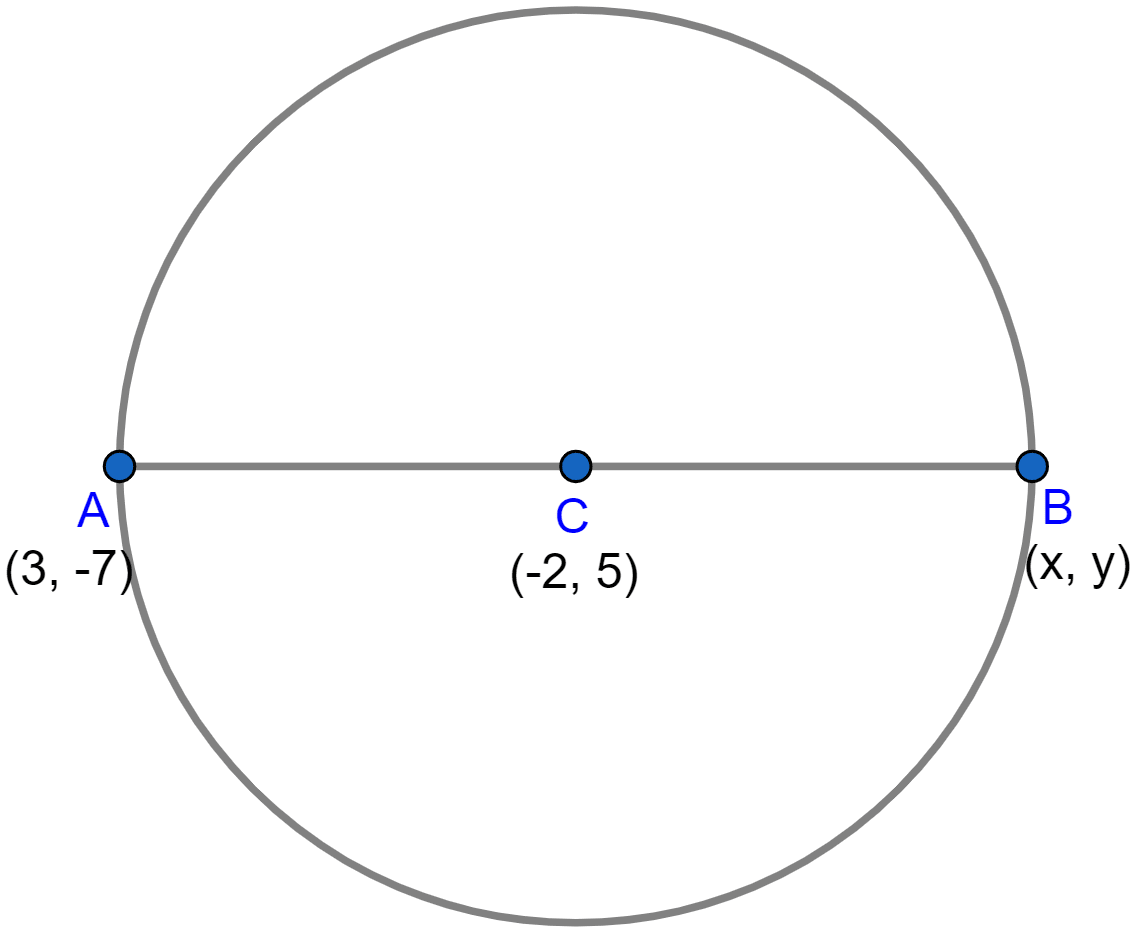
AB is a diameter of a circle with centre C(-2, 5). If the point A is (3, -7). Find :
(i) The length of radius AC.
(ii) The coordinates of B.
Answer
Below figure shows the circle with Centre C(-2, 5)
(i) We know that,
Distance formula = ( x 2 − x 1 ) 2 + ( y 2 − y 1 ) 2 \sqrt{(x_2 - x_1)^2 + (y_2 - y_1)^2} ( x 2 − x 1 ) 2 + ( y 2 − y 1 ) 2
∴ The length of radius AC = ( − 2 − 3 ) 2 + ( 5 − ( − 7 ) ) 2 \sqrt{(-2 - 3)^2 + (5 - (-7))^2} ( − 2 − 3 ) 2 + ( 5 − ( − 7 ) ) 2
= ( − 5 ) 2 + ( 12 ) 2 = 25 + 144 = 169 = 13. = \sqrt{(-5)^2 + (12)^2} \\[1em] = \sqrt{25 + 144} \\[1em] = \sqrt{169} \\[1em] = 13. = ( − 5 ) 2 + ( 12 ) 2 = 25 + 144 = 169 = 13.
Hence, the length of radius AC is 13 units.
(ii) Given, AB is the diameter and C is the mid-point
Let coordinates of B are (x, y) so, by mid-point formula,
( 3 + x ) 2 = − 2 and ( y − 7 ) 2 = 5 \dfrac{(3 + x)}{2} = -2 \text{ and } \dfrac{(y - 7)}{2} = 5 2 ( 3 + x ) = − 2 and 2 ( y − 7 ) = 5
Hence, coordinates of B are (-7, 17).
Find the reflection (image) of the point (5, -3) in the point (-1, 3).
Answer
Let the coordinates of the image of the point A(5, -3) be A'(x, y) in the point (-1, 3) then,
The point (-1, 3) will be the mid-point of AA'
By midpoint formula,
⇒ − 1 = ( 5 + x ) 2 and 3 = ( − 3 + y ) 2 \Rightarrow -1 = \dfrac{(5 + x)}{2} \text{ and } 3 = \dfrac{(-3 + y)}{2} ⇒ − 1 = 2 ( 5 + x ) and 3 = 2 ( − 3 + y )
∴ A' = (x, y) = (-7, 9).
Hence, the coordinates of the images of (5, -3) in the point (-1, 3) is (-7, 9).
The line segment joining A ( − 1 , 5 3 ) \Big(-1, \dfrac{5}{3}\Big) ( − 1 , 3 5 )
(i) the value of a.
(ii) the coordinates of P.
Answer
(i) Let P(x, y) divide the line segment joining the points A( − 1 , 5 3 ) \Big(-1, \dfrac{5}{3}\Big) ( − 1 , 3 5 )
We know that,
Section-formula = ( m 1 x 2 + m 2 x 1 m 1 + m 2 , m 1 y 2 + m 2 y 1 m 1 + m 2 ) . \Big(\dfrac{m_1x_2 + m_2x_1}{m_1 + m_2}, \dfrac{m_1y_2 + m_2y_1}{m_1 + m_2}\Big). ( m 1 + m 2 m 1 x 2 + m 2 x 1 , m 1 + m 2 m 1 y 2 + m 2 y 1 ) .
Putting values in above equation we get, coordinates of P
= ( 1 × a + 3 × ( − 1 ) 1 + 3 , 1 × 5 + 3 × 5 3 1 + 3 ) = ( a − 3 4 , 5 + 5 4 ) = ( a − 3 4 , 10 4 ) = ( a − 3 4 , 5 2 ) . = \Big(\dfrac{1 \times a + 3 \times (-1)}{1 + 3}, \dfrac{1 \times 5 + 3 \times \dfrac{5}{3}}{1 + 3}\Big) \\[1em] = \Big(\dfrac{a - 3}{4}, \dfrac{5 + 5}{4}\Big) \\[1em] = \Big(\dfrac{a - 3}{4}, \dfrac{10}{4}\Big) \\[1em] = \Big(\dfrac{a - 3}{4}, \dfrac{5}{2}\Big). = ( 1 + 3 1 × a + 3 × ( − 1 ) , 1 + 3 1 × 5 + 3 × 3 5 ) = ( 4 a − 3 , 4 5 + 5 ) = ( 4 a − 3 , 4 10 ) = ( 4 a − 3 , 2 5 ) .
According to the question,
The point P lies on y-axis so, x coordinate will be equal to zero.
∴ a − 3 4 = 0 \therefore \dfrac{a - 3}{4} = 0 ∴ 4 a − 3 = 0
Hence, the value of a = 3.
(ii) From part (i) we get the y coordinate of P = 5 2 \dfrac{5}{2} 2 5
Hence, the coordinates of P are ( 0 , 5 2 ) . \Big(0, \dfrac{5}{2}\Big). ( 0 , 2 5 ) .
The point P(-4, 1) divides the line segment joining the points A(2, -2) and B in the ratio 3 : 5. Find the point B.
Answer
Let the coordinates of B be (x, y).
As the point P(-4, 1) divides the line segment joining the points A (2, -2) and B (x, y) in the ratio 3 : 5, we have
We know that,
Section-formula = ( m 1 x 2 + m 2 x 1 m 1 + m 2 , m 1 y 2 + m 2 y 1 m 1 + m 2 ) . \Big(\dfrac{m_1x_2 + m_2x_1}{m_1 + m_2}, \dfrac{m_1y_2 + m_2y_1}{m_1 + m_2}\Big). ( m 1 + m 2 m 1 x 2 + m 2 x 1 , m 1 + m 2 m 1 y 2 + m 2 y 1 ) .
Putting values in above equation we get coordinates of P as
= ( 3 × x + 5 × 2 3 + 5 , 3 × y + 5 × ( − 2 ) 3 + 5 ) = ( 3 x + 10 8 , 3 y − 10 8 ) . = \Big(\dfrac{3 \times x + 5 \times 2}{3 + 5}, \dfrac{3 \times y + 5 \times (-2)}{3 + 5}\Big) \\[1em] = \Big(\dfrac{3x + 10}{8}, \dfrac{3y - 10}{8}\Big). = ( 3 + 5 3 × x + 5 × 2 , 3 + 5 3 × y + 5 × ( − 2 ) ) = ( 8 3 x + 10 , 8 3 y − 10 ) .
According to question the coordinates of P are (-4, 1) comparing we get,
⇒ 3 x + 10 8 = − 4 and 3 y − 10 8 = 1 \Rightarrow \dfrac{3x + 10}{8} = -4 \text{ and } \dfrac{3y - 10}{8} = 1 ⇒ 8 3 x + 10 = − 4 and 8 3 y − 10 = 1
∴ B = (x, y) = (-14, 6).
Hence, the coordinates of B are (-14, 6).
In what ratio does the point (5, 4) divide the line segment joining the points (2, 1) and (7, 6) ?
Answer
Let the point P(5, 4) divide the line segment joining the points (2, 1), (7, 6) in the ratio m1 : m2 .
By Section-formula, we get the coordinates of point P as:
( m 1 x 2 + m 2 x 1 m 1 + m 2 , m 1 y 2 + m 2 y 1 m 1 + m 2 ) . \Big(\dfrac{m_1x_2 + m_2x_1}{m_1 + m_2}, \dfrac{m_1y_2 + m_2y_1}{m_1 + m_2}\Big). ( m 1 + m 2 m 1 x 2 + m 2 x 1 , m 1 + m 2 m 1 y 2 + m 2 y 1 ) .
Putting values in x coordinate of above equation we get,
= m 1 × 7 + m 2 × 2 m 1 + m 2 = 7 m 1 + 2 m 2 m 1 + m 2 = \dfrac{m_1 \times 7 + m_2 \times 2}{m_1 + m_2} \\[1em] = \dfrac{7m_1 + 2m_2}{m_1 + m_2} \\[1em] = m 1 + m 2 m 1 × 7 + m 2 × 2 = m 1 + m 2 7 m 1 + 2 m 2
According to question, the x-coordinate of P = 5. Comparing we get,
⇒ 7 m 1 + 2 m 2 m 1 + m 2 = 5 ⇒ 7 m 1 + 2 m 2 = 5 m 1 + 5 m 2 ⇒ 7 m 1 − 5 m 1 = 5 m 2 − 2 m 2 ⇒ 2 m 1 = 3 m 2 ⇒ m 1 m 2 = 3 2 . \Rightarrow \dfrac{7m_1 + 2m_2}{m_1 + m_2} = 5 \\[1em] \Rightarrow 7m_1 + 2m_2 = 5m_1 + 5m_2 \\[1em] \Rightarrow 7m_1 - 5m_1 = 5m_2 - 2m_2 \\[1em] \Rightarrow 2m_1 = 3m_2 \\[1em] \Rightarrow \dfrac{m_1}{m_2} = \dfrac{3}{2}. ⇒ m 1 + m 2 7 m 1 + 2 m 2 = 5 ⇒ 7 m 1 + 2 m 2 = 5 m 1 + 5 m 2 ⇒ 7 m 1 − 5 m 1 = 5 m 2 − 2 m 2 ⇒ 2 m 1 = 3 m 2 ⇒ m 2 m 1 = 2 3 .
Hence, the ratio in which point (5, 4) divides the line segment is 3 : 2.
In what ratio does the point (-4, b) divide the line segment joining the points P(2, -2), Q(-14, 6)? Hence, find the value of b.
Answer
Let the point P(-4, b) divide the line segment joining the points P(2, -2) and Q(-14, 6) in the ratio m1 : m2 .
By section formula, the x-coordinate = ( m 1 x 2 + m 2 x 1 m 1 + m 2 ) \Big(\dfrac{m_1x_2 + m_2x_1}{m_1 + m_2}\Big) ( m 1 + m 2 m 1 x 2 + m 2 x 1 )
Putting value in above formula we get,
⇒ − 4 = m 1 × − 14 + m 2 × 2 m 1 + m 2 ⇒ − 4 m 1 − 4 m 2 = − 14 m 1 + 2 m 2 ⇒ − 4 m 1 + 14 m 1 = 2 m 2 + 4 m 2 ⇒ 10 m 1 = 6 m 2 ⇒ m 1 m 2 = 6 10 ⇒ m 1 : m 2 = 3 : 5. \Rightarrow -4 = \dfrac{m_1 \times -14 + m_2 \times 2}{m_1 + m_2} \\[1em] \Rightarrow -4m_1 - 4m_2 = -14m_1 + 2m_2 \\[1em] \Rightarrow -4m_1 + 14m_1 = 2m_2 + 4m_2 \\[1em] \Rightarrow 10m_1 = 6m_2 \\[1em] \Rightarrow \dfrac{m_1}{m_2} = \dfrac{6}{10} \\[1em] \Rightarrow m_1 : m_2 = 3 : 5. ⇒ − 4 = m 1 + m 2 m 1 × − 14 + m 2 × 2 ⇒ − 4 m 1 − 4 m 2 = − 14 m 1 + 2 m 2 ⇒ − 4 m 1 + 14 m 1 = 2 m 2 + 4 m 2 ⇒ 10 m 1 = 6 m 2 ⇒ m 2 m 1 = 10 6 ⇒ m 1 : m 2 = 3 : 5.
By section formula, y-coordinate = ( m 1 y 2 + m 2 y 1 m 1 + m 2 ) \Big(\dfrac{m_1y_2 + m_2y_1}{m_1 + m_2}\Big) ( m 1 + m 2 m 1 y 2 + m 2 y 1 )
Putting value in above formula we get,
⇒ b = m 1 × 6 + m 2 × − 2 m 1 + m 2 = 6 m 1 − 2 m 2 m 1 + m 2 = 6 × 3 − 2 × 5 3 + 5 = 18 − 10 8 = 8 8 = 1. \Rightarrow b = \dfrac{m_1 \times 6 + m_2 \times -2}{m_1 + m_2} \\[1em] = \dfrac{6m_1 - 2m_2}{m_1 + m_2} \\[1em] = \dfrac{6 \times 3 - 2 \times 5}{3 + 5} \\[1em] = \dfrac{18 - 10}{8} \\[1em] = \dfrac{8}{8} \\[1em] = 1. ⇒ b = m 1 + m 2 m 1 × 6 + m 2 × − 2 = m 1 + m 2 6 m 1 − 2 m 2 = 3 + 5 6 × 3 − 2 × 5 = 8 18 − 10 = 8 8 = 1.
Hence, the ratio is 3 : 5 and the value of b = 1.
The line segment joining A(2, 3) and B(6, -5) is intersected by x-axis at a point K. Write down the ordinate of the point K. Hence, find the ratio in which K divides AB. Also find the coordinates of point K.
Answer
Let the coordinates of K be (x, 0) as it intersects x-axis. Let point K divides the line segment joining the points1 : m2 .
By section formula, y-coordinate = ( m 1 y 2 + m 2 y 1 m 1 + m 2 ) \Big(\dfrac{m_1y_2 + m_2y_1}{m_1 + m_2}\Big) ( m 1 + m 2 m 1 y 2 + m 2 y 1 )
Putting value in above formula we get,
⇒ 0 = m 1 × ( − 5 ) + m 2 × 3 m 1 + m 2 ⇒ 0 = − 5 m 1 + 3 m 2 ⇒ 5 m 1 = 3 m 2 ⇒ m 1 m 2 = 3 5 \Rightarrow 0 = \dfrac{m_1 \times (-5) + m_2 \times 3}{m_1 + m_2} \\[1em] \Rightarrow 0 = -5m_1 + 3m_2 \\[1em] \Rightarrow 5m_1 = 3m_2 \\[1em] \Rightarrow \dfrac{m_1}{m_2} = \dfrac{3}{5} ⇒ 0 = m 1 + m 2 m 1 × ( − 5 ) + m 2 × 3 ⇒ 0 = − 5 m 1 + 3 m 2 ⇒ 5 m 1 = 3 m 2 ⇒ m 2 m 1 = 5 3
Now for x coordinate by section formula we get,
x = m 1 x 2 + m 2 x 1 m 1 + m 2 = 3 × 6 + 5 × 2 3 + 5 = 18 + 10 8 = 28 8 = 7 2 . x = \dfrac{m_1x_2 + m_2x_1}{m_1 + m_2} \\[1em] = \dfrac{3 \times 6 + 5 \times 2}{3 + 5} \\[1em] = \dfrac{18 + 10}{8} \\[1em] = \dfrac{28}{8} \\[1em] = \dfrac{7}{2}. x = m 1 + m 2 m 1 x 2 + m 2 x 1 = 3 + 5 3 × 6 + 5 × 2 = 8 18 + 10 = 8 28 = 2 7 .
∴ K = (x, 0) = ( 7 2 , 0 ) . \Big(\dfrac{7}{2}, 0\Big). ( 2 7 , 0 ) .
Hence, the coordinates of K are ( 7 2 , 0 ) \Big(\dfrac{7}{2}, 0\Big) ( 2 7 , 0 )
If A = (-4, 3) and B = (8, -6),
(i) find the length of AB.
(ii) in what ratio is the line segment joining AB, divided by the x-axis?
Answer
The graph is given below:
(i) Given,
A = (-4, 3), B = (8, -6)
Length of AB = ( x 2 − x 1 ) 2 + ( y 2 − y 1 ) 2 = ( 8 − ( − 4 ) ) 2 + ( − 6 − 3 ) 2 = ( 8 + 4 ) 2 + ( − 6 − 3 ) 2 = 12 2 + ( − 9 ) 2 = 144 + 81 = 225 = 15. \text{Length of AB = } \sqrt{(x_2 - x_1)^2 + (y_2 - y_1)^2} \\[1em] = \sqrt{(8 - (-4))^2 + (-6 - 3)^2} \\[1em] = \sqrt{(8 + 4)^2 + (-6 - 3)^2} \\[1em] = \sqrt{12^2 + (-9)^2} \\[1em] = \sqrt{144 + 81} \\[1em] = \sqrt{225} \\[1em] = 15. Length of AB = ( x 2 − x 1 ) 2 + ( y 2 − y 1 ) 2 = ( 8 − ( − 4 ) ) 2 + ( − 6 − 3 ) 2 = ( 8 + 4 ) 2 + ( − 6 − 3 ) 2 = 1 2 2 + ( − 9 ) 2 = 144 + 81 = 225 = 15.
Hence, the length of AB = 15 units.
(ii) From graph, we see that O (0, 0) lies on AB.1 : m2 .
By section-formula the coordinates of point dividing a line in m1 : m2 are given by
( m 1 x 2 + m 2 x 1 m 1 + m 2 , m 1 y 2 + m 2 y 1 m 1 + m 2 ) \Big(\dfrac{m_1x_2 + m_2x_1}{m_1 + m_2}, \dfrac{m_1y_2 + m_2y_1}{m_1 + m_2}\Big) ( m 1 + m 2 m 1 x 2 + m 2 x 1 , m 1 + m 2 m 1 y 2 + m 2 y 1 )
Putting values in above equation for finding x coordinates we get,
⇒ m 1 × 8 + m 2 × − 4 m 1 + m 2 ⇒ 8 m 1 − 4 m 2 m 1 + m 2 . \Rightarrow \dfrac{m_1 \times 8 + m_2 \times -4}{m_1 + m_2} \\ \\[1em] \Rightarrow \dfrac{8m_1 - 4m_2}{m_1 + m_2}. ⇒ m 1 + m 2 m 1 × 8 + m 2 × − 4 ⇒ m 1 + m 2 8 m 1 − 4 m 2 .
Since origin (0, 0) is the dividing point the x-coordinate = 0. Comparing it with above equation we get,
8 m 1 − 4 m 2 m 1 + m 2 = 0 8 m 1 − 4 m 2 = 0 8 m 1 = 4 m 2 m 1 m 2 = 4 8 m 1 m 2 = 1 2 . \dfrac{8m_1 - 4m_2}{m_1 + m_2} = 0 \\[1em] 8m_1 - 4m_2 = 0 \\[1em] 8m_1 = 4m_2 \\[1em] \dfrac{m_1}{m_2} = \dfrac{4}{8} \\[1em] \dfrac{m_1}{m_2} = \dfrac{1}{2}. m 1 + m 2 8 m 1 − 4 m 2 = 0 8 m 1 − 4 m 2 = 0 8 m 1 = 4 m 2 m 2 m 1 = 8 4 m 2 m 1 = 2 1 .
∴ m1 : m2 = 1 : 2.
Hence, the x-axis divides the line segment AB in the ratio 1 : 2.
In what ratio does the line x - y - 2 = 0 divide the line segment joining the points (3, -1) and (8, 9)? Also, find the coordinates of the point of division.
Answer
Let the point A be (3, -1) and point B be (8, 9) and let the line x - y - 2 = 0 divide the line segment AB in the ratio m1 : m2 at point P(x, y) then,
x = m 1 x 2 + m 2 x 1 m 1 + m 2 = m 1 × 8 + m 2 × 3 m 1 + m 2 = 8 m 1 + 3 m 2 m 1 + m 2 ....[Eq 1] and y = m 1 y 2 + m 2 y 1 m 1 + m 2 = m 1 × 9 + m 2 × − 1 m 1 + m 2 = 9 m 1 − m 2 m 1 + m 2 ....[Eq 2] . x = \dfrac{m_1x_2 + m_2x_1}{m_1 + m_2} \\[1em] = \dfrac{m_1 \times 8 + m_2 \times 3}{m_1 + m_2} \\[1em] = \dfrac{8m_1 + 3m_2}{m_1 + m_2} \qquad \text{....[Eq 1]} \\[1em] \text{and y } = \dfrac{m_1y_2 + m_2y_1}{m_1 + m_2} \\[1em] = \dfrac{m_1 \times 9 + m_2 \times -1}{m_1 + m_2} \\[1em] = \dfrac{9m_1 - m_2}{m_1 + m_2} \qquad \text{....[Eq 2]}. x = m 1 + m 2 m 1 x 2 + m 2 x 1 = m 1 + m 2 m 1 × 8 + m 2 × 3 = m 1 + m 2 8 m 1 + 3 m 2 ....[Eq 1] and y = m 1 + m 2 m 1 y 2 + m 2 y 1 = m 1 + m 2 m 1 × 9 + m 2 × − 1 = m 1 + m 2 9 m 1 − m 2 ....[Eq 2] .
Given, the point P(x, y) lies on the line x - y - 2 = 0.
∴ 8 m 1 + 3 m 2 m 1 + m 2 − 9 m 1 − m 2 m 1 + m 2 − 2 = 0 ⇒ 8 m 1 + 3 m 2 − 9 m 1 + m 2 − 2 m 1 − 2 m 2 m 1 + m 2 = 0 ⇒ − 3 m 1 + 2 m 2 = 0 ⇒ 3 m 1 = 2 m 2 ⇒ m 1 m 2 = 2 3 . \therefore \dfrac{8m_1 + 3m_2}{m_1 + m_2} - \dfrac{9m_1 - m_2}{m_1 + m_2} - 2 = 0 \\[1em] \Rightarrow \dfrac{8m_1 + 3m_2 - 9m_1 + m_2 - 2m_1 - 2m_2}{m_1 + m_2} = 0 \\[1em] \Rightarrow -3m_1 + 2m_2 = 0 \\[1em] \Rightarrow 3m_1 = 2m_2 \\[1em] \Rightarrow \dfrac{m_1}{m_2} = \dfrac{2}{3} \\[1em]. ∴ m 1 + m 2 8 m 1 + 3 m 2 − m 1 + m 2 9 m 1 − m 2 − 2 = 0 ⇒ m 1 + m 2 8 m 1 + 3 m 2 − 9 m 1 + m 2 − 2 m 1 − 2 m 2 = 0 ⇒ − 3 m 1 + 2 m 2 = 0 ⇒ 3 m 1 = 2 m 2 ⇒ m 2 m 1 = 3 2 .
Putting value of m1 : m2 in Eq 1,
⇒ x = 8 × 2 + 3 × 3 2 + 3 = 16 + 9 5 = 25 5 = 5. \Rightarrow x = \dfrac{8 \times 2 + 3 \times 3}{2 + 3} \\[1em] = \dfrac{16 + 9}{5} \\[1em] = \dfrac{25}{5} \\[1em] = 5. ⇒ x = 2 + 3 8 × 2 + 3 × 3 = 5 16 + 9 = 5 25 = 5.
Putting value of m1 : m2 in Eq 2,
⇒ y = 9 × 2 − 3 2 + 3 = 18 − 3 5 = 15 5 = 3. \Rightarrow y = \dfrac{9 \times 2 - 3}{2 + 3} \\[1em] = \dfrac{18 - 3}{5} \\[1em] = \dfrac{15}{5} \\[1em] = 3. ⇒ y = 2 + 3 9 × 2 − 3 = 5 18 − 3 = 5 15 = 3.
Hence, the ratio is 2 : 3 and coordinates of P are (5, 3).
Given, a line segment AB joining the points A(-4, 6) and B(8, -3). Find :
(i) The ratio in which AB is divided by the y-axis.
(ii) The coordinates of the point of intersection.
(iii) The length of AB.
Answer
(i) Let the y-axis divide AB in the ratio m1 : m2 .
By section formula, the x-coordinate = ( m 1 x 2 + m 2 x 1 m 1 + m 2 ) \Big(\dfrac{m_1x_2 + m_2x_1}{m_1 + m_2}\Big) ( m 1 + m 2 m 1 x 2 + m 2 x 1 )
Since, the x coordinate on y-axis is 0. Putting value in above formula we get,
⇒ 0 = m 1 × 8 + m 2 × ( − 4 ) m 1 + m 2 ⇒ 8 m 1 − 4 m 2 = 0 ⇒ 8 m 1 = 4 m 2 ⇒ m 1 m 2 = 4 8 ⇒ m 1 : m 2 = 1 : 2 \Rightarrow 0 = \dfrac{m_1 \times 8 + m_2 \times (-4)}{m_1 + m_2} \\[1em] \Rightarrow 8m_1 - 4m_2 = 0 \\[1em] \Rightarrow 8m_1 = 4m_2 \\[1em] \Rightarrow \dfrac{m_1}{m_2} = \dfrac{4}{8} \\[1em] \Rightarrow m_1 : m_2 = 1 : 2 ⇒ 0 = m 1 + m 2 m 1 × 8 + m 2 × ( − 4 ) ⇒ 8 m 1 − 4 m 2 = 0 ⇒ 8 m 1 = 4 m 2 ⇒ m 2 m 1 = 8 4 ⇒ m 1 : m 2 = 1 : 2
Hence, required ratio = 1 2 : 1 \dfrac{1}{2} : 1 2 1 : 1
(ii) By section formula, the y-coordinate is given by
( m 1 y 2 + m 2 y 1 m 1 + m 2 ) \Big(\dfrac{m_1y_2 + m_2y_1}{m_1 + m_2}\Big) ( m 1 + m 2 m 1 y 2 + m 2 y 1 )
Putting value in above formula we get,
⇒ y = 1 × − 3 + 2 × 6 1 + 2 = − 3 + 12 3 = 9 3 = 3. \Rightarrow y = \dfrac{1 \times -3 + 2 \times 6}{1 + 2} \\[1em] = \dfrac{-3 + 12}{3} \\[1em] = \dfrac{9}{3} \\[1em] = 3. ⇒ y = 1 + 2 1 × − 3 + 2 × 6 = 3 − 3 + 12 = 3 9 = 3.
Hence, the coordinates of the point of intersection are (0, 3).
(iii) Distance formula = ( x 2 − x 1 ) 2 + ( y 2 − y 1 ) 2 \sqrt{(x_2 - x_1)^2 + (y_2 - y_1)^2} ( x 2 − x 1 ) 2 + ( y 2 − y 1 ) 2
By distance formula,
A B = ( 8 − ( − 4 ) ) 2 + ( − 3 − 6 ) 2 = 12 2 + ( − 9 ) 2 = 144 + 81 = 225 = 15. AB = \sqrt{(8 - (-4))^2 + (-3 - 6)^2} \\[1em] = \sqrt{12^2 + (-9)^2} \\[1em] = \sqrt{144 + 81} \\[1em] = \sqrt{225} \\[1em] = 15. A B = ( 8 − ( − 4 ) ) 2 + ( − 3 − 6 ) 2 = 1 2 2 + ( − 9 ) 2 = 144 + 81 = 225 = 15.
Hence, the length of AB = 15 units.
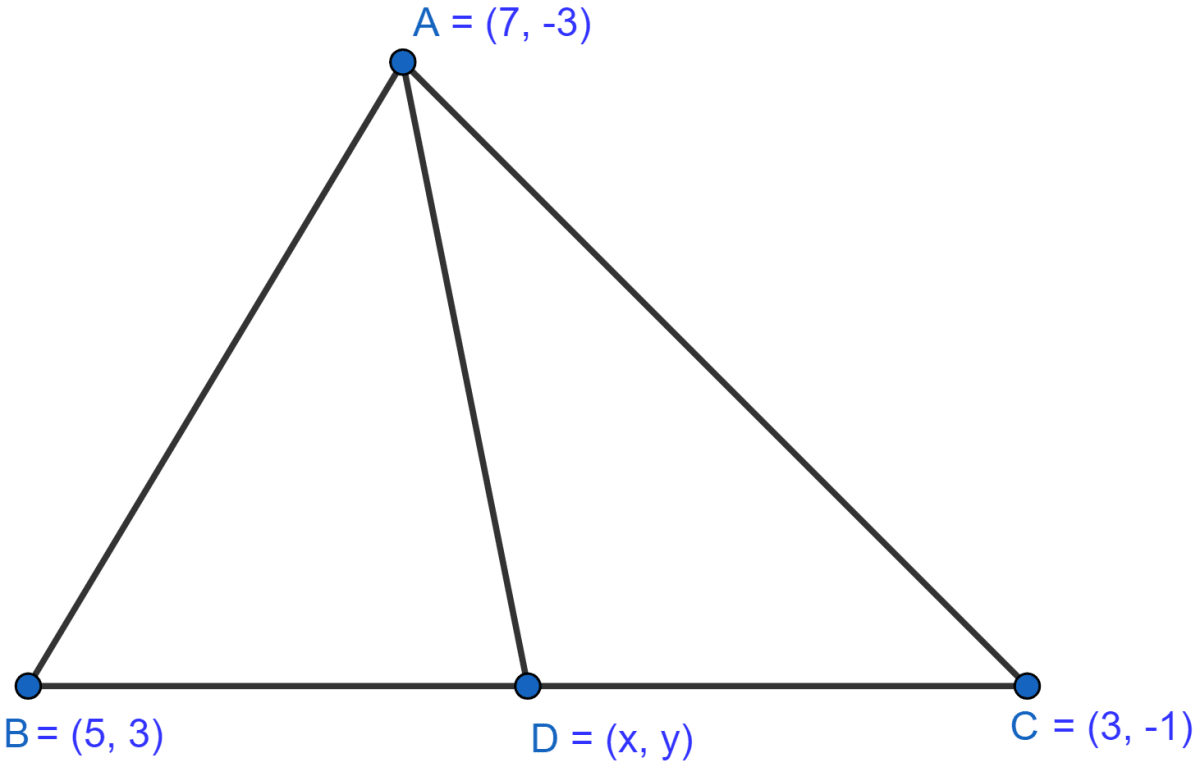
Calculate the length of the median through the vertex A of the triangle ABC with vertices A(7, -3), B(5, 3) and C(3, -1).
Answer
Below figure shows the triangle ABC with vertices A(7, -3), B(5, 3) and C(3, -1):
Let D (x, y) be the mid-point of BC, then AD is the median through A.
As D is the mid-point of BC, then coordinates of D by mid-point formula are
⇒ x = 5 + 3 2 and y = 3 + ( − 1 ) 2 ⇒ x = 8 2 and y = 2 2 ⇒ x = 4 and y = 1. \Rightarrow x = \dfrac{5 + 3}{2} \text{ and } y = \dfrac{3 + (-1)}{2} \\[1em] \Rightarrow x = \dfrac{8}{2} \text{ and } y = \dfrac{2}{2} \\[1em] \Rightarrow x = 4 \text{ and } y = 1. ⇒ x = 2 5 + 3 and y = 2 3 + ( − 1 ) ⇒ x = 2 8 and y = 2 2 ⇒ x = 4 and y = 1.
Hence, coordinates of D are (4, 1).
Distance formula = ( x 2 − x 1 ) 2 + ( y 2 − y 1 ) 2 \sqrt{(x_2 - x_1)^2 + (y_2 - y_1)^2} ( x 2 − x 1 ) 2 + ( y 2 − y 1 ) 2
By distance formula length of median,
A D = ( 7 − 4 ) 2 + ( − 3 − 1 ) 2 = 3 2 + ( − 4 ) 2 = 9 + 16 = 25 = 5. AD = \sqrt{(7 - 4)^2 + (-3 - 1)^2} \\[1em] = \sqrt{3^2 + (-4)^2} \\[1em] = \sqrt{9 + 16} \\[1em] = \sqrt{25} \\[1em] = 5. A D = ( 7 − 4 ) 2 + ( − 3 − 1 ) 2 = 3 2 + ( − 4 ) 2 = 9 + 16 = 25 = 5.
Hence, the length of the median through vertex A is 5 units.
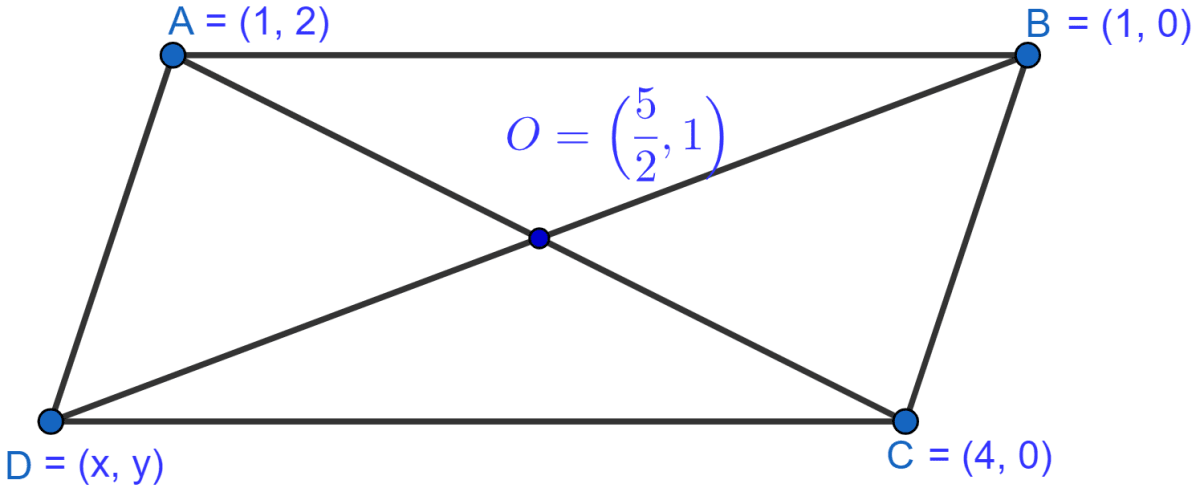
Three consecutive vertices of a parallelogram ABCD are A(1, 2), B(1, 0) and C(4, 0). Find the fourth vertex D.
Answer
In the parallelogram ABCD, the three consecutive vertices are A(1, 2), B(1, 0) and C(4, 0). Let the fourth vertex D be (x, y) as shown in the figure below:
Let O be the mid-point of AC, the diagonal of ABCD.
By Mid-point formula, the coordinates of O = ( 1 + 4 2 , 2 + 0 2 ) \Big(\dfrac{1 + 4}{2}, \dfrac{2 + 0}{2}\Big) ( 2 1 + 4 , 2 2 + 0 )
∴ Coordinates of O will be ( 5 2 , 1 ) \Big(\dfrac{5}{2}, 1\Big) ( 2 5 , 1 )
The mid-point of BD is ( 1 + x 2 , y 2 ) \Big(\dfrac{1 + x}{2}, \dfrac{y}{2}\Big) ( 2 1 + x , 2 y )
Since, the diagonals of a parallelogram bisect each other, the mid-points of AC and BD are same.
∴ 5 2 = 1 + x 2 and 1 = 0 + y 2 ⇒ 5 = 1 + x and y + 0 = 2 ⇒ x = 5 − 1 and y = 2. ⇒ x = 4 and y = 2. \therefore \dfrac{5}{2} = \dfrac{1 + x}{2} \text{ and } 1 = \dfrac{0 + y}{2} \\[1em] \Rightarrow 5 = 1 + x \text{ and } y + 0 = 2 \\[1em] \Rightarrow x = 5 - 1 \text{ and } y = 2. \\[1em] \Rightarrow x = 4 \text{ and } y = 2. ∴ 2 5 = 2 1 + x and 1 = 2 0 + y ⇒ 5 = 1 + x and y + 0 = 2 ⇒ x = 5 − 1 and y = 2. ⇒ x = 4 and y = 2.
Hence, coordinates of D are (4, 2).
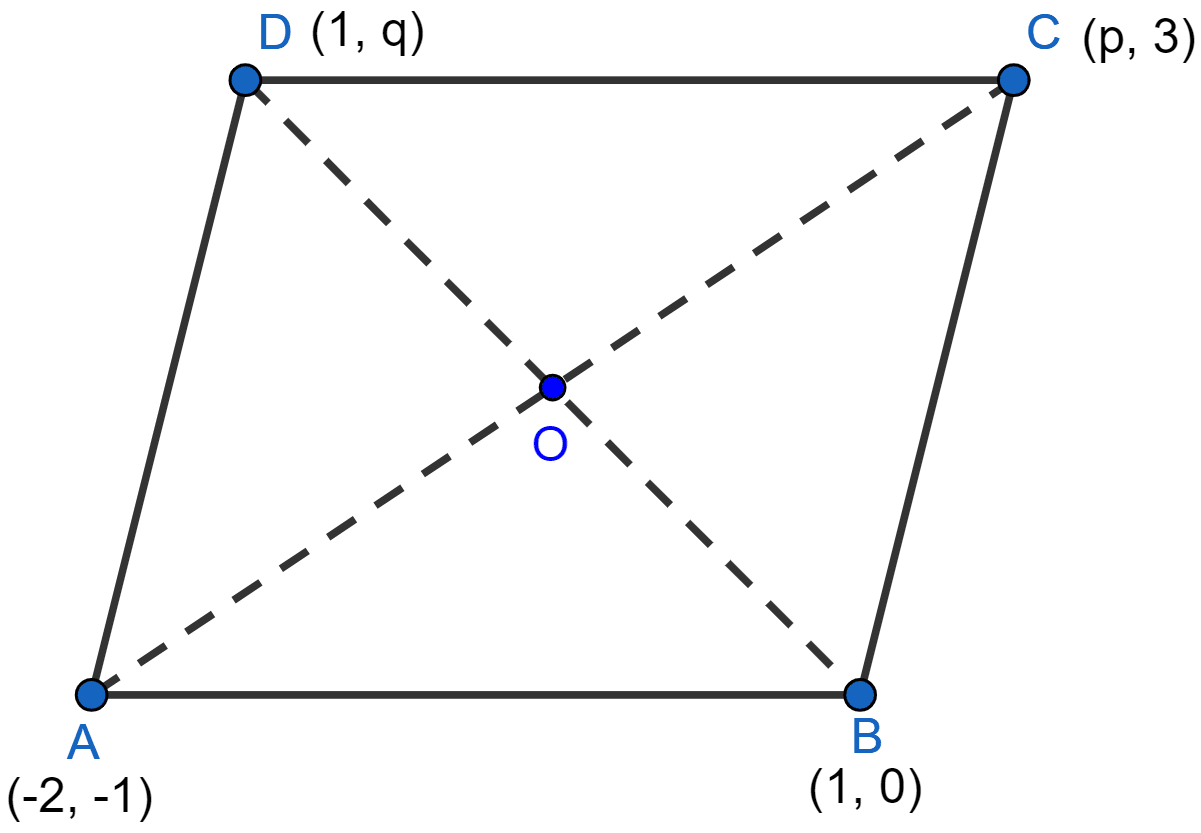
If the points A(-2, -1), B(1, 0), C(p, 3) and D(1, q) form a parallelogram ABCD, find the values of p and q.
Answer
A(-2, -1), B(1, 0), C(p, 3) and D(1, q) are the vertices of a parallelogram ABCD as shown in the figure below:
∴ Diagonal AC and BD bisect each other at O.
When O is the mid-point of AC, then by mid-point formula
⇒ x = p + ( − 2 ) 2 and y = 3 + ( − 1 ) 2 ⇒ x = p − 2 2 and y = 2 2 ∴ x = p − 2 2 and y = 1. \Rightarrow x = \dfrac{p + (-2)}{2} \text{ and y = } \dfrac{3 + (-1)}{2} \\[1em] \Rightarrow x = \dfrac{p - 2}{2} \text{ and y = } \dfrac{2}{2} \\[1em] \therefore x = \dfrac{p - 2}{2} \text{ and } y = 1. ⇒ x = 2 p + ( − 2 ) and y = 2 3 + ( − 1 ) ⇒ x = 2 p − 2 and y = 2 2 ∴ x = 2 p − 2 and y = 1.
When O is the mid-point of BD, then by mid-point formula
⇒ x = 1 + 1 2 and y = 0 + q 2 ⇒ x = 2 2 and y = q 2 ∴ x = 1 and y = q 2 . \Rightarrow x = \dfrac{1 + 1}{2} \text{ and y = } \dfrac{0 + q}{2} \\[1em] \Rightarrow x = \dfrac{2}{2} \text{ and y = } \dfrac{q}{2} \\[1em] \therefore x = 1 \text{ and } y = \dfrac{q}{2}. ⇒ x = 2 1 + 1 and y = 2 0 + q ⇒ x = 2 2 and y = 2 q ∴ x = 1 and y = 2 q .
Now comparing, we get the values of the coordinates of point O in both cases,
⇒ p − 2 2 = 1 and q 2 = 1 ⇒ p − 2 = 2 and q = 2 ⇒ p = 4 and q = 2. \Rightarrow \dfrac{p - 2}{2} = 1 \text{ and } \dfrac{q}{2} = 1 \\[1em] \Rightarrow p - 2 = 2 \text{ and } q = 2 \\[1em] \Rightarrow p = 4 \text{ and } q = 2. ⇒ 2 p − 2 = 1 and 2 q = 1 ⇒ p − 2 = 2 and q = 2 ⇒ p = 4 and q = 2.
Hence, the value of p = 4 and q = 2.
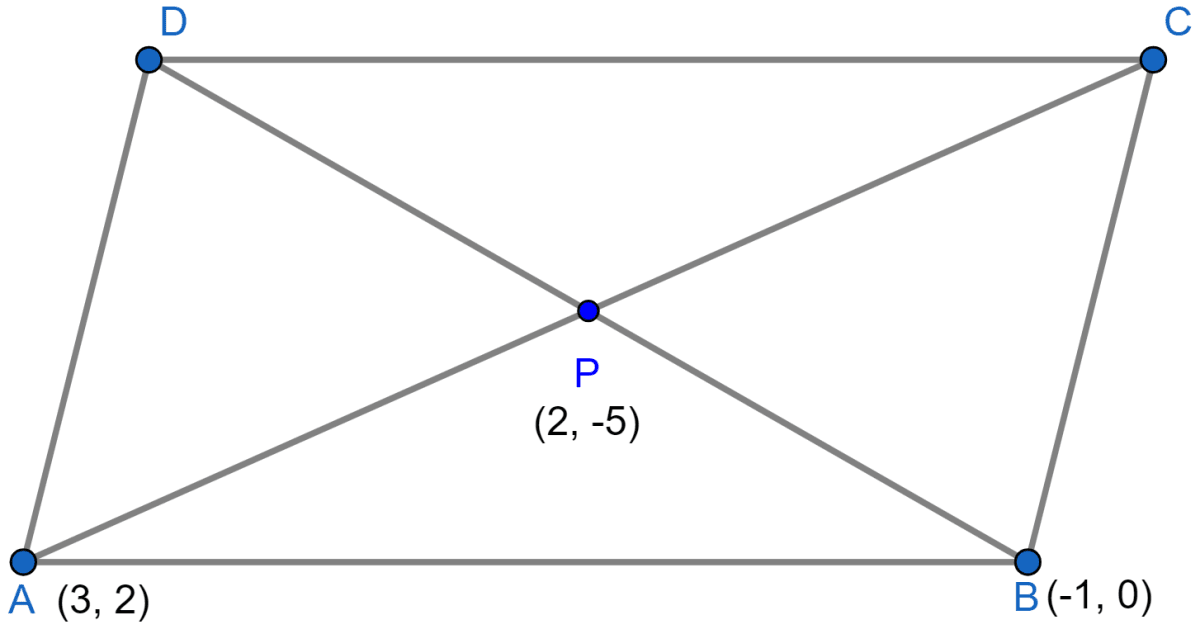
If two vertices of a parallelogram are (3, 2), (-1, 0) and its diagonals meet at (2, -5), find the other two vertices of the parallelogram.
Answer
The mid-point of the line segment joining the points (3, 2) and (-1, 0) is ( 3 + ( − 1 ) 2 , 2 + 0 2 ) \Big(\dfrac{3 + (-1)}{2}, \dfrac{2 + 0}{2}\Big) ( 2 3 + ( − 1 ) , 2 2 + 0 )
The below figure shows the parallelogram:
Let coordinates of C be (x, y) then by mid-point formula,
⇒ 2 = x + 3 2 and − 5 = y + 2 2 \Rightarrow 2 = \dfrac{x + 3}{2} \text{ and} -5 = \dfrac{y + 2}{2} ⇒ 2 = 2 x + 3 and − 5 = 2 y + 2
∴ Coordinates of C are (1, -12).
Now finding coordinates of D, let D be (m, n). Applying mid-point formula we get,
⇒ 2 = m − 1 2 and − 5 = n + 0 2 \Rightarrow 2 = \dfrac{m - 1}{2} \text{ and } -5 = \dfrac{n + 0}{2} ⇒ 2 = 2 m − 1 and − 5 = 2 n + 0
∴ Coordinates of D are (5, -10).
Hence, the coordinates of C are (1, -12) and D are (5, -10).
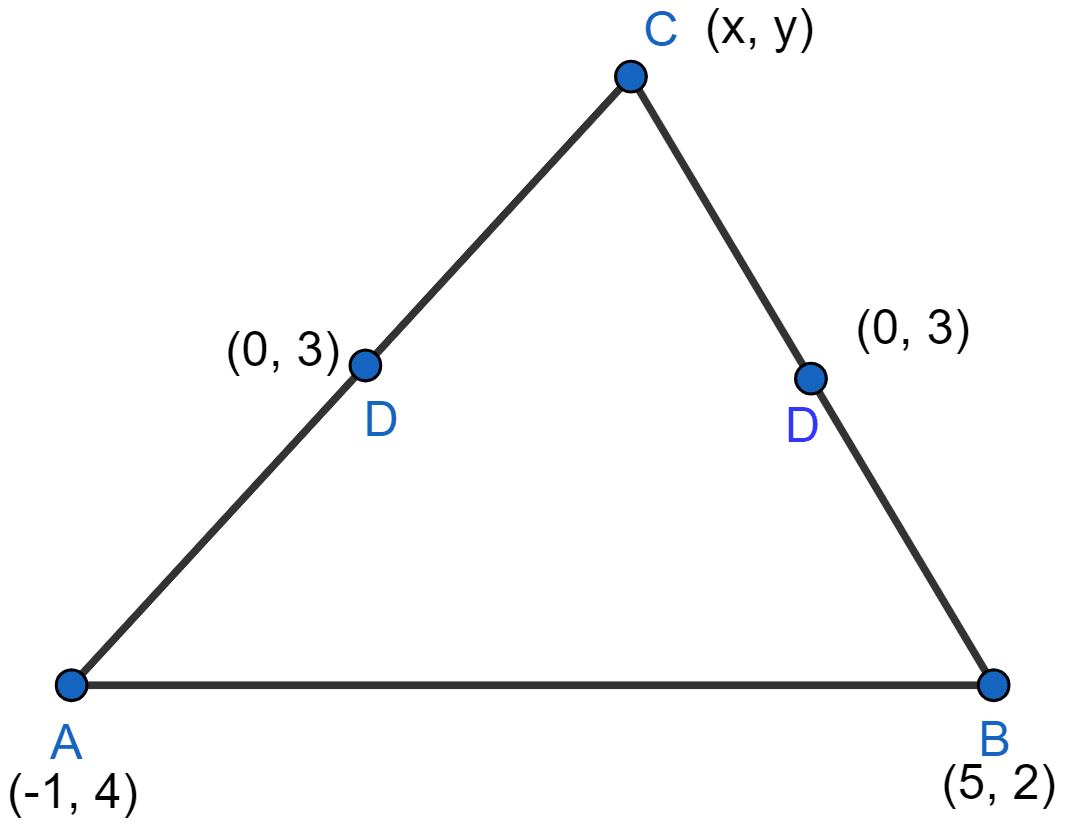
Find the third vertex of a triangle if its two vertices are (-1, 4) and (5, 2) and mid-point of one side is (0, 3).
Answer
Let A(-1, 4) and B(5, 2) be the two points and let C(x, y) be the third vertex of the triangle as shown in the figure below:
By mid-point formula, mid-point of AB
= ( − 1 + 5 2 , 4 + 2 2 ) = ( 4 2 , 6 2 ) = ( 2 , 3 ) = \Big(\dfrac{-1 + 5}{2}, \dfrac{4 + 2}{2}\Big) \\[1em] = \Big(\dfrac{4}{2}, \dfrac{6}{2}\Big) \\[1em] = (2, 3) = ( 2 − 1 + 5 , 2 4 + 2 ) = ( 2 4 , 2 6 ) = ( 2 , 3 )
Since, (0, 3) is not the mid-point of AB hence, it is either the mid point of AC or BC.
Let D(0, 3) be the midpoint of AC. So, by mid-point formula,
0 = x + ( − 1 ) 2 and 3 = y + 4 2 0 = \dfrac{x + (-1)}{2} \text{ and } 3 = \dfrac{y + 4}{2} 0 = 2 x + ( − 1 ) and 3 = 2 y + 4
∴ Coordinates of C will be (1, 2).
Let D(0, 3) be the midpoint of BC. So, by mid-point formula,
0 = 5 + x 2 and 3 = 2 + y 2 0 = \dfrac{5 + x}{2} \text{ and } 3 = \dfrac{2 + y}{2} 0 = 2 5 + x and 3 = 2 2 + y
∴ Coordinates of C will be (-5, 4).
Hence, the coordinates of C will be (1, 2) or (-5, 4).
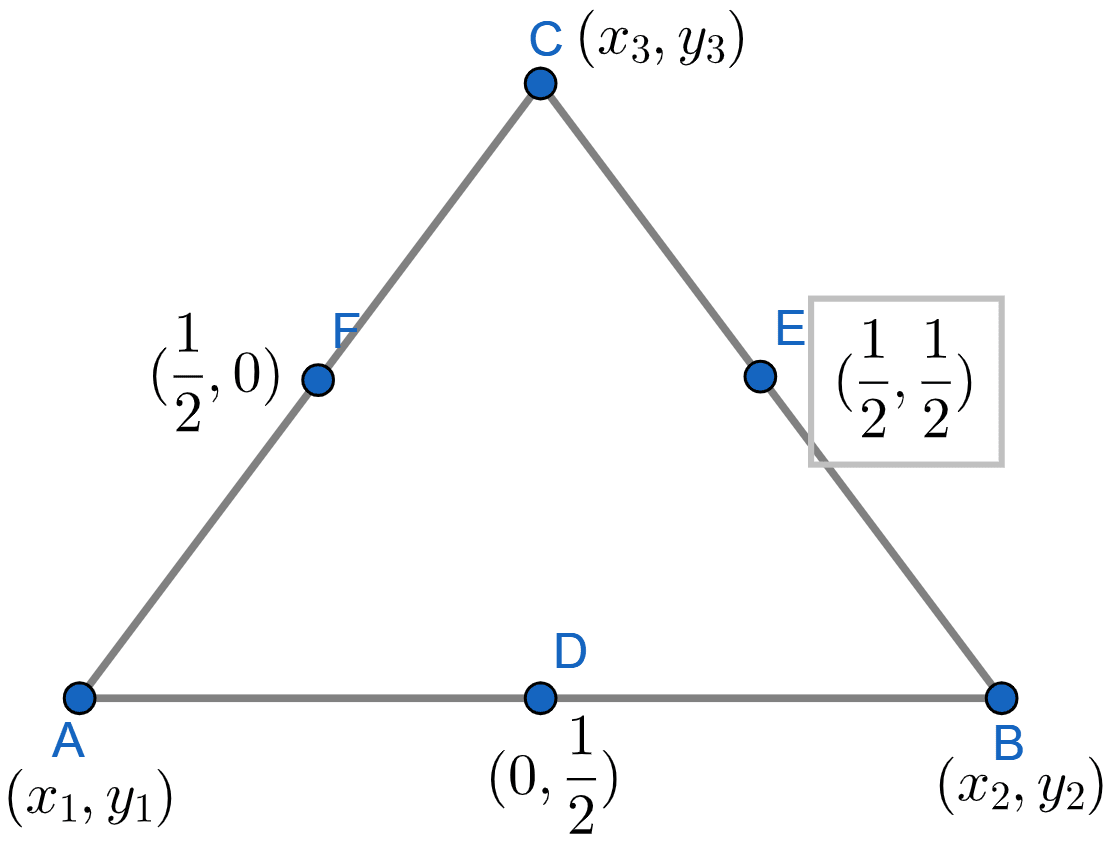
Find the coordinates of the vertices of the triangle, the middle points of whose sides are ( 0 , 1 2 ) , ( 1 2 , 1 2 ) and ( 1 2 , 0 ) \Big(0, \dfrac{1}{2}\Big), \Big(\dfrac{1}{2}, \dfrac{1}{2}\Big) \text{ and } \Big(\dfrac{1}{2}, 0\Big) ( 0 , 2 1 ) , ( 2 1 , 2 1 ) and ( 2 1 , 0 )
Answer
Let ABC be a triangle in which D, E and F are the mid-points of sides AB, BC and CA respectively.
Let coordinates of A be (x1 , y1 ), B(x2 , y2 ), C(x3 , y3 ).
Applying mid-point formula on side AB,
0 = x 1 + x 2 2 ⇒ x 1 + x 2 = 0 ....[Eq 1] 1 2 = y 1 + y 2 2 ⇒ y 1 + y 2 = 1 ....[Eq 2] 0 = \dfrac{x_1 + x_2}{2} \\[1em] \Rightarrow x_1 + x_2 = 0 \qquad \text{....[Eq 1]} \\[1.5em] \dfrac{1}{2} = \dfrac{y_1 + y_2}{2} \\[1em] \Rightarrow y_1 + y_2 = 1 \qquad \text{....[Eq 2]} \\[1em] 0 = 2 x 1 + x 2 ⇒ x 1 + x 2 = 0 ....[Eq 1] 2 1 = 2 y 1 + y 2 ⇒ y 1 + y 2 = 1 ....[Eq 2]
Applying mid-point formula on side BC,
1 2 = x 2 + x 3 2 ⇒ x 2 + x 3 = 1. ....[Eq 3] 1 2 = y 2 + y 3 2 ⇒ y 2 + y 3 = 1 ....[Eq 4] \dfrac{1}{2} = \dfrac{x_2 + x_3}{2} \\[1em] \Rightarrow x_2 + x_3 = 1. \qquad \text{....[Eq 3]} \\[1em] \dfrac{1}{2} = \dfrac{y_2 + y_3}{2} \\[1em] \Rightarrow y_2 + y_3 = 1 \qquad \text{....[Eq 4]} \\[1em] 2 1 = 2 x 2 + x 3 ⇒ x 2 + x 3 = 1. ....[Eq 3] 2 1 = 2 y 2 + y 3 ⇒ y 2 + y 3 = 1 ....[Eq 4]
Applying mid-point formula on side CA,
1 2 = x 3 + x 1 2 ⇒ x 3 + x 1 = 1. ....[Eq 5] 0 = y 3 + y 1 2 ⇒ y 3 + y 1 = 0 ....[Eq 6] \dfrac{1}{2} = \dfrac{x_3 + x_1}{2} \\[1em] \Rightarrow x_3 + x_1 = 1. \qquad \text{....[Eq 5]} \\[1em] 0 = \dfrac{y_3 + y_1}{2} \\[1em] \Rightarrow y_3 + y_1 = 0 \qquad \text{....[Eq 6]} \\[1em] 2 1 = 2 x 3 + x 1 ⇒ x 3 + x 1 = 1. ....[Eq 5] 0 = 2 y 3 + y 1 ⇒ y 3 + y 1 = 0 ....[Eq 6]
Adding Eq 1, 3 and 5,
x 1 + x 2 + x 2 + x 3 + x 3 + x 1 = 0 + 1 + 1. x_1 + x_2 + x_2 + x_3 + x_3 + x_1 = 0 + 1 + 1. x 1 + x 2 + x 2 + x 3 + x 3 + x 1 = 0 + 1 + 1. 1 + x2 + x3 = 1. ....[Eq 7] \qquad \text{....[Eq 7]} ....[Eq 7]
On subtracting Eq 3 from Eq 7 we get,1 + x2 + x3 - (x2 + x3 ) = 1 - 11 + x2 + x3 - x2 - x3 = 01 = 0.
On subtracting Eq 5 from Eq 7 we get,1 + x2 + x3 - (x3 + x1 ) = 1 - 11 + x2 + x3 - x3 - x1 = 02 = 0.
On subtracting Eq 1 from Eq 7 we get,1 + x2 + x3 - (x1 + x2 ) = 1 - 01 + x2 + x3 - x1 - x2 = 13 = 1.
Adding Eq 2, 4 and 5,
y 1 + y 2 + y 2 + y 3 + y 3 + y 1 = 1 + 1 + 0. y_1 + y_2 + y_2 + y_3 + y_3 + y_1 = 1 + 1 + 0. y 1 + y 2 + y 2 + y 3 + y 3 + y 1 = 1 + 1 + 0. 1 + y2 + y3 = 1. (Eq 8)
On subtracting Eq 4 from Eq 8 we get,1 + y2 + y3 - (y2 + y3 ) = 1 - 11 + y2 + y3 - y2 - y3 = 01 = 0.
On subtracting Eq 6 from Eq 8 we get,1 + y2 + y3 - (y3 + y1 ) = 1 - 01 + y2 + y3 - y3 - y1 = 12 = 1.
On subtracting Eq 2 from Eq 8 we get,1 + y2 + y3 - (y1 + y2 ) = 1 - 11 + y2 + y3 - y1 - y2 = 1 - 13 = 0.
Hence, coordinates of vertices of triangle are (0, 0), (0, 1) and (1, 0) respectively.
Show by section formula that the points (3, -2), (5, 2) and (8, 8) are collinear.
Answer
Let the point (5, 2) divides the line joining the points (3, -2) and (8, 8) in the ratio m1 : m2 .
By section formula the x-coordinate of dividing points is given by
( m 1 x 2 + m 2 x 1 m 1 + m 2 ) \Big(\dfrac{m_1x_2 + m_2x_1}{m_1 + m_2}\Big) ( m 1 + m 2 m 1 x 2 + m 2 x 1 )
Putting values we get,
5 = m 1 × 8 + m 2 × 3 m 1 + m 2 ⇒ 8 m 1 + 3 m 2 = 5 m 1 + 5 m 2 ⇒ 8 m 1 − 5 m 1 = 5 m 2 − 3 m 2 ⇒ 3 m 1 = 2 m 2 ⇒ m 1 m 2 = 2 3 . ....[Eq 1] 5 = \dfrac{m_1 \times 8 + m_2 \times 3}{m_1 + m_2} \\[1em] \Rightarrow 8m_1 + 3m_2 = 5m_1 + 5m_2 \\[1em] \Rightarrow 8m_1 - 5m_1 = 5m_2 - 3m_2 \\[1em] \Rightarrow 3m_1 = 2m_2 \\[1em] \Rightarrow \dfrac{m_1}{m_2} = \dfrac{2}{3}. \qquad \text{....[Eq 1]} 5 = m 1 + m 2 m 1 × 8 + m 2 × 3 ⇒ 8 m 1 + 3 m 2 = 5 m 1 + 5 m 2 ⇒ 8 m 1 − 5 m 1 = 5 m 2 − 3 m 2 ⇒ 3 m 1 = 2 m 2 ⇒ m 2 m 1 = 3 2 . ....[Eq 1]
By section formula the y-coordinate of dividing points is given by
( m 1 y 2 + m 2 y 1 m 1 + m 2 ) \Big(\dfrac{m_1y_2 + m_2y_1}{m_1 + m_2}\Big) ( m 1 + m 2 m 1 y 2 + m 2 y 1 )
Putting values we get,
2 = m 1 × 8 + m 2 × ( − 2 ) m 1 + m 2 ⇒ 8 m 1 − 2 m 2 = 2 m 1 + 2 m 2 ⇒ 8 m 1 − 2 m 1 = 2 m 2 + 2 m 2 ⇒ 6 m 1 = 4 m 2 ⇒ m 1 m 2 = 4 6 ⇒ m 1 m 2 = 2 3 ....[Eq 2] 2 = \dfrac{m_1 \times 8 + m_2 \times (-2)}{m_1 + m_2} \\[1em] \Rightarrow 8m_1 - 2m_2 = 2m_1 + 2m_2 \\[1em] \Rightarrow 8m_1 - 2m_1 = 2m_2 + 2m_2 \\[1em] \Rightarrow 6m_1 = 4m_2 \\[1em] \Rightarrow \dfrac{m_1}{m_2} = \dfrac{4}{6} \\[1em] \Rightarrow \dfrac{m_1}{m_2} = \dfrac{2}{3} \qquad \text{....[Eq 2]} 2 = m 1 + m 2 m 1 × 8 + m 2 × ( − 2 ) ⇒ 8 m 1 − 2 m 2 = 2 m 1 + 2 m 2 ⇒ 8 m 1 − 2 m 1 = 2 m 2 + 2 m 2 ⇒ 6 m 1 = 4 m 2 ⇒ m 2 m 1 = 6 4 ⇒ m 2 m 1 = 3 2 ....[Eq 2]
Since, we get ratio m1 : m2 from both the equations it means that the point (5, 2) lies on the line joining the points (3, -2) and (8, 8).
Hence, proved that the points (3, -2), (5, 2) and (8, 8) are collinear.
Find the value of p for which the points (-5, 1), (1, p) and (4, -2) are collinear.
Answer
Since, the points A, B are C are collinear then the point A(-5, 1) divides BC in the ratio of m1 : m2 .
For x-coordinate using section formula,
x = m 1 x 2 + m 2 x 1 m 1 + m 2 ⇒ − 5 = m 1 × 4 + m 2 × 1 m 1 + m 2 ⇒ − 5 = 4 m 1 + m 2 m 1 + m 2 ⇒ − 5 m 1 − 5 m 2 = 4 m 1 + m 2 ⇒ − 5 m 1 − 4 m 1 = m 2 + 5 m 2 ⇒ − 9 m 1 = 6 m 2 ⇒ m 1 m 2 = − 6 9 = − 2 3 ....[Eq 1] x = \dfrac{m_1x_2 + m_2x_1}{m_1 + m_2} \\[1em] \Rightarrow -5 = \dfrac{m_1 \times 4 + m_2 \times 1}{m_1 + m_2} \\[1em] \Rightarrow -5 = \dfrac{4m_1 + m_2}{m_1 + m_2} \\[1em] \Rightarrow -5m_1 - 5m_2 = 4m_1 + m_2 \\[1em] \Rightarrow -5m_1 - 4m_1 = m_2 + 5m_2 \\[1em] \Rightarrow -9m_1 = 6m_2 \\[1em] \Rightarrow \dfrac{m_1}{m_2} = -\dfrac{6}{9} = -\dfrac{2}{3} \qquad \text{....[Eq 1]} x = m 1 + m 2 m 1 x 2 + m 2 x 1 ⇒ − 5 = m 1 + m 2 m 1 × 4 + m 2 × 1 ⇒ − 5 = m 1 + m 2 4 m 1 + m 2 ⇒ − 5 m 1 − 5 m 2 = 4 m 1 + m 2 ⇒ − 5 m 1 − 4 m 1 = m 2 + 5 m 2 ⇒ − 9 m 1 = 6 m 2 ⇒ m 2 m 1 = − 9 6 = − 3 2 ....[Eq 1]
For y-coordinate using section formula,
y = m 1 y 2 + m 2 y 1 m 1 + m 2 ⇒ 1 = m 1 × ( − 2 ) + m 2 × p m 1 + m 2 ⇒ 1 = − 2 m 1 + m 2 p m 1 + m 2 ⇒ m 1 + m 2 = − 2 m 1 + m 2 p ⇒ m 1 + 2 m 1 = m 2 p − m 2 ⇒ 3 m 1 = m 2 ( p − 1 ) ⇒ m 1 m 2 = p − 1 3 ....[Eq 2] y = \dfrac{m_1y_2 + m_2y_1}{m_1 + m_2} \\[1em] \Rightarrow 1 = \dfrac{m_1 \times (-2) + m_2 \times p}{m_1 + m_2} \\[1em] \Rightarrow 1 = \dfrac{-2m_1 + m_2p}{m_1 + m_2} \\[1em] \Rightarrow m_1 + m_2 = -2m_1 + m_2p \\[1em] \Rightarrow m_1 + 2m_1 = m_2p - m_2 \\[1em] \Rightarrow 3m_1 = m_2(p - 1) \\[1em] \Rightarrow \dfrac{m_1}{m_2} = \dfrac{p - 1}{3} \qquad \text{....[Eq 2]} y = m 1 + m 2 m 1 y 2 + m 2 y 1 ⇒ 1 = m 1 + m 2 m 1 × ( − 2 ) + m 2 × p ⇒ 1 = m 1 + m 2 − 2 m 1 + m 2 p ⇒ m 1 + m 2 = − 2 m 1 + m 2 p ⇒ m 1 + 2 m 1 = m 2 p − m 2 ⇒ 3 m 1 = m 2 ( p − 1 ) ⇒ m 2 m 1 = 3 p − 1 ....[Eq 2]
Comparing Eq 1 and 2,
⇒ − 2 3 = p − 1 3 ⇒ − 2 3 = p − 1 3 ⇒ − 2 × 3 = 3 ( p − 1 ) ⇒ − 6 = 3 p − 3 ⇒ 3 p = − 3 ⇒ p = − 1. \Rightarrow -\dfrac{2}{3} = \dfrac{p - 1}{3} \\[1em] \Rightarrow -\dfrac{2}{3} = \dfrac{p - 1}{3} \\[1em] \Rightarrow -2 \times 3 = 3(p - 1) \\[1em] \Rightarrow -6 = 3p - 3 \\[1em] \Rightarrow 3p = -3 \\[1em] \Rightarrow p = -1. ⇒ − 3 2 = 3 p − 1 ⇒ − 3 2 = 3 p − 1 ⇒ − 2 × 3 = 3 ( p − 1 ) ⇒ − 6 = 3 p − 3 ⇒ 3 p = − 3 ⇒ p = − 1.
Hence, the value of p = -1.
The mid-point of the line segment AB shown in the adjoining diagram is (4, -3). Write down the coordinates of A and B.
Answer
From graph we see,
A lies on x-axis and B be on the y-axis.
∴ 4 = x + 0 2 and − 3 = 0 + y 2 \therefore 4 = \dfrac{x + 0}{2} \text{ and } -3 = \dfrac{0 + y}{2} ∴ 4 = 2 x + 0 and − 3 = 2 0 + y
Hence, coordinates of A will be (8, 0) and of B will be (0, -6).
Find the coordinates of the centroid of a triangle whose vertices are :
A(-1, 3), B(1, -1) and C(5, 1).
Answer
Coordinates of the centroid of the triangle whose vertices are (x1 , y1 ), (x2 , y2 ) and (x3 , y3 ) is given by
( x 1 + x 2 + x 3 3 , y 1 + y 2 + y 3 3 ) \Big(\dfrac{x_1 + x_2 + x_3}{3}, \dfrac{y_1 + y_2 + y_3}{3}\Big) ( 3 x 1 + x 2 + x 3 , 3 y 1 + y 2 + y 3 )
Putting values in the formula we get,
= ( − 1 + 1 + 5 3 , 3 + ( − 1 ) + 1 3 ) = ( 5 3 , 3 3 ) = ( 5 3 , 1 ) . = \Big(\dfrac{-1 + 1 + 5}{3}, \dfrac{3 + (-1) + 1}{3}\Big) \\[1em] = \Big(\dfrac{5}{3}, \dfrac{3}{3}\Big) \\[1em] = \Big(\dfrac{5}{3}, 1\Big). = ( 3 − 1 + 1 + 5 , 3 3 + ( − 1 ) + 1 ) = ( 3 5 , 3 3 ) = ( 3 5 , 1 ) .
Hence, the coordinates of the centroid of the triangle are ( 5 3 , 1 ) \Big(\dfrac{5}{3}, 1\Big) ( 3 5 , 1 )
Two vertices of a triangle are (3, -5) and (-7, 4). Find the third vertex given that the centroid is (2, -1).
Answer
Let the coordinates of third vertex be (x, y) and other two vertices are (3, -5) and (-7, 4) and centroid = (2, -1).
Coordinates of Centroid of the triangle are given by
( x 1 + x 2 + x 3 3 , y 1 + y 2 + y 3 3 ) ⇒ 2 = 3 + ( − 7 ) + x 3 and − 1 = − 5 + 4 + y 3 ⇒ 6 = x − 4 and − 3 = y − 1 ⇒ x = 6 + 4 and y = − 3 + 1 ⇒ x = 10 and y = − 2. \Big(\dfrac{x_1 + x_2 + x_3}{3}, \dfrac{y_1 + y_2 + y_3}{3}\Big) \\[1em] \Rightarrow 2 = \dfrac{3 + (-7) + x}{3} \text{ and } -1 = \dfrac{-5 + 4 + y}{3} \\[1em] \Rightarrow 6 = x - 4 \text{ and } -3 = y - 1 \\[1em] \Rightarrow x = 6 + 4 \text{ and } y = -3 + 1 \\[1em] \Rightarrow x = 10 \text{ and } y = -2. ( 3 x 1 + x 2 + x 3 , 3 y 1 + y 2 + y 3 ) ⇒ 2 = 3 3 + ( − 7 ) + x and − 1 = 3 − 5 + 4 + y ⇒ 6 = x − 4 and − 3 = y − 1 ⇒ x = 6 + 4 and y = − 3 + 1 ⇒ x = 10 and y = − 2.
Hence, the coordinates of centroid are (10, -2).
The vertices of a triangle are A(-5, 3), B(p, -1) and C(6, q). Find the values of p and q if the centroid of the triangle ABC is the point (1, -1).
Answer
The vertices of the triangle ABC are A(-5, 3), B(p, -1), C(6, q) and the centroid of the △ABC will be
( x 1 + x 2 + x 3 3 , y 1 + y 2 + y 3 3 ) \Big(\dfrac{x_1 + x_2 + x_3}{3}, \dfrac{y_1 + y_2 + y_3}{3}\Big) ( 3 x 1 + x 2 + x 3 , 3 y 1 + y 2 + y 3 )
Putting the values in above formula,
= ( − 5 + p + 6 3 , 3 + ( − 1 ) + q 3 ) = ( 1 + p 3 , 2 + q 3 ) . = \Big(\dfrac{-5 + p + 6}{3}, \dfrac{3 + (-1) + q}{3}\Big) \\[1em] = \Big(\dfrac{1 + p}{3}, \dfrac{2 + q}{3}\Big). = ( 3 − 5 + p + 6 , 3 3 + ( − 1 ) + q ) = ( 3 1 + p , 3 2 + q ) .
Given, the centroid of the triangle is (1, -1).
Comparing we get,
1 + p 3 = 1 and q + 2 3 = − 1 \dfrac{1 + p}{3} = 1 \text{ and } \dfrac{q + 2}{3} = -1 3 1 + p = 1 and 3 q + 2 = − 1
Hence, the values are p = 2 and q = -5.