KnowledgeBoat Logo
|
OPEN IN APP

Chapter 11

Section Formula — Chapter Test

Class - 10 ML Aggarwal Understanding ICSE Mathematics


Chapter Test

Question 1

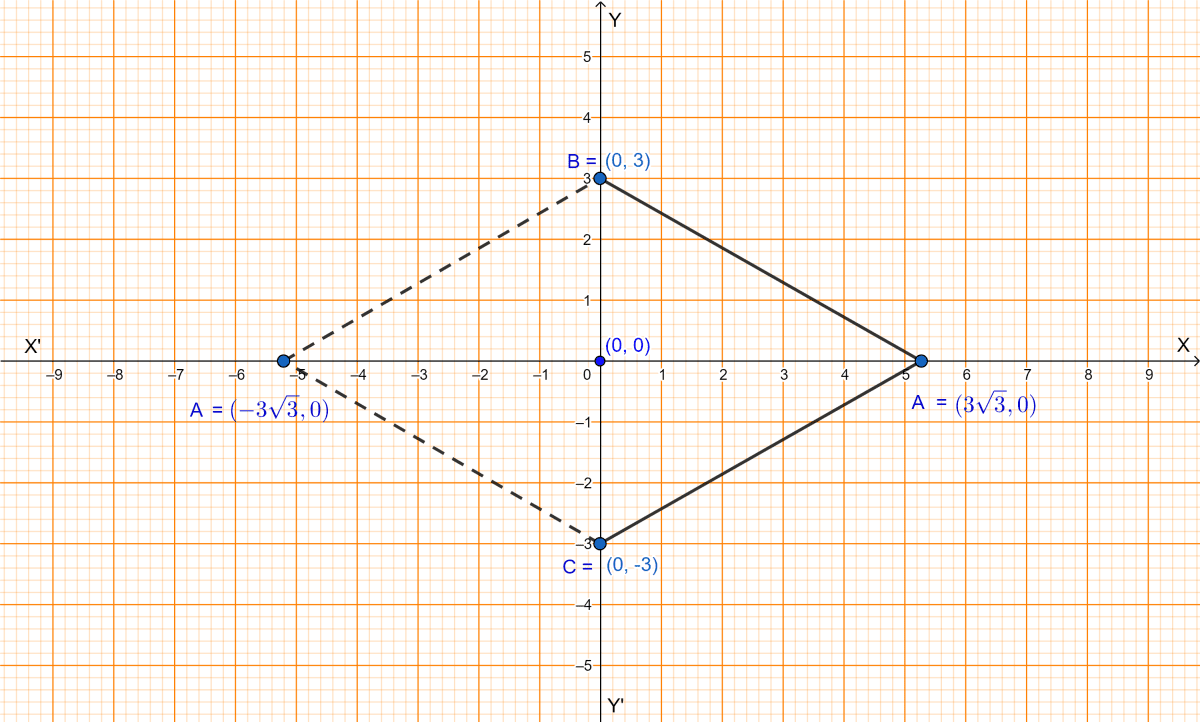
The base BC of an equilateral triangle ABC lies on y-axis. The coordinates of the point C are (0, -3). If origin is the mid-point of the base BC, find the coordinates of the points A and B.

Answer

Given, base BC of an equilateral triangle ABC lies on y-axis and coordinates of the point C are (0, -3).

Let coordinates of B be (x, y). Since, origin is the mid-point of the BC. So, by mid-point formula,

0=x+02 and y32=0x2=0 and y3=0x=0 and y3=0x=0 and y=3.\Rightarrow 0 = \dfrac{x + 0}{2} \text{ and } \dfrac{y - 3}{2} = 0 \\[1em] \Rightarrow \dfrac{x}{2} = 0 \text{ and } y - 3 = 0 \\[1em] \Rightarrow x = 0 \text{ and } y - 3 = 0 \\[1em] \Rightarrow x = 0 \text{ and } y = 3.

∴ Coordinates of B are (0, 3).

The base BC of an equilateral triangle ABC lies on y-axis. The coordinates of the point C are (0, -3). If origin is the mid-point of the base BC, find the coordinates of the points A and B. Section Formula, ML Aggarwal Understanding Mathematics Solutions ICSE Class 10.

From graph we can see that BC = 6 units. Since, ABC is an equilateral triangle so, AB = BC = AC.

Let coordinates of A be (a, 0) as it lies on x-axis.

AB = (a0)2+(03)2\sqrt{(a - 0)^2 + (0 - 3)^2}

Since AB = 6 units,

(a0)2+(03)2=6a2+9=6a2+9=36a2=369a2=27a=27a=±33.\therefore \sqrt{(a - 0)^2 + (0 - 3)^2} = 6 \\[1em] \Rightarrow \sqrt{a^2 + 9} = 6 \\[1em] \Rightarrow a^2 + 9 = 36 \\[1em] \Rightarrow a^2 = 36 - 9 \\[1em] \Rightarrow a^2 = 27 \\[1em] \Rightarrow a = \sqrt{27} \\[1em] \Rightarrow a = ±3\sqrt{3}.

∴ Coordinates of A are (±33,0)(±3\sqrt{3}, 0).

Hence, coordinates of A are (±33,0)(±3\sqrt{3}, 0) and of B are (0, 3).

Question 2

Find the coordinates of the point that divides the line segment joining the points P(5, -2) and Q(9, 6) internally in the ratio of 3 : 1.

Answer

Let R be the point whose co-ordinates are (x, y) which divides PQ in the ratio of 3 : 1.

By section formula, x-coordinate is given by,

x=m1x2+m2x1m1+m2=3×9+1×53+1=27+54=324=8.x = \dfrac{m_1x_2 + m_2x_1}{m_1 + m_2} \\[1em] = \dfrac{3 \times 9 + 1 \times 5}{3 + 1} \\[1em] = \dfrac{27 + 5}{4} \\[1em] = \dfrac{32}{4} \\[1em] = 8.

Similarly y-coordinate is given by,

y=m1y2+m2y1m1+m2=3×6+1×(2)3+1=18+(2)4=164=4.y = \dfrac{m_1y_2 + m_2y_1}{m_1 + m_2} \\[1em] = \dfrac{3 \times 6 + 1 \times (-2)}{3 + 1} \\[1em] = \dfrac{18 + (-2)}{4} \\[1em] = \dfrac{16}{4} \\[1em] = 4.

∴ R = (8, 4).

Hence, coordinates of point that divides PQ in the ratio 3 : 1 is (8, 4).

Question 3

Find the coordinates of the point P which is three-fourth of the way from A(3, -1) to B(-2, 5).

Answer

Coordinates of A(3, 1) and B(-2, 5).

Let P divides AB in ratio m1 : m2. Given P lies on AB such that,

AP = 34\dfrac{3}{4}AB = 34\dfrac{3}{4}(AP + PB)
⇒ 4AP = 3AP + 3PB
⇒ 4AP - 3AP = 3PB
⇒ AP = 3PB
⇒ AP : PB = 3 : 1.

∴ m1 : m2 = 3 : 1.

Let coordinates of P be (x, y). By section formula,

x=m1x2+m2x1m1+m2=(3×(2)+1×3)3+1=6+34=34.x = \dfrac{m_1x_2 + m_2x_1}{m_1 + m_2} \\[1em] = \dfrac{(3 \times (-2) + 1 \times 3)}{3 + 1} \\[1em] = \dfrac{-6 + 3}{4} \\[1em] = -\dfrac{3}{4}.

Similarly applying section formula we get y-coordinate,

y=m1y2+m2y1m1+m2=3×5+1×13+1=15+14=164=4.y = \dfrac{m_1y_2 + m_2y_1}{m_1 + m_2} \\[1em] = \dfrac{3 \times 5 + 1 \times 1}{3 + 1} \\[1em] = \dfrac{15 + 1}{4} \\[1em] = \dfrac{16}{4} \\[1em] = 4.

∴ P = (34,4).\Big(-\dfrac{3}{4}, 4\Big).

Hence, coordinates of P are (34,4).\Big(-\dfrac{3}{4}, 4\Big).

Question 4

P and Q are the points on the line segment joining the points A(3, -1) and B(-6, 5) such that AP = PQ = QB. Find the coordinates of P and Q.

Answer

Given, AP = PQ = QB

P and Q are the points on the line segment joining the points A(3, -1) and B(-6, 5) such that AP = PQ = QB. Find the coordinates of P and Q. Section Formula, ML Aggarwal Understanding Mathematics Solutions ICSE Class 10.

∴ P divides AB in the ratio of 1 : 2 and Q divides it in 2 : 1.

Let coordinates of P be (a, b) and of Q be (c, d)

Applying section formula for x coordinate of P we get,

a=m1x2+m2x1m1+m2=1×(6)+2×31+2=6+63=0.a = \dfrac{m_1x_2 + m_2x_1}{m_1 + m_2} \\[1em] = \dfrac{1 \times (-6) + 2 \times 3}{1 + 2} \\[1em] = \dfrac{-6 + 6}{3} \\[1em] = 0.

Similarly, applying section formula for y coordinate of P we get,

b=m1y2+m2y1m1+m2=1×5+2×(1)1+2=523=33=1.b = \dfrac{m_1y_2 + m_2y_1}{m_1 + m_2} \\[1em] = \dfrac{1 \times 5 + 2 \times (-1)}{1 + 2} \\[1em] = \dfrac{5 - 2}{3} \\[1em] = \dfrac{3}{3} \\[1em] = 1.

∴ Coordinates of P = (a, b) = (0, 1).

Applying section formula for x coordinate of Q we get,

c=m1x2+m2x1m1+m2=2×(6)+1×32+1=12+33=3.c = \dfrac{m_1x_2 + m_2x_1}{m_1 + m_2} \\[1em] = \dfrac{2 \times (-6) + 1 \times 3}{2 + 1} \\[1em] = \dfrac{-12 + 3}{3} \\[1em] = -3.

Similarly, applying section formula for y coordinate of Q we get,

d=m1y2+m2y1m1+m2=2×5+1×(1)2+1=10+(1)3=93=3.d = \dfrac{m_1y_2 + m_2y_1}{m_1 + m_2} \\[1em] = \dfrac{2 \times 5 + 1 \times (-1)}{2 + 1} \\[1em] = \dfrac{10 + (-1)}{3} \\[1em] = \dfrac{9}{3} \\[1em] = 3.

∴ Coordinates of Q = (c, d) = (-3, 3).

Hence, coordinates of P = (0, 1) and Q = (-3, 3).

Question 5

The center of a circle is (α + 2, α - 5). Find the value of α, given that the circle passes through points (2, -2) and (8, -2).

Answer

Given O(α + 2, α - 5) is the center of the circle. A and B are the points on the circle. So, we can say OA = OB = radius.

From distance formula we get,

OA=(2(α+2))2+(2(α5))2=(2α2)2+(2α+5)2=(α)2+(α+3)2=α2+α2+96α=2α26α+9....[Eq 1]OB=(8(α+2))2+(2(α5))2=(8α2)2+(2α+5)2=(6α)2+(3α)2=36+α212α+9+α26α=2α2+4518α....[Eq 2]OA = \sqrt{(2 - (α + 2))^2 + (-2 - (α - 5))^2} \\[1em] = \sqrt{(2 - α - 2)^2 + (-2 - α + 5)^2} \\[1em] = \sqrt{(-α)^2 + (-α + 3)^2} \\[1em] = \sqrt{α^2 + α^2 + 9 - 6α} \\[1em] = \sqrt{2α^2 - 6α + 9} \qquad \text{....[Eq 1]} \\[1em] OB = \sqrt{(8 - (α + 2))^2 + (-2 - (α - 5))^2} \\[1em] = \sqrt{(8 - α - 2)^2 + (-2 - α + 5)^2} \\[1em] = \sqrt{(6 - α)^2 + (3 - α)^2} \\[1em] = \sqrt{36 + α^2 - 12α + 9 + α^2 - 6α} \\[1em] = \sqrt{2α^2 + 45 - 18α} \qquad \text{....[Eq 2]}

Comparing both the Equation, since they are equal to radius,

2α26α+9=2α2+4518α\Rightarrow \sqrt{2α^2 - 6α + 9} = \sqrt{2α^2 + 45 - 18α} \\[1em]

Squaring both sides we get,

2α26α+9=2α2+4518α2α22α26α+18α+945=012α36=012α=36α=3.\Rightarrow 2α^2 - 6α + 9 = 2α^2 + 45 - 18α \\[1em] \Rightarrow 2α^2 - 2α^2 - 6α + 18α + 9 - 45 = 0 \\[1em] \Rightarrow 12α - 36 = 0 \\[1em] \Rightarrow 12α = 36 \\[1em] \Rightarrow α = 3.

Hence, the value of α = 3.

Question 6

The mid-point of the line segment joining A(2, p) and B(q, 4) is (3, 5). Calculate the values of p and q.

Answer

Given, (3, 5) is the mid-point of A(2, p) and B(q, 4).

By mid-point formula,

3=(2+q)2 and 5=(p+4)22+q=6 and p+4=10q=4 and p=6.\Rightarrow 3 = \dfrac{(2 + q)}{2} \text{ and } 5 = \dfrac{(p + 4)}{2} \\[1em] \Rightarrow 2 + q = 6 \text{ and } p + 4 = 10 \\[1em] \Rightarrow q = 4 \text{ and } p = 6.

Hence, p = 6 and q = 4.

Question 7

The ends of a diameter of a circle have the coordinates (3, 0) and (-5, 6). PQ is another diameter where Q has the coordinates (-1, -2). Find the coordinates of P and the radius of the circle.

Answer

Let AB be the diameter where coordinates of A are (3, 0) and of B are (-5, 6).

∴ Coordinates of its midpoint will be (3+(5)2,0+62)\Big(\dfrac{3 + (-5)}{2}, \dfrac{0 + 6}{2}\Big) or (-1, 3).

Now PQ is another diameter in which the coordinates of Q are (-1, -2).

Let coordinates of P be (x, y), then by mid-point formula coordinates of mid-point will be (1+x2,2+y2)\Big(\dfrac{-1 + x}{2}, \dfrac{-2 + y}{2}\Big)

Since, the diameters of circle intersect at their midpoint.

1+x2=1 and 2+y2=31+x=2 and 2+y=6x=2+1 and y=6+2x=1 and y=8.\therefore \dfrac{-1 + x}{2} = -1 \text{ and } \dfrac{-2 + y}{2} = 3 \\[1em] \Rightarrow -1 + x = -2 \text{ and } -2 + y = 6 \\[1em] \Rightarrow x = -2 + 1 \text{ and } y = 6 + 2 \\[1em] \Rightarrow x = -1 \text{ and } y = 8.

∴ Coordinates of P will be (-1, 8).

Radius = OP, by distance-formula we get,

OP=(1(1))2+(83)2=(1+1)2+(5)2=02+25=25=5 units.OP = \sqrt{(-1 - (-1))^2 + (8 - 3)^2} \\[1em] = \sqrt{(-1 + 1)^2 + (5)^2} \\[1em] = \sqrt{0^2 + 25} \\[1em] = \sqrt{25} \\[1em] = 5 \text{ units}.

Hence, the radius of circle is 5 units and the coordinates of P is (-1, 8).

Question 8

In what ratio does the point (-4, 6) divide the line segment joining the points A(-6, 10) and B(3, -8) ?

Answer

Let the point (-4, 6) divide the line segment joining the points A(-6, 10) and B(3, -8) in the ratio m : n

Using section-formula,

x-coordinate = (mx2+nx1m+n)\Big(\dfrac{mx_2 + nx_1}{m + n}\Big)

Comparing,

4=(m×3+n×(6)m+n)4=3m6nm+n4(m+n)=3m6n4m4n=3m6n4m3m=6n+4n7m=2nmn=27m:n=2:7.\Rightarrow -4 = \Big(\dfrac{m \times 3 + n \times (-6)}{m + n} \Big) \\[1em] \Rightarrow -4 = \dfrac{3m - 6n}{m + n} \\[1em] \Rightarrow -4(m + n) = 3m - 6n \\[1em] \Rightarrow -4m -4n = 3m - 6n \\[1em] \Rightarrow -4m - 3m = -6n + 4n \\[1em] \Rightarrow -7m = -2n \\[1em] \Rightarrow \dfrac{m}{n} = \dfrac{2}{7} \\[1em] \Rightarrow m : n = 2 : 7.

The ratio in which the point (-4, 6) divides the line segment is 2 : 7.

Question 9

Find the ratio in which the point P(-3, p) divides the line segment joining the points (-5, -4) and (-2, 3). Hence, find the value of p.

Answer

Let (-3, p) divides the line segment in the ratio of m : n.

By section-formula,

x-coordinate = (mx2+nx1m+n)\Big(\dfrac{mx_2 + nx_1}{m + n}\Big)

3=m×(2)+n×(5)m+n3=2m5nm+n3(m+n)=2m5n3m3n=2m5n3m+2m=5n+3nm=2nmn=21m:n=2:1.\therefore -3 = \dfrac{m \times (-2) + n \times (-5)}{m + n} \\[1em] \Rightarrow -3 = \dfrac{-2m - 5n}{m + n} \\[1em] \Rightarrow -3(m + n) = -2m - 5n \\[1em] \Rightarrow -3m - 3n = -2m - 5n \\[1em] \Rightarrow -3m + 2m = -5n + 3n \\[1em] \Rightarrow -m = -2n \\[1em] \Rightarrow \dfrac{m}{n} = \dfrac{2}{1} \\[1em] \Rightarrow m : n = 2 : 1. \\[1em]

By section formula, y-coordinate = p

=my2+ny1m+n=2×3+1×(4)2+1=643=23.= \dfrac{my_2 + ny_1}{m + n} \\[1em] = \dfrac{2 \times 3 + 1 \times (-4)}{2 + 1} \\[1em] = \dfrac{6 - 4}{3} \\[1em] = \dfrac{2}{3}.

Hence, the value of p = 23\dfrac{2}{3} and the ratio in which point P divides the line segment is 2 : 1.

Question 10

In what ratio is the line joining the points (4, 2) and (3, -5) divided by the x-axis? Also find the coordinates of the point of division.

Answer

Let the point P which is on the x-axis, divide the line segment joining the points A(4, 2) and B(3, -5) in the ratio of m : n. Let the coordinates of P be (x, 0).

By section formula,

y-coordinate = my2+ny1m+n\dfrac{my_2 + ny_1}{m + n}

0=m×(5)+n×2m+n0=5m+2n5m=2nmn=25m:n=2:5.\Rightarrow 0 = \dfrac{m \times (-5) + n \times 2}{m + n} \\[1em] \Rightarrow 0 = -5m + 2n \\[1em] \Rightarrow 5m = 2n \\[1em] \Rightarrow \dfrac{m}{n} = \dfrac{2}{5} \\[1em] \Rightarrow m : n = 2 : 5.

Putting value of m : n in section-formula for x-coordinate,

x-coordinate = mx2+nx1m+n\dfrac{mx_2 + nx_1}{m+ n}

=2×3+5×42+5=6+207=267.= \dfrac{2 \times 3 + 5 \times 4}{2 + 5} \\[1em] = \dfrac{6 + 20}{7} \\[1em] = \dfrac{26}{7}.

Hence, coordinates of P are (267,0)(\dfrac{26}{7}, 0) and 2 : 5 is the ratio in which the line joining the points (4, 2) and (3, -5) is divided by the x-axis.

Question 11

If the abscissa of a point P is 2, find the ratio in which it divides the line segment joining the points (-4, 3) and (6, 3). Hence, find the coordinates of P.

Answer

Let coordinates of A be (-4, 3) and of B be (6, 3) and of P be (2, y).

Let the ratio in which the P divides AB be m : n.

If the abscissa of a point P is 2, find the ratio in which it divides the line segment joining the points (-4, 3) and (6, 3). Hence, find the coordinates of P. Section Formula, ML Aggarwal Understanding Mathematics Solutions ICSE Class 10.

By section formula,

x-coordinate = mx2+nx1m+n\dfrac{mx_2 + nx_1}{m+ n}

2=m×6+n×(4)m+n2=6m4nm+n2(m+n)=6m4n2m+2n=6m4n2n+4n=6m2m6n=4m6n=4mmn=64m:n=3:2.\Rightarrow 2 = \dfrac{m \times 6 + n \times (-4)}{m + n} \\[1em] \Rightarrow 2 = \dfrac{6m - 4n}{m + n} \\[1em] \Rightarrow 2(m + n) = 6m - 4n \\[1em] \Rightarrow 2m + 2n = 6m - 4n \\[1em] \Rightarrow 2n + 4n = 6m - 2m \\[1em] \Rightarrow 6n = 4m \\[1em] \Rightarrow 6n = 4m \\[1em] \Rightarrow \dfrac{m}{n} = \dfrac{6}{4} \\[1em] \Rightarrow m : n = 3 : 2.

Similarly for y-coordinate,

y=my2+ny1m+n=3×3+2×33+2=9+65=155=3.\Rightarrow y = \dfrac{my_2 + ny_1}{m + n} \\[1em] = \dfrac{3 \times 3 + 2 \times 3}{3 + 2} \\[1em] = \dfrac{9 + 6}{5} \\[1em] = \dfrac{15}{5} \\[1em] = 3.

Hence, the coordinates of P is (2, 3) and it divides the line in the ratio 3 : 2.

Question 12

Determine the ratio in which the line 2x + y - 4 = 0 divide the line segment joining the points A(2, -2) and B(3, 7). Also find the coordinates of the point of the division.

Answer

Let the line 2x + y - 4 divide the line segment AB in the ratio m : n at P. So, by section-formula coordinates of P are,

x-coordinate = x = m×x2+n×x1m+n\dfrac{m \times x_2 + n \times x_1}{m + n}

=m×3+n×2m+n=3m+2nm+n....[Eq 1]= \dfrac{m \times 3 + n \times 2}{m + n} \\[1em] = \dfrac{3m + 2n}{m + n} \qquad \text{....[Eq 1]} \\[1em]

Similarly,

y-coordinate = y = m×y2+n×y1m+n\dfrac{m \times y_2 + n \times y_1}{m + n}

=m×7+n×(2)m+n=7m2nm+n....[Eq 2]= \dfrac{m \times 7 + n \times (-2)}{m + n} \\[1em] = \dfrac{7m - 2n}{m + n} \qquad \text{....[Eq 2]} \\[1em]

Since, P lies on the line 2x + y - 4 = 0.

2(3m+2n)m+n+7m2nm+n4=06m+4n+7m2n4(m+n)m+n=06m+4n+7m2n4m4n=09m2n=09m=2nmn=29\therefore 2\dfrac{(3m + 2n)}{m + n} + \dfrac{7m - 2n}{m + n} - 4 = 0 \\[1em] \Rightarrow \dfrac{6m + 4n + 7m - 2n -4(m + n)}{m + n} = 0 \\[1em] \Rightarrow 6m + 4n + 7m - 2n - 4m - 4n = 0 \\[1em] \Rightarrow 9m - 2n = 0 \\[1em] \Rightarrow 9m = 2n \\[1em] \Rightarrow \dfrac{m}{n} = \dfrac{2}{9} \\[1em]

Putting values in Eq 1 for x-coordinate we get,

x=3×2+2×92+9=6+1811=2411.\therefore x = \dfrac{3 \times 2 + 2 \times 9}{2 + 9} \\[1em] = \dfrac{6 + 18}{11} \\[1em] = \dfrac{24}{11}. \\[1em]

Putting values in Eq 2 for y-coordinate we get,

y = 7×22×92+9=141811=411.\text{y = } \dfrac{7 \times 2 - 2 \times 9}{2 + 9} \\[1em] = \dfrac{14 - 18}{11} \\[1em] = -\dfrac{4}{11}.

Hence, coordinates of P will be (2411,411)\Big(\dfrac{24}{11}, -\dfrac{4}{11}\Big) and 2 : 9 is the ratio in which the line 2x + y - 4 divides AB.

Question 13

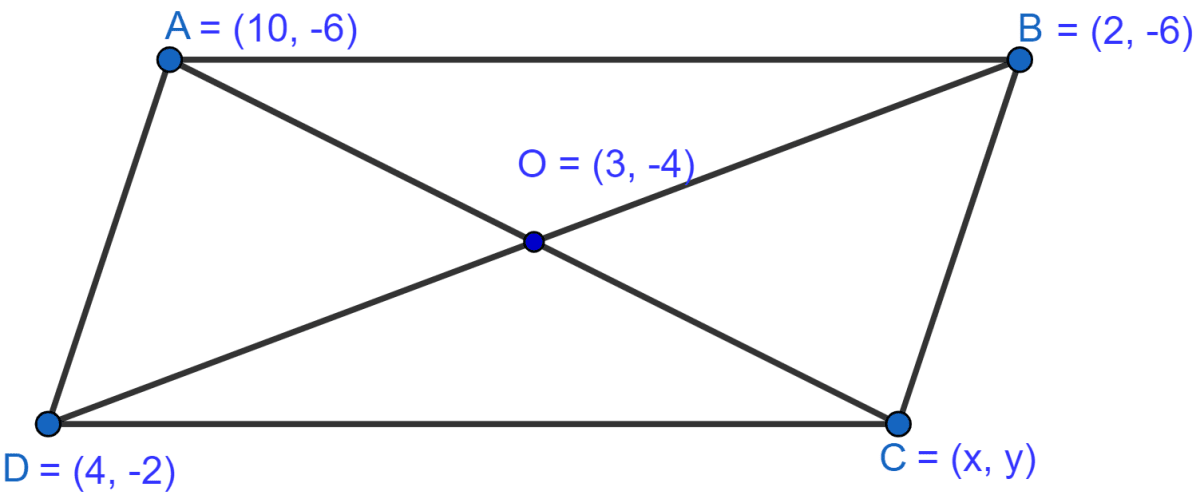
ABCD is a parallelogram. If the coordinates of A, B and D are (10, -6), (2, -6) and (4, -2) respectively, find the coordinates of C.

Answer

Let the coordinates of C be (x, y) and other three vertices of the given parallelogram are A(10, -6), B(2, -6) and D(4, -2).

Since, ABCD is a parallelogram, its diagonals bisect each other.

ABCD is a parallelogram. If the coordinates of A, B and D are (10, -6), (2, -6) and (4, -2) respectively, find the coordinates of C. Section Formula, ML Aggarwal Understanding Mathematics Solutions ICSE Class 10.

Let AC and BD intersect each other at O.

So, O is the mid-point of BD, so coordinates of O are,

(2+42,6+(2)2)=(62,82)=(3,4).\Rightarrow \Big(\dfrac{2 + 4}{2}, \dfrac{-6 + (-2)}{2}\Big) \\[1em] = \Big(\dfrac{6}{2}, \dfrac{-8}{2}\Big) \\[1em] = (3, -4).

The mid-point of AC is

(10+x2,6+y2)\Rightarrow \Big(\dfrac{10 + x}{2}, \dfrac{-6 + y}{2}\Big)

Since O is the mid-point of AC so comparing,

10+x2=3 and 6+y2=410+x=6 and 6+y=8x=610 and y=8+6x=4 and y=2.\Rightarrow \dfrac{10 + x}{2} = 3 \text{ and } \dfrac{-6 + y}{2} = -4 \\[1em] \Rightarrow 10 + x = 6 \text{ and } -6 + y = -8 \\[1em] \Rightarrow x = 6 - 10 \text{ and } y = -8 + 6 \\[1em] \Rightarrow x = -4 \text{ and } y = -2.

Hence, the coordinates of P are (-4, -2).

Question 14

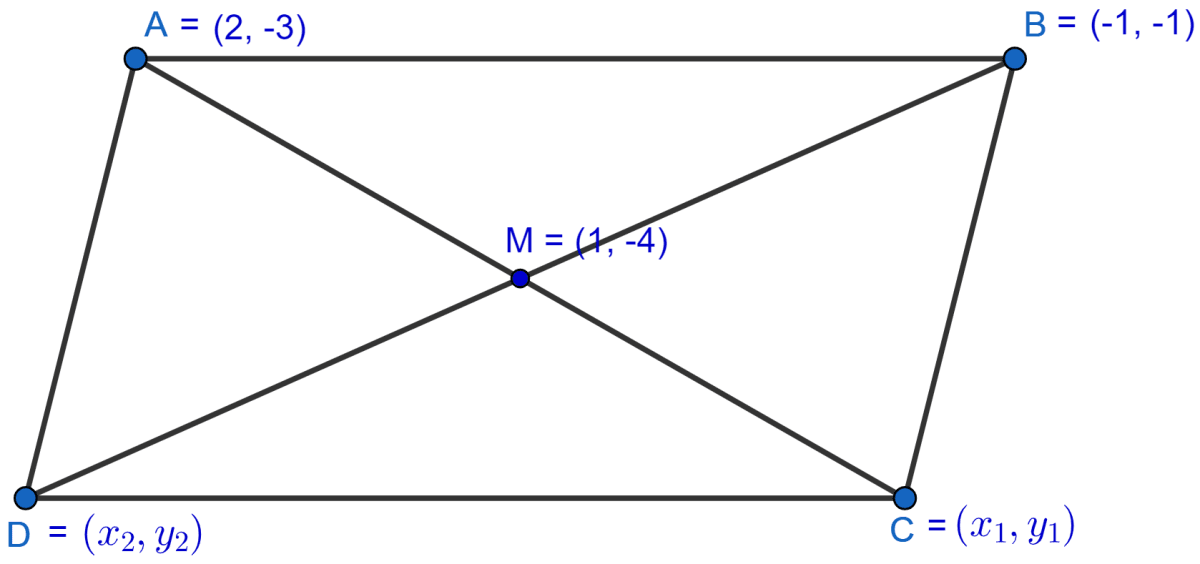
ABCD is a parallelogram whose vertices A and B have coordinates (2, -3) and (-1, -1) respectively. If the diagonals of the parallelogram meet at the point M(1, -4), find the coordinates of C and D. Hence, find the perimeter of the parallelogram.

Answer

Coordinates of A are (2, -3) and B (-1, -1).

Since, M is the point where diagonals meet, hence it is midpoint of AC and BD.

Let coordinates of C and D be (x1, y1) and (x2, y2).

ABCD is a parallelogram whose vertices A and B have coordinates (2, -3) and (-1, -1) respectively. If the diagonals of the parallelogram meet at the point M(1, -4), find the coordinates of C and D. Hence, find the perimeter of the parallelogram. Section Formula, ML Aggarwal Understanding Mathematics Solutions ICSE Class 10.

When M(1, -4) is the midpoint of AC then by midpoint formula,

1=2+x12 and 4=3+y122+x1=2 and 3+y1=8x1=22 and y1=8+3x1=0 and y1=5.\Rightarrow 1 = \dfrac{2 + x_1}{2} \text{ and } -4 = \dfrac{-3 + y_1}{2} \\[1em] \Rightarrow 2 + x_1 = 2 \text{ and } -3 + y_1 = -8 \\[1em] \Rightarrow x_1 = 2 - 2 \text{ and } y_1 = -8 + 3 \\[1em] \Rightarrow x_1 = 0 \text{ and } y_1 = -5.

∴ Coordinates of C are (0, -5)

When M(1, -4) is the midpoint of BD then by midpoint formula,

1=1+x22 and 4=1+y221+x2=2 and 1+y2=8x2=2+1 and y2=8+1x2=3 and y2=7.\Rightarrow 1 = \dfrac{-1 + x_2}{2} \text{ and } -4 = \dfrac{-1 + y_2}{2} \\[1em] \Rightarrow -1 + x_2 = 2 \text{ and } -1 + y_2 = -8 \\[1em] \Rightarrow x_2 = 2 + 1 \text{ and } y_2 = -8 + 1 \\[1em] \Rightarrow x_2 = 3 \text{ and } y_2 = -7.

∴ Coordinates of D are (3, -7).

By distance formula, the length of AB is,

=[2(1)]2+[(3)(1)]2=(2+1)2+(3+1)2=32+(2)2=9+4=13.= \sqrt{[2 - (-1)]^2 + [(-3) - (-1)]^2} \\[1em] = \sqrt{(2 + 1)^2 + (-3 + 1)^2} \\[1em] = \sqrt{3^2 + (-2)^2} \\[1em] = \sqrt{9 + 4} \\[1em] = \sqrt{13}.

By distance formula, the length of BC is,

=[0(1)]2+[(5)(1)]2=(1)2+(5+1)2=1+(4)2=1+16=17.= \sqrt{[0 - (-1)]^2 + [(-5) - (-1)]^2} \\[1em] = \sqrt{(1)^2 + (-5 + 1)^2} \\[1em] = \sqrt{1 + (-4)^2} \\[1em] = \sqrt{1 + 16} \\[1em] = \sqrt{17}.

Perimeter of parallelogram ABCD = 2(AB + BC) = 2(13+17).2(\sqrt{13} + \sqrt{17}).

Hence, the coordinates of C and D are (0, -5) and (3, -7) respectively. The perimeter of parallelogram ABCD is 2(13+17)2(\sqrt{13} + \sqrt{17}) units.

Question 15

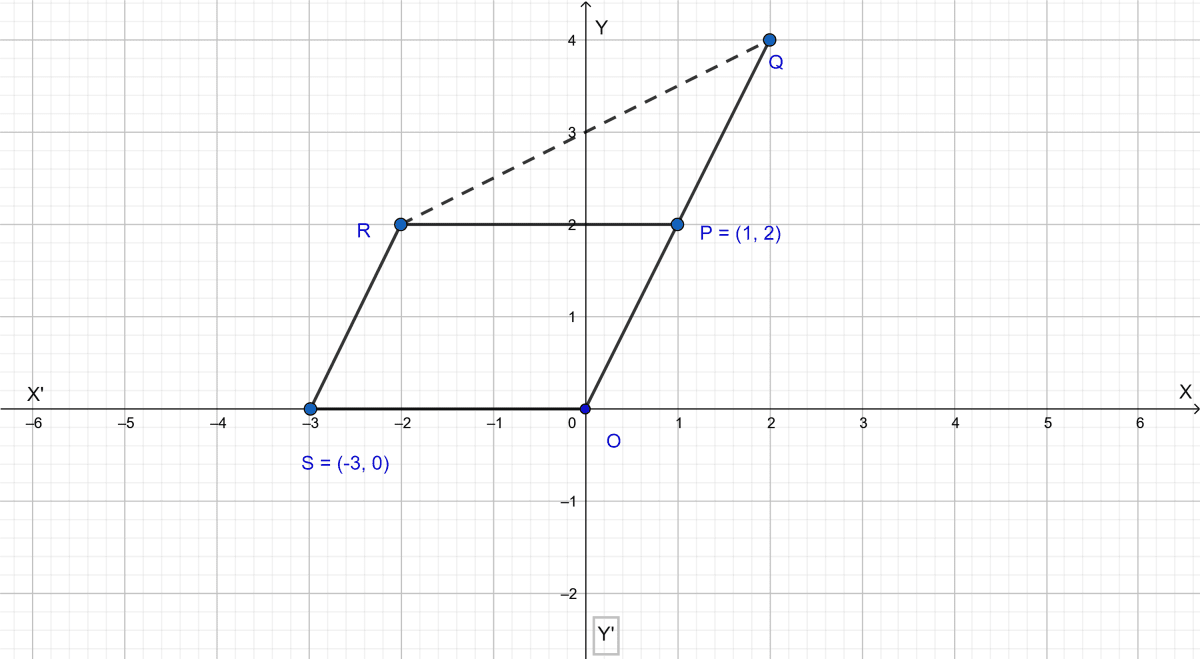
Given O (0, 0), P(1, 2), S(-3, 0). P divides OQ in the ratio 2 : 3 and OPRS is a parallelogram.

Given O (0, 0), P(1, 2), S(-3, 0). P divides OQ in the ratio 2 : 3 and OPRS is a parallelogram. Find (i) the coordinates of Q. (ii) the coordinates of R. (iii) the ratio in which RQ is divided by the x-axis. Section Formula, ML Aggarwal Understanding Mathematics Solutions ICSE Class 10.

Find :

(i) the coordinates of Q.

(ii) the coordinates of R.

(iii) the ratio in which RQ is divided by the x-axis.

Answer

(i) Let coordinates of Q be (a, b).

Given, point P(1, 2) divides OQ in the ratio of 2 : 3. Here, O(0, 0) is the origin.

By section formula we get x,

x-coordinate = m1x2+m2x1m1+m2\dfrac{m_1x_2 + m_2x_1}{m_1 + m_2}

1=2×a+3×02+31=2a5a=52.\Rightarrow 1 = \dfrac{2 \times a + 3 \times 0}{2 + 3} \\[1em] \Rightarrow 1 = \dfrac{2a}{5} \\[1em] \Rightarrow a = \dfrac{5}{2}.

By section formula we get y,

y-coordinate = m1y2+m2y1m1+m2\dfrac{m_1y_2 + m_2y_1}{m_1 + m_2}

2=2×b+3×02+32=2b5b=5.\Rightarrow 2 = \dfrac{2 \times b + 3 \times 0}{2 + 3} \\[1em] \Rightarrow 2 = \dfrac{2b}{5} \\[1em] \Rightarrow b = 5.

Hence, coordinates of Q are (52,5)(\dfrac{5}{2}, 5).

(ii) In OPRS, OR and PS are diagonals. Let them bisect each other at point M which is the mid-point of both the diagonals. Let coordinates of R be (c, d).

Since, M is the midpoint of PS, by mid-point formula, coordinates of M

=(1+(3)2,2+02)=(22,22)=(1,1).= \Big(\dfrac{1 + (-3)}{2}, \dfrac{2 + 0}{2}\Big) \\[1em] = \Big(\dfrac{-2}{2}, \dfrac{2}{2}\Big) \\[1em] = (-1, 1).

Since, M is the mid-point of OR also so,

1=0+c2 and 1=0+d2c=2 and d=2.\Rightarrow -1 = \dfrac{0 + c}{2} \text{ and } 1 = \dfrac{0 + d}{2} \\[1em] \Rightarrow c = -2 \text{ and } d = 2.

Hence, coordinates of R are (-2, 2).

(iii) Let the point on y-axis that divides RQ is N and it divides in ratio m1 : m2.

Since, N lies on y-axis so abscissa(x) = 0.

By section formula we get,

x-coordinate =m1x2+m2x1m1+m20=m1×52+m2×(2)m1+m25m122m2=052m1=2m2m1:m2=2×25m1:m2=4:5.\text{x-coordinate } = \dfrac{m_1x_2 + m_2x_1}{m_1 + m_2} \\[1em] \Rightarrow 0 = \dfrac{m_1 \times \dfrac{5}{2} + m_2 \times (-2)}{m_1 + m_2} \\[1em] \Rightarrow \dfrac{5m_1}{2} - 2m_2 = 0 \\[1em] \Rightarrow \dfrac{5}{2}m_1 = 2m_2 \\[1em] \Rightarrow m_1 : m_2 = \dfrac{2 \times 2}{5} \\[1em] \Rightarrow m_1 : m_2 = 4 : 5.

Hence, RQ is divided in the ratio 4 : 5 by x-axis.

Question 16

If A(5, -1), B(-3, -2) and C(-1, 8) are the vertices of a triangle ABC, find the length of the median through A and the coordinates of the centroid of triangle ABC.

Answer

A(5, -1), B(-3, -2) and C(-1, 8) are the vertices of △ABC. Below figure shows the triangle:

If A(5, -1), B(-3, -2) and C(-1, 8) are the vertices of a triangle ABC, find the length of the median through A and the coordinates of the centroid of triangle ABC. Section Formula, ML Aggarwal Understanding Mathematics Solutions ICSE Class 10.

Let D be the midpoint of BC. By midpoint formula, coordinates of D are,

=(3+(1)2,2+82)=(42,62)=(2,3).= \Big(\dfrac{-3 + (-1)}{2}, \dfrac{-2 + 8}{2}\Big) \\[1em] = \Big(\dfrac{-4}{2}, \dfrac{6}{2}\Big) \\[1em] = (-2, 3).

By distance formula we get,

AD=(x2x1)2+(y2y1)2=(25)2+(3(1))2=(7)2+(3+1)2=49+16=65 units.AD = \sqrt{(x_2 - x_1)^2 + (y_2 - y_1)^2} \\[1em] = \sqrt{(-2 - 5)^2 + (3 - (-1))^2} \\[1em] = \sqrt{(-7)^2 + (3 + 1)^2} \\[1em] = \sqrt{49 + 16} \\[1em] = \sqrt{65} \text{ units.}

Coordinates of centroid is given by (x1+x2+x33,y1+y2+y33)\Big(\dfrac{x_1 + x_2 + x_3}{3}, \dfrac{y_1 + y_2 + y_3}{3}\Big)

=(5+(3)+(1)3,1+(2)+83)=(13,53).= \Big(\dfrac{5 + (-3) + (-1)}{3}, \dfrac{-1 + (-2) + 8}{3}\Big) \\[1em] = \Big(\dfrac{1}{3}, \dfrac{5}{3}\Big).

Hence, the coordinates of the centroid of triangle is (13,53)\Big(\dfrac{1}{3}, \dfrac{5}{3}\Big) and the length of the median through A is 65\sqrt{65} units.

PrevNext