
Find the curved surface area of a right circular cone whose slant height is 10 cm and base radius is 7 cm.
Answer
Given, l = 10 cm and r = 7 cm.
Curved surface area of cone = πrl.
Putting values in above equation we get,
Curved surface area = = 22 × 10 = 220 cm2.
Hence, the curved surface area of right circular cone = 220 cm2.
Diameter of the base of a cone is 10.5 cm and slant height is 10 cm. Find its curved surface area.
Answer
Radius of base =
= = 5.25 cm.
Given, l = 10 cm.
Curved surface area of cone = πrl.
Putting values in above equation we get,
Curved surface area =
= = 165 cm2.
Hence, the curved surface area of right circular cone = 165 cm2.
Curved surface area of a cone is 308 cm2 and its slant height is 14 cm. Find :
(i) radius of the base
(ii) total surface area of the cone.
Answer
(i) Given, Curved surface area of a cone = 308 cm2 and slant height = 14 cm.
We know that,
Curved surface area of cone = πrl.
∴ πrl = 308
⇒ x r x 14 = 308
⇒ 22 × r × 2 = 308
⇒ 44r = 308
⇒ r = = 7 cm.
Hence, the radius of the base = 7 cm.
(ii) Total surface area of cone = πr(l + r)
Putting values in above equation we get,
Total surface area = x 7 x (14 + 7) = 22 × 1 × 21 = 462 cm2.
Hence, the total surface area of right circular cone = 462 cm2.
Find the volume of the right circular cone with
(i) radius 6 cm and height 7 cm
(ii) radius 3.5 cm and height 12 cm.
Answer
(i) Given, r = 6 cm and h = 7 cm.
Volume of cone =
Putting values in equation we get,
Volume of cone = = 22 × 12 = 264 cm3.
Hence, the volume of cone = 264 cm3.
(ii) Given, r = 3.5 cm and h = 12 cm.
Volume of cone =
Putting values in equation we get,
Volume of cone = = 22 × 1.75 × 4 = 154 cm3.
Hence, the volume of cone = 154 cm3.
Find the capacity in litres of a conical vessel with
(i) radius 7 cm, slant height 25 cm
(ii) height 12 cm, slant height 13 cm.
Answer
(i) Given, l = 25 cm and r = 7 cm.
We know that,
l2 = r2 + h2
⇒ 252 = 72 + h2
⇒ h2 = 252 - 72
⇒ h2 = 625 - 49
⇒ h2 = 576
⇒ h = = 24 cm.
Volume of cone =
Putting values in equation we get,
Volume of cone = = 22 × 7 × 8 = 1232 cm3.
Since 1 litre = 1000 cm3 or, 1 cm3 = litre.
∴ 1232 cm3 = litre = 1.232 litre.
Hence, the volume of cone = 1.232 litre.
(ii) Given, l = 13 cm and h = 12 cm.
We know that,
l2 = r2 + h2
⇒ 132 = r2 + 122
⇒ r2 = 132 - 122
⇒ r2 = 169 - 144
⇒ r2 = 25
⇒ r = = 5 cm.
Volume of cone =
Putting values in equation we get,
Volume of cone = cm3.
Since 1 litre = 1000 cm3 or, 1 cm3 = litre.
∴ cm3 = litres.
Hence, the volume of cone = litres.
A conical pit of top diameter 3.5 m is 12 m deep. What is its capacity in kiloliters ?
Answer
Radius = m.
Height = 12 m.
Volume of cone =
Putting values in equation we get,
Volume of cone,
m3.
Since, 1 m3 = 1 kiloliters.
Hence, capacity of pit = 38.5 kiloliters.
If the volume of a right circular cone of height 9 cm is 48π cm3, find the diameter of its base.
Answer
We know,
Volume of cone = .
Given, Volume of cone = 48π cm3 and h = 9 cm.
Diameter = 2 × Radius = 2 × 4 = 8 cm.
Hence, the diameter of the base = 8 cm.
The height of the cone is 15 cm. If its volume is 1570 cm3, find the radius of the base. (Use π = 3.14)
Answer
We know,
Volume of cone = .
Given, Volume of cone = 1570 cm3 and h = 15 cm.
Hence, the radius of the base = 10 cm.
The slant height and base diameter of a conical tomb are 25 m and 14 m respectively. Find the cost of white washing its curved surface area at the rate of ₹210 per 100 m2.
Answer
Cost = ₹ 210 / 100 m2 = ₹ 2.1 / m2.
Given, l = 25 m and diameter = 14 m.
Radius = = = 7m.
Curved surface area of cone = πrl.
Putting values in equation,
Curved surface area = = 22 × 25 = 550 m2.
Cost of white washing 1 m2 = ₹ 2.1
∴ Cost of white washing 550 m2 = ₹ 2.1 × 550 = ₹ 1155.
Hence, the cost of white washing 550 m2 = ₹ 1155.
A conical tent is 10 m high and the radius of its base is 24 m. Find :
(i) slant height of the tent.
(ii) cost of the canvas required to make the tent, if the cost of 1 m2 canvas is ₹ 70.
Answer
(i) Given r = 24 m and h = 10 m.
We know that,
Putting values in the formula we get,
Hence, the slant height of the cone = 26 cm.
(ii) Curved surface area of cone = πrl.
Putting values in equation,
Curved surface area of tent = m2.
Cost of 1 m2 of canvas = ₹ 70
∴ Cost of m2 of canvas = ₹ × 70 = ₹ 137280.
Hence, the cost of canvas required to make tent = ₹ 137280.
A Joker's cap is in the form of a right circular cone of base radius 7 cm and height 24 cm. Find the area of the cloth required to make 10 such caps.
Answer
Given, r = 7 cm and h = 24 cm.
We know that,
Putting values in the formula we get,
Curved surface area of cone = πrl.
Putting values in equation,
Curved surface area of cap = = 22 × 25 = 550 cm2.
∴ Curved surface area of 10 caps = 10 × 550 = 5500 cm2.
Hence, the area of the cloth required to make 10 such caps is 5500 cm2.
The ratio of the base radii of two right circular cones of the same height is 3 : 4. Find the ratio of their volumes.
Answer
Let radius of cones be 3a and 4a.
Since, height of both cones is same let it be h.
We know volume of cone = .
Ratio of volume of two cones =
Hence, the ratio of the volume of two cones = 9 : 16.
The ratio of the heights of two right circular cones is 5 : 2 and that of their base radii is 2 : 5. Find the ratio of their volumes.
Answer
Let height of cones be 5a and 2a and radius of cones be 2b and 5b.
We know volume of cone = .
Ratio of volume of two cones =
Hence, the ratio of the volume of two cones = 2 : 5.
The height and the radius of the base of a right circular cone is half the corresponding height and radius of another bigger cone. Find :
(i) the ratio of their volumes.
(ii) the ratio of their lateral surface areas.
Answer
(i) Let the radius and height of the bigger cone be r and h respectively.
So, smaller cone's radius = and height = .
We know volume of cone = .
Ratio of volume of two cones =
Hence, the ratio of the volumes of cone = 1 : 8.
(ii) Let the slant height of bigger cone be l .
l =
Let slant height of smaller cone be l1.
We know that lateral surface area of cone = π × radius × slant height.
Ratio of lateral surface area of two cones
Hence, the ratio of the lateral surface area of cones = 1 : 4.
Find what length of canvas 2 m in width is required to make a conical tent 20 m in diameter and 42 m in slant height allowing 10% for folds and the stitching. Also find the cost of the canvas at the rate of ₹80 per meter.
Answer
Given diameter of conical tent = 20 m and l = 42 m.
Radius = = 10 m.
We know that curved surface area of cone = π × radius × slant height.
Putting values we get,
Curved surface area of tent = x 10 x 42 = 22 × 10 × 6 = 1320 m2.
10% of 1320 = x 1320 = 132 m2.
Total area of canvas required for making tent = 1320 + 132 = 1452 m2.
Area of rectangular cloth = l × b.
∴ l × b = 1452
⇒ l × 2 = 1452
⇒ l = m.
Since, the cost of canvas = ₹ 80/meter.
∴ The cost of 726 m of canvas = ₹ 726 × 80 = ₹ 58080.
Hence, the length of canvas required to make conical tent is 726 m and the cost of canvas = ₹ 58080.
The perimeter of the base of a cone is 44 cm and the slant height is 25 cm. Find the volume and the curved surface of the cone.
Answer
Given, circumference of base = 44 cm.
⇒ 2πr = 44
Given, l = 25 cm.
We know that,
l2 = r2 + h2
⇒ 252 = 72 + h2
⇒ h2 = 252 - 72
⇒ h2 = 625 - 49
⇒ h2 = 576
⇒ h = = 24 cm.
Volume of cone =
Putting values in equation we get,
Volume of cone =
=
= 22 × 7 × 8 = 1232 cm3.
Curved surface area = πrl.
Putting values in equation we get,
Curved surface area = = 22 × 25 = 550 cm2.
The volume of a right circular cone is 9856 cm3 and the area of its base is 616 cm2. Find
(i) the slant height of the cone.
(ii) total surface area of the cone.
Answer
Given, area of base = 616 cm2.
Area of base = πr2.
∴ πr2 = 616
Volume of cone =
(i) We know that,
l2 = r2 + h2
⇒ l2 = 142 + 482
⇒ l2 = 196 + 2304
⇒ l2 = 2500
⇒ l = = 50 cm.
Hence, the slant height of cone = 50 cm.
(ii) Total surface area of cone = πr(l + r).
Putting values in equation we get,
Total surface area of cone = = 22 × 2 × 64 = 2816 cm2.
Hence, the total surface area of cone = 2816 cm2.
A right triangle with sides 6 cm, 8 cm and 10 cm is revolved about the side 8 cm. Find the volume and the curved surface of the cone so formed. (Take π = 3.14)
Answer
Since, triangle is revolved about 8 cm side so,
h = 8 cm, r = 6 cm and l = 10 cm.
Volume of cone =
Putting values in equation we get,
Volume of cone =
=
= 301.44 cm3.
Curved surface area = πrl.
Putting values in equation we get,
Curved surface area = 3.14 × 6 × 10 = 188.4 cm2.
Hence, the volume of cone = 301.44 cm3 and curved surface area = 188.4 cm2.
The height of a cone is 30 cm. A small cone is cut off at the top by a plane parallel to its base. If its volume be of the volume of the given cone, at what height above the base is the section cut?
Answer
Let OAB be the given cone of height 30 cm and base radius R cm. Let this cone be cut by the plane CND (parallel to the base plane AMB) to obtain cone OCD with height h cm and base radius r cm as shown in the figure below:
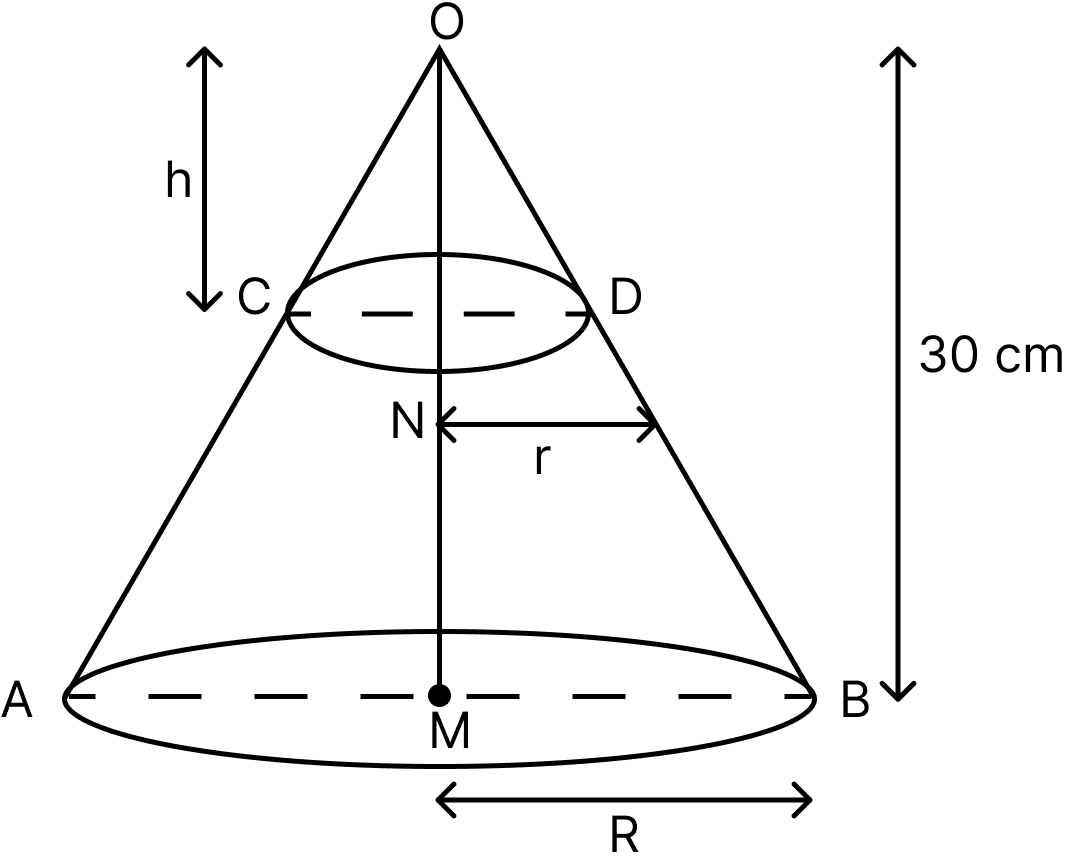
Then △OND ~ △OMB.
∴ .....(i)
According to given,
Volume of cone OCD = Volume of cone OAB
Dividing both sides by π and multiplying by 3 we get,
Using (i)
The height of the cone OCD = 10 cm.
∴ The section is cut at the height of (30 - 10) cm = 20 cm.
Hence, the section cut is above 20 cm from the base.
A semi-circular lamina of radius 35 cm is folded so that the two bounding radii are joined together to form a cone. Find :
(i) the radius of the cone.
(ii) the (lateral) surface area of the cone.
Answer
(i) Length of the arc of the semi-circular sheet =
= πr = x 35 = 110 cm

Let r cm be the radius of the cone, then
Hence, the radius of the cone is 17.5 cm.
(ii) Curved surface area of cone = area of semi-circular sheet.
Hence, the curved surface area of the cone = 1925 cm2.