
State which one of the following is true :
The straight lines y = 3x - 5 and 2y = 4x + 7 are
(i) parallel
(ii) perpendicular
(iii) neither parallel nor perpendicular.
Answer
Lines are y = 3x - 5 and 2y = 4x + 7 or y = 2x + .
Comparing y = 3x - 5 and y = 2x + with y = mx + c we get,
slopes = 3 and 2.
Since, slope of both the lines are neither equal nor their products is -1. Thus, the lines are neither parallel nor perpendicular.
∴ Option (iii) is correct
Hence, the straight lines y = 3x - 5 and 2y = 4x + 7 are neither parallel nor perpendicular.
If 6x + 5y - 7 = 0 and 2px + 5y + 1 = 0 are parallel lines, find the value of p.
Answer
Converting 6x + 5y - 7 = 0 in the form y = mx + c we get,
⇒ 6x + 5y - 7 = 0
⇒ 5y = -6x + 7
⇒ y =
Comparing, we get slope of this line = m1 = .
Converting 2px + 5y + 1 = 0 in the form y = mx + c we get,
⇒ 2px + 5y + 1 = 0
⇒ 5y = -2px - 1
⇒ y =
Comparing, we get slope of this line = m2 =
Given, two lines are parallel so their slopes will be equal,
m1 = m2
Hence, the value of p = 3.
If the straight lines 3x - 5y + 7 = 0 and 4x + ay + 9 = 0 are perpendicular to one another, find the value of a.
Answer
Converting 3x - 5y + 7 = 0 in the form y = mx + c we get,
⇒ 3x - 5y + 7 = 0
⇒ 5y = 3x + 7
⇒ y =
Comparing, we get slope of first line = m1 = .
Converting 4x + ay + 9 = 0 in the form y = mx + c we get,
⇒ 4x + ay + 9 = 0
⇒ ay = -4x - 9
⇒ y =
Comparing, we get slope of second line = m2 =
Given, two lines are perpendicular so product of their slopes will be equal to -1,
m1.m2 = -1
Hence, the value of a = .
If the lines 3x + by + 5 = 0 and ax - 5y + 7 = 0 are perpendicular to each other, find the relation connecting a and b.
Answer
Given,
Lines 3x + by + 5 = 0 and ax - 5y + 7 = 0 are perpendicular to each other. Then the product of their slopes is -1.
Converting 3x + by + 5 = 0 in the form y = mx + c.
⇒ by = -3x - 5
⇒ y = .
Comparing with y = mx + c we get,
Slope of first line = m1 = .
Converting ax - 5y + 7 = 0 in the form y = mx + c.
⇒ 5y = ax + 7
⇒ y = .
Comparing with y = mx + c we get,
Slope of second line = m2 = .
For perpendicular lines, product of their slopes is -1.
∴ m1.m2 = -1.
Hence, the relation between a and b is given by 3a = 5b.
Is the line through (-2, 3) and (4, 1) perpendicular to the line 3x = y + 1? Does the line 3x = y + 1 bisect the join of (-2, 3) and (4, 1)?
Answer
Equation of line through (-2, 3) and (4, 1) can be given by two-point form i.e.,
Putting values in above formula we get,
Comparing the above equation with y = mx + c we get,
slope = m1 =
The other equation is 3x = y + 1 or y = 3x - 1, comparing this with y = mx + c we get,
slope = m2 = 3.
Product of slopes,
Since, the product of slopes is -1 hence, the lines are perpendicular to each other.
Mid-point of (-2, 3) and (4, 1) can be given by mid-point formula i.e.,
= (1, 2).
Line 3x = y + 1 bisects the line joining (-2, 3) and (4, 1) if the mid-point i.e., (1, 2) satisfies the equation.
Putting (1, 2) in 3x = y + 1.
L.H.S. = 3x = 3(1) = 3.
R.H.S. = y + 1 = 2 + 1 = 3.
Since, L.H.S. = R.H.S. hence, (1, 2) satisfies 3x = y + 1.
Hence, the line 3x = y + 1 is perpendicular to the line joining (-2, 3) and (4, 1) and also bisects it.
The line through A(-2, 3) and B(4, b) is perpendicular to the line 2x - 4y = 5. Find the value of b.
Answer
Slope of the line =
Slope of line passing through A and B is m1,
The equation of other line is,
⇒ 2x - 4y = 5
⇒ 4y = 2x - 5
⇒ y =
⇒ y =
Comparing the equation with y = mx + c we get,
slope = m2 =
As lines are perpendicular to each other, we have
Hence, the value of b is -9.
If the lines 3x + y = 4, x - ay + 7 = 0 and bx + 2y + 5 = 0 form three consecutive sides of a rectangle, find the values of a and b.
Answer
Given lines are :
3x + y = 4 ....(i)
x- ay + 7 = 0 ....(ii)
bx + 2y + 5 = 0 ....(iii)
It's said that these lines form three consecutive sides of a rectangle.
So,
Lines (i) and (ii) must be perpendicular and also (ii) and (iii) will be perpendicular.
Slope of line (i) is
⇒ 3x + y = 4
⇒ y = -3x + 4.
Comparing with y = mx + c we get,
slope = m1 = -3.
Slope of line (ii) is
⇒ x - ay + 7 = 0
⇒ ay = x + 7
⇒ y =
Comparing with y = mx + c we get,
slope = m2 = .
Slope of line (iii) is
⇒ bx + 2y + 5 = 0
⇒ 2y = -bx - 5
⇒ y =
Comparing with y = mx + c we get,
slope = m3 = .
Since, lines (i) and (ii) are perpendicular so,
⇒ m1 × m2 = -1
Since, lines (ii) and (iii) are perpendicular so,
⇒ m2 × m3 = -1
Thus, the value of a is 3 and the value of b is 6.
Find the value of 'p' if the lines 5x - 3y + 2 = 0 and 6x - py + 7 = 0 are perpendicular to each other. Hence find the equation of a line passing through (-2, -1) and parallel to 6x - py + 7 = 0.
Answer
Given lines,
⇒ 5x - 3y + 2 = 0 and 6x - py + 7 = 0
⇒ 3y = 5x + 2 and py = 6x + 7
⇒ y =
Comparing above equations with y = mx + c we get,
Slope of 1st line =
Slope of 2nd line =
Since, product of slopes of perpendicular lines = -1.
Given,
⇒ 6x - py + 7 = 0
⇒ 6x - (-10)y + 7 = 0
⇒ 6x + 10y + 7 = 0
⇒ 10y = -6x - 7
⇒ y =
Comparing above equations with y = mx + c we get,
Slope =
Since, parallel lines have equal slope.
∴ Slope of line parallel to line 6x + 10y + 7 = 0 is
By point-slope form,
⇒ y - y1 = m(x - x1)
Equation of line passing through (-2, -1) and slope is
Hence, p = -10 and the equation of line is 3x + 5y + 11 = 0.
Find the equation of a line, which has the y-intercept 4, and is parallel to the line 2x - 3y - 7 = 0. Find the coordinates of the point where it cuts the x-axis.
Answer
Given equation of line,
⇒ 2x - 3y - 7 = 0,
Converting it in the form y = mx + c,
⇒ 3y = 2x - 7
⇒ y = .
Comparing with y = mx + c, slope = .
Since,the other line is parallel so, its slope will also be equal to . Given, y-intercept is 4 or c = 4.
Putting values of slope and y-intercept in y = mx + c, we will get the equation of line as,
⇒ y =
⇒ y =
⇒ 3y = 2x + 12
⇒ 2x - 3y + 12 = 0.
At the point where the line intersects the x-axis, the y-coordinate there will be zero. So, putting y = 0 in 2x - 3y + 12 = 0.
⇒ 2x - 3(0) + 12 = 0
⇒ 2x = -12
⇒ x = -6.
∴ Coordinates = (-6, 0).
Hence, the equation of the line is 2x - 3y + 12 = 0 and it intersects the x-axis at (-6, 0).
Find the equation of a straight line perpendicular to the line 2x + 5y + 7 = 0 and with y-intercept -3.
Answer
Given equation of line,
⇒ 2x + 5y + 7 = 0
Converting it in the form y = mx + c,
⇒ 5y = -2x - 7
⇒ y = .
Comparing with y = mx + c we get,
m =
Let slope of other line be m', since lines are perpendicular so,
⇒ m × m' = -1
Given, y-intercept = -3, putting values of slope and y-intercept in y = mx + c we get,
Hence, the equation of the line is 5x - 2y - 6 = 0.
Find the equation of a straight line perpendicular to the line 3x - 4y + 12 = 0 and having same y-intercept as 2x - y + 5 = 0.
Answer
Given equation of line,
⇒ 3x - 4y + 12 = 0
Converting it in the form y = mx + c,
⇒ 4y = 3x + 12
⇒ y = .
Comparing with y = mx + c we get,
Slope (m1) = .
Let the slope of the line perpendicular to the given line be m2. So,
m1 × m2 = -1
The other line is 2x - y + 5 = 0 or y = 2x + 5.
Comparing with y= mx + c we get, c = 5.
So, the new line has slope = and y-intercept = 5.
Putting these values in y = mx + c,
Hence, the equation of the line is 4x + 3y - 15 = 0.
Find the equation of the line passing through (0, 4) and parallel to the line 3x + 5y + 15 = 0.
Answer
Given equation of line,
⇒ 3x + 5y + 15 = 0
Converting it in the form y = mx + c,
⇒ 5y = -3x - 15
⇒ y =
Comparing with y = mx + c we get,
Slope =
The slope of the line parallel to the given line will also be .
Given, the new line has slope = and passes through (0, 4).
So, equation can be given by,
⇒ y - y1 = m(x - x1)
Hence, the equation of the line is 3x + 5y - 20 = 0.
(i) The line 4x - 3y + 12 = 0 meets the x-axis at A. Write down the coordinates of A.
(ii) Determine the equation of the line passing through A and perpendicular to 4x - 3y + 12 = 0.
Answer
(i) When the line meets x-axis, its y-coordinate = 0.
So, putting y = 0 in 4x - 3y + 12 = 0, we get
⇒ 4x - 3(0) + 12 = 0
⇒ 4x = -12
⇒ x = -3.
Hence, the line meets the x-axis at A(-3, 0).
(ii) Converting 4x - 3y + 12 = 0, in the form y = mx + c.
⇒ 4x - 3y + 12 = 0
⇒ 3y = 4x + 12
⇒ y =
Comparing the above equation with y = mx + c we get,
Slope (m1) =
Let the slope of the line perpendicular to the given line be m2.
∴ m1 × m2 = -1
Equation of the line having slope = and passing through (-3, 0) can be given by,
Hence, the equation of the line is 3x + 4y + 9 = 0.
Find the equation of the line that is parallel to 2x + 5y - 7 = 0 and passes through the mid-point of the line segment joining the points (2, 7) and (-4, 1).
Answer
Given equation of line,
⇒ 2x + 5y - 7 = 0
Converting it in the form y = mx + c,
⇒ 5y = -2x + 7
⇒ y =
So, the slope is .
Since, slope of parallel lines are equal. So, slope of parallel line will be
By mid-point formula, the mid-point of the line segment joining the points (2, 7) and (-4, 1) is
= (-1, 4).
Equation of the line having slope = and passing through (-1, 4) can be given by,
Hence, the equation of the line is 2x + 5y - 18 = 0.
Find the equation of the line that is perpendicular to 3x + 2y - 8 = 0 and passes through the mid-point of the line segment joining the points (5, -2) and (2, 2).
Answer
Given equation of line,
⇒ 3x + 2y - 8 = 0
Converting it in the form y = mx + c,
⇒ 2y = -3x + 8
⇒ y =
Comparing with y = mx + c we get,
Slope (m1) =
Now, the coordinates of the mid-point of the line segment joining the points (5, -2) and (2, 2) will be
Let's consider the slope of the line perpendicular to the given line be m2.
Then,
The equation of the new line with slope m2 and passing through can be given by point-slope form i.e.,
y - y1 = m(x - x1)
Putting values we get,
Hence, the equation of the line is 2x - 3y - 7 = 0.
Find the equation of a straight line passing through the intersection of 2x + 5y - 4 = 0 with x-axis and parallel to the line 3x - 7y + 8 = 0.
Answer
Let the point of intersection of the line 2x + 5y - 4 = 0 and the x-axis be (x1, 0).
Substituting the value of points in equation,
⇒ 2x1 + 5 × 0 - 4 = 0
⇒ 2x1 = 4
⇒ x1 = 2.
Coordinates of the point of intersection will be (2, 0).
Given new line is parallel to 3x - 7y + 8 = 0.
Converting it in the form y = mx + c,
3x - 7y + 8 = 0
⇒ 7y = 3x + 8
⇒ y =
Comparing equation with y = mx + c, we get slope = .
The equation of the line with slope and passing through (2, 0) can be given by point-slope form,
Hence, the equation of the new line is 3x - 7y - 6 = 0.
Line AB is perpendicular to line CD. Coordinates of B, C and D are (4, 0), (0, -1) and (4, 3) respectively. Find
(i) the slope of CD
(ii) the equation of line AB
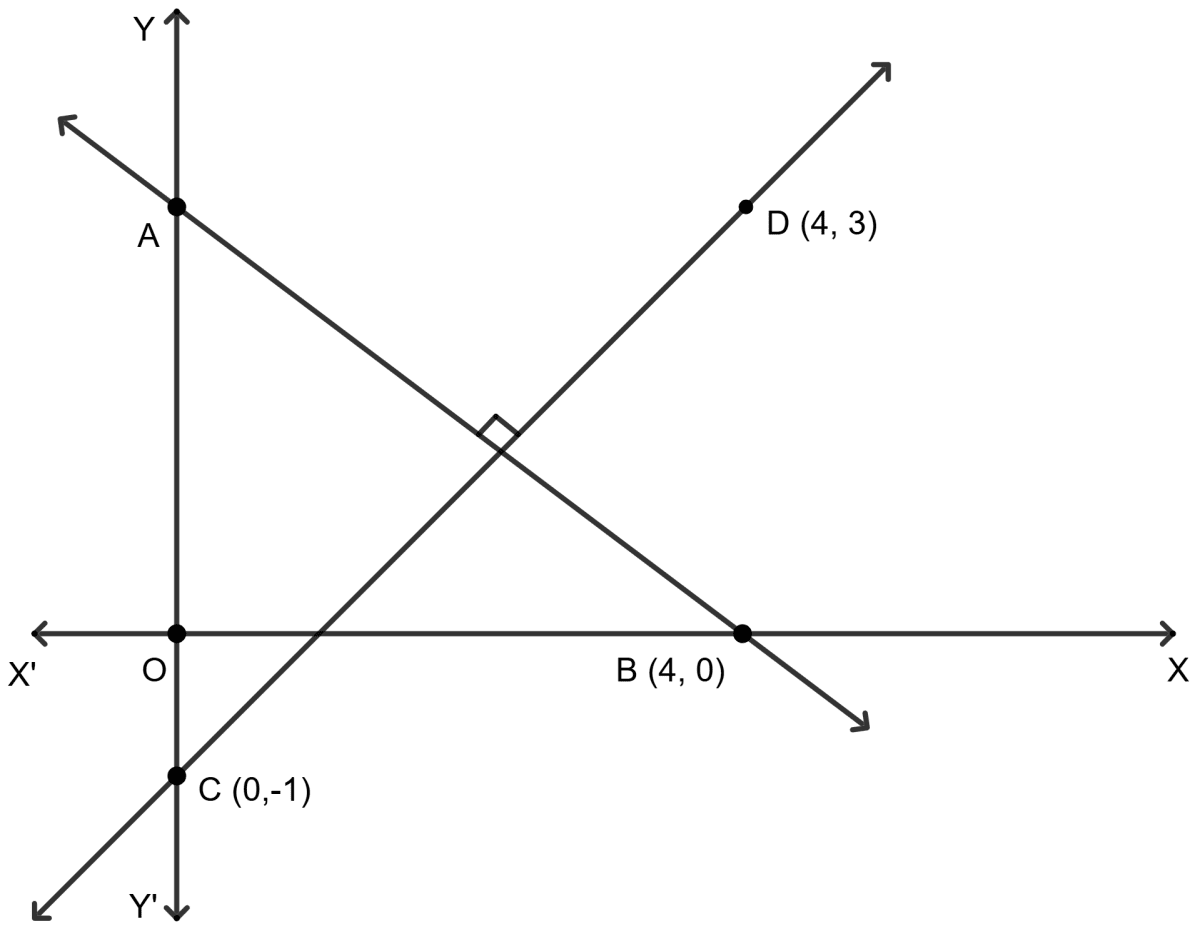
Answer
(i) By formula,
Slope of a line =
Substituting values we get :
Slope of CD = = 1.
Hence, slope of CD = 1.
(ii) We know that,
The product of slope of two perpendicular lines equals to -1.
∴ Slope of AB × Slope of CD = -1
⇒ Slope of AB × 1 = -1
⇒ Slope of AB = -1.
By point-slope formula,
Equation of line :
⇒ y - y1 = m(x - x1)
Equation of AB :
⇒ y - 0 = -1(x - 4)
⇒ y = -x + 4
⇒ x + y = 4.
Hence, equation of AB is x + y = 4.
Find the equation of a line parallel to the line 2x + y - 7 = 0 and passing through the point of intersection of the lines x + y - 4 = 0 and 2x - y = 8.
Answer
Simultaneously solving equations :
⇒ x + y - 4 = 0 .......(1)
⇒ 2x - y = 8 ........(2)
Solving equation (1), we get :
⇒ x = 4 - y ...........(3)
Substituting value of x from (3) in (2), we get :
⇒ 2(4 - y) - y = 8
⇒ 8 - 2y - y = 8
⇒ 8 - 3y = 8
⇒ 3y = 0
⇒ y = 0.
Substituting value of y in (3), we get :
⇒ x = 4 - 0 = 4.
Point of intersection = (4, 0).
Given,
Equation :
⇒ 2x + y - 7 = 0
⇒ y = -2x + 7
Comparing above equation with y = mx + c, we get :
⇒ m = -2.
We know that,
Slope of parallel lines are equal.
∴ Slope of line parallel to 2x + y - 7 is -2.
By point-slope formula,
Equation of line :
⇒ y - y1 = m(x - x1)
Substituting value we get :
Equation of line parallel to line 2x + y - 7 = 0 and passing through the point of intersection of the lines x + y - 4 = 0 and 2x - y = 8 is :
⇒ y - 0 = -2(x - 4)
⇒ y = -2x + 8
⇒ 2x + y = 8.
Hence, the equation of required line is 2x + y = 8.
The equation of a line is 3x + 4y - 7 = 0. Find
(i) slope of the line.
(ii) the equation of a line perpendicular to the given line and passing through the intersection of the lines x - y + 2 = 0 and 3x + y - 10 = 0.
Answer
(i) Given, 3x + 4y - 7 = 0
Converting the equation in the form of y = mx + c,
⇒ 4y = -3x + 7
⇒ y =
Comparing the equation with y = mx + c, we get slope (m1) = .
(ii) Let the slope of the line perpendicular to the given line be m2.
Then,
Now to find the point of intersection of
x - y + 2 = 0 ... (i)
3x + y - 10 = 0 ... (ii)
On adding (i) and (ii), we get
⇒ x - y + 2 + 3x + y - 10 = 0
⇒ 4x - 8 = 0
⇒ 4x = 8
⇒ x = 2.
Putting x = 2 in (i), we get
⇒ 2 - y + 2 = 0
⇒ y = 4.
Hence, the point of intersection of the lines is (2, 4).
The equation of the line with slope and passing through (2, 4) can be given by point-slope form,
Hence, the equation of the new line is 4x - 3y + 4 = 0.
Find the equation of the perpendicular from the point (1, -2) on the line 4x - 3y - 5 = 0. Also find the coordinates of the foot of perpendicular.
Answer
Converting 4x - 3y - 5 = 0 in the form of y = mx + c.
⇒ 4x - 3y - 5 = 0
⇒ 3y = 4x - 5
⇒ y =
Slope of the line (m1) = .
Let the slope of the line perpendicular to 4x - 3y - 5 = 0 be m2.
Then, m1 × m2 = -1.
The equation of the line having slope m2 and passing through the point (1, -2) can be given by point-slope form i.e.,
For finding the coordinates of the foot of the perpendicular which is the point of intersection of the lines
4x - 3y - 5 = 0 ....(i)
3x + 4y + 5 = 0 ....(ii)
On multiplying (i) by 4 and (ii) by 3 we get,
16x - 12y - 20 = 0 ....(iii)
9x + 12y + 15 = 0 ....(iv)
Adding (iii) and (iv) we get,
⇒ 16x - 12y - 20 + 9x + 12y + 15 = 0
⇒ 25x - 5 = 0
⇒ x =
⇒ x = .
Putting value of x in (i), we have
∴ Coordinates = .
Hence, the equation of the new line is 3x + 4y + 5 = 0 and coordinates of the foot of perpendicular (i.e., its intersection with 4x - 3y - 5 = 0) are .
Prove that the line through (0, 0) and (2, 3) is parallel to the line through (2, -2) and (6, 4).
Answer
The slope of the line passing through two points (x1, y1) and (x2, y2) is given by
Slope = .
So, slope (m1) of (0, 0) and (2, 3) is,
So, slope (m2) of (2, -2) and (6, 4) is,
Since, m1 = = m2.
Hence, the lines are parallel to each other.
Prove that the line through, (-2, 6) and (4, 8) is perpendicular to the line through (8, 12) and (4, 24).
Answer
The slope of the line passing through two points (x1, y1) and (x2, y2) is given by
Slope = .
Slope (m1) of line joining (-2, 6) and (4, 8) is,
Slope (m2) of line joining (8, 12) and (4, 24) is,
Since, m1 × m2 = .
Hence, the lines are perpendicular to each other.
Show that the triangle formed by the points A(1, 3), B(3, -1) and C(-5, -5) is a right angled triangle (by using slopes).
Answer
The slope of the line passing through two points (x1, y1) and (x2, y2) is given by
Slope = .
Slope (m1) of the line joining A(1, 3) and B(3, -1) is,
Slope (m2) of line joining B(3, -1) and C(-5, -5) is,
Since, m1 × m2 = .
Thus AB and BC are perpendicular to each other.
Hence, △ABC is a right-angled triangle.
Find the equation of the line through the point (-1, 3) and parallel to the line joining the points (0, -2) and (4, 5).
Answer
The slope of the line passing through two points (x1, y1) and (x2, y2) is given by
Slope = .
Slope of the line joining the points (0, -2) and (4, 5) is,
∴ Slope of line parallel to the line joining (0, -2) and (4, 5) =
The equation of the line having slope and passing through (-1, 3) can be given by point-slope form i.e.,
Hence, the equation of the line through the point (-1, 3) and parallel to the line joining the points (0, -2) and (4, 5) is 7x - 4y + 19 = 0.
A(-1, 3), B(4, 2), C(3, -2) are the vertices of a triangle.
(i) Find the coordinates of the centroid G of the triangle.
(ii) Find the equation of the line through G and parallel to AC.
Answer
(i) Centroid of the triangle is given by,
Hence, the coordinates of the centroid G of the triangle is (2, 1).
(ii) Slope of AC =
So, the slope of the line parallel to AC is also and it passes through (2, 1). Hence, its equation can be given by point-slope form i.e.,
Hence, the equation of the required line is 5x + 4y - 14 = 0.
Find the equation of the line through (0, -3) and perpendicular to the line joining the points (-3, 2) and (9, 1).
Answer
The slope (m1) of the line joining (-3, 2) and (9, 1) i.e. two points is so,
Let the slope of the line perpendicular to the above line be m2.
Then, m1 × m2 = -1.
So, the equation of the line passing through (0, -3) and slope 12 can be given by point-slope form i.e.,
Hence, the equation of the required line is 12x - y - 3 = 0.
The vertices of a △ABC are A(3, 8), B(-1, 2) and C(6, -6). Find:
(i) slope of BC.
(ii) equation of a line perpendicular to BC and passing through A.
Answer
(i) Let the slope of BC be m1. Slope of BC is given by,
Hence, the slope of BC is
(ii) Let slope of line perpendicular to BC be m2.
So, m1 × m2 = -1.
Equation of the line having the slope = and passing through A(3, 8) can be given by point-slope formula i.e.,
Hence, the equation of the required line is 7x - 8y + 43 = 0.
The vertices of a triangle are A(10, 4), B(4, -9) and C(-2, -1). Find the equation of the altitude through A.
[The perpendicular drawn from a vertex of a triangle to the opposite side is called altitude.]
Answer
Given, vertices of a triangle are A(10, 4), B(4, -9) and C(-2, -1).
Now,
Slope of line BC (m1),
Let the slope of the altitude from A(10, 4) to BC be m2.
Then, m1 × m2 = -1.
Equation of the line having the slope = and passing through A(10, 4) can be given by point-slope formula i.e.,
Hence, the equation of the required line is 3x - 4y - 14 = 0.
A(2, -4), B(3, 3) and C(-1, 5) are the vertices of triangle ABC. Find the equation of :
(i) the median of the triangle through A.
(ii) the altitude of the triangle through B.
Answer
Triangle ABC with vertices A(2, -4), B(3, 3) and C(-1, 5) is shown below:
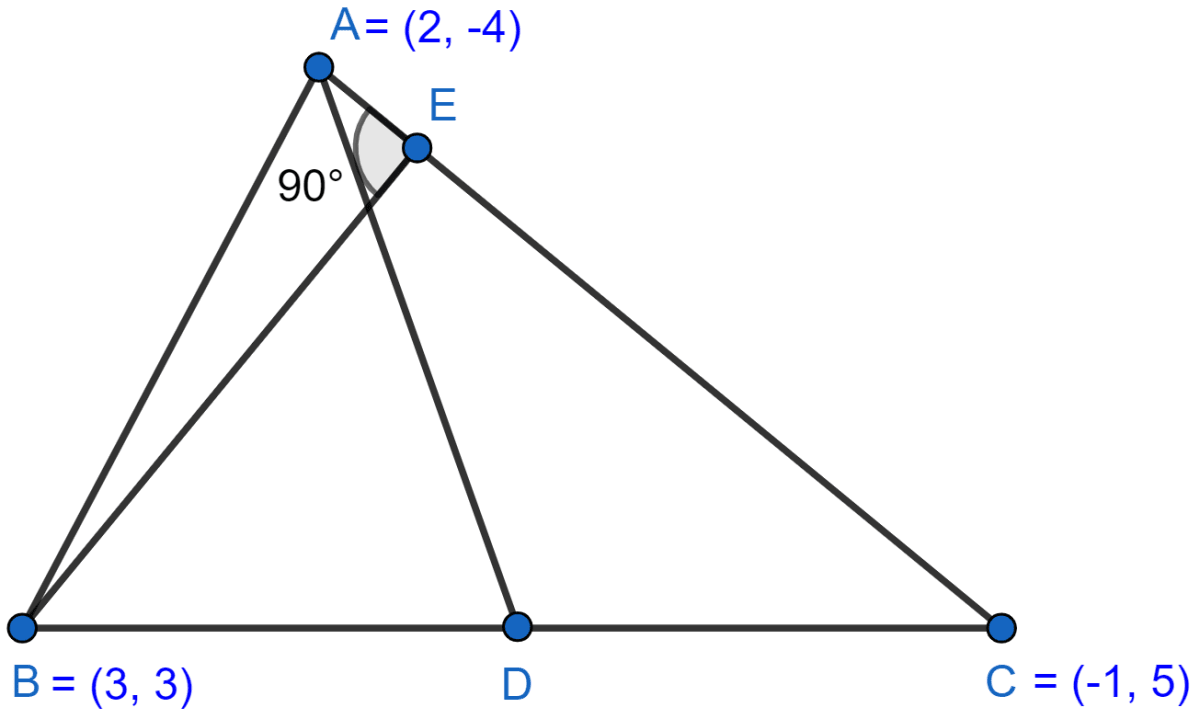
(i) Let D be the mid-point of BC. So, AD will be the median.
Coordinates of D by mid-point formula will be,
The equation of AD can be given by two-point formula i.e.,
Hence, the equation of the median of the triangle through A is 8x + y - 12 = 0.
(ii) Let E be a point on AC such that BE is perpendicular to AC.
Slope (m1) of AC is,
Let slope of BE be m2. Since, BE is perpendicular to AC so,
So, the equation of BE by point-slope form will be
Hence, the equation of the required line is x - 3y + 6 = 0.
Find the equation of the right bisector of the line segment joining the points (1, 2) and (5, -6).
Answer
Slope of the line joining the points (1, 2) and (5, -6) is,
Let m2 be the slope of the right bisector of the above line. Then,
The mid-point of the line segment joining (1, 2) and (5, -6) will be
Equation of the line having the slope = and passing through (3, -2) can be given by point-slope formula i.e.,
Hence, the equation of the required right bisector is x - 2y - 7 = 0.
Points A and B have coordinates (7, -3) and (1, 9) respectively. Find
(i) the slope of AB.
(ii) the equation of the perpendicular bisector of the line segment AB.
(iii) the value of p if (-2, p) lies on it.
Answer
(i) Slope (m1) of AB is,
Hence, the slope of AB is -2.
(ii) Let PQ be the perpendicular bisector of AB intersecting it at M. Now, the coordinates of M will be
Let the slope of the line PQ be m2. Since, PQ is perpendicular to AB then product of their slopes will be equal to -1,
Thus, by point-slope form equation of PQ is,
Hence, the equation of the required line is x - 2y + 2 = 0.
(iii) As (-2, p) lies on the above line. The point will satisfy the line equation x - 2y + 2 = 0.
⇒ -2 - 2p + 2 = 0
⇒ 2p = 0
⇒ p = 0.
Hence, the value of p is 0.
The points B(1, 3) and D(6, 8) are two opposite vertices of a square ABCD. Find the equation of the diagonal AC.
Answer
Slope of BD is given by
m1 = = 1.
We know that diagonal AC is a perpendicular bisector of diagonal BD.
So, the slope of AC (m2) will be,
Coordinates of mid-point of BD and AC will be same as diagonals of a square meet at their mid-point.
By point-slope formula equation of AC is
Hence, the equation of the required line is x + y - 9 = 0.
ABCD is a rhombus. The coordinates of A and C are (3, 6) and (-1, 2) respectively. Write down the equation of BD.
Answer
Slope of AC is given by,
= 1.
We know that diagonal of a rhombus bisect each other at right angles. So, the diagonal BD is perpendicular to diagonal AC.
Let the slope of BD be m2. Then,
Coordinates of mid-point of AC and BD are same which are
Equation of the line having the slope = -1 and passing through (1, 4) can be given by point-slope formula i.e.,
Hence, the equation of BD is x + y - 5 = 0.
Find the image of the point (1, 2) in the line x - 2y - 7 = 0.
Answer
The given line is x - 2y - 7 = 0 .....(i)
⇒ 2y = x - 7
⇒ y = .
The slope of the line (i) = m1 =
Let the point (1, 2) be P.
From P draw a perpendicular to the line (i) and produce it to point P' such that P'M = MP, then P' is the image of P in line (i) and line (i) is the right bisector of the segment PP'.
Let P' be (a, b).
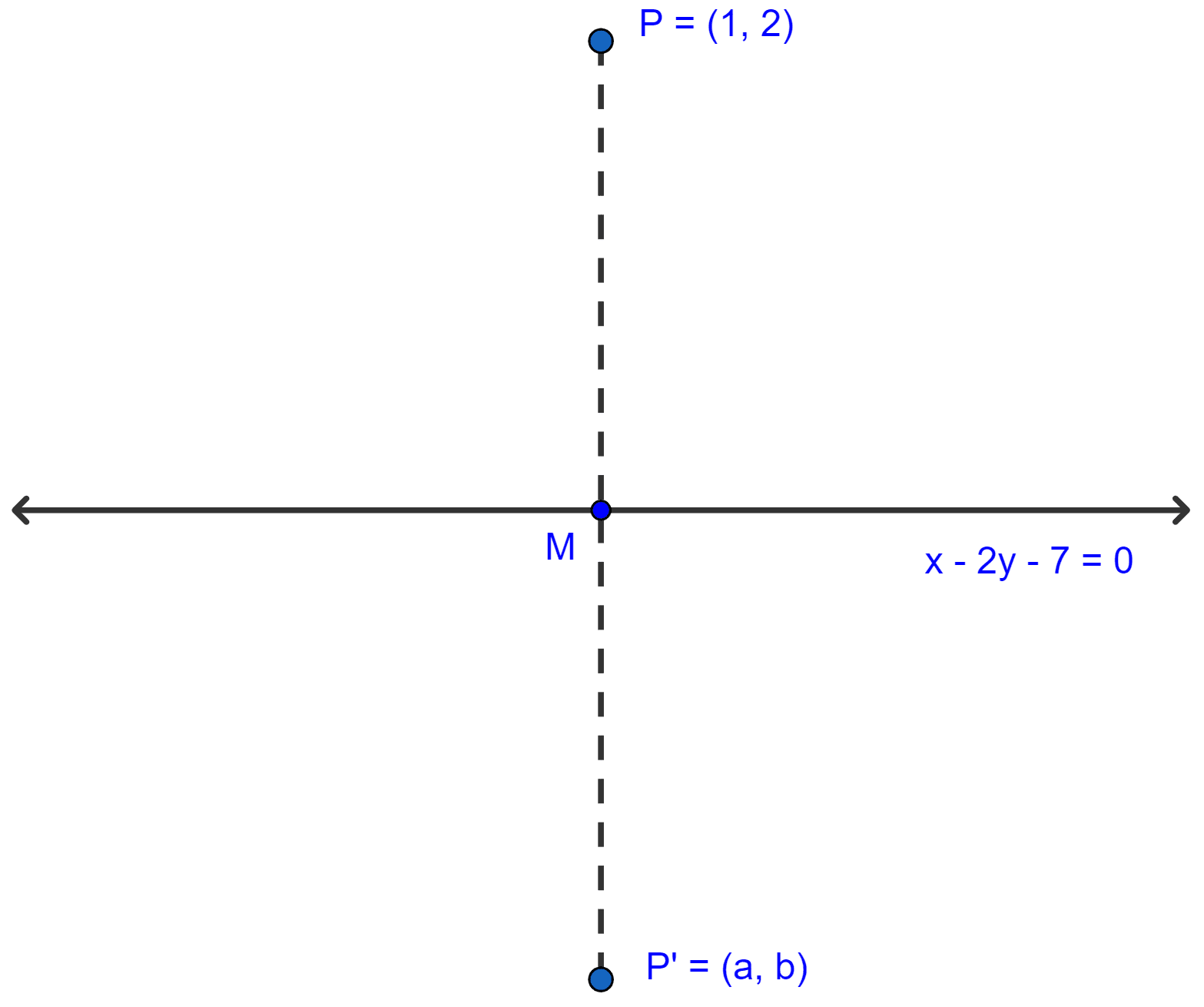
Then slope of PP' = m2 = .
Since, line (i) is perpendicular to PP' so,
Also mid-point of PP' is M.
Since, (i) is the right bisector of the segment PP', M lies on (i)
Multiplying equation (iv) by 2 and subtracting from (iii) we get,
Putting value of b in Eq (iii),
⇒ 2a - 6 = 4
⇒ 2a = 10
⇒ a = 5.
P' = (a, b) = (5, -6).
Hence, the coordinates of image are (5, -6).
If the line x - 4y - 6 = 0 is the perpendicular bisector of the line segment PQ and the coordinates of P are (1, 3), find the coordinates of Q.
Answer
Given, equation of line,
⇒ x - 4y - 6 = 0
⇒ 4y = x - 6
⇒ y =
Comparing with y = mx + c we get, slope = .
Since, given line and PQ are perpendicular so their products will be equal to -1. Let slope of PQ be m1,
Hence, slope of PQ = -4.
Now equation of PQ can be found by point slope form i.e.,
Since, line x - 4y - 6 = 0 is perpendicular bisector of 4x + y - 7 = 0 hence solving them simultaneously to find point of intersection,
⇒ x - 4y = 6 ......(i)
⇒ 4x + y = 7 ......(ii)
Multiplying (ii) with 4 and adding with (i) we get,
⇒ 16x + 4y + x - 4y = 28 + 6
⇒ 17x = 34
⇒ x = 2.
Putting value of x = 2 in (i),
⇒ 2 - 4y = 6
⇒ -4y = 4
⇒ y = -1.
Hence, the point of intersection which is the mid-point of PQ is (2, -1).
Let coordinates of Q be (a, b).
By mid-point formula, coordinates of mid-point of PQ are
Equating with mid-point of PQ (2, -1) we get,
Hence, the coordinates of Q are (3, -5).
OABC is a square, O is the origin and the points A and B are (3, 0) and (p, q). If OABC lies in the first quadrant, find the values of p and q. Also write down the equations of AB and BC.
Answer
The square OABC is plotted on the graph below:
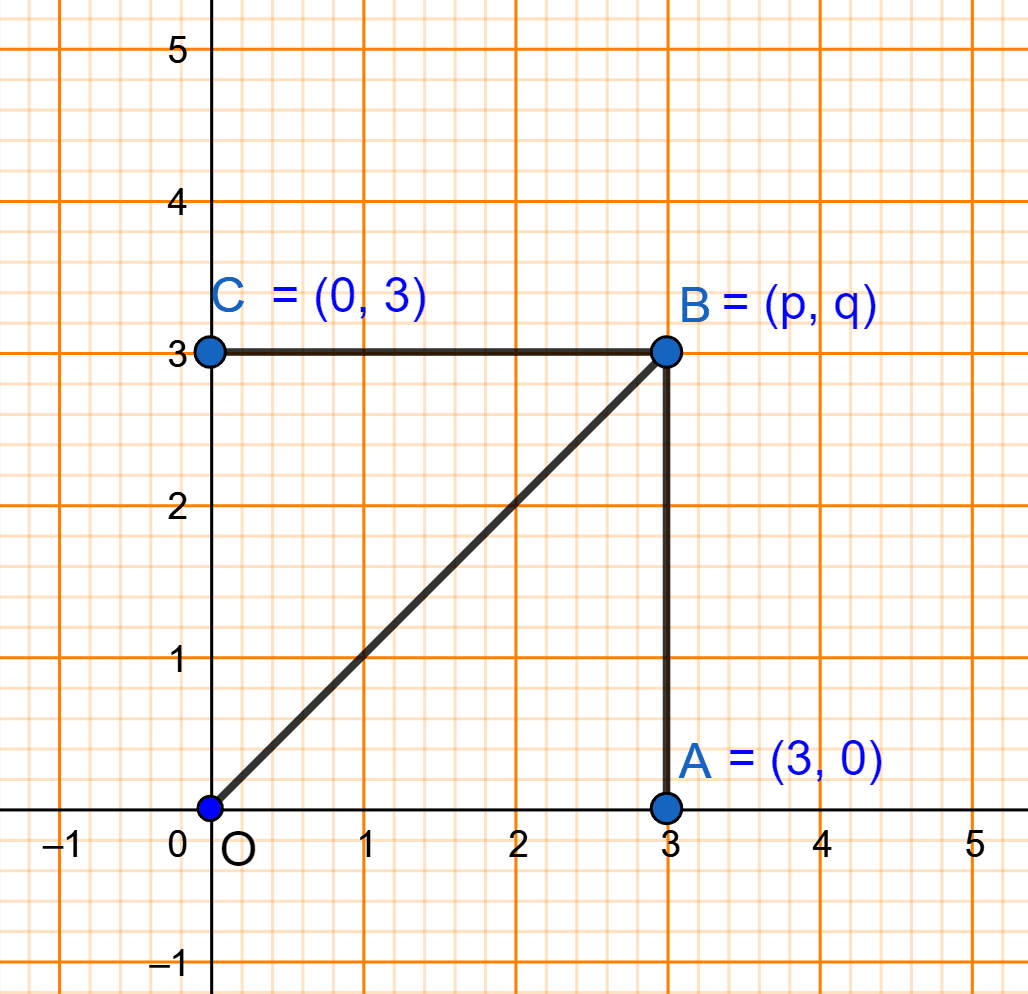
Since, OA = AB (as sides of square are equal)
By pythagoras theorem, OB2 = OA2 + AB2.
Substituting value of p in (i),
But q = -3 is not possible as the square is in 1st quadrant and the coordinates are positive in 1st quadrant.
∴ p = 3 and q = 3.
AB is parallel to y-axis,
∴ Equation of AB will be x = 3 or x - 3 = 0.
BC is parallel to x-axis,
∴ Equation BC will be y = 3 or y - 3 = 0.
Hence, the value of p = 3 and q = 3. Equation of AB is x - 3 = 0 and BC is y - 3 = 0.